Informasi Pengunjung
Mengunjungi Mausoleum of Khoja Ahmed Yasawi
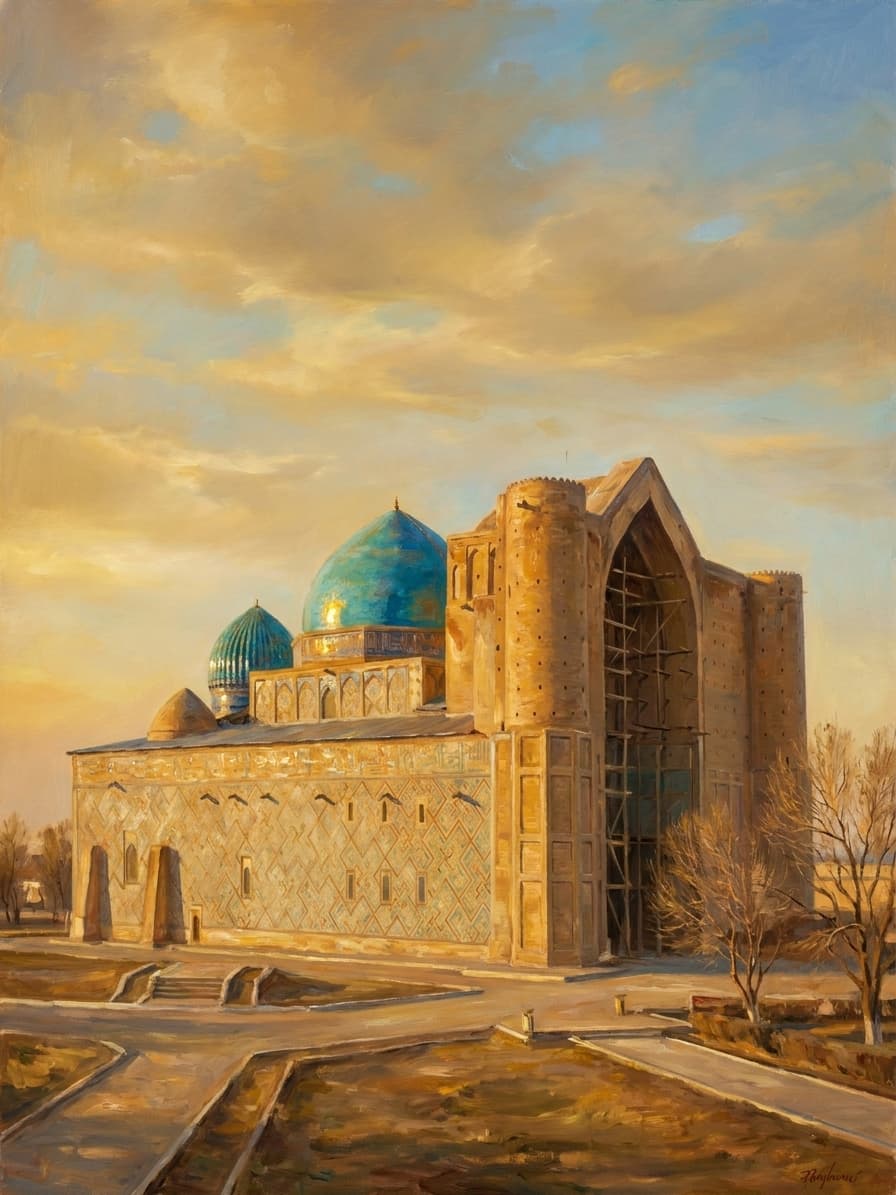
The sanctuary stands within the Khazret Sultan Reserve in the historic center of Turkistan. Visitors experience an active place of Islamic worship, pilgrimage, and preserved fourteenth-century architecture. Modest attire covering shoulders and knees is strictly observed throughout all interior chambers.
Sorotan
- The colossal two-ton bronze Taykazan ritual water cauldron resting in the central Kazanlyk hall.
- The fluted turquoise double dome rising 38.7 meters over the sacred Gurkhana tomb chamber.
- Monumental banna'i brickwork spelling sacred kufic phrases across towering exterior facades.
- The underground Halvet hermitage complex where Yasawi lived out his final contemplative years.
Hal yang Perlu Diketahui
- Shoes must be removed before stepping onto carpeted prayer areas within the mosque.
- Interior photography inside the Gurkhana tomb sanctuary is prohibited during active prayer.
- Visiting during spring or autumn avoids the extreme summer temperatures of the steppe.
Lokasi
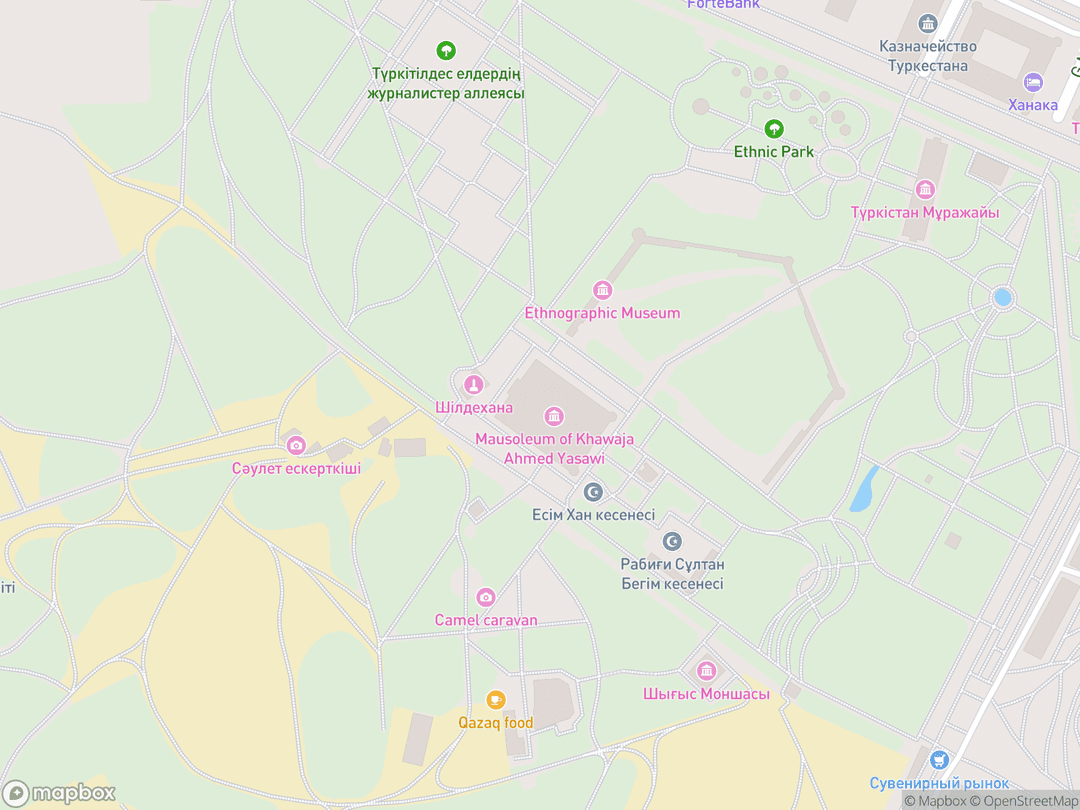
Khazret Sultan State Historical and Cultural Reserve Museum, Turkistan 161200, Republic of Kazakhstan
Jam Buka: 08:00 - 19:00 (May to September); 09:00 - 18:00 (October to April)
Cara Menuju: Located 15 km from Hazrat Sultan International Airport and 3 km from Turkistan Railway Station.
Petunjuk ArahTips Kunjungan
Berpakaian Sopan
Kenakan pakaian longgar yang menutupi bahu dan pergelangan kaki, serta bawalah kerudung untuk memasuki masjid.
Hormati Waktu Salat
Akses ke Gurkhana mungkin dihentikan sementara selama waktu salat berjamaah harian.
Jelajahi Halvet
Kunjungi pertapaan bata yang terletak di bawah permukaan tanah di dekatnya untuk melihat tempat tinggal pertapa yang bersejarah.
Tentang
The Mausoleum of Khoja Ahmed Yasawi is an unfinished but architecturally significant structure located in the city of Turkistan, Kazakhstan. Commissioned by Timur (Tamerlane) in 1389 to replace a smaller 12th-century mausoleum, it serves as the final resting place of the renowned Sufi poet and mystic Khoja Ahmed Yasawi.
This UNESCO World Heritage site is celebrated for its innovative engineering, including the largest brick dome in Central Asia. Although the construction was halted following the death of Timur in 1405, the building remains a profound example of the transition from traditional Persian-style architecture to the monumental Timurid style that would later influence the construction of the Taj Mahal.
Galeri
Elemen Simbolis
Eksterior kuil menampilkan ukiran rumit, masing-masing kaya akan makna spiritual:

Taykazan
Kuali perunggu cor monumental yang melambangkan keramahtamahan spiritual, kemurahan hati, dan persatuan komunal.

Kubah Beralur Pirus
Kubah ganda berusuk melambangkan kubah surgawi dan transendensi ilahi dalam tradisi Islam Turkik.
Geometris Kufi Banna'i
Batu bata biru berlapis kaca dan terakota yang saling mengunci membentuk frasa suci monumental untuk mengingat Tuhan.
Pintu Portal Kayu Aras Ukir
Pintu kayu abad keempat belas yang diukir dengan halus menandai peralihan antara tanah duniawi dan tanah suci.
Plester Muqarnas Squinch
Kubah stalaktit yang menjuntai memberikan metafora visual bagi tatanan surgawi yang menjembatani dinding persegi ke kubah melingkar.
Halvet Bawah Tanah
Sel bata bawah tanah mencerminkan kerendahan hati yang berpusat pada nabi dan penarikan diri untuk kontemplasi dari Yasawi.
Mihrab Ubin Mosaik
Ceruk doa berubin faïence di dalam masjid yang menyelaraskan jemaah ke arah suci Mekkah.
Tempat Lilin Perunggu Shamdan
Obor seremonial kekaisaran melambangkan cahaya pengetahuan ilahi yang memancarkan sinar untuk mengusir ketidaktahuan spiritual.
Fakta Menarik
Three pilgrimages to the shrine historically held the spiritual merit of one Minor Hajj on the steppe (Tier B).
The two-ton bronze Taykazan was held in Leningrad's Hermitage for fifty-four years before returning in 1989 (Tier A).
Amir Timur personally modified the blueprints and supervised vaulting designs for the complex (Tier B).
Medieval cedar scaffolding timbers remain embedded in the portal wall more than six centuries later (Tier A).
The cauldron was cast from an alloy traditionally described as containing seven metals (Tier B).
The sanctuary served as the royal pantheon holding the tombs of twenty-one Kazakh khans (Tier B).
At age sixty-three, Yasawi moved into an underground hermitage to emulate the Prophet Muhammad's lifespan (Tier B).
The central hall features an 18.2-meter dome, the largest medieval brick dome in Central Asia (Tier A).
The building withstood eleven direct artillery shell hits during the Tsarist siege of 1864 (Tier B).
In 2003, the mausoleum became the very first UNESCO World Heritage Site in Kazakhstan (Tier A).
Pertanyaan Umum
Is there an entrance fee to visit the mausoleum?
Yes, there is a modest entrance fee for international visitors, which helps support the ongoing preservation of the site.
Can I take photographs inside?
Photography is generally permitted in most areas, but please be respectful and avoid using flash inside the burial chamber.
Is the site an active place of religious worship?
Yes, it functions as an operating mosque and a revered destination for pious visitation.
Why did Yasawi retire to an underground cell at age sixty-three?
He chose to live underground to avoid living in sunlight beyond the lifespan of the Prophet Muhammad.
Cerita Pilihan
Kembalinya Kuali Agung
September 18, 1989
Pada tahun 1935, Taykazan perunggu seberat dua ton dikirim ke Leningrad untuk pameran akademik dan tetap berada di sana selama lebih dari lima dekade. Menyusul petisi terus-menerus dari para sarjana Kazakh dan tetua masyarakat, otoritas Soviet setuju untuk memulangkannya. Kepulangannya ke aula Kazanlyk tepat sebelum kemerdekaan Kazakh dirayakan sebagai pemulihan jantung spiritual bangsa.
Sumber: Khazret Sultan State Reserve Records
Monumen yang Membeku dalam Waktu
1405
Amir Timur mengawasi pembangunan tempat suci Yasawi dengan sangat cermat, sering kali menyesuaikan rencana arsitektur. Pada bulan Februari 1405, saat berkemah di Otrar dalam kampanyenya ke Tiongkok, Timur meninggal secara mendadak karena sakit. Para pengrajin yang dikerahkan segera meletakkan peralatan mereka, membiarkan lengkungan selatan yang masif dan perancah kayu yang menonjol tidak berubah selama berabad-abad.
Sumber: Timurid Imperial Chronicles
Tempat Tinggal Bawah Tanah Hazrat Yasawi
1156
Setelah mencapai usia enam puluh tiga tahun, Khoja Ahmed Yasawi memutuskan bahwa ia tidak akan lagi berjalan di bawah terik matahari sebagai bentuk pengabdian kepada Nabi Muhammad. Ia mengasingkan diri ke Halvet, sebuah pertapaan bata bawah tanah yang digali di bawah padang rumput. Di sana ia menyusun ayat-ayat Kitab Kebijaksanaannya hingga wafatnya.
Sumber: Yasawiyya Oral Tradition and Divan-i Hikmet
Garis Waktu
Wafatnya Khoja Ahmed Yasawi
Sebuah mausoleum bata sederhana dari era Karakhanid dibangun di atas makam Yasawi di Yasi kuno.
TonggakDekrit Kekaisaran Amir Timur
Timur memerintahkan pembongkaran makam lama untuk membangun kompleks monumental.
component.timeline.groundbreakingPengecoran Taykazan
Pandai logam Abd al-Aziz al-Tabrizi mengecor kuali perunggu ritual yang sangat besar di Karnak.
PeristiwaWafatnya Timur dan Penghentian Pembangunan
Timur meninggal di Otrar, meninggalkan portal selatan yang megah dalam keadaan tidak selesai secara permanen.
TonggakRestorasi Shaybanid
Abdullah Khan II dari Bukhara memperbaiki dan memperkuat lengkungan fasad selatan yang belum selesai.
RenovasiPantheon Kekhanan Kazakh
Para khan dan hakim terkemuka Kazakh dimakamkan di sekitar tempat suci mausoleum.
PeristiwaPengepungan Turkistan
Artileri Tsar menghantam mausoleum selama kemajuan kekaisaran Rusia.
PeristiwaRelokasi Taykazan
Pihak berwenang Soviet memindahkan kuali bersejarah tersebut ke Museum State Hermitage di Leningrad.
PeristiwaRestitusi Kuali Agung
Taykazan dikembalikan ke aula tengah setelah lima puluh empat tahun diasingkan.
TonggakPenetapan Warisan Dunia UNESCO
Mausoleum ini didaftarkan sebagai properti Warisan Dunia UNESCO pertama di Kazakhstan.
PersembahanSejarah per Dekade
1160s — Passing of the Mystic
Seek wisdom with a humble heart and share your bread with the traveler.
Following decades of teaching the Yasawiyya Sufi way, Khoja Ahmed Yasawi passed away in 1166. A modest brick tomb was constructed over his burial site in Yasi, drawing nomadic pilgrims from across the region.
1380s–1390s — Imperial Timurid Commission
Amir Timur ordered the construction of a grand complex in 1389 to honor Yasawi and legitimize his authority over the steppe. Master craftsmen gathered from Shiraz and Tabriz to engineer unprecedented vaults and cast ritual bronze vessels.
1400s — The Halted Portal
Timur's sudden demise in 1405 halted building work across the site. The monumental southern portal remained unfinished, preserving the medieval scaffolding sockets that remain visible today.
1580s–1590s — Shaybanid Consolidation
Abdullah Khan II of Bukhara directed essential structural preservation on the unfinished portal arch. Builders secured the masonry with cedar beams, stabilizing the immense entryway against earthquakes.
1600s–1700s — Royal Pantheon of the Steppe
Turkistan flourished as the political capital of the Kazakh Khanate. The mausoleum became the pantheon where khans, warriors, and judges were laid to rest beside the holy mystic.
1860s — Russian Expansion and Shelling
During the siege of Turkistan in 1864, Tsarist artillery fired heavy shells that damaged the outer portal and punctured the tiled dome. Despite direct hits, the robust medieval masonry remained structurally sound.
1930s–1980s — Soviet Conservation and Repatriation
The Taykazan was relocated to Leningrad in 1935 as Soviet authorities curtailed religious practice. Following decades of scholarly advocacy, the cauldron was repatriated to Turkistan in 1989.
1990s–2000s — Independence and Global Recognition
Joint Kazakh-Turkish restoration projects preserved the dome and stabilized internal microclimates during the 1990s. In 2003, the complex was inscribed as Kazakhstan's first UNESCO World Heritage Site.
Arsitektur dan Fasilitas
The Mausoleum of Khoja Ahmed Yasawi stands as the prototype of high Timurid monumentalism, synthesizing Persian spatial engineering with the vast communal scale of the Central Asian steppe. Master architect Khwaja Hosein Shirazi consolidated civic, educational, and religious functions beneath a single colossal rectangular structure, pioneering structural vaults and double-shelled ribbed domes that later defined Samarkand and Bukhara.
Bahan Bangunan
Fired Plinthite Brick
Dense kiln-fired square clay bricks form the load-bearing walls and monumental vaulting.
Ganch Mortar
Fast-setting gypsum and lime mortar used throughout the intricate vaulting and squinches.
Glazed Ceramic Tiles
Cobalt, turquoise, and white glazed ceramic tiles adorn the exterior banna'i calligraphy.
Carved Walnut and Cedar
Historic fourteenth-century timber beams and carved panels frame the ceremonial doors.
Seven-Metal Bronze Alloy
Cast bronze containing multiple metals forms the two-ton ceremonial Taykazan cauldron.
Fitur Interior
Kazanlyk
The primary 18.2-meter square hall crowned by the largest medieval brick dome in Central Asia.
Gurkhana
The northern tomb chamber containing Yasawi's cenotaph sheltered beneath the turquoise dome.
Mezgithana
The vaulted communal mosque chamber featuring an intact mosaic-tiled prayer niche.
Aksaray Chambers
Flanking assembly halls utilized for scholarly debates, monastic councils, and royal interments.
Ashkhana
The monastic refectory retaining historic hearths where food was ritually prepared for pilgrims.
Area Kuil
The mausoleum sits in a protected historical reserve encompassing archaeological ruins, landscaped pathways, and the sunken Halvet hermitage.
Fasilitas Tambahan
The site features a visitor center, the Khazret Sultan Reserve Museum, and preserved medieval bathhouses.
Makna Keagamaan
Dalam tradisi Islam, tempat suci memupuk kedekatan dengan Tuhan melalui doa, pelayanan komunal, dan mengenang guru-guru yang saleh. Makam Khoja Ahmed Yasawi mewakili pusat spiritualitas Sufi dan identitas Islam padang rumput yang abadi.
Berfungsi sebagai pusat doa berjamaah, kontemplasi spiritual, dan keramahtamahan amal bagi para peziarah.
Upacara Suci
Ziarah
Kunjungan saleh ke makam yang disertai dengan pembacaan Al-Qur'an dan permohonan kedamaian.
Dzikir
Mengingat Tuhan secara komunal dan berirama yang dipraktikkan secara historis oleh tarekat Sufi Yasawiyya.
Salah
Pelaksanaan lima waktu salat berjamaah Islam di masjid yang bersebelahan.
Futuwwa
Kemurahan hati spiritual dan keramahtamahan komunal yang dicontohkan dengan berbagi air dan makanan kepada para musafir.
Warisan Hazrat Yasawi
Khoja Ahmed Yasawi menyelaraskan ajaran Islam dengan warisan nomaden Turki. Koleksi puisinya, Divan-i Hikmet, menyebarkan pengetahuan spiritual ke seluruh padang rumput dan menumbuhkan budaya toleransi, keramahtamahan, dan pengabdian komunal yang abadi.
Tradisi Ziarah Padang Rumput
Secara historis, orang-orang beriman nomaden yang menghadapi rintangan besar saat bepergian ke Mekkah justru melakukan perjalanan ke Turkistan. Sebuah tradisi regional yang dihormati menyatakan bahwa tiga kunjungan saleh ke makam Yasawi memberikan pahala spiritual setara dengan ibadah umrah.
Sumber dan Penelitian
Setiap fakta di Temples.org didukung oleh Sumber dan Penelitian yang terverifikasi. Setiap informasi diklasifikasikan berdasarkan tingkat sumber dan kepercayaan.
Lihat Semua Sumber (7)
| Bidang | Sumber | Tingkat | Diambil |
|---|---|---|---|
| About & Historical Background | Official Portal of South Kazakhstan / Turkistan Region (terbuka di tab baru) | A | 2026-03-31 |
| Architecture & Structural Survey | UNESCO World Heritage Centre (terbuka di tab baru) | B | 2026-03-31 |
| Historical Timeline & Inscription | UNESCO World Heritage Convention Advisory Body (terbuka di tab baru) | B | 2026-03-31 |
| Visitor Insights & Regional Tourism | Kazakh Tourism National Company (terbuka di tab baru) | A | 2026-03-31 |
| Academic Research on Yasawi Complex | L.N. Gumilyov Eurasian National University (terbuka di tab baru) | B | 2026-03-31 |
| Heritage Assessment | World Heritage Sites Registry (terbuka di tab baru) | B | 2026-03-31 |
| Cultural Studies & Relic History | Siberian Steppes Heritage Review (terbuka di tab baru) | B | 2026-03-31 |