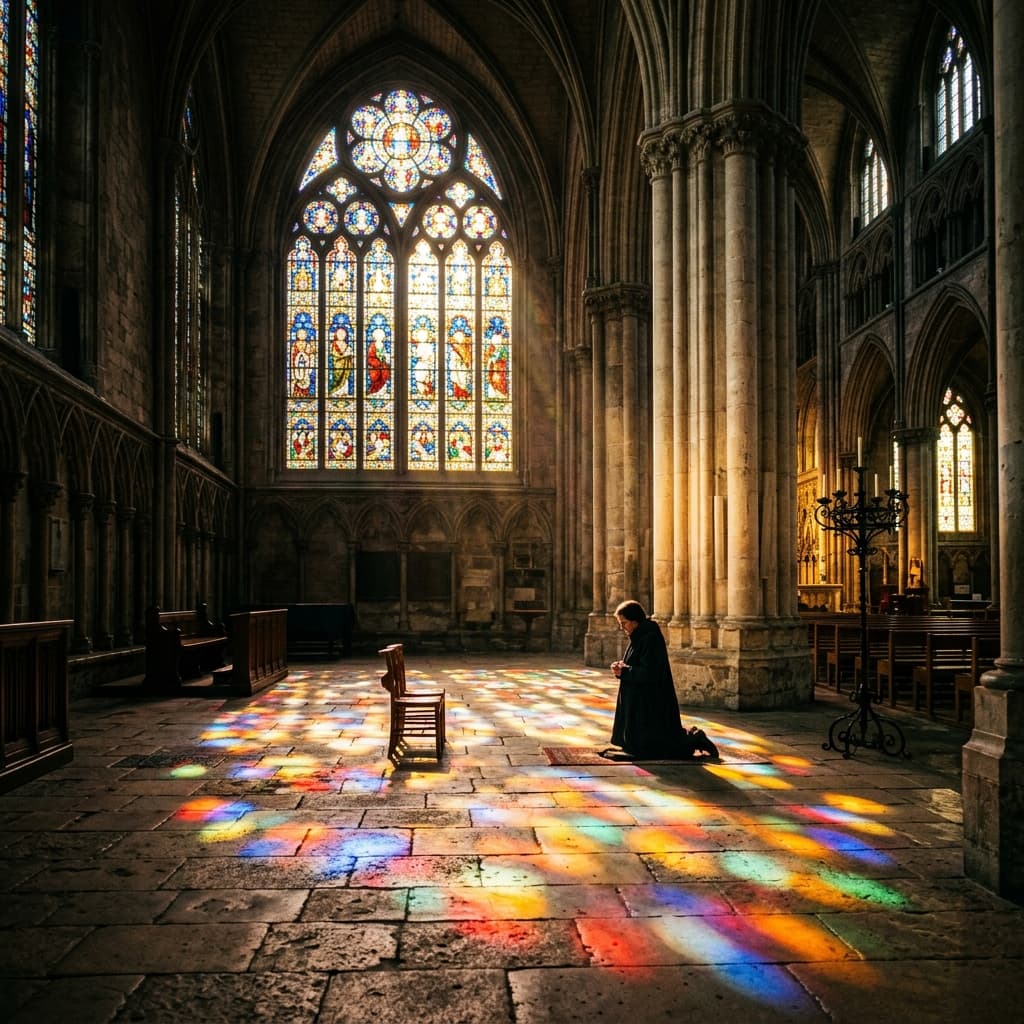
A Universal Metaphor for the Divine
Across nearly every major religious tradition, light serves as a profound bridge between the physical and the metaphysical. It is a universal symbol of divinity, guidance, and truth. Unlike heavy materials like stone, brick, and timber, light is intangible, ever-shifting, and weightless. By utilizing light, builders of sacred architecture do not just illuminate a physical space—they make the invisible visible, transforming ordinary environments into venues of profound spiritual resonance.
At Temples.org, we explore how different traditions throughout history have harnessed the power of light to express their theology, calculate solar trajectories, and invite worshippers to experience the presence of the Divine.
Abu Simbel: Solar Alignments
“The sun's rays pierce the dark interior to touch the crown of the living god-king, leaving the god of the underworld in eternal shadow.”
— Ancient Egyptian Temple Description
- Architectural Physics & Engineering:* The Great Temple of Abu Simbel, carved directly into the sandstone cliffs of Nubia, represents a masterclass in ancient solar orientation. Egyptian engineers aligned the temple's 60-meter-long axis so that twice a year, the rising sun's rays would penetrate the narrow entrance and travel the entire length of the dark corridor. This precise calculation relied on tracking the sun's position relative to the horizon, accounting for the local topography to ensure the beams struck the sanctuary at exactly the correct angle on specific calendar days.
- Theological Contrasts:* In the theology of the New Kingdom, light was the ultimate sign of divine endorsement. The solar alignment occurs on February 22 and October 22, dates traditionally associated with Ramses II's coronation and birth. As the sunlight reaches the innermost sanctuary, it illuminates three seated statues: Ramses II himself, Ra-Horakhty (the sun god), and Amun-Ra (the king of gods). Significantly, the fourth statue—Ptah, the god of the underworld and darkness—remains in perpetual shadow. This selective illumination reinforced the king's cosmic role as the living intermediary of light and order (Ma'at) against chaos and darkness.
The Pantheon: The Oculus
“The dome of the Pantheon is the sky itself, captured and brought down to earth, with the oculus as its single, brilliant eye.”
— Roman Architectural Commentary
- Architectural Physics & Engineering:* Commissioned by Emperor Hadrian, the Pantheon's dome remains the largest unreinforced concrete dome in the world. Its primary light source is the oculus—a circular opening 9 meters in diameter at the dome's apex. To make this opening possible, Roman engineers constructed a thick brick compression ring that distributes the massive downward forces outward through the dome's ribs. Because there are no side windows, the oculus serves as a moving spotlight, casting a sharp, dramatic beam of sunlight that slowly travels across the patterned marble interior as the earth rotates.
- Theological Contrasts:* Roman state religion was deeply connected to the cosmos and the sun (Sol Invictus). The oculus acted as a vertical eye, connecting the earthly temple directly to the heavens. Rather than restricting light to priests, the Pantheon gathered the entire solar cycle inside the public hall. On April 21—the traditional founding date of Rome—the midday sun shines directly through the oculus to illuminate the temple's entrance portal. When the emperor entered the building on this day, he was bathed in a brilliant column of light, visually representing his divine authority and status as the ruler of the Roman cosmos.
Sainte-Chapelle: Gothic Stained Glass
“Physical light, passing through the stained glass, is transformed into a spiritual radiance that elevates the mind from the material to the true Light.”
— Abbot Suger of Saint-Denis
- Architectural Physics & Engineering:* Sainte-Chapelle in Paris is the ultimate expression of the Rayonnant Gothic style, where the structural walls are almost entirely replaced by stained glass. Gothic architects achieved this engineering feat by utilizing pointed arches and ribbed vaults to channel the weight of the roof onto slender external buttresses. This design minimized the need for thick load-bearing walls, allowing for 15-meter-high windows. These massive glass panels are reinforced by an internal framework of iron chains and bars, stabilizing the structure against wind pressure while remaining virtually invisible to the viewer.
- Theological Contrasts: The design of Sainte-Chapelle was governed by the medieval theology of Lux Nova* ("new light"), pioneered by Abbot Suger. In this view, material light was not just a physical phenomenon, but a direct manifestation of divine truth. By filtering the raw, blinding sunlight through deep red and blue stained glass, the cathedral transformed it into a soft, colored glow. This colored light symbolized the heavenly Jerusalem, transportive and mysterious, designed to lift the pilgrim's mind from earthly concerns to spiritual contemplation of scriptural narratives depicted in the glass.
Nasir al-Mulk: Orsi Windows
“Allah is the Light of the heavens and the earth. The parable of His Light is as if there were a Niche and within it a Lamp.”
— Surah An-Nur 24:35
- Architectural Physics & Engineering: Built in Shiraz during the Qajar dynasty, the Nasir al-Mulk Mosque features a winter prayer hall fronted by seven large Orsi* windows—traditional Persian wooden-framed sash windows with intricate geometric patterns of stained glass. The architects oriented this facade toward the southeast to capture the maximum amount of low-angle morning sun during the cold winter months. Additionally, the interior walls are covered with glazed tiles in shades of pink, yellow, and blue, which reflect and scatter the colored light, magnifying the brightness and casting shifting kaleidoscopic patterns across the floor.
- Theological Contrasts: In Islamic theology, the oneness of God (Tawhid) is represented through abstract and geometric beauty, avoiding figurative art. Light itself becomes the primary medium to express the divine presence, reflecting the Qur'anic "Verse of Light" (Surah An-Nur 24:35). The complex geometric screens (mashrabiya*) and stained glass filter the light into a vibrant, vibrating pattern, representing how the infinite unity of God manifests as diversity in the physical world. The resulting space feels weightless and alive, inviting worshippers to contemplate the divine beauty.
Salt Lake Temple: Celestial Light
“The glory of God is intelligence, or, in other words, light and truth.”
— Doctrine and Covenants 93:36
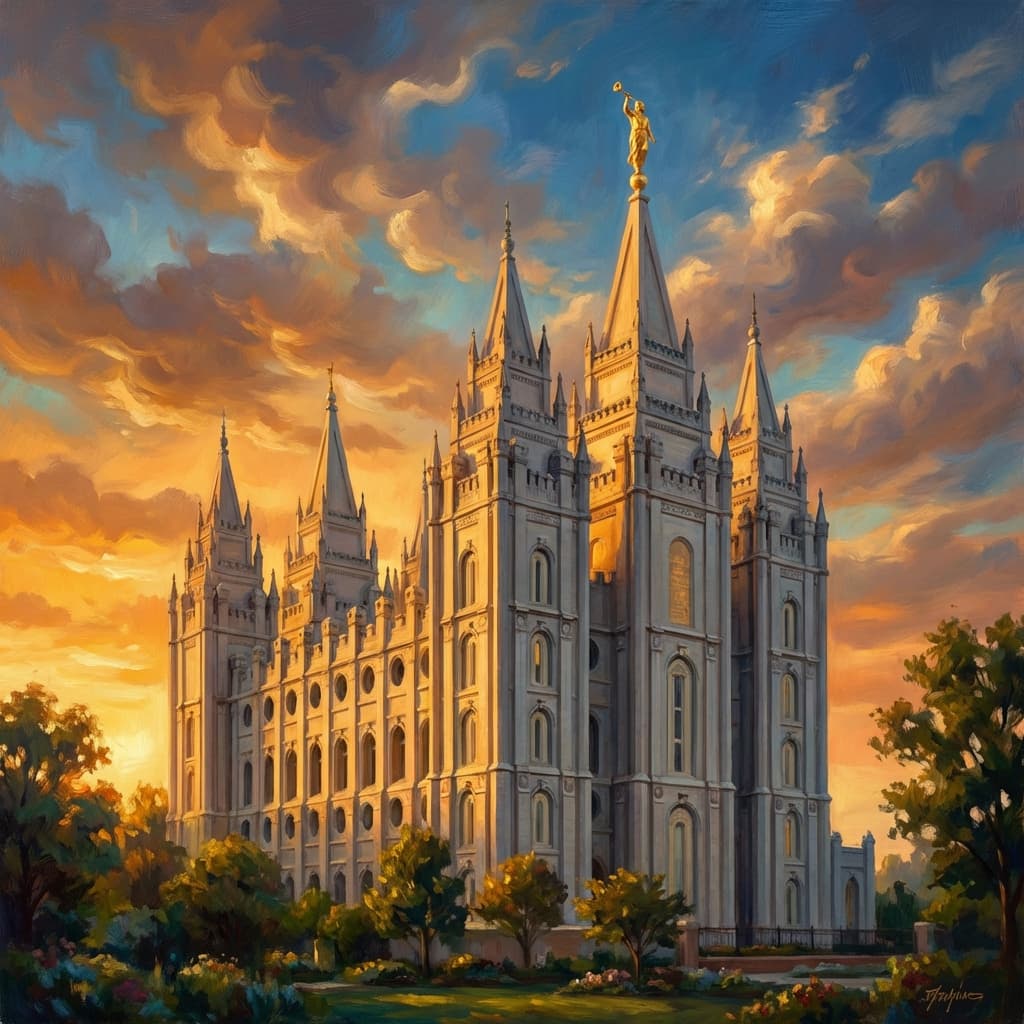
- Architectural Physics & Engineering:* Designed by Truman O. Angell and constructed from dense quartz monzonite hauled from Little Cottonwood Canyon, the Salt Lake Temple is built like a sacred fortress. The temple's interior is laid out to facilitate a symbolic path of spiritual progression, which is mirrored by the levels of illumination. Worshippers move from the lower-level baptismal font, illuminated with soft, low-intensity light, upward through instruction rooms with gradually increasing brightness, culminating in the Celestial Room. This final room is illuminated by massive arched windows and grand crystalline chandeliers that refract light into a bright, warm, and highly uniform illumination.
- Theological Contrasts:* In Latter-day Saint theology, light represents truth, intelligence, and the glory of God. The physical progression through the temple represents the journey of the soul returning to the presence of Heavenly Father. The exterior features symbolic stones—earth, moon, sun, and star stones—carved into the granite, reflecting the degrees of glory in the afterlife and Christ as the source of all light. At night, the exterior is brightly illuminated, serving as a literal "city set on a hill" (Matthew 5:14) and a visible beacon of hope in the community.
Church of the Light: Modern Minimalism
“In my opinion, light is the origin of all being. Light gives, with each moment, new form to things and new relationships to space.”
— Tadao Ando, Architect
- Architectural Physics & Engineering:* Designed by Japanese architect Tadao Ando in Ibaraki, Osaka, the Church of the Light is a masterclass in minimalist concrete architecture. The building consists of a simple concrete box intersected at a 15-degree angle by a freestanding concrete wall. The defining feature of the chapel is the eastern wall behind the altar, which is sliced with a vertical and horizontal opening in the shape of a cross. Ando deliberately left this slot completely glassless (later sealed with double glazing for climate control) so that the raw, unfiltered morning light cuts directly through the darkness of the cast-concrete interior, creating a sharp, glowing cross of light.
- Theological Contrasts:* Unlike the historic cathedrals that relied on colored, stained glass to create a mystical atmosphere, Ando's design uses the stark contrast between pure light and dark shadow. The unadorned concrete walls act as a canvas for the changing sky, reflecting the sun's movement without distraction. This minimalism represents a Protestant focus on the raw, unembellished Word and the sharp boundary between the sacred interior and the secular outside world. By using light as the sole ornament, the architecture emphasizes that the sacred is not found in luxury or material wealth, but in the quiet, simple presence of the divine light.
Role of Light Temple Comparison
Abu Simbel: Solar Alignments
“The sun's rays pierce the dark interior to touch the crown of the living god-king, leaving the god of the underworld in eternal shadow.”
— Ancient Egyptian Temple Description
- Architectural Physics & Engineering:* The Great Temple of Abu Simbel, carved directly into the sandstone cliffs of Nubia, represents a masterclass in ancient solar orientation. Egyptian engineers aligned the temple's 60-meter-long axis so that twice a year, the rising sun's rays would penetrate the narrow entrance and travel the entire length of the dark corridor. This precise calculation relied on tracking the sun's position relative to the horizon, accounting for the local topography to ensure the beams struck the sanctuary at exactly the correct angle on specific calendar days.
- Theological Contrasts:* In the theology of the New Kingdom, light was the ultimate sign of divine endorsement. The solar alignment occurs on February 22 and October 22, dates traditionally associated with Ramses II's coronation and birth. As the sunlight reaches the innermost sanctuary, it illuminates three seated statues: Ramses II himself, Ra-Horakhty (the sun god), and Amun-Ra (the king of gods). Significantly, the fourth statue—Ptah, the god of the underworld and darkness—remains in perpetual shadow. This selective illumination reinforced the king's cosmic role as the living intermediary of light and order (Ma'at) against chaos and darkness.
Quick Facts & Insights
- ✦ Era Bronze Age (c. 1264 BCE)
- ✦ Location Aswan, Egypt
- ✦ Primary Material Excavated Sandstone Cliff
- ✦ Key Dimension 60-meter inner corridor
- ✦ Light Feature Bi-annual solar alignment on innermost sanctuary
The Pantheon: The Oculus
“The dome of the Pantheon is the sky itself, captured and brought down to earth, with the oculus as its single, brilliant eye.”
— Roman Architectural Commentary
- Architectural Physics & Engineering:* Commissioned by Emperor Hadrian, the Pantheon's dome remains the largest unreinforced concrete dome in the world. Its primary light source is the oculus—a circular opening 9 meters in diameter at the dome's apex. To make this opening possible, Roman engineers constructed a thick brick compression ring that distributes the massive downward forces outward through the dome's ribs. Because there are no side windows, the oculus serves as a moving spotlight, casting a sharp, dramatic beam of sunlight that slowly travels across the patterned marble interior as the earth rotates.
- Theological Contrasts:* Roman state religion was deeply connected to the cosmos and the sun (Sol Invictus). The oculus acted as a vertical eye, connecting the earthly temple directly to the heavens. Rather than restricting light to priests, the Pantheon gathered the entire solar cycle inside the public hall. On April 21—the traditional founding date of Rome—the midday sun shines directly through the oculus to illuminate the temple's entrance portal. When the emperor entered the building on this day, he was bathed in a brilliant column of light, visually representing his divine authority and status as the ruler of the Roman cosmos.
Quick Facts & Insights
- ✦ Era Roman Empire (c. 125 CE)
- ✦ Location Rome, Italy
- ✦ Primary Material Roman Concrete & Brick
- ✦ Key Dimension 43.3-meter dome height & diameter
- ✦ Light Feature 9-meter open oculus casting moving beam
Sainte-Chapelle: Gothic Stained Glass
“Physical light, passing through the stained glass, is transformed into a spiritual radiance that elevates the mind from the material to the true Light.”
— Abbot Suger of Saint-Denis
- Architectural Physics & Engineering:* Sainte-Chapelle in Paris is the ultimate expression of the Rayonnant Gothic style, where the structural walls are almost entirely replaced by stained glass. Gothic architects achieved this engineering feat by utilizing pointed arches and ribbed vaults to channel the weight of the roof onto slender external buttresses. This design minimized the need for thick load-bearing walls, allowing for 15-meter-high windows. These massive glass panels are reinforced by an internal framework of iron chains and bars, stabilizing the structure against wind pressure while remaining virtually invisible to the viewer.
- Theological Contrasts: The design of Sainte-Chapelle was governed by the medieval theology of Lux Nova* ("new light"), pioneered by Abbot Suger. In this view, material light was not just a physical phenomenon, but a direct manifestation of divine truth. By filtering the raw, blinding sunlight through deep red and blue stained glass, the cathedral transformed it into a soft, colored glow. This colored light symbolized the heavenly Jerusalem, transportive and mysterious, designed to lift the pilgrim's mind from earthly concerns to spiritual contemplation of scriptural narratives depicted in the glass.
Quick Facts & Insights
- ✦ Era Gothic Middle Ages (1248 CE)
- ✦ Location Paris, France
- ✦ Primary Material Stained Glass & Limestone
- ✦ Key Dimension 15-meter tall window panels
- ✦ Light Feature Soaring gothic stained glass windows (Lux Nova)
Nasir al-Mulk: Orsi Windows
“Allah is the Light of the heavens and the earth. The parable of His Light is as if there were a Niche and within it a Lamp.”
— Surah An-Nur 24:35
- Architectural Physics & Engineering: Built in Shiraz during the Qajar dynasty, the Nasir al-Mulk Mosque features a winter prayer hall fronted by seven large Orsi* windows—traditional Persian wooden-framed sash windows with intricate geometric patterns of stained glass. The architects oriented this facade toward the southeast to capture the maximum amount of low-angle morning sun during the cold winter months. Additionally, the interior walls are covered with glazed tiles in shades of pink, yellow, and blue, which reflect and scatter the colored light, magnifying the brightness and casting shifting kaleidoscopic patterns across the floor.
- Theological Contrasts: In Islamic theology, the oneness of God (Tawhid) is represented through abstract and geometric beauty, avoiding figurative art. Light itself becomes the primary medium to express the divine presence, reflecting the Qur'anic "Verse of Light" (Surah An-Nur 24:35). The complex geometric screens (mashrabiya*) and stained glass filter the light into a vibrant, vibrating pattern, representing how the infinite unity of God manifests as diversity in the physical world. The resulting space feels weightless and alive, inviting worshippers to contemplate the divine beauty.
Quick Facts & Insights
- ✦ Era Qajar Era Persia (1888 CE)
- ✦ Location Shiraz, Iran
- ✦ Primary Material Pink Tiles, Wood, & Stained Glass
- ✦ Key Dimension 7-window southeast facade
- ✦ Light Feature Morning light through Orsi stained glass windows
Salt Lake Temple: Celestial Light
“The glory of God is intelligence, or, in other words, light and truth.”
— Doctrine and Covenants 93:36
- Architectural Physics & Engineering:* Designed by Truman O. Angell and constructed from dense quartz monzonite hauled from Little Cottonwood Canyon, the Salt Lake Temple is built like a sacred fortress. The temple's interior is laid out to facilitate a symbolic path of spiritual progression, which is mirrored by the levels of illumination. Worshippers move from the lower-level baptismal font, illuminated with soft, low-intensity light, upward through instruction rooms with gradually increasing brightness, culminating in the Celestial Room. This final room is illuminated by massive arched windows and grand crystalline chandeliers that refract light into a bright, warm, and highly uniform illumination.
- Theological Contrasts:* In Latter-day Saint theology, light represents truth, intelligence, and the glory of God. The physical progression through the temple represents the journey of the soul returning to the presence of Heavenly Father. The exterior features symbolic stones—earth, moon, sun, and star stones—carved into the granite, reflecting the degrees of glory in the afterlife and Christ as the source of all light. At night, the exterior is brightly illuminated, serving as a literal "city set on a hill" (Matthew 5:14) and a visible beacon of hope in the community.
Quick Facts & Insights
- ✦ Era Latter-day Saint Pioneer Era (1893 CE)
- ✦ Location Salt Lake City, Utah, USA
- ✦ Primary Material Quartz Monzonite
- ✦ Key Dimension 68-meter main spire height
- ✦ Light Feature Increasing interior illumination ending in Celestial Room
Church of the Light: Modern Minimalism
“In my opinion, light is the origin of all being. Light gives, with each moment, new form to things and new relationships to space.”
— Tadao Ando, Architect
- Architectural Physics & Engineering:* Designed by Japanese architect Tadao Ando in Ibaraki, Osaka, the Church of the Light is a masterclass in minimalist concrete architecture. The building consists of a simple concrete box intersected at a 15-degree angle by a freestanding concrete wall. The defining feature of the chapel is the eastern wall behind the altar, which is sliced with a vertical and horizontal opening in the shape of a cross. Ando deliberately left this slot completely glassless (later sealed with double glazing for climate control) so that the raw, unfiltered morning light cuts directly through the darkness of the cast-concrete interior, creating a sharp, glowing cross of light.
- Theological Contrasts:* Unlike the historic cathedrals that relied on colored, stained glass to create a mystical atmosphere, Ando's design uses the stark contrast between pure light and dark shadow. The unadorned concrete walls act as a canvas for the changing sky, reflecting the sun's movement without distraction. This minimalism represents a Protestant focus on the raw, unembellished Word and the sharp boundary between the sacred interior and the secular outside world. By using light as the sole ornament, the architecture emphasizes that the sacred is not found in luxury or material wealth, but in the quiet, simple presence of the divine light.
Quick Facts & Insights
- ✦ Era Late 20th Century Modernism (1989 CE)
- ✦ Location Ibaraki, Osaka, Japan
- ✦ Primary Material Reinforced Concrete
- ✦ Key Dimension 6.7m High Chapel Walls
- ✦ Light Feature Eastern wall sliced with concrete cross of raw light
Related Temples
Explore the temples referenced in this article.
Sources & Research
Every fact on Temples.org is backed by verified Sources & Research. Each piece of information is rated by source tier and confidence level.
View All Sources (12)
| Field | Source | Tier | Retrieved |
|---|---|---|---|
| Birth of the Gothic: Abbot Suger and the Ambulatory at St. Denis | Smarthistory (opens in a new tab) | B | 2026-05-22 |
| Sainte-Chapelle (Official Historical Monument Guide) | Centre des monuments nationaux (opens in a new tab) | A | 2026-05-22 |
| The Pantheon | World History Encyclopedia (opens in a new tab) | B | 2026-05-22 |
| The Role of the Sun in the Pantheon's Design | Numen (Brill) (opens in a new tab) | B | 2026-05-22 |
| Mosque of Whirling Colours: Nasīr al-Mulk Mosque | Muslim Heritage (opens in a new tab) | B | 2026-05-22 |
| An Introduction to Architecture of Nasir Al-Mulk Mosque | World Journal of Engineering and Technology (opens in a new tab) | B | 2026-05-22 |
| Abu Simbel | Encyclopaedia Britannica (opens in a new tab) | B | 2026-05-22 |
| On the orientation of ancient Egyptian temples: (1) Upper Egypt and Lower Nubia | Journal for the History of Astronomy (opens in a new tab) | B | 2026-05-22 |
| AD Classics: Church of the Light / Tadao Ando | ArchDaily (opens in a new tab) | B | 2026-05-22 |
| Tectonic character in Tadao Ando's Church of the Light: Structure, space, and form | Journal of Design for Resilience in Architecture & Planning (opens in a new tab) | B | 2026-05-22 |
| The Salt Lake Temple: Iconography and Symbolism | Intermountain Histories (opens in a new tab) | B | 2026-05-22 |
| Exterior Symbolism of the Salt Lake Temple | BYU Studies (opens in a new tab) | B | 2026-05-22 |