Visitor Insights
Visiting Salt Lake Temple
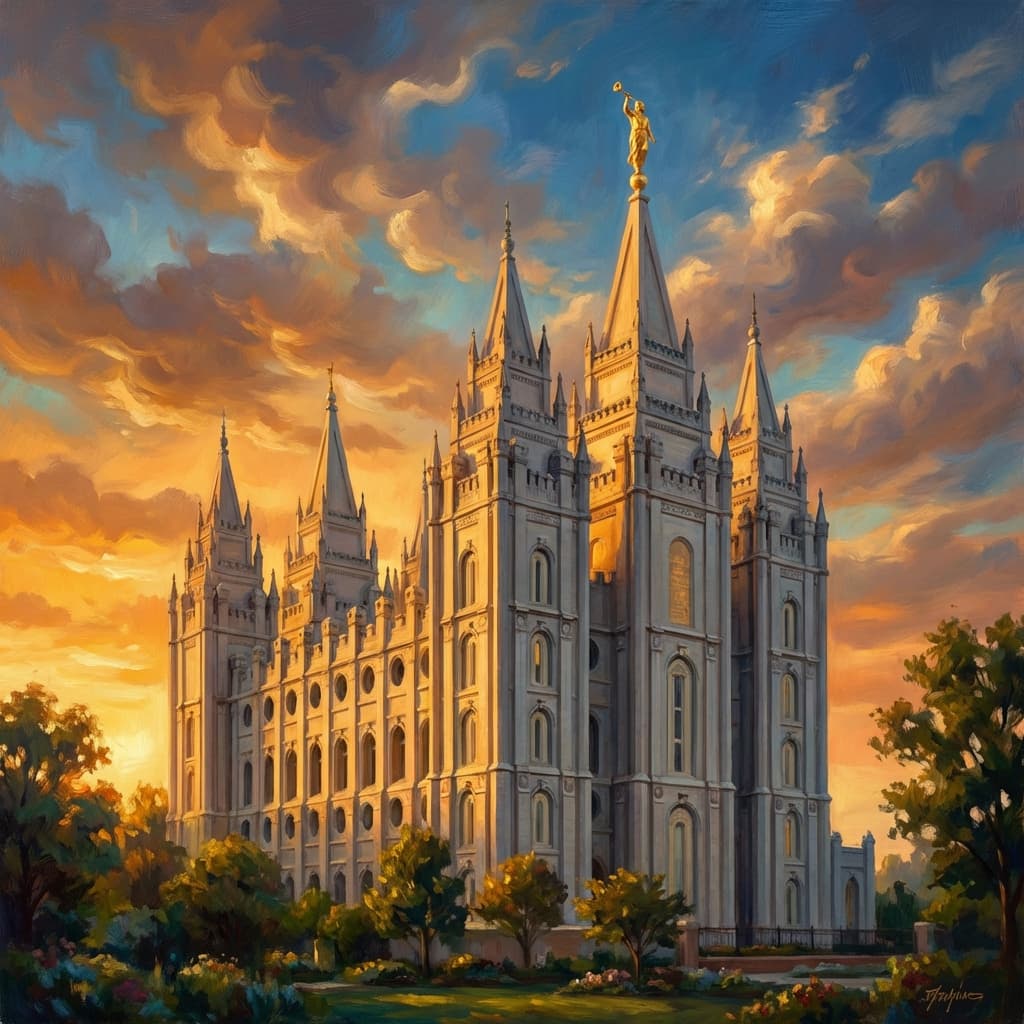
Visitors consistently describe the Salt Lake Temple as breathtaking and awe-inspiring. The temple's granite craftsmanship—with walls up to nine feet thick at the base—and the surrounding Temple Square gardens make it one of the most photographed sites in Utah. Many note the profound sense of peace on the grounds, regardless of religious background. The Angel Moroni statue, gilded in 22-karat gold leaf, catches the light and has become an iconic silhouette against the Wasatch Mountains.
Highlights
- Stunning granite architecture with intricate symbolic carvings
- Beautiful gardens that change dramatically with the seasons
- Free guided tours of Temple Square in many languages
- Christmas lights display (late November–New Year's) with hundreds of thousands of lights
- Reflecting pool provides iconic photo opportunities
- Conference Center rooftop garden with panoramic city views
- Tabernacle with world-famous organ and exceptional acoustics
Things to Know
- Temple interior is reserved for members with temple recommend
- Currently under renovation until 2027 — exterior may have scaffolding
- Peak tourist seasons (summer, Christmas) can be very crowded
- Limited parking on Temple Square — TRAX light rail recommended
- Visitor centers remain open during renovation
Location
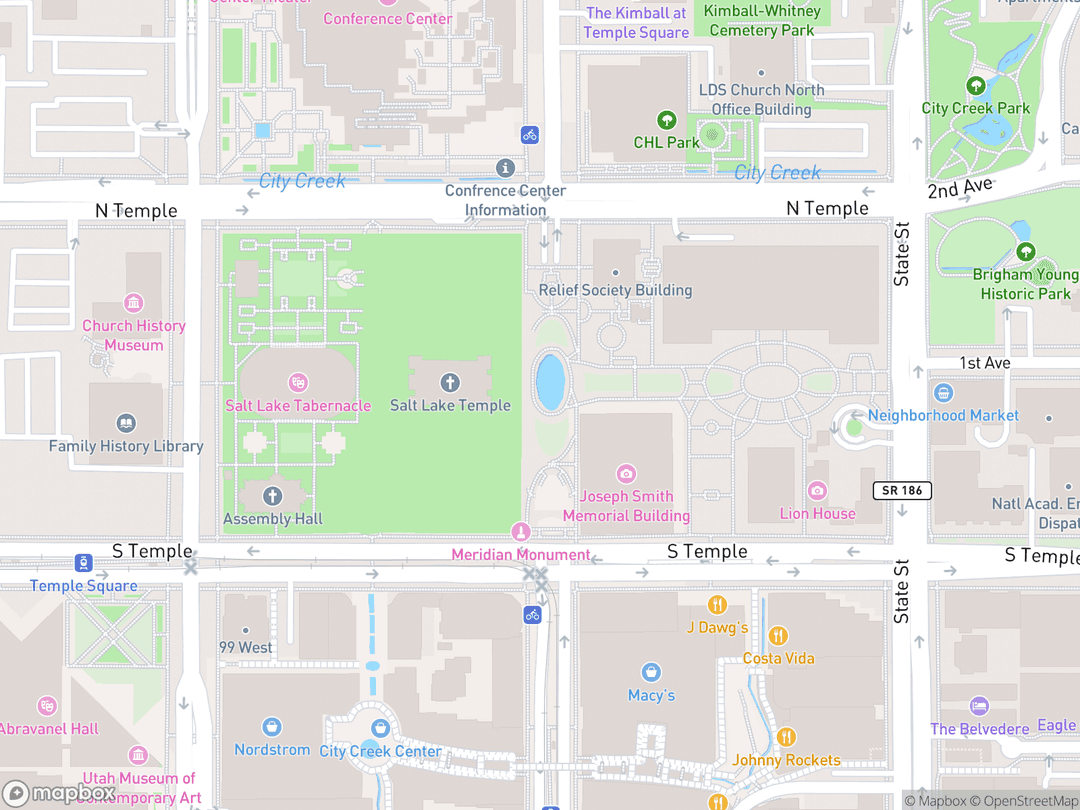
50 W North Temple St, Salt Lake City, Utah 84150
Hours: Temporarily closed for renovation (expected reopening 2027). Temple Square grounds and visitor centers remain open daily 9am-9pm.
Getting There: Take TRAX (Green or Blue line) to Temple Square stop. Limited parking downtown—public transit recommended.
Get DirectionsTips for Your Visit
Best Photography
Visit at sunrise or sunset for golden light on the temple's granite spires. The reflecting pool offers mirror-like reflections in calm weather.
Seasonal Magic
The Christmas lights display features hundreds of thousands of lights. Nativity scenes and live performances add to the experience.
Free Tours
Take advantage of free Temple Square tours offered by sister missionaries in over 30 languages.
Conference Center
Don't miss the rooftop garden with panoramic views of the temple and city. Theater performances are often free.
TRAX Access
Use the Temple Square TRAX stop (Green and Blue lines) for easy public transit access. Parking is limited and expensive downtown.
Tabernacle Organ
Free organ recitals are held most days at noon and 2 PM (check schedule). The acoustics are legendary.
About
The Salt Lake Temple, completed in 1893 after 40 years of construction, is the centerpiece of Temple Square in downtown Salt Lake City, Utah, and the spiritual heart of the faith. Rising 222 ft (68 m) to the top of the Angel Moroni statue (the highest spire reaches 210 feet (64 m) to the capstone), the temple took from groundbreaking in 1853 to dedication in 1893 to construct, making it one of the longest construction projects in religious history.
The temple's granite walls, some up to nine feet thick at the base, were quarried from Little Cottonwood Canyon, located about 20 miles southeast of the temple site. Each massive block—some weighing up to 5,600 pounds—was transported first by oxen (a 3-5 day journey) and later by a purpose-built railroad completed in 1872. The stone is technically quartz monzonite, chosen by architect Truman O. Angell for its exceptional durability after earlier attempts with adobe and sandstone proved inadequate.
The temple is crowned by the Angel Moroni statue, a 12-foot 5-inch (3.8 m) figure sculpted by Cyrus Dallin in hammered copper and covered with 22-karat gold leaf. Placed atop the central east spire during the 1892 capstone ceremony witnessed by an estimated 30,000-40,000 people, it has become one of the most recognized religious symbols in the world.
Currently undergoing the most extensive renovation in its history (2019-2027), the temple is being fitted with 98 seismic base isolators that literally lift the entire structure off its original foundation—a remarkable engineering feat that will protect this sacred building for centuries to come.
Gallery
Symbolic Elements
The temple's exterior features intricate carvings, each rich with spiritual meaning:
Angel Moroni
The 12-foot 5-inch (3.8 m) gilded figure atop the central east spire, facing east in anticipation of the Second Coming. Sculpted by Cyrus Dallin.

Six Spires
Three taller east spires (Melchizedek Priesthood) and three shorter west spires (Aaronic Priesthood), representing priesthood authority.

Sun Stones
Carved stones representing celestial glory and the highest degree of heaven.

Moon Stones
Representing terrestrial glory and the second degree of heaven.

Star Stones
Representing telestial glory and the third degree of heaven.

Earth Stones
Large carved stones at the foundation level representing the physical world.

All-Seeing Eye
Symbol of God's omniscience and watchfulness.

Clasped Hands
Fellowship, brotherhood, and covenants between God and humanity.

Big Dipper
Points to the North Star, representing Christ as the fixed point guiding all souls.
Interesting Facts
The foundation was temporarily buried in 1857 to hide it from approaching U.S. troops during the Utah War.
Foundation stones weigh up to 5,600 pounds each—transported first by oxen, then by a purpose-built railroad.
The original Angel Moroni design was hammered copper; the current 22-karat gold leaf coating was added in 1912.
During the 2020s renovation, the entire temple (170 million pounds) was lifted off its foundation to install seismic base isolators.
The Salt Lake Temple is the most widely recognized symbol of the Church and has been featured prominently in official Church media and publications for over a century.
President Wilford Woodruff used an electric current to trigger the capstone placement in 1892—remarkably modern for the era.
The capstone ceremony drew an estimated 30,000-40,000 people—one of the largest gatherings in Utah Territory history.
Dedication services lasted 18 days (April 6-24, 1893) to accommodate all who wanted to attend.
The granite is technically quartz monzonite, a particularly durable igneous rock.
The Big Dipper carved on the exterior points to the North Star, symbolizing Christ as the fixed point for all souls.
Common Questions
Can I go inside the Salt Lake Temple?
The Salt Lake Temple interior is reserved for members of The Church of Jesus Christ of Latter-day Saints who hold a valid temple recommend. However, Temple Square grounds, the North and South Visitor Centers, the Tabernacle, and the Conference Center are open to all visitors free of charge.
How long did it take to build?
The Salt Lake Temple took exactly 40 years to build—from groundbreaking on February 14, 1853, to dedication on April 6, 1893. The temple was built entirely by pioneer labor using granite quarried from Little Cottonwood Canyon, about 20 miles away.
Why is it made of granite instead of simpler materials?
The Salt Lake Temple is made of granite because the builders originally planned adobe, then tried sandstone, but both deteriorated. Truman O. Angell recommended granite for permanence. The quartz monzonite from Little Cottonwood Canyon has proven incredibly durable, with walls up to 9 feet thick at the base.
What is the statue on top?
The Salt Lake Temple features the Angel Moroni statue, a 12-foot 5-inch (3.8 m) figure sculpted by Cyrus Dallin, which stands atop the central east spire facing east. Made of hammered copper and covered in 22-karat gold leaf, it was placed during the capstone ceremony on April 6, 1892.
When will the renovation be complete?
The Salt Lake Temple renovation is expected to be complete and reopen by 2027. The renovation includes 98 seismic base isolators that literally lifted the temple off its foundation, plus expanded sealing rooms, a second baptistry, and restored historic features.
What do the six spires represent?
The Salt Lake Temple's three taller east spires represent the Melchizedek Priesthood, while the three shorter west spires represent the Aaronic Priesthood. Together they symbolize the restoration of priesthood authority.
Featured Stories
Heavenly Voices at the Dedication
April 6–24, 1893
The dedication of the Salt Lake Temple in April 1893 was accompanied by remarkable spiritual manifestations. During the ceremonies, multiple attendees reported hearing "most heavenly voices singing" that seemed to come from behind and above them—though no other choir was present in the room. The voices appeared during an organ selection, and those who heard them described them as unmistakably angelic.
One participant recorded in their diary that the dedicatory prayer offered by President Wilford Woodruff was "simply grand" and that "the veil was almost rent and we indeed felt we were in the presence of our God and Jesus Christ our Redeemer and hosts of heavenly beings." Several people reported seeing angels, and a "bright halo" was observed surrounding President Lorenzo Snow, in which the figures of Brigham Young, John Taylor, and a third personage—Joseph Smith—were reportedly seen.
Following the "Hosanna Shout," the choir performed the "Hosanna Hymn," and the congregation joined in singing "The Spirit of God Like a Fire is Burning"—the same hymn sung at the dedication of the Kirtland Temple in 1836. The dedication services continued for 18 days to accommodate the thousands who wished to participate, with many recording these experiences in their personal journals.
Source: Diaries of Wilford Woodruff, John Mills Whitaker, Emmeline B. Wells; Dialogue Journal
Wilford Woodruff's Dream of a Granite Temple
Decades before 1893
President Wilford Woodruff, who offered the dedicatory prayer on April 6, 1893, revealed that he had seen this very temple in a dream "many years ago, before we came to the Rocky Mountains." In the dream, he saw a large, granite temple erected in one of the valleys—a vision that came years before the Saints ever left Nauvoo or knew where their final destination would be.
When the foundation of the Salt Lake Temple was laid, Woodruff recognized it as the fulfillment of his prophetic dream. During the dedication ceremony itself, Woodruff recorded that if the eyes of the congregation could have been opened, they would have seen Joseph and Hyrum Smith, Brigham Young, John Taylor, and other "good men who had lived in this dispensation" assembled there, along with "all the Holy Prophets and Apostles who had prophesied of the latter day work"—all rejoicing with them in this building which had been accepted of the Lord.
Woodruff kept a daily journal for 65 years, and his entry for April 6, 1893, captures both his personal emotion and his spiritual witness of the day. Having walked with Joseph Smith, crossed the plains, and dedicated temples, the culmination of his life's work stood before him in granite.
Source: Wilford Woodruff journals (65 years of daily entries); Joseph Smith Foundation; Church History
John Moyle: The Man Who Walked on a Wooden Leg
1870s–1893
Perhaps no story better captures the sacrifice involved in building the Salt Lake Temple than that of John Moyle, a stonemason from Alpine, Utah—22 miles from Temple Square. Every Monday morning, Moyle would walk the 22 miles to Salt Lake City to work on the temple, labor through the week, and then walk home on Friday night to be with his family for the Sabbath.
In 1871, a tragic accident occurred when a cow kicked Moyle's leg, resulting in an infection that required amputation below the knee. Most would have considered their temple service complete—but not John Moyle. He fashioned himself a wooden leg, allowed time to heal, and then resumed his weekly 22-mile walk to continue his work on the temple.
For years, on his hand-carved wooden leg, Moyle walked those 22 miles each way. His skilled hands carved the inscription "Holiness to the Lord" that still adorns the east wall of the temple today. He never saw the completed temple, but his inscription remains—carved letter by letter by a man who refused to let hardship stop his service.
Source: Church of Jesus Christ of Latter-day Saints; Intermountain Histories; Latter-day Saint Magazine
The Foundation That Had to Be Rebuilt
1857–1867
In 1857, word reached Salt Lake City that U.S. troops were marching toward Utah in what became known as the Utah War. Brigham Young ordered the temple foundation—years of work—to be buried and covered with earth to disguise it as a plowed field, protecting it from potential destruction. The Saints prepared to burn their homes and flee rather than surrender their temple site.
When the crisis passed and the buried foundation was uncovered, a devastating discovery awaited: the original sandstone foundation, made of smaller stones with mortar, had begun to crack under the immense projected weight. Engineers determined it would not support the massive granite structure planned above it.
In 1862, the painful decision was made: the entire foundation would have to be removed and replaced with solid granite blocks. Years of labor were demolished, and the work began again from scratch. It was not until 1867—fourteen years after groundbreaking—that the new, stronger foundation was complete. When asked why they would invest such effort, Brigham Young responded that this temple was being built to "endure through the Millennium."
Source: Church History; From the Desk; Utah Rails Archive; BYU Studies
Timeline
Pioneer Arrival
Brigham Young and the pioneer company arrive in the Salt Lake Valley.
MilestoneSite Selected
Brigham Young plants his cane to mark the temple site, declaring 'Here we will build the temple of our God.'
MilestoneArchitect Appointed
Truman O. Angell appointed as Church Architect by Brigham Young.
EventGroundbreaking
Ceremony conducted by Brigham Young. Musicians perform 'Auld Lang Syne' to signify a new era.
component.timeline.groundbreakingCornerstones Laid
Cornerstones dedicated on the 23rd anniversary of the Church's organization.
MilestoneMaterial Change
Plans changed from adobe to granite, ensuring the temple would stand for centuries.
EventUtah War
Construction halted; foundation temporarily buried to protect from potential destruction by U.S. troops.
EventFoundation Rebuilt
Original sandstone foundation replaced entirely with granite from Little Cottonwood Canyon.
MilestoneRailroad Built
Railroad completed to granite quarry, reducing stone transport from 3-5 days to same-day delivery.
MilestoneCapstone Ceremony
30,000-40,000 people gather as the Angel Moroni statue is placed atop the central spire. President Wilford Woodruff triggers the placement via electric current.
MilestoneDedication Day 1
President Wilford Woodruff offers the dedicatory prayer. Attendees report heavenly manifestations and feelings of the Lord's acceptance.
DedicationDedication Concludes
After 18 days of dedication sessions, the temple opens for regular ordinances.
DedicationAngel Moroni Gilded
The statue receives 22-karat gold leaf coating, giving it the radiant appearance seen today.
EventRededication
President David O. McKay rededicates the temple following interior renovations.
DedicationRenovation Begins
Temple closes for the most extensive renovation in its history, including seismic upgrades.
RenovationFirst Base Isolator
First of 98 seismic base isolators installed, lifting the entire temple off its original foundation.
RenovationSeismic Foundation Complete
Temple load fully transferred to new seismic foundation at east and west towers.
RenovationReopening (Projected)
Temple expected to reopen following completion of interior finishing and restoration.
RenovationHistory by Decade
1840s — Vision & Arrival
Here we will build the temple of our God.
Just four days after the pioneer company's arrival in the Salt Lake Valley on July 24, 1847, Brigham Young planted his cane in the ground to mark the temple site. This was remarkable foresight—the Saints were exhausted from their 1,300-mile trek, but temple building was already the priority.
1850s — Groundbreaking & Early Construction
Truman O. Angell, Brigham Young's brother-in-law, was appointed Church Architect in 1850. The groundbreaking ceremony took place on February 14, 1853, with musicians performing "Auld Lang Syne" to symbolize a new era. Just weeks later, on April 6, 1853, the cornerstones were laid on the 23rd anniversary of the Church's organization. Originally planned in adobe, then sandstone, the decision was made in 1854 to use granite for permanence. The Utah War of 1857 forced a halt to construction, and the foundation was temporarily buried to protect it from potential destruction by U.S. troops.
1860s–1870s — Foundation Rebuilt & Railroad Era
By 1867, the original sandstone foundation had deteriorated and was entirely replaced with granite from Little Cottonwood Canyon. The construction of a railroad to the quarry in 1872 transformed the project, reducing stone transport from 3-5 days by oxen to same-day delivery by rail.
1880s–1890s — Completion & Dedication
The walls rose steadily through the 1880s. The capstone ceremony on April 6, 1892, drew an estimated 30,000-40,000 people to Temple Square—one of the largest gatherings in the territory's history. President Wilford Woodruff used an electric current to trigger the placement of the capstone and the Angel Moroni statue. One year later, on April 6, 1893, President Woodruff offered the dedicatory prayer. The dedication services continued for 18 days, with many attendees reporting spiritual manifestations and a powerful sense of the Lord's acceptance of their 40-year sacrifice.
1900s–1960s — The Established Temple
In 1912, the Angel Moroni statue received its current 22-karat gold leaf coating. Interior renovations led to a rededication by President David O. McKay on May 21, 1963.
2019–Present — Historic Renovation
The temple closed on December 29, 2019, for the most extensive renovation in its history. Engineers installed 98 seismic base isolators, literally lifting the 170-million-pound structure off its foundation. The renovation adds a second baptistry, expands sealing rooms from 13 to 22, and restores historic features. Completion is expected by 2027.
Architecture & Facilities
The Salt Lake Temple represents a unique blend of Gothic Revival and Romanesque architecture, adapted to pioneer capabilities and frontier conditions. Its castellated towers, pointed arch windows, and buttressed walls evoke medieval European cathedrals, while its six spires carry profound symbolic meaning for Latter-day Saints.
Building Materials
Granite (Quartz Monzonite)
Quarried from Little Cottonwood Canyon, the gray granite walls are up to 9 feet thick at the base. The stone was chosen after adobe and sandstone proved inadequate.
Foundation
16-foot-deep footings of concrete and stone, now supplemented by 98 seismic base isolators.
Spires
Originally wood covered in metal; completely rebuilt during the 2020s renovation with modern materials while maintaining historic appearance.
First Stones
The very first foundation stones came from Red Butte Canyon before Little Cottonwood granite was adopted.
Interior Features
Instruction Rooms
5 with separate veil rooms (increased from 3)
Sealing Rooms
22 (increased from 13)
Baptistries
2 (added a second)
Floor Area
~382,207 square feet
Temple Grounds
Tabernacle
Historic domed building seating 6,500, home to the world-famous Tabernacle Choir at Temple Square.
Assembly Hall
Gothic-style meeting hall built from leftover granite.
North & South Visitor Centers
Exhibits on Christ's life, temple worship, and family history.
Reflecting Pool
Iconic photo spot offering mirror reflections of the temple.
Gardens
Meticulously maintained with seasonal plantings and the famous Christmas lights display.
Additional Facilities
The 21,000-seat Conference Center, one of the largest auditoriums in the world, hosts General Conference twice yearly. Its rooftop garden offers panoramic views of the temple and downtown Salt Lake City.
Religious Significance
For members of The Church of Jesus Christ of Latter-day Saints, the Salt Lake Temple is far more than an architectural marvel—it is the spiritual center of their faith and a sacred place where eternal covenants are made with God.
Latter-day Saint temples are distinct from regular meetinghouses. While Sunday worship services are open to all, temples are reserved for members who have prepared spiritually and obtained a "temple recommend" from their local leaders. Inside, members participate in ordinances (sacred ceremonies) that connect heaven and earth, bind families together eternally, and make possible the salvation of all humanity—including those who have died.
Sacred Ordinances
Endowment
A ceremony in which members receive instruction about God's plan, make covenants of faithfulness, and receive symbolic blessings of power and protection.
Initiatory
A ceremonial washing and anointing that symbolizes spiritual cleanliness and prepares members to receive the endowment.
Sealing
Marriages performed in temples last not just "until death do you part" but for eternity. Families can also be "sealed" together across generations.
Baptism for the Dead
Members are baptized on behalf of deceased ancestors, offering them the opportunity to accept the gospel in the afterlife. This is why Latter-day Saints are so dedicated to family history research.
Why 40 Years of Sacrifice?
The pioneers who built the Salt Lake Temple did so under extraordinary hardship. They quarried granite by hand, hauled it 20 miles by oxen, and worked through persecution, poverty, and political conflict. Why? Because they believed temples were essential to God's work—that without them, the promises made to ancient prophets could not be fulfilled. Brigham Young declared this temple would be built to "endure through the Millennium." The 2020s renovation, with its 98 seismic base isolators designed to protect the building from earthquakes, suggests the current generation takes that mandate just as seriously.
The Temple in Latter-day Saint Life
For many Latter-day Saints, attending the temple is a weekly or monthly practice—a respite from the world where they seek peace, clarity, and connection to God. The Salt Lake Temple, as the flagship temple of the faith, holds a unique place: it is the temple most associated with Church history and the temple where many converts dream of worshiping. When the temple reopens following its historic renovation in 2027, members worldwide are expected to travel great distances for the privilege of worshiping within its granite walls—continuing a tradition that began with the pioneer builders who sacrificed everything to see it completed.
Similar Temples
Sources & Research
Every fact on Temples.org is backed by verified Sources & Research. Each piece of information is rated by source tier and confidence level.
View All Sources (10)
| Field | Source | Tier | Retrieved |
|---|---|---|---|
| Dedication Date & Status | The Church of Jesus Christ of Latter-day Saints (opens in a new tab) | A | 2026-01-27 |
| Historical Timeline | Church History Library (opens in a new tab) | A | 2026-01-27 |
| Capstone Ceremony Details | Church Historian's Press (opens in a new tab) | B | 2026-01-27 |
| Architect (Truman O. Angell) | From The Desk (opens in a new tab) | B | 2026-01-27 |
| Floor Area & Room Count | ChurchofJesusChristTemples.org (opens in a new tab) | C | 2026-01-27 |
| Granite Quarry Details | BYU Geology (opens in a new tab) | B | 2026-01-27 |
| Angel Moroni Statue | LDS Living (opens in a new tab) | B | 2026-01-27 |
| Renovation Timeline | The Church of Jesus Christ of Latter-day Saints (opens in a new tab) | A | 2026-01-27 |
| Base Isolator Installation | Latter-day Saint Magazine (opens in a new tab) | C | 2026-01-27 |
| Construction History | State of Utah (opens in a new tab) | B | 2026-01-27 |