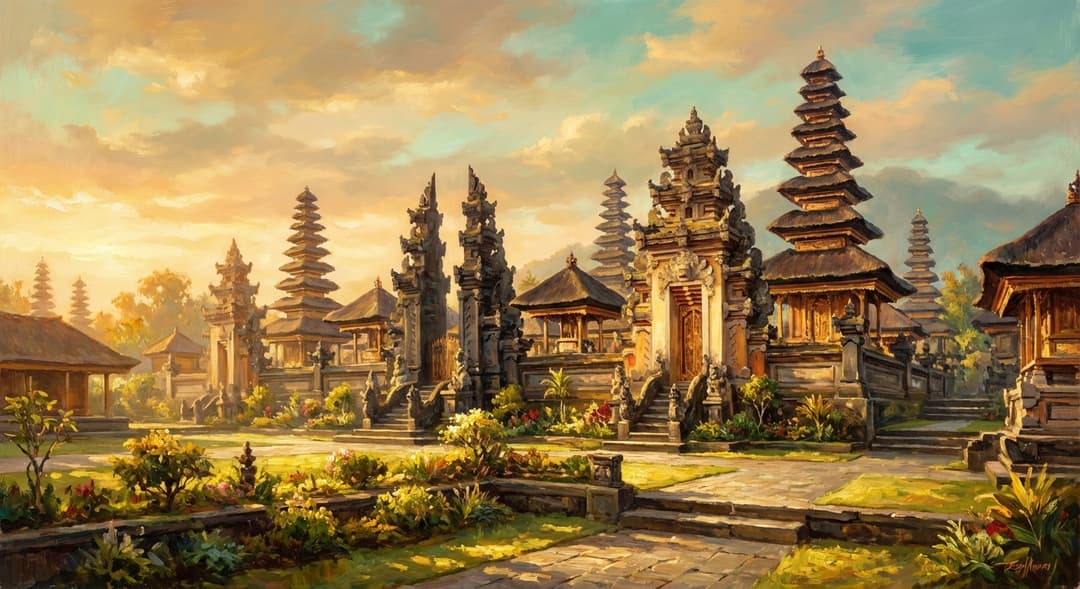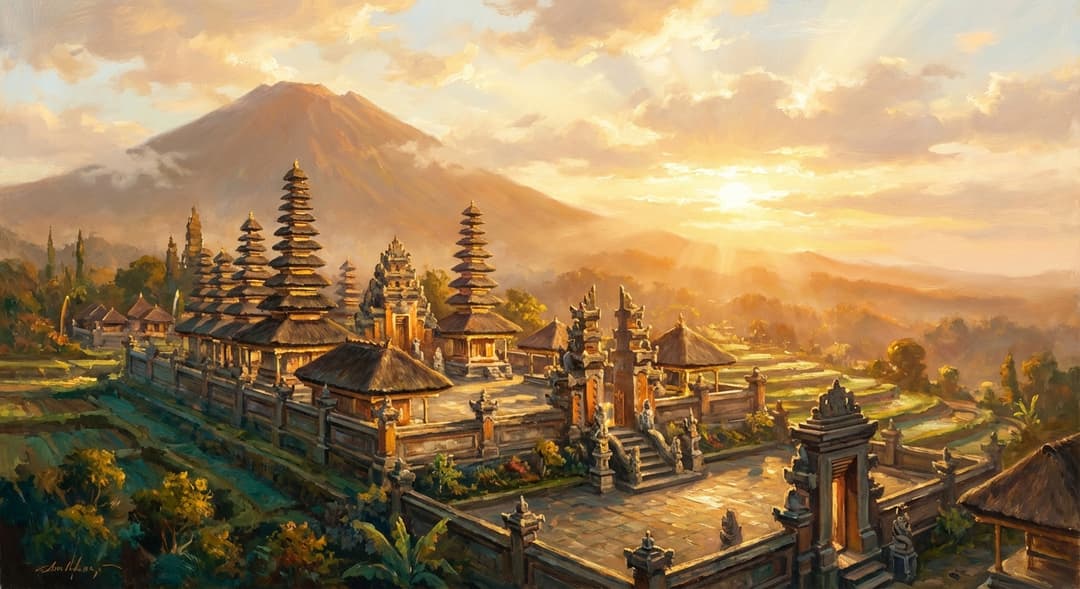
Mount Agung (Gunung Agung) is the highest point on the island of Bali, rising 3,031 meters above sea level. Far more than a geological landmark, it is the spiritual axis of Balinese Hinduism — the abode of the gods and the center of the universe in Balinese cosmology. Every aspect of Balinese life, from the orientation of homes and temples to the direction of sleep, is calibrated in relation to this sacred peak.
In Balinese Hindu belief, Mount Agung is a replica of Mount Meru, the cosmic mountain at the center of the universe in Hindu-Buddhist cosmology. The gods are believed to reside on its summit, and the mountain serves as a bridge between the earthly and divine realms. Besakih Temple, the "Mother Temple" of Bali, sits on its southwestern slopes at an elevation of approximately 1,000 meters, positioned to honor the spiritual power that radiates from the volcano.
Mount Agung is an active stratovolcano, and its eruptions have shaped both the physical landscape and spiritual consciousness of Bali. The catastrophic 1963 eruption — one of the most powerful in Indonesia's 20th-century history — killed over 1,500 people, displaced tens of thousands, and blanketed eastern Bali in ash and lava. Yet the lava flows stopped just short of Besakih Temple, an event the Balinese interpret as a divine miracle confirming the temple's sacred status.
The mountain erupted again in 2017–2019, forcing mass evacuations and disrupting air travel across the region. Despite these dangers, the Balinese relationship with Agung remains one of reverence rather than fear. The volcano is understood as both creator and destroyer — its fertile volcanic soils sustain Bali's legendary rice terraces, while its eruptions remind humans of the power and unpredictability of the divine.
Key Details
- Elevation 3,031 meters (9,944 feet)
- Type Active Stratovolcano
- Location Karangasem Regency, eastern Bali
- Last Major Eruption 2017–2019
- Deadliest Eruption 1963 — over 1,500 killed
- Spiritual Significance Seat of the gods and axis of Balinese cosmology
Timeline
Formation of Mount Agung
Besakih Temple Founded on Its Slopes
First Recorded Eruption
Catastrophic Eruption
Eruption Resumes
Continued Activity
Sources & Research
Every fact on Temples.org is backed by verified Sources & Research. Each piece of information is rated by source tier and confidence level.
View All Sources (3)
| Field | Source | Tier | Retrieved |
|---|---|---|---|
| Mount Agung Geological Profile | Smithsonian Institution Global Volcanism Program (opens in a new tab) | A | 2026-02-13 |
| Spiritual Significance of Agung | Atlas Obscura (opens in a new tab) | C | 2026-02-13 |
| 2017–2019 Eruption Coverage | BBC News (opens in a new tab) | B | 2026-02-13 |