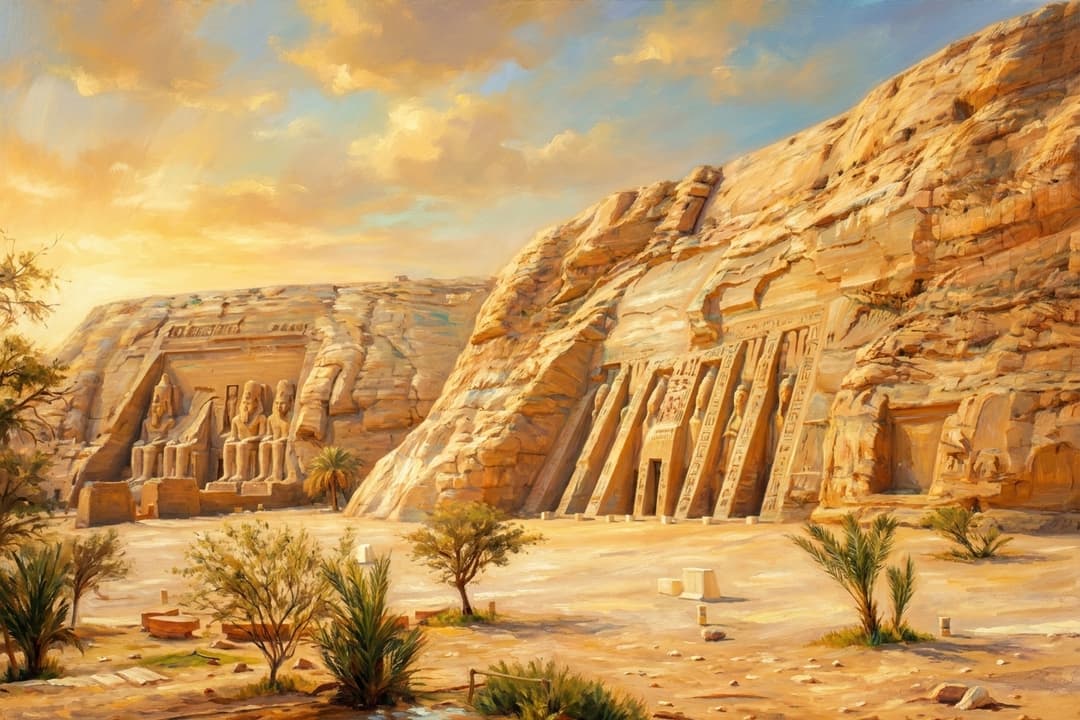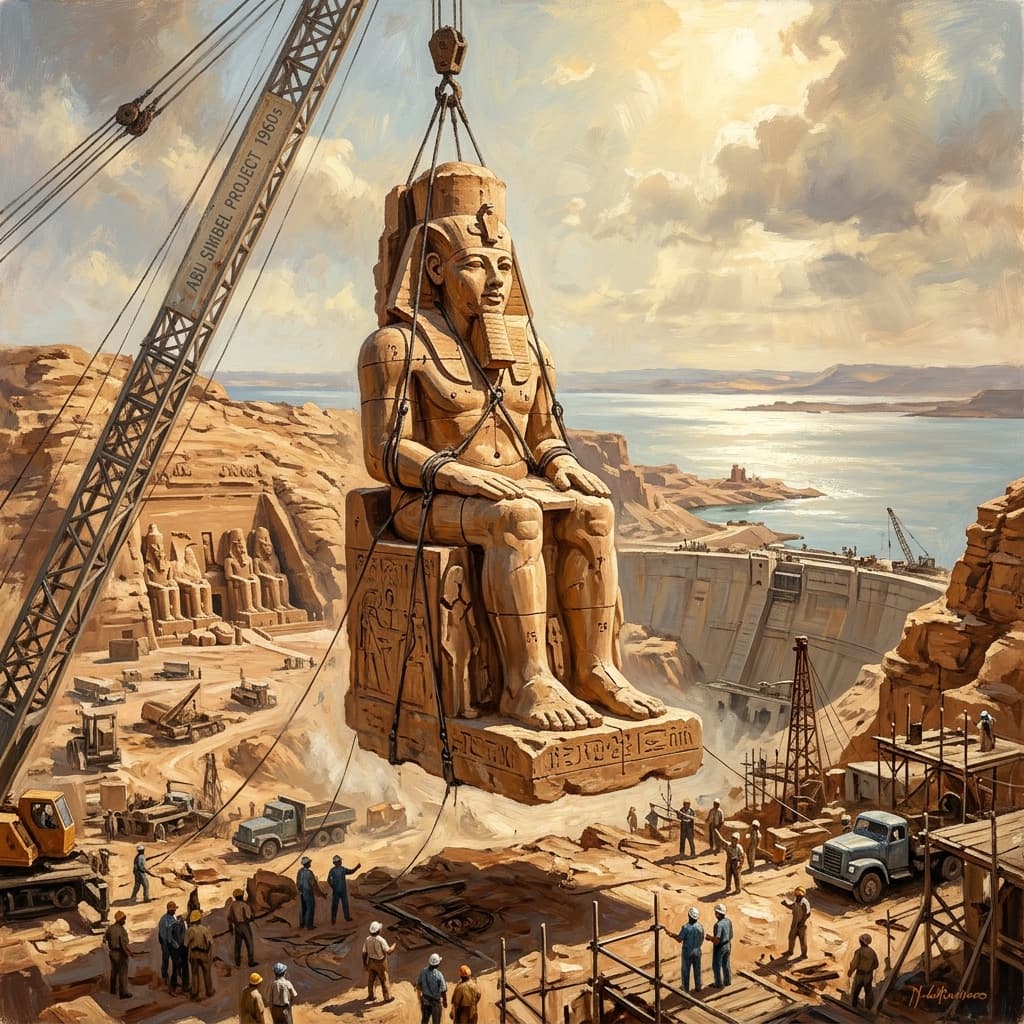
In the 1960s, the construction of the Aswan High Dam threatened to submerge the ancient temples of Abu Simbel beneath the rising waters of Lake Nasser. In response to this cultural crisis, UNESCO launched a historic international campaign to save the 3,200-year-old structures. A team of engineers, archaeologists, and stonecutters from around the world dismantled the Great Temple of Ramesses II and the Small Temple of Queen Nefertari, moving them to higher ground.
The relocation project was a triumph of engineering. Since the temples were carved directly into the mountain cliff, workers first had to carefully excavate the rock above and behind the temples without explosives. They then sliced the temples into 1,035 massive blocks, each weighing between 7 and 30 tons, using hand saws and wire saws to minimize damage to the sandstone.
The blocks were cataloged, transported, and reassembled on a new site 65 meters higher and 200 meters further inland. To recreate the appearance of the original cliff, engineers constructed massive reinforced concrete domes above the reassembled temple chambers and covered them with an artificial mountain of rock and rubble.
Remarkably, the engineers successfully preserved the original temple's solar alignment, where the rising sun illuminates the inner sanctuary twice a year. Although the repositioning resulted in a slight shift of the alignment dates by one day—from February 21 and October 21 to February 22 and October 22—the phenomenon remains a breathtaking tribute to ancient astronomy and modern engineering.
Key Details
- Relocation Period 1964–1968
- Leading Organization UNESCO
- Number of Blocks 1,035 blocks (7 to 30 tons each)
- New Position 65m higher, 200m further inland
- Total Cost Approximately $40 million (funded by over 50 nations)
- Modern Solar Alignment Dates February 22 and October 22
Timeline
UNESCO Campaign Launched
UNESCO issues a global appeal to save the Nubian monuments threatened by the Aswan High Dam.
MilestoneDam Construction Begins
Work begins on the Aswan High Dam, initiating the rising waters of Lake Nasser.
component.timeline.historicRelocation Work Begins
A temporary cofferdam is built, and workers begin excavating the sandstone above the temples.
RenovationDismantling and Cutting
The temples are precision-cut into 1,035 blocks and transported to a staging area.
RenovationReassembly Commences
Reassembly of the blocks begins, and construction of the concrete dome starts.
RenovationInauguration Ceremony
The relocated Abu Simbel temples are officially inaugurated and opened to the public.
DedicationSources & Research
Every fact on Temples.org is backed by verified Sources & Research. Each piece of information is rated by source tier and confidence level.
View All Sources (2)
| Field | Source | Tier | Retrieved |
|---|---|---|---|
| Saving the Temples of Abu Simbel | UNESCO World Heritage Centre (opens in a new tab) | B | 2026-06-01 |
| Relocation of Abu Simbel | Britannica (opens in a new tab) | B | 2026-06-01 |