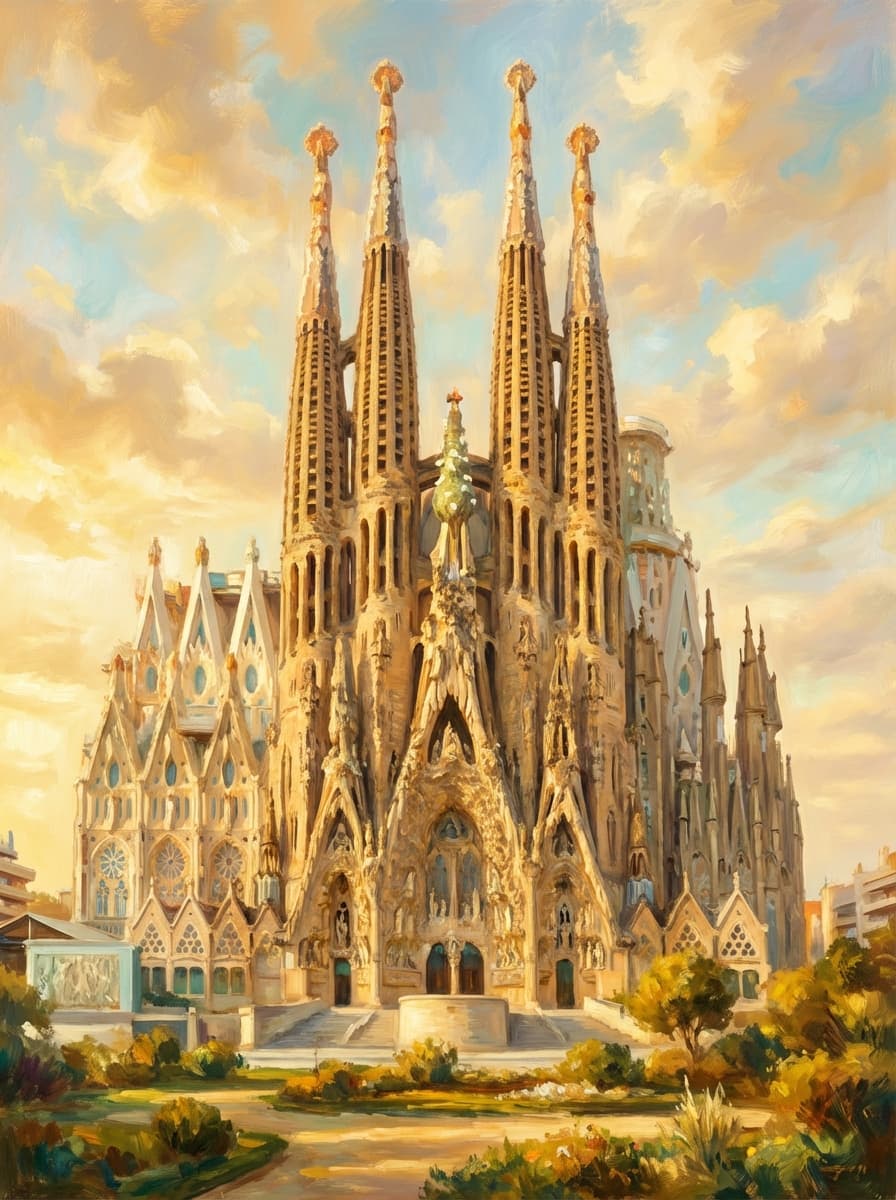
When the Spanish Civil War erupted in July 1936, Barcelona became one of the epicenters of revolutionary violence. Anarchist and anti-clerical groups targeted churches across the city, and the Sagrada Família — still under construction, still incomplete, still Gaudí's unfinished dream — did not escape their attention.
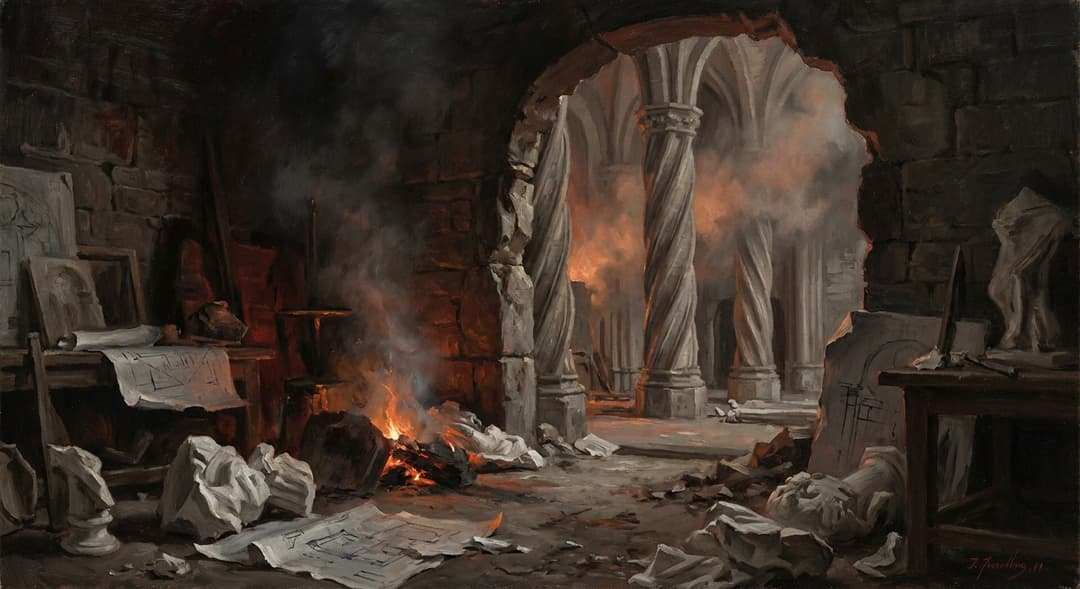
On July 20, 1936, a group stormed into the Sagrada Família's crypt and workshop. They set fire to Gaudí's studio, destroying an irreplaceable collection of original plans, plaster models, sketches, and notes that the architect had spent over four decades creating. The detailed plaster models — three-dimensional blueprints that Gaudí had used to communicate his complex organic designs to builders — were smashed to fragments. The crypt, where Gaudí himself was buried, was damaged but not destroyed.
The loss was catastrophic. Gaudí had worked without detailed written plans, preferring to express his ideas through models and on-site improvisation. With the models and sketches destroyed, the architectural community feared that the basilica could never be completed as Gaudí intended. Some argued that the project should be abandoned as a ruin, a monument to his truncated genius.
But a small group of devoted architects and craftsmen refused to accept that verdict. In the years following the war, they painstakingly gathered fragments of the shattered models — some no larger than a fingernail — and began reconstructing Gaudí's designs. They studied published plans, photographs, and the testimony of workers who had known Gaudí personally. This forensic reconstruction of an architect's vision from rubble and memory remains one of the most remarkable feats of architectural preservation in history.
Construction resumed in 1944 and has continued ever since, guided by both the reconstructed models and modern computational modeling that has allowed architects to extrapolate Gaudí's geometric principles into areas he never specified. The Sagrada Família's expected completion around 2026 — the centenary of Gaudí's death — is a testament not only to his vision but to the generations of builders who refused to let it die.
Key Details
- Date of Attack July 20, 1936
- What Was Destroyed Original plans, plaster models, sketches, workshop
- Crypt Damage Damaged but not destroyed; Gaudí's tomb survived
- Reconstruction Method Fragments gathered, photos studied, worker testimony collected
- Construction Resumed 1944
- Expected Completion 2026 (centenary of Gaudí's death)
Timeline
Spanish Civil War Erupts
Revolutionary violence sweeps Barcelona as anti-clerical groups target churches across the city.
EventWorkshop Destroyed
Anarchists storm the Sagrada Família, setting fire to Gaudí's workshop and smashing his irreplaceable plaster models.
EventWar Ends
The Spanish Civil War concludes. The Sagrada Família stands damaged but structurally intact.
EventPainstaking Reconstruction
Architects begin gathering fragments of destroyed models and reconstructing Gaudí's designs from photographs and testimony.
MilestoneConstruction Resumes
Work on the Sagrada Família resumes under the guidance of reconstructed plans and new architects.
MilestoneConsecrated by Pope Benedict XVI
Pope Benedict XVI consecrates the Sagrada Família as a minor basilica, affirming the continuation of Gaudí's vision.
DedicationSources & Research
Every fact on Temples.org is backed by verified Sources & Research. Each piece of information is rated by source tier and confidence level.
View All Sources (2)
| Field | Source | Tier | Retrieved |
|---|---|---|---|
| Model Reconstruction | Junta Constructora del Temple (opens in a new tab) | B | 2026-02-19 |
| Architecture Analysis | Khan Academy (opens in a new tab) | C | 2026-02-16 |