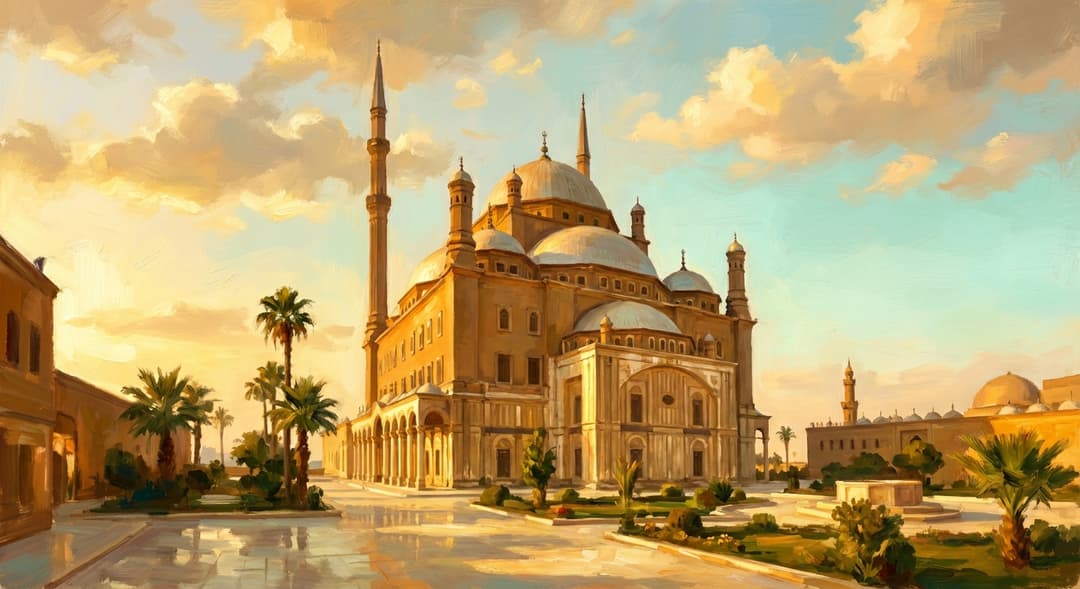
The Muhammad Ali Mosque, an iconic structure within Cairo's Citadel, stands as a powerful testament to the ambition and strategic acumen of Muhammad Ali Pasha, the Ottoman governor who shaped modern Egypt. Its construction, initiated in 1830 and largely completed by 1848, was not merely an act of piety but a carefully calculated move to consolidate power and establish a lasting dynasty in the wake of the brutal Mamluk massacre of 1811. The mosque's imposing presence served as a visual declaration of Muhammad Ali's authority, both to the Egyptian populace and to the Ottoman Sultan in Istanbul.
The massacre of the Mamluks, a long-standing military caste that had wielded significant influence in Egypt for centuries, was a pivotal moment in Muhammad Ali's rise to power. By eliminating this formidable rival, he cleared the path for centralized control and ambitious reforms. However, this act of violence also necessitated a concerted effort to legitimize his rule and project an image of strength and stability. The construction of the Muhammad Ali Mosque became a central component of this strategy, serving as a tangible symbol of his power, wealth, and religious devotion.
The mosque's architectural style, heavily influenced by Ottoman imperial mosques, was a deliberate choice. It signaled Muhammad Ali's connection to the Ottoman Empire, while simultaneously asserting his own independence and ambition. The lavish use of alabaster, the towering minarets, and the overall grandeur of the structure were designed to impress and inspire awe, reinforcing Muhammad Ali's position as the undisputed ruler of Egypt. Furthermore, the mosque was intended to serve as a family mausoleum, underscoring his ambition to establish a lasting dynasty that would rule Egypt for generations to come.
Beyond its political symbolism, the Muhammad Ali Mosque also holds religious significance as a functioning place of worship. Its grand scale and intricate decoration reflect the importance of religious architecture in Islamic culture, providing a space for prayer and reflection for both the local community and visitors from around the world. The mosque stands as a lasting reminder of a transformative period in Egyptian history, a testament to the ambition, ruthlessness, and enduring legacy of Muhammad Ali Pasha.
Key Details
- Commissioned by Muhammad Ali Pasha
- Construction Began 1830
- Architectural Style Ottoman
- Also Known As The Alabaster Mosque
- Architect Yusuf Bushnak
- Location Cairo Citadel
Timeline
Massacre of the Mamluks
Muhammad Ali eliminates the Mamluk leadership at the Cairo Citadel.
EventConstruction Begins
Construction of the Muhammad Ali Mosque commences.
component.timeline.groundbreakingInitial Completion
The main structure of the mosque is largely completed during Muhammad Ali's reign.
DedicationFinal Touches
Final additions and decorations are completed during the reign of Said Pasha.
RenovationSources & Research
Every fact on Temples.org is backed by verified Sources & Research. Each piece of information is rated by source tier and confidence level.
View All Sources (4)
| Field | Source | Tier | Retrieved |
|---|---|---|---|
| the beatrice daily express (beatrice, neb.) 1884-1924 (beatrice, nebraska) | Library of Congress (opens in a new tab) | C | 2024-01-01 |
| new-york tribune (new york [n.y.]) 1866-1924 (new york, new york) | Library of Congress (opens in a new tab) | C | 2024-01-01 |
| the daily morning journal and courier (new haven, conn.) 1894-1907 (new haven, connecticut) | Library of Congress (opens in a new tab) | C | 2024-01-01 |
| Library of Congress | loc.gov (opens in a new tab) | D | 2024-01-01 |