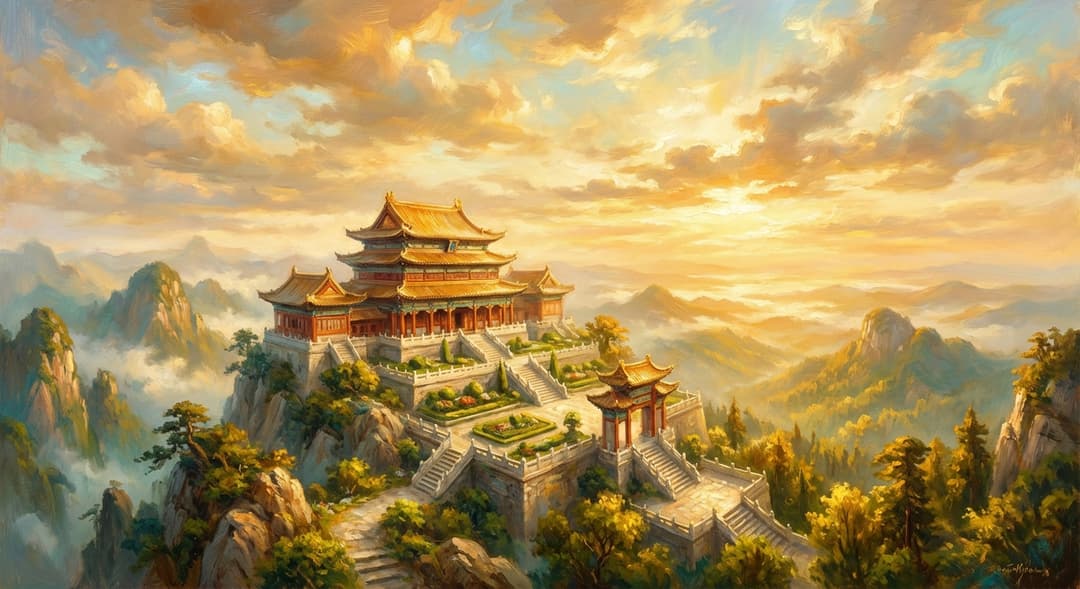
Nestled in the Hubei province of China, the Wudang Mountains stand as a testament to the profound intersection of Taoism and martial arts. Long before its association with the graceful yet powerful movements of Taijiquan, Wudang was revered as a sacred site, drawing hermits and ascetics seeking enlightenment amidst its natural beauty. The mountains' spiritual history, predating even the formalization of Taoism, laid the foundation for its future role as a major Taoist center, marked by the construction of temples and shrines dedicated to various Taoist deities.
The deity Zhenwu, the Perfected Warrior, became intrinsically linked to Wudang's identity. Legend has it that Zhenwu achieved enlightenment on these very mountains, transforming into a powerful protector of the Taoist faith. This association, coupled with significant imperial patronage, particularly during the Ming Dynasty under the Yongle Emperor, catapulted Wudang to prominence. The Yongle Emperor, believing in Zhenwu's divine assistance, initiated a massive construction project, transforming Wudang into a sprawling complex of temples, monasteries, and pavilions, solidifying its status as a major pilgrimage site and a symbol of imperial power.
While the precise origins of Taoist martial arts in Wudang remain debated, the mountains are undeniably associated with internal martial arts like Taijiquan, Baguazhang, and Xingyiquan. These arts, deeply rooted in Taoist philosophy, emphasize the cultivation of qi and harmony with the natural world. Wudang martial arts are characterized by their soft, yielding movements, internal power, and the integration of mind, body, and spirit, serving as a path towards health, longevity, and spiritual enlightenment. The unique environment of Wudang, with its rugged terrain and secluded location, further contributed to the development of these distinctive styles.
The establishment of Wudang as a center for Taoist martial arts broadened the appeal of Taoism, attracting practitioners from all walks of life and enhancing its spiritual authority. The integration of martial arts into Taoist practice reinforced the holistic nature of Taoist philosophy, embodying the ideal of achieving harmony and balance in all aspects of life. Today, Wudang continues to be revered as a sacred site, a center for martial arts, and a symbol of the enduring power of Taoist philosophy.
Key Details
- Location Hubei Province, China
- Associated Deity Zhenwu (Perfected Warrior)
- Dynasty of Major Construction Ming Dynasty (Yongle Emperor)
- Key Martial Arts Taijiquan, Baguazhang, Xingyiquan
- Core Principle Cultivation of Qi (vital energy)
- Primary Philosophy Harmony with Nature
Timeline
Early Religious Significance
Wudang Mountains begin to be associated with Taoist immortals and deities.
component.timeline.historicalYongle Emperor's Patronage
The Yongle Emperor initiates a massive construction project on Wudang, transforming it into a grand complex.
MilestoneEmergence of Taoist Martial Arts
Development of internal martial arts like Taijiquan, Baguazhang, and Xingyiquan within the Taoist context.
EventSources & Research
Every fact on Temples.org is backed by verified Sources & Research. Each piece of information is rated by source tier and confidence level.
View All Sources (4)
| Field | Source | Tier | Retrieved |
|---|---|---|---|
| Newspaper: the birmingham age-herald (birmingham, ala.) 1902-1950 (birmingham, alabama) | Library of Congress (opens in a new tab) | C | 2024-01-01 |
| Newspaper: montgomery county sentinel (rockville, md.) 1855-1974 (rockville, gaithersburg, maryland) | Library of Congress (opens in a new tab) | D | 2024-01-01 |
| Newspaper: vernon county censor (viroqua, wis.) 1865-1955 (viroqua, wisconsin) | Library of Congress (opens in a new tab) | D | 2024-01-01 |
| Wudang Mountains Official Website | Wudangshan Tourism Bureau (opens in a new tab) | A | 2024-01-01 |