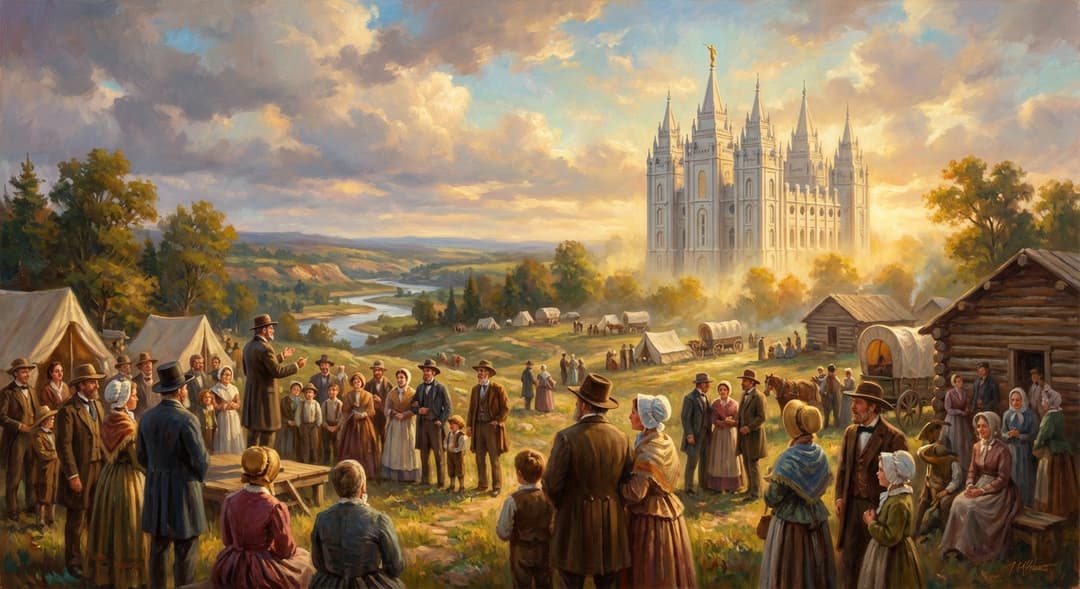
The year 1838 marked a period of intense upheaval for the early Latter-day Saints. Driven from Jackson County, Missouri, in 1833, they sought refuge and the chance to rebuild their community in Caldwell County. However, tensions simmered with other settlers in the region, fueled by religious and political differences, and anxieties surrounding the growing economic and political influence of the Latter-day Saint community. Against this backdrop of escalating conflict and persecution, the gathering at Adam-ondi-Ahman unfolded.
Adam-ondi-Ahman, situated in present-day Daviess County, Missouri, holds profound theological significance for Latter-day Saints. Joseph Smith, the founder of the movement, identified this location as the very site where Adam, after his expulsion from the Garden of Eden, offered sacrifices. Furthermore, it is prophesied to be the place where Adam will, in the future, meet with his posterity. This identification, revealed in May 1838, immediately elevated the location to a place of sacred importance. The name itself, interpreted from the Adamic language, is understood to mean "the place or land of God where Adam dwelt."
In the spring and summer of 1838, Latter-day Saints began to converge upon Adam-ondi-Ahman. Under the direction of Joseph Smith, they commenced the establishment of a settlement, laying out a city and constructing homes. Their intention was to create a safe haven for the Saints, a place where they could live and worship in peace, free from the persecutions they had previously endured. The population of Adam-ondi-Ahman swelled rapidly, becoming one of the largest Latter-day Saint settlements in Missouri.
Tragically, the settlement at Adam-ondi-Ahman was short-lived. In the autumn of 1838, escalating violence between Latter-day Saints and other Missourians reached a breaking point. Governor Lilburn Boggs issued an infamous "Extermination Order," which mandated that the Mormons be driven from the state or exterminated. Faced with this dire threat, the Latter-day Saints were forced to abandon Adam-ondi-Ahman and flee Missouri, scattering once again in search of safety and religious freedom. Despite its brief existence, the gathering at Adam-ondi-Ahman remains a significant event in Latter-day Saint history. The location continues to be revered as a sacred site, and the events of 1838 serve as a poignant reminder of the challenges and persecutions faced by the early members of the faith. The prophecies associated with Adam-ondi-Ahman continue to hold a prominent place in Latter-day Saint eschatology, representing a future gathering and a restoration of God's kingdom on earth.
Key Details
- Location Daviess County, Missouri
- Year of Gathering 1838
- Significance Site of Adam's altar and future gathering
- Leader Joseph Smith
- Reason for Abandonment "Extermination Order" by Governor Boggs
- Meaning of Name "The place or land of God where Adam dwelt"
Timeline
Expulsion from Jackson County
Latter-day Saints are driven from Jackson County, Missouri.
component.timeline.historicalIdentification of Adam-ondi-Ahman
Joseph Smith identifies Adam-ondi-Ahman as a sacred site.
MilestoneGathering at Adam-ondi-Ahman
Latter-day Saints gather and establish a settlement.
Event"Extermination Order" and Abandonment
Governor Boggs issues the "Extermination Order," forcing the Saints to flee.
EventSources & Research
Every fact on Temples.org is backed by verified Sources & Research. Each piece of information is rated by source tier and confidence level.
View All Sources (4)
| Field | Source | Tier | Retrieved |
|---|---|---|---|
| The Salt Lake Tribune (Salt Lake City, Utah) | Library of Congress (opens in a new tab) | A | 2023-10-27 |
| The Salt Lake Herald (Salt Lake City, Utah) | Library of Congress (opens in a new tab) | A | 2023-10-27 |
| The Ogden Standard (Ogden City, Utah) | Library of Congress (opens in a new tab) | A | 2023-10-27 |
| Latter-day Saint History | The Church of Jesus Christ of Latter-day Saints (opens in a new tab) | B | 2023-10-27 |