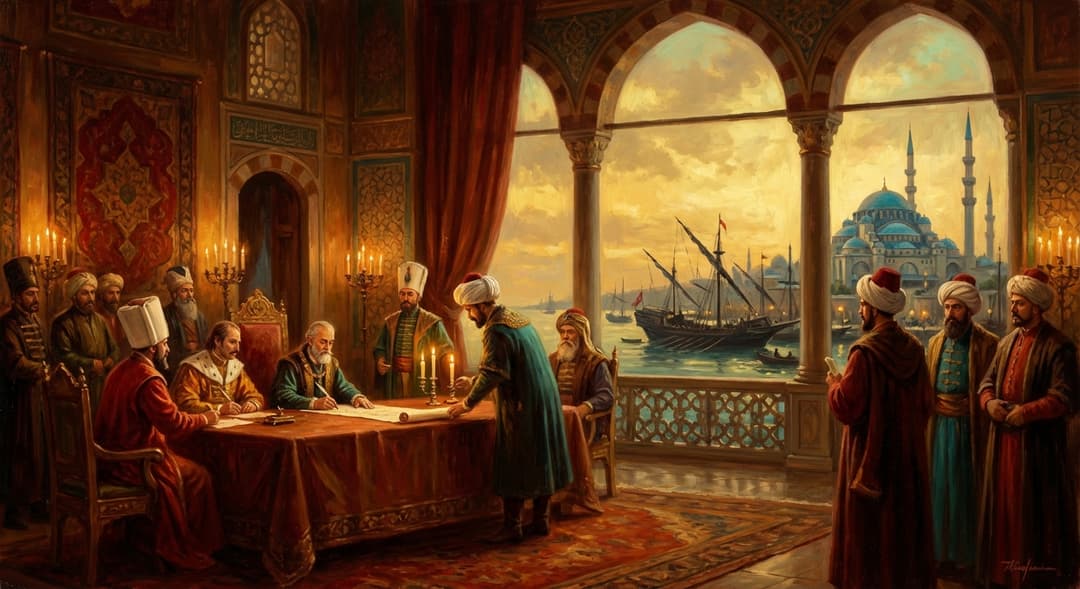
The Treaty of Constantinople, signed in 1533, stands as a testament to the burgeoning power of the Ottoman Empire under Sultan Suleiman the Magnificent. This agreement with the Habsburg Archduke Ferdinand I formally acknowledged Ottoman supremacy in Hungary and the Balkans, marking a significant shift in the balance of power in Europe. The treaty was not merely a diplomatic accord; it was a direct consequence of the Ottoman Empire's ascendant naval strength, which allowed it to project its influence across the Mediterranean Sea and beyond.
The Ottoman navy's dominance was no accident. It was the result of strategic investments in naval infrastructure, the cultivation of skilled admirals like Hayreddin Barbarossa, and the adoption of cutting-edge naval technologies. Major naval bases in Istanbul, Gallipoli, and Alexandria served as hubs for shipbuilding and fleet deployment, while victories like the Battle of Preveza in 1538 solidified Ottoman control over the Eastern Mediterranean. This naval prowess enabled the Ottomans to secure favorable terms in the Treaty of Constantinople, compelling the Habsburgs to acknowledge Ottoman sovereignty and pay tribute.
The legacy of this era is vividly captured in the construction of the Blue Mosque (Sultan Ahmed Mosque), completed in 1616. Commissioned by Sultan Ahmed I, the mosque was intended to be a powerful symbol of Ottoman power, piety, and legitimacy. Its grand scale, intricate design, and strategic location near the Hagia Sophia were meant to showcase the empire's devotion to Islam and its position as a leading Islamic power. The mosque's architecture, blending Islamic and Byzantine elements, reflects the Ottoman Empire's role as a bridge between East and West.
The Blue Mosque's six minarets, a feature that initially sparked controversy, were a bold statement of Ottoman ambition, intended to rival the Kaaba in Mecca. This architectural audacity, coupled with the empire's political and military achievements, underscored the complex interplay of power, religion, and culture in the Ottoman Empire. The Treaty of Constantinople and the Blue Mosque, therefore, stand as enduring symbols of a pivotal moment in history, when Ottoman naval supremacy shaped the political landscape of Europe and left an indelible mark on the cultural landscape of Istanbul.
Key Details
- Treaty Signed July 1533
- Key Players Sultan Suleiman I & Archduke Ferdinand I
- Ottoman Naval Bases Istanbul, Gallipoli, Alexandria
- Battle of Preveza 1538
- Blue Mosque Completion 1616
- Tribute Paid By Habsburgs to Ottomans
Timeline
Battle of Mohács
The Ottoman Empire defeats the Kingdom of Hungary, leading to a power vacuum and conflict with the Habsburgs.
EventTreaty of Constantinople
The Ottoman Empire and the Habsburg Archduke Ferdinand I sign a treaty recognizing Ottoman supremacy in Hungary.
MilestoneBattle of Preveza
The Ottoman fleet, led by Hayreddin Barbarossa, defeats a combined Christian fleet, solidifying Ottoman naval dominance in the Eastern Mediterranean.
EventBlue Mosque Construction Begins
Construction commences on the Sultan Ahmed Mosque, commissioned by Sultan Ahmed I.
component.timeline.groundbreakingBlue Mosque Completion
The Sultan Ahmed Mosque is completed, becoming a symbol of Ottoman power and piety.
DedicationSources & Research
Every fact on Temples.org is backed by verified Sources & Research. Each piece of information is rated by source tier and confidence level.
View All Sources (4)
| Field | Source | Tier | Retrieved |
|---|---|---|---|
| Sultan Süleyman's Agreement with Charles V | The University of Chicago Press (opens in a new tab) | A | 2024-01-01 |
| The Ottoman Empire, 1300-1650: The Structure of Power | Cambridge University Press (opens in a new tab) | A | 2024-01-01 |
| The Cambridge History of Turkey | Cambridge University Press (opens in a new tab) | A | 2024-01-01 |
| Naval Technology in Sixteenth-Century Ottoman Egypt | Brill (opens in a new tab) | B | 2024-01-01 |