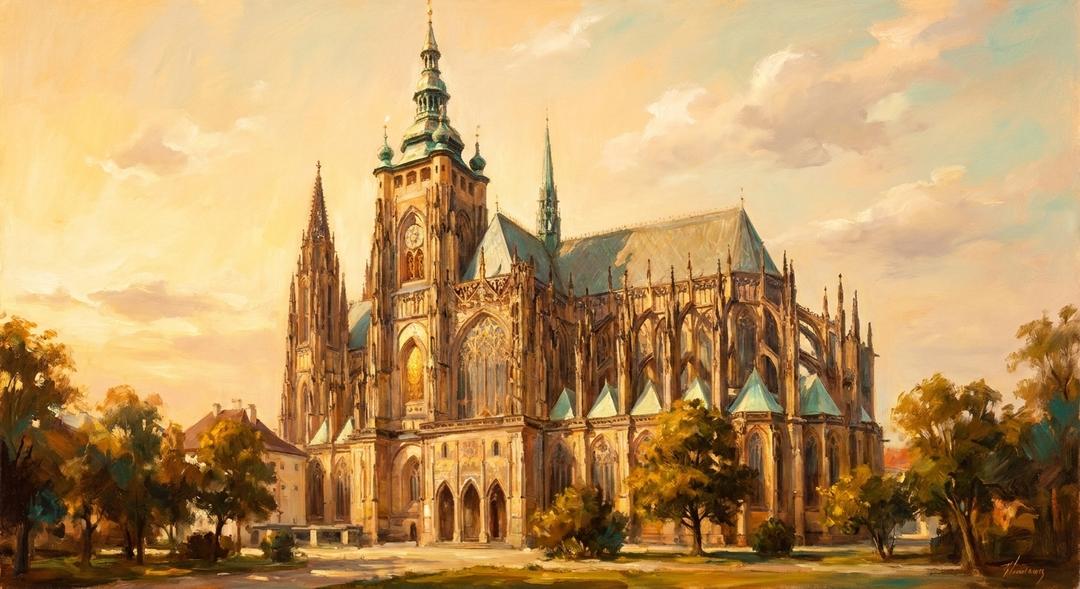
Visitor Insights
Visiting Metropolitan Cathedral of Saints Vitus, Wenceslaus, and Adalbert
St. Vitus Cathedral is an active house of worship and the centerpiece of the Prague Castle complex. Visitors can explore the historic Gothic chancel, the jeweled St. Wenceslas Chapel, and the royal crypt with a Castle Circuit ticket, while the western nave remains accessible for quiet contemplation. Modest attire is required, and early morning visits offer the best opportunity to experience the quiet grandeur before crowds arrive.
Highlights
- Marvel at Peter Parler's pioneering 14th-century net vaults spanning the high chancel.
- Admire the 1,300 semi-precious gemstones encrusting the walls of Saint Wenceslas Chapel.
- View Alphonse Mucha's celebrated Art Nouveau stained-glass window in the north nave aisle.
- Stand before the monumental high Baroque tomb of Saint John of Nepomuk cast in solid silver.
Things to Know
- Modest dress covering shoulders and knees is mandatory inside the consecrated sanctuary.
- Castle Circuit tickets are required to enter the chancel, crypt, and choir ambulatory.
- Climbing the 287 steps of the Great South Tower requires a separate admission ticket.
- Tour access is restricted during Sunday morning Eucharistic liturgies and pontifical masses.
Location
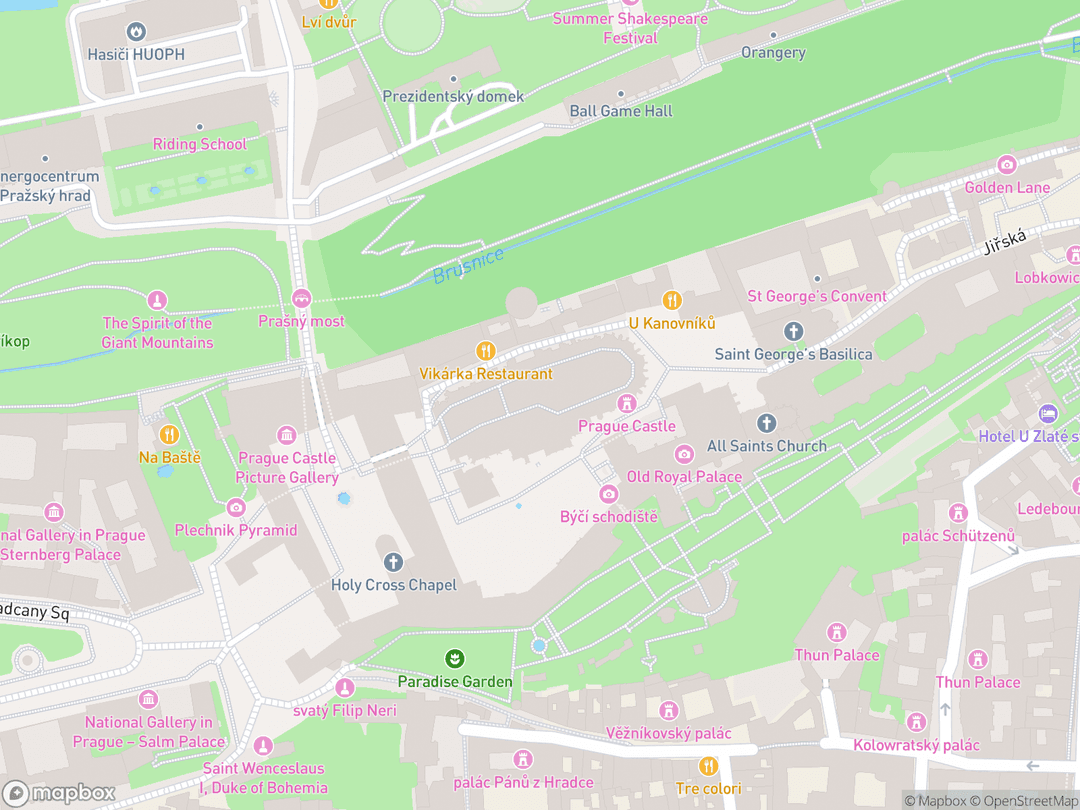
III. nádvoří 48/2, Pražský hrad, 119 01 Praha 1 – Hradčany, Czech Republic
Hours: Monday through Saturday: 09:00–17:00 (summer) / 09:00–16:00 (winter); Sunday: 12:00–17:00 (summer) / 12:00–16:00 (winter)
Getting There: Take Tram 22 or 23 to Pražský hrad for a flat 5-minute walk to the courtyards, or take Metro Line A to Malostranská and climb the historic Old Castle Stairs.
Get DirectionsTips for Your Visit
Afternoon Light for Stained Glass
Visit in mid-afternoon when western sunlight streams through the great rose window and illuminates the modern chapels.
Free Liturgical Attendance
Catholic Mass is celebrated daily, providing peaceful spiritual access to the sanctuary without castle entrance fees.
Climb the South Tower
Ascend the Great South Tower on clear days for an unobstructed panoramic view across Prague's historic rooftops and the Vltava River.
Audio Guides
Rent an official Prague Castle audio guide at the visitor center to decipher the complex theological iconography of the choir chapels.
About
The Metropolitan Cathedral of Saints Vitus, Wenceslaus, and Adalbert stands as the preeminent sanctuary of the Czech lands, commanding the skyline of Prague Castle. Inheriting the Abrahamic theology of the temple as a consecrated threshold between heaven and earth, this Roman Catholic cathedral elevates stone, timber, and stained glass into a monumental sacramental vessel. Within its soaring Gothic walls, the earthly realm converges with the divine through liturgical prayer, communal worship, and perpetual Eucharistic devotion.
Founded in 1344 by King John of Bohemia and his son Charles IV on the site of a 10th-century Romanesque rotunda, the cathedral took nearly six centuries to complete. Master masons Matthias of Arras and Peter Parler established groundbreaking Late Gothic design principles, including innovative net vaulting and naturalistic stone portraiture. Work was halted by the Hussite Wars and fires, leaving the chancel walled off from an unfinished yard until a dedicated civic and ecclesiastical union completed the western nave in 1929.
Beyond its role as a triumph of European architecture, St. Vitus functions as the cathedra of the Archbishop of Prague, Primate of Bohemia. It houses the venerated relics of Bohemia's founding patron martyrs—Saint Vitus, Saint Wenceslaus, and Saint Adalbert—and preserves the Bohemian Crown Jewels within its fortified Crown Chamber. For centuries, the cathedral witnessed the solemn coronation of Bohemian monarchs, permanently binding the spiritual destiny and national identity of the Czech people.
Gallery
Symbolic Elements
The temple's exterior features intricate carvings, each rich with spiritual meaning:

The Holy Crown Chamber
A fortified chamber secured by seven distinct keys that preserves the sacred Bohemian Crown Jewels.

Saint Wenceslas Chapel
A jewel-encrusted sanctuary proportioned after the Heavenly Jerusalem and containing Bohemia's principal patron shrine.
The Last Judgment Mosaic
A monumental 14th-century exterior glass mosaic over the Golden Gate depicting Christ judging humanity.

Tomb of Saint John of Nepomuk
A monumental Baroque reliquary cast from solid Bohemian silver symbolizing sacred secrecy and spiritual fortitude.
Mucha Art Nouveau Window
A vibrant stained-glass window portraying Saints Cyril and Methodius bringing spiritual illumination to the Slavic lands.

Creation Rose Window
A colossal western portal window illustrating the biblical six days of divine cosmological creation.

Triforium Portrait Gallery
A groundbreaking 14th-century stone gallery of realistic portrait busts honoring kings, bishops, and cathedral architects.

The Royal Crypt
Subterranean vaulted tombs housing Bohemian kings and Holy Roman Emperors beneath the high altar.
Interesting Facts
The cathedral required 585 years to finish, stretching from its 1344 cornerstone to its 1929 consecration. (Tier A)
Unlocking the Bohemian Crown Jewels requires the simultaneous assembly of seven distinct constitutional and religious keyholders. (Tier A)
Peter Parler's 14th-century stone bust in the triforium is recognized as one of the earliest autonomous artist self-portraits in Europe. (Tier B)
The third chapel of the northern nave features a world-renowned Art Nouveau stained-glass window painted by Alphonse Mucha in 1931. (Tier A)
Cast in 1549, the South Tower's Zikmund bell weighs over 13 metric tons and requires four bell-ringers to swing. (Tier A)
A visible change in sandstone shading marks the physical boundary where medieval work ceased in 1419 and resumed in 1873. (Tier B)
The Baroque tomb of Saint John of Nepomuk contains more than 3,700 pounds of solid Viennese silver. (Tier A)
St. Vitus served as the coronation venue for 26 Bohemian monarchs, concluding with Emperor Ferdinand V in 1836. (Tier A)
Duke Wenceslaus chose the dedication to Saint Vitus in 929 partly to harmonize with the Slavic deity Svantovit. (Tier B)
Laser measurements reveal the South Tower's stone gallery reaches 56 meters, with the lantern finial peaking at 99.6 meters. (Tier B)
Common Questions
Can visitors enter St. Vitus Cathedral for free?
A designated area at the western entrance is accessible without charge, while the historic Gothic chancel requires a Castle Circuit ticket.
Who holds the seven keys to the Bohemian Crown Chamber?
The keys are held by the Czech President, Prime Minister, Archbishop of Prague, two parliamentary speakers, the Chapter Dean, and Prague's Mayor.
Is St. Vitus Cathedral an active Catholic church?
Yes, it is an active cathedral with daily Catholic liturgies, choral services, and pontifical masses celebrated by the Archbishop of Prague.
What makes the Mucha stained-glass window unique?
Painted in vibrant Art Nouveau style in 1931, it depicts the Christianization of the Slavic peoples through Saints Cyril and Methodius.
Why did construction take nearly six centuries to complete?
Work was repeatedly interrupted by the Hussite Wars, catastrophic castle fires, political turmoil, and long periods of depleted funds.
Featured Stories
The Architect's Daring Self-Portrait
1374
When 23-year-old Peter Parler assumed leadership over cathedral construction following the death of Matthias of Arras, he broke every rigid convention of medieval masonry. In a revolutionary act of artistic self-consciousness, Parler carved realistic stone likenesses of himself and Matthias directly into the triforium beside Emperor Charles IV and royal queens. This audacious gallery established the master builder not merely as an anonymous craftsman, but as an inspired intellectual co-creator of sacred space.
Source: Archdiocese of Prague Historical Archives
The Seven Keys of Bohemian Sovereignty
1929
Above the jeweled Chapel of Saint Wenceslaus lies the fortified Crown Chamber, home to the gold and sapphire Crown of Saint Wenceslaus. The massive iron door is secured by seven separate locks whose keys are held individually by seven civil and ecclesiastical dignitaries, including the President and Archbishop. Opening the vault requires all seven guardians to assemble in person, continuing a sacred medieval covenant uniting Church, state, and citizenry in mutual stewardship.
Source: Prague Castle Administration Archives
Casting the Great Zikmund Bell
1549
Following the catastrophic Prague Castle fire of 1541 that destroyed the medieval timber roofs, master bellfounder Tomáš Jaroš was tasked with casting an unprecedented liturgical instrument. Pouring over 13 metric tons of bronze into a massive loam pit, Jaroš created 'Zikmund,' the largest and most resonant church bell in Bohemia. Suspended high in the South Tower, its deep voice has marked coronation joys, wartime perils, and national rebirth across five centuries.
Source: Metropolitan Chapter of St. Vitus Documentation
Timeline
Foundation of Romanesque Rotunda
Duke Wenceslaus founds a preromanesque rotunda on Hradčany hill to enshrine the relic of Saint Vitus.
MilestoneErection of Romanesque Basilica
Prince Spytihněv II replaces the rotunda with a monumental double-choir Romanesque basilica.
MilestoneFoundation of Gothic Cathedral
King John and future Emperor Charles IV lay the foundation stone of the current Gothic cathedral.
component.timeline.groundbreakingPeter Parler Appointed Master
Young Swabian mason Peter Parler takes charge, introducing innovative net vaults and expressive sculpture.
MilestoneConsecration of St. Wenceslas Chapel
The gemstone-encrusted chapel housing the sacred tomb of Bohemia's patron saint is formally consecrated.
DedicationHussite Wars Halt Construction
Religious conflict breaks out across Bohemia, halting construction and leaving the chancel isolated for centuries.
EventThe Great Fire of Prague Castle
A devastating fire sweeps Hradčany, destroying the medieval choir roofs and damaging stone vaults.
EventInstallation of the Zikmund Bell
Master Tomáš Jaroš casts Bohemia's largest church bell and mounts it in the Great South Tower.
MilestoneBaroque Tower Lantern Completed
Court architect Nicolaus Pacassi tops the unfinished southern tower with an imposing copper bulbous dome.
RenovationNeo-Gothic Nave Construction Begins
Architect Josef Mocker commences construction on the western nave to complete the medieval master plan.
MilestoneGrand Jubilee Consecration
Archbishop František Kordač solemnly consecrates the fully finished cathedral for the Saint Wenceslaus Millennium.
DedicationPapal Co-Dedication of the Cathedral
Pope John Paul II officially rededicates the cathedral to Saints Vitus, Wenceslaus, and Adalbert.
EventHistory by Decade
920s–1050s — The Early Romanesque Foundation
Here shall rise a sanctuary worthy of the holy martyr whose relics guard our sovereign realm.
The sacred history of the site commenced when Prince Wenceslaus erected a preromanesque stone rotunda around 925 to house the holy arm of Saint Vitus. Following the creation of the Bishopric of Prague in 973, Prince Spytihněv II replaced the cramped rotunda in 1060 with a double-choired Romanesque basilica. This monumental structure served as the ceremonial nexus where early Bohemian dukes were anointed and buried before God.
1340s–1390s — The High Gothic Era of Charles IV
The temple is the gate of heaven, wrought in living stone for the glory of Christ and the kingdom.
Pope Clement VI elevated Prague to an archbishopric in 1344, inspiring Charles IV to inaugurate a cathedral rivaling the French monarchy. French master Matthias of Arras commenced the choir with classic geometric precision, but his successor, Peter Parler, transformed the interior into an experimental masterwork. Parler devised dynamic net vaulting and the gemstone-lined Chapel of Saint Wenceslaus, creating Europe's most innovative late-medieval court sanctuary.
1410s–1530s — The Hussite Wars and Stagnation
The outbreak of the Hussite Wars in 1419 abruptly shattered the flourishing building campaign. Iconoclastic sweeps purged altarpieces, structural timbers burned, and the cathedral choir was sealed off behind a temporary wall facing an open-air building yard. Despite fitful royal revival attempts under the Jagiellonian kings, the cathedral remained half-finished, a visible symbol of religious conflict and disrupted royal patronage.
1540s–1770s — Renaissance Rebirth and Baroque Adaptation
The Great Fire of 1541 gutted Prague Castle, necessitating sweeping structural stabilization. Renaissance master Bonifác Wolmut added an ornate singing gallery and topped the South Tower with an open arcade, followed by the installation of the immense Zikmund Bell. In the 1770s, court architect Nicolaus Pacassi crowned the tower with a colossal Baroque copper lantern, completing an eclectic silhouette that fused centuries of architectural movements.
1860s–1890s — The Neo-Gothic Union and Mocker's Nave
In 1859, patriotic Catholic clergy and civic intellectuals established the Union for the Completion of St. Vitus Cathedral. Lead architect Josef Mocker methodically surveyed Parler's original medieval sketches, constructing a triple-aisled neo-Gothic western nave and two soaring 82-meter stone spires. The ambitious project harmoniously bridged five centuries of division, joining the 14th-century chancel to modern stone masonry with extraordinary fidelity.
1900s–1930s — 20th-Century Art and Final Consecration
Under final master Kamil Hilbert, the interior was adorned with modern masterpieces, including František Kysela's western Rose Window and Alphonse Mucha's Art Nouveau stained glass. On May 12, 1929, exactly one thousand years after Saint Wenceslaus's martyrdom, the cathedral was consecrated in a national celebration. Although nationalized by the communist regime in 1954, St. Vitus was restored to shared ecclesiastical and civil stewardship in 2010.
Architecture & Facilities
St. Vitus Cathedral exemplifies European High Gothic and Late Gothic architecture, seamlessly integrated with 19th-century Neo-Gothic completion. The medieval eastern choir combines French Rayonnant basilican geometry with Peter Parler's groundbreaking German-Bohemian Sondergotik net vaults and organic flying buttresses. The 19th-century nave mirrors Parler's medieval elevation, creating an expansive 124-meter liturgical vista crowned by twin western spires and an asymmetric Baroque-domed South Tower.
Building Materials
Bohemian Sandstone
Quarried from Cretaceous basin quarries at Hloubětín and Kamenné Žehrovice for all exterior load-bearing ashlar walls.
Jasper and Amethyst
Over 1,300 polished Bohemian hardstones set in gilded plaster to line the walls of the Saint Wenceslas Chapel.
Solid Bohemian Silver
More than 1.5 tons of chased and cast Viennese silver forming the monumental Baroque sarcophagus of Saint John of Nepomuk.
Copper and Wrought Iron
Patinated green sheet copper cladding the Baroque tower dome alongside medieval wrought-iron structural tie-rods.
Interior Features
High Chancel and Presbytery
The historic sanctuary covered by Peter Parler's net vault where the high altar and archiepiscopal cathedra reside.
Saint Wenceslas Chapel
The jewel-lined spiritual sanctum containing the gothic tomb and personal relics of Bohemia's duke-martyr patron.
Ambulatory and Radial Chapels
A semi-circular procession of Gothic chapels housing historic burial monuments and vibrant historicist stained glass.
The Royal Crypt
A subterranean brick-vaulted chamber containing the sarcophagi of Bohemian monarchs including Charles IV and Rudolf II.
Temple Grounds
The cathedral anchors the Third Courtyard of Prague Castle atop Hradčany hill, enclosed by Renaissance palace facades, open granite paving, and panoramic vantage points over the historic city.
Additional Facilities
Visitor reception and ticketing offices within the castle complex, the Prague Castle Picture Gallery, diocesan administrative offices, and secure exhibition vaults for church treasuries.
Religious Significance
Within Christian sacramental theology, St. Vitus Cathedral is a sacred temple consecrated as the dwelling place of God with humanity. Inheriting the biblical archetype of the Jerusalem sanctuary, the cathedral provides a holy realm where the faithful gather in communion, confess their sins, and encounter the transcendent presence of the risen Christ.
To serve as the mother church of the Archdiocese of Prague, house the archiepiscopal cathedra, and provide a consecrated sanctuary for the celebration of the Holy Eucharist and the veneration of Bohemia's founding saints.
Sacred Ordinances
The Holy Sacrifice of the Mass
The daily liturgical re-presentation of Christ's sacrifice on Calvary celebrated at the high altar.
Sacrament of Penance and Reconciliation
The administration of divine forgiveness through private confession, echoing Saint John of Nepomuk's martyrdom.
Veneration of Holy Relics
Solemn prayer before the bodily remains of Saints Vitus, Wenceslaus, and Adalbert, affirming belief in the resurrection.
Sacrament of Holy Orders
The ordination of Catholic deacons and priests at the archiepiscopal cathedra through the apostolic laying on of hands.
The Cathedral as Sacramental Vessel
Cruciform in plan, the cathedral represents the mystical body of Christ. The upward thrust of stone piers draws the human soul toward heaven, while the expansive stained glass dissolves heavy stone into glowing light, symbolizing Christ as the Light of the World illuminating the darkness.
The Cathedra and the Communion of Saints
The cathedral houses the cathedra of the Archbishop of Prague, embodying apostolic succession and spiritual leadership. Surrounding the bishop's seat are the tombs of Bohemian martyrs and kings, creating an enduring witness to the communion of saints across generations.
Similar Temples
Sources & Research
Every fact on Temples.org is backed by verified Sources & Research. Each piece of information is rated by source tier and confidence level.
View All Sources (8)
| Field | Source | Tier | Retrieved |
|---|---|---|---|
| About & Historical Background | Metropolitan Chapter of St. Vitus in Prague (opens in a new tab) | A | 2026-03-31 |
| Visitor Insights & Access | Prague Castle Administration (opens in a new tab) | A | 2026-03-31 |
| Religious Significance & Sacraments | Archdiocese of Prague (opens in a new tab) | A | 2026-03-31 |
| Crown Jewels & Chapels | The Holy See (opens in a new tab) | A | 2026-03-31 |
| Architecture & Structural Preservation | National Heritage Institute of the Czech Republic (opens in a new tab) | B | 2026-03-31 |
| Historical Monuments & UNESCO Status | UNESCO World Heritage Centre (opens in a new tab) | B | 2026-03-31 |
| Gothic Construction & Peter Parler Studies | Charles University Faculty of Arts (opens in a new tab) | B | 2026-03-31 |
| Timeline & Restoration History | Ministry of Culture of the Czech Republic (opens in a new tab) | B | 2026-03-31 |