Visitor Insights
Visiting Holy Trinity Russian Orthodox Cathedral
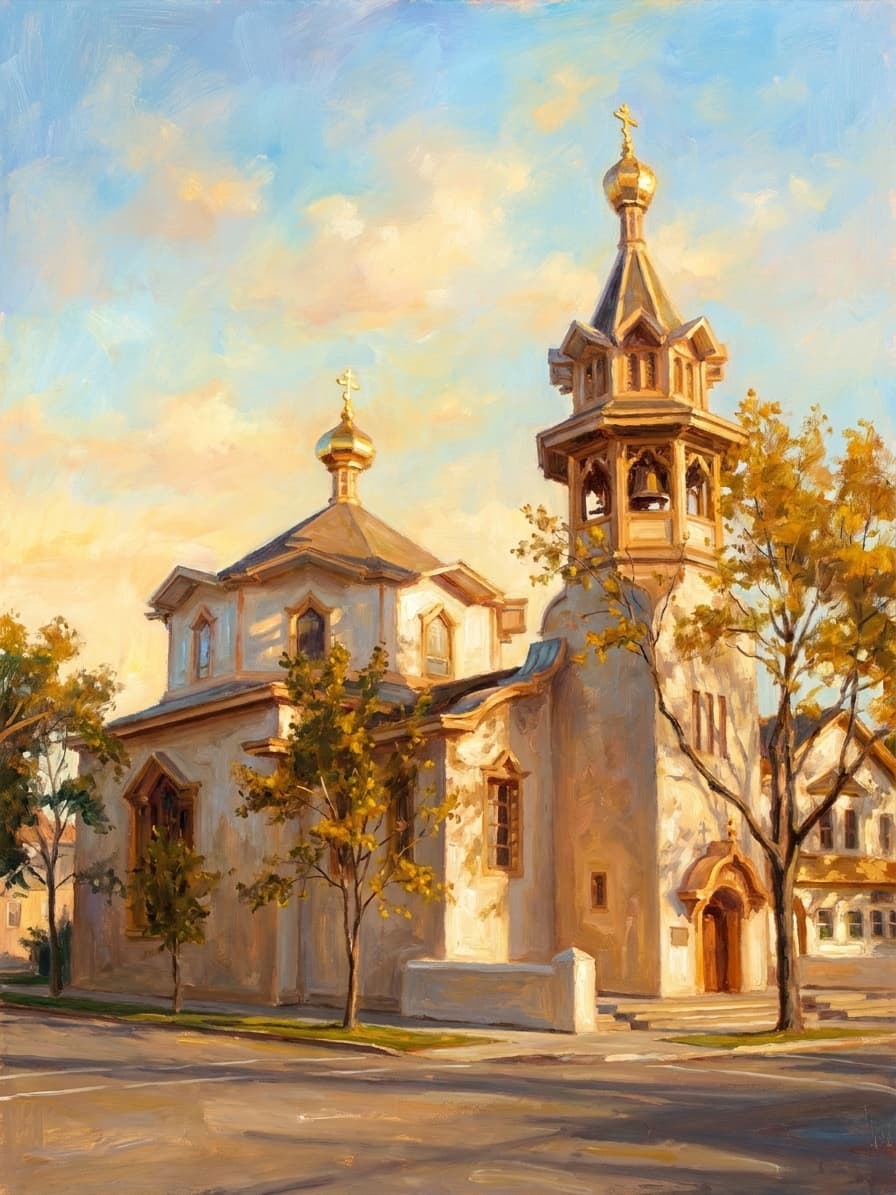
Holy Trinity Orthodox Cathedral welcomes visitors to experience ancient liturgical worship marked by unaccompanied choral singing and reverent incense. Services are conducted primarily in English within a historic, candlelit interior free of fixed pews.
Highlights
- Historic nineteenth-century bronze bells presented by Russian Emperor Alexander III
- Extensive traditional Byzantine and Russian iconography written by Dmitry Shkolnik
- Intricately hand-carved classical multi-tier iconostasis dividing the nave and sanctuary
- Historic vestments and poppy-embroidered pastoral belt of Saint Tikhon of Moscow
Things to Know
- Congregants traditionally stand throughout liturgical services, though wall seating is available
- Photography is strictly prohibited during divine services without prior pastoral permission
- Modest attire covering shoulders and knees is customary for all visitors
Location
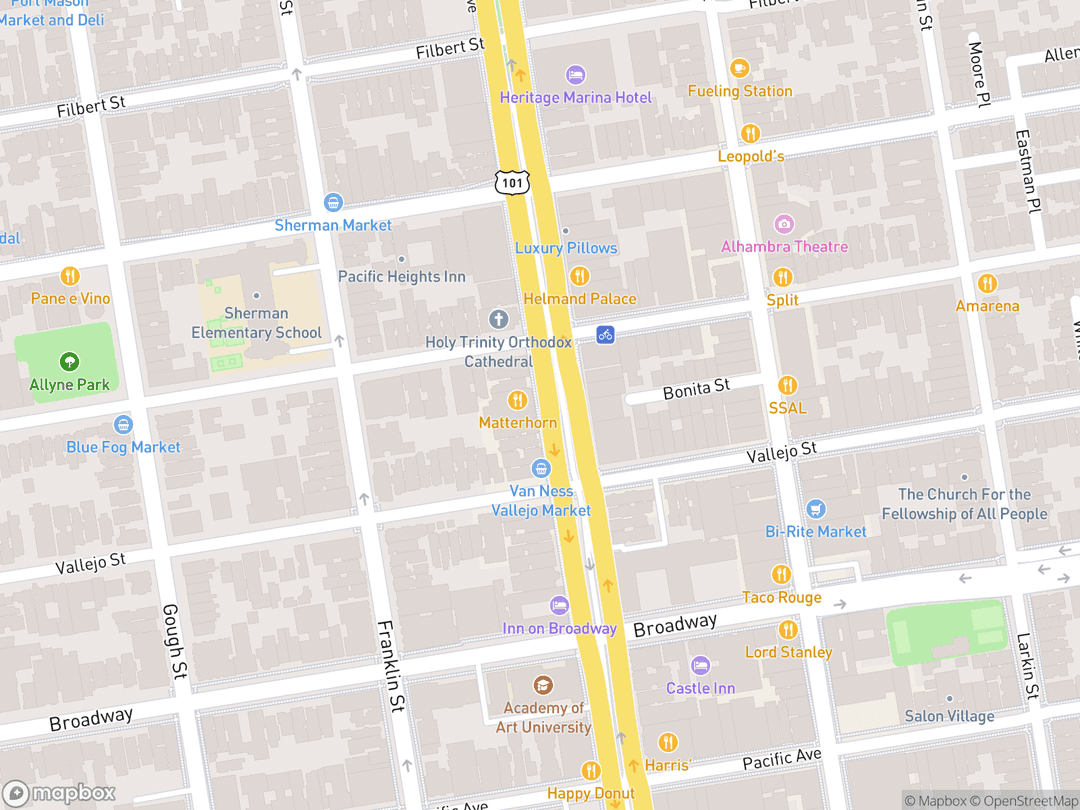
1520 Green Street, San Francisco, CA 94123, United States
Hours: Saturday Vigil at 6:00 PM; Sunday Divine Liturgy at 9:30 AM
Getting There: Located at Green Street and Van Ness Avenue, accessible via SF Muni Bus Route 49.
Get DirectionsTips for Your Visit
Arrive Early for Choir and Lighting
Arrive fifteen minutes before the Divine Liturgy to light a beeswax candle and hear the opening liturgical hours.
Receiving Blessed Bread
While Holy Communion is reserved for prepared Orthodox Christians, all guests are welcome to receive blessed bread (antidoron) after service.
About
Holy Trinity Orthodox Cathedral in San Francisco is the oldest continuously functioning Eastern Orthodox parish community in the contiguous United States. Originally organized by multi-ethnic Gold Rush pioneers in 1857 and formally incorporated in 1867, it served as the historic episcopal cathedra of the North American mission under the Russian Orthodox Church.
Following the complete destruction of its Powell Street sanctuary in the 1906 San Francisco earthquake and fire, the present temple was erected in 1909 under the pastoral guidance of Archpriest Theodore Pashkovsky and architect Charles Paff. Saint Tikhon of Moscow personally selected the prominent corner site on Green Street and Van Ness Avenue prior to his departure for New York.
Architecturally, the building synthesizes traditional Northern Russian ecclesiastical forms with early twentieth-century American timber framing, crowned by distinctive onion domes and corbelled kokoshniki gables. Today, it remains the mother cathedral for the Diocese of the West of the Orthodox Church in America.
Gallery
Symbolic Elements
The temple's exterior features intricate carvings, each rich with spiritual meaning:

Onion Dome (Lukovichnaya Glava)
The tapered bulbous dome resembles an upturned candle flame, symbolizing prayers ascending to heaven.

Russian Three-Bar Cross
The three horizontal beams represent the Pilate titulus, Christ's outstretched hands, and the tilted footrest of judgment.

Royal Doors (Tsarskiye Vrata)
The central gates of the icon screen represent the threshold to the heavenly kingdom through which the Eucharist emerges.

Imperial Panikadilo
The grand tier-mounted chandelier gifted by Tsar Nicholas II symbolizes the radiant assembly of the heavenly hosts.

Courtyard Zvonnitsa
The open timber campanile supports traditional polyrhythmic bells that serve as audible acoustic icons.

California Poppy Vestments
Saint Tikhon's vestment belt hand-embroidered with state wildflowers symbolizes ancient faith blossoming on Pacific shores.

Corbelled Kokoshniki Gables
Decorative layered semicircular exterior arches recall traditional Northern Russian headdresses and ecclesiastical architecture.
Interesting Facts
It is the oldest continuously functioning Eastern Orthodox parish community in the contiguous United States. (Tier A)
The cathedral houses historic gifts from two consecutive Russian Tsars: Alexander III and Nicholas II. (Tier A)
Saint Tikhon personally selected the corner lot at Green and Van Ness before becoming Patriarch of Moscow. (Tier A)
The first Orthodox priest born in the United States was baptized and ordained in this community. (Tier A)
Saint Tikhon's episcopal belt preserved in the treasury is embroidered with golden California poppies. (Tier A)
Constructed with resilient timber framing, the 1909 edifice survived the 1989 Loma Prieta earthquake undamaged. (Tier B)
The cathedral bell octave includes original 1888 imperial bells cast in Russia alongside modern castings. (Tier A)
The original legal charter encompassed Greek, Russian, and Slavonian Christians under one unified congregation. (Tier A)
Common Questions
Why are there no pews inside the cathedral nave?
Orthodox tradition favors standing during worship to cultivate bodily vigilance and active participation.
What language is used during services?
Divine services are celebrated primarily in English with select choral hymns in Church Slavonic and Greek.
Are non-Orthodox visitors allowed to attend services?
Visitors of all faiths are warmly welcomed to attend divine services and experience the liturgy.
How did the historic bells survive the 1906 earthquake?
The bells had been unhung for belfry maintenance and sat safely on ground skids away from burning timbers.
Featured Stories
The Miracle of the Imperial Bells
April 18, 1906
When the catastrophic 1906 earthquake and firestorm leveled the Powell Street cathedral, the historic bells gifted by Tsar Alexander III appeared hopelessly lost. Miraculously, the massive bronze instruments had been lowered to ground skids days earlier for tower repairs, surviving the blaze intact in an open yard to ring again over the city.
Source: Holy Trinity Cathedral Historical Archives
Saint Tikhon and the California Poppies
1905
Before Bishop Tikhon departed San Francisco to oversee the wider North American mission, the cathedral women's society presented him with a hand-stitched monastic belt. Embroidered with bright California golden poppies, this garment united Russian ascetic devotion with American soil and remained his cherished memento through his eventual martyrdom in Moscow.
Source: Diocese of the West Historical Ledger
The First American-Born Priest
1892
Born in San Francisco in 1863 to pioneer Serbian immigrants, Sebastian Dabovich was baptized by visiting naval chaplains and grew up within the parish fold. In 1892, he was ordained at Holy Trinity as the first native-born American Orthodox priest, embarking on pioneering missionary circuits across the Western frontier.
Source: Society for Orthodox Christian History
Timeline
Formation of the Orthodox Society
Multi-ethnic Christian settlers in Gold Rush San Francisco establish the first dedicated Orthodox fraternal society.
MilestoneFormal Civil Incorporation
The parish incorporates under California law following the purchase of Alaska by the United States.
MilestoneTransfer of Episcopal See
Bishop John transfers the North American diocesan see from Sitka to San Francisco, making this the cathedral.
MilestoneEstablishment on Powell Street
The parish acquires a permanent facility at 1713 Powell Street near Russian Hill.
MilestoneGift of Imperial Bronze Bells
Emperor Alexander III donates five bronze bells following his family's miraculous train disaster survival.
EventFirst American-Born Ordination
Future saint Sebastian Dabovich is ordained at the cathedral as the first American-born Orthodox priest.
MilestoneArrival of Bishop Tikhon
Saint Tikhon arrives to direct the expanding multi-ethnic North American mission from San Francisco.
MilestoneCatastrophe and Bell Survival
The San Francisco earthquake and fire destroy the Powell Street church, but the unhung imperial bells survive.
EventConsecration on Green Street
The new cathedral designed by Charles Paff is consecrated at the corner of Green Street and Van Ness Avenue.
DedicationAutocephaly of the OCA
The parish becomes the mother cathedral of the Diocese of the West in the newly autocephalous Orthodox Church in America.
MilestoneErection of Courtyard Belfry
A timber campanile is constructed to return the historic 1888 imperial bells to regular liturgical ringing.
RenovationComprehensive Iconography Project
Master iconographer Dmitry Shkolnik begins painting traditional frescoes across the dome, walls, and iconostasis.
RenovationHistory by Decade
1850s–1860s — Gold Rush Foundations and Incorporation
Orthodox believers of diverse nations united on Pacific shores to plant the ancient Church.
During the California Gold Rush, Orthodox immigrants gathered in private residences to worship. Visiting naval chaplains provided pastoral care until the parish formally incorporated in 1867 under the Russian Empire's benevolent patronage.
1870s–1880s — Episcopal See and the Powell Street Home
Bishop John transferred the diocesan headquarters from Alaska to San Francisco in 1872, elevating Holy Trinity to an episcopal cathedral. In 1881, the community secured a permanent sanctuary on Powell Street, later receiving imperial bells from Tsar Alexander III.
1890s–1900s — Saint Tikhon and the Great Earthquake
Bishop Tikhon led the mission from San Francisco before selecting the Green Street site for future growth. The catastrophic 1906 earthquake razed the Powell Street church, but the community rallied to erect and consecrate the current Green Street cathedral in 1909.
1910s–1920s — Revolution and Refuge
The Bolshevik Revolution severed communication and funding from the Church of Russia, transforming the cathedral into a haven for displaced Russian refugees. The parish aligned with the autonomous North American Metropolia to protect its spiritual independence.
1930s–1960s — Metropolitan Theophilus and Cultural Flourishing
Metropolitan Theophilus led the American church from Holy Trinity, modernizing parish facilities and reinforcing community programs. Later, Archbishop John Shakhovskoy fostered an intellectually active, multilingual parish life through religious broadcasts and writing.
1970s–Present — Autocephaly and Artistic Renewal
Following the 1970 grant of autocephaly establishing the Orthodox Church in America, the cathedral erected an outdoor belfry for its historic bells. Master iconographer Dmitry Shkolnik adorned the interior with comprehensive liturgical frescoes, completing the cathedral's artistic vision.
Architecture & Facilities
The cathedral exemplifies traditional Northern Russian ecclesiastical architecture adapted to early twentieth-century California construction methods, blending central-plan wooden basilican massing with decorative kokoshniki gables, multifaceted onion cupolas, and Orthodox three-bar crosses designed by San Francisco architect Charles Paff.
Building Materials
Superstructure Framing
Seismically resilient Pacific Northwest Douglas fir timber framing was engineered to endure coastal earthquakes.
Exterior Cladding
Horizontal painted wooden weatherboards provide historic exterior weather protection against maritime moisture.
Liturgical Bells
Resonant bronze bells cast in imperial Russia in 1888 hang alongside matching modern American castings.
Icon Screen Woodwork
Carved native California hardwoods were meticulously shaped to form the multi-tiered classical iconostasis.
Interior Features
Cathedral Nave
An open sacred congregational space without fixed pews allows active liturgical standing and processions.
Sanctuary and Altar
The sacred enclosure behind the icon screen houses the holy table where the Divine Liturgy is celebrated.
Iconostasis Screen
A tiered wooden barrier adorned with theological icons separates the holy altar from the gathering nave.
Main Dome Cupola
The interior ceiling fresco portrays Christ the Pantocrator blessing the cosmos surrounded by heavenly angelic hosts.
Temple Grounds
The urban property features a compact landscaped entry terrace, an open-air wooden campanile, and perimeter wrought-iron fencing along Green Street.
Additional Facilities
A finished lower level includes parish fellowship halls, library archives, and an educational assembly room.
Religious Significance
Holy Trinity Cathedral stands as the historic episcopal cradle of Eastern Orthodox Christianity in the contiguous United States, embodying unbroken apostolic sacramental tradition.
The cathedral serves as the mother seat of the Bishop of San Francisco and the West, providing corporate worship, theological instruction, and sacramental life.
Sacred Ordinances
Divine Liturgy
The central eucharistic service uniting the congregation with Christ through scripture, prayer, and communion.
Vespers and Vigil
Evening prayer services preparing the faithful for Sunday eucharistic celebration through Psalms and hymns.
Sacrament of Chrismation
Anointing with holy oil signifying the gift of the Holy Spirit for entrance into the Church.
Theology of Icons
Orthodox iconography affirms the reality of the Incarnation, presenting sacred images as spiritual windows connecting earthly worshipers with heavenly realities.
The Episcopal Cathedra
As the historic mother seat of Saint Tikhon, the cathedral embodies pastoral succession and unity across Orthodox dioceses in the American West.
Similar Temples
Sources & Research
Every fact on Temples.org is backed by verified Sources & Research. Each piece of information is rated by source tier and confidence level.
View All Sources (8)
| Field | Source | Tier | Retrieved |
|---|---|---|---|
| About & Historical Background | Orthodox Church in America (opens in a new tab) | A | 2026-02-18 |
| About & Historical Background | Holy Trinity Orthodox Cathedral (opens in a new tab) | A | 2026-02-18 |
| Diocesan Oversight & Administration | Diocese of the West, Orthodox Church in America (opens in a new tab) | A | 2026-02-18 |
| Parish History & Cultural Heritage | Holy Trinity Orthodox Cathedral Archives (opens in a new tab) | A | 2026-02-18 |
| Historical Timeline & Bell Heritage | Society for Orthodox Christian History in the Americas (opens in a new tab) | B | 2026-02-18 |
| Architectural & Historical Research | ResearchGate Scientific Repository (opens in a new tab) | B | 2026-02-18 |
| Russian Bells & Acoustic Liturgy Study | Taylor & Francis Online (opens in a new tab) | B | 2026-02-18 |
| Historical Emigration & Ecclesiastical Studies | Canadian Orthodox History Project (opens in a new tab) | B | 2026-02-18 |