Visitor Insights
Visiting First Unitarian Church of Oakland
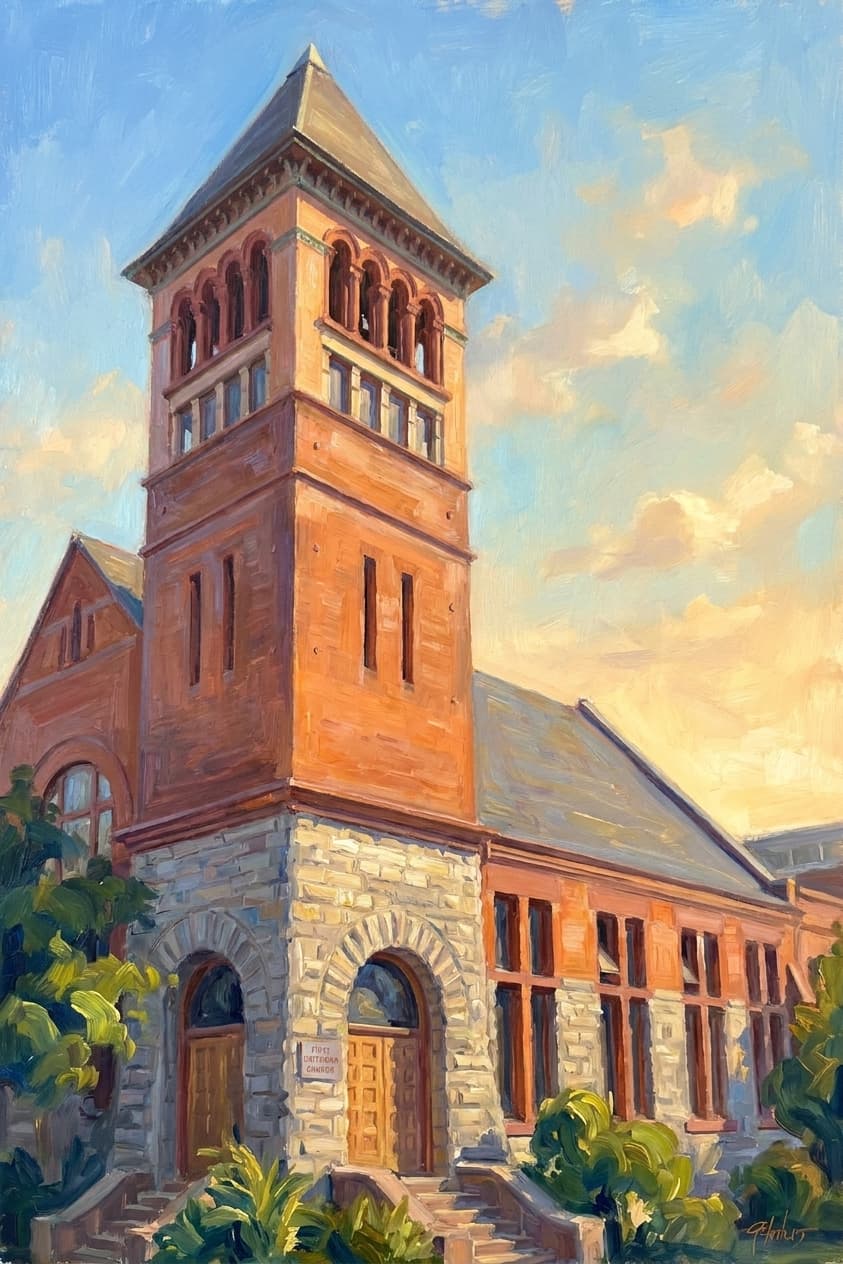
First Unitarian Church welcomes guests for weekly public worship, fellowship, and ticketed evening cultural concerts. Visitors can experience the dramatic timber nave, vibrant Goodhue stained glass, and historic Roosevelt pipe organ.
Highlights
- Monumental 65-foot unsupported first-growth California redwood ceiling arches in Hamilton Hall
- Opalescent stained glass rose and lancet windows crafted by the Harry E. Goodhue Studio of Boston
- Historic 1891 Roosevelt Organ Works pipe organ Opus 462 framed by ornamental woodwork
- Tranquil central quadrangle courtyard opening between the sanctuary and parish wings
Things to Know
- Weekday interior access requires advance appointment with the administrative office
- Metered street parking is available along 14th and Castro Streets alongside nearby commercial garages
- Wheelchair-accessible ramps provide step-free entry via 14th Street and the courtyard quadrangle
Location
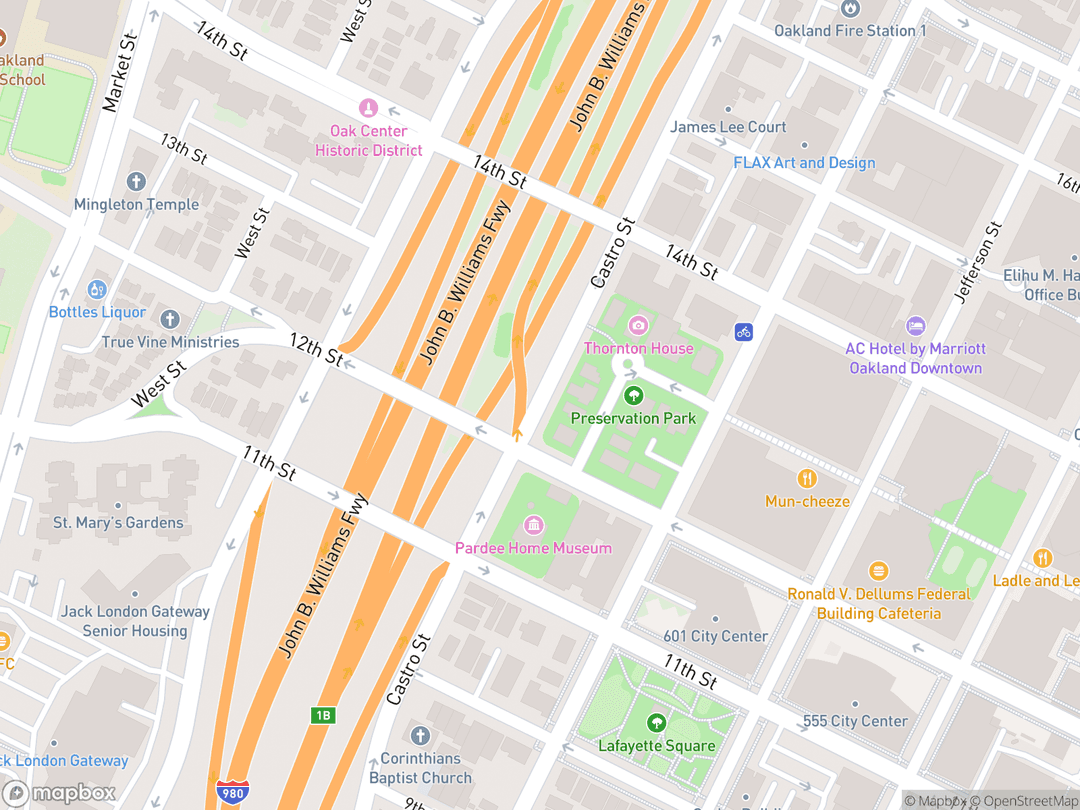
685 14th Street, Oakland, California 94612, United States
Hours: Sunday worship at 10:30 AM; administrative offices open Monday through Thursday, 9:30 AM to 3:30 PM
Getting There: Conveniently situated five blocks from the 12th Street Oakland City Center BART station and directly accessible from Interstate 980.
Get DirectionsTips for Your Visit
Join Sunday Fellowship
Attend the post-service coffee hour in the courtyard to meet members and learn about local justice ministries.
Afternoon Light Viewing
Visit during clear late afternoons to witness the luminous west-facing stained glass illuminate the nave.
Acoustic Recitals
Attend public candlelight classical concerts to hear the remarkable acoustic warmth of the redwood sanctuary.
About
The First Unitarian Church of Oakland is one of the Pacific Coast's most significant monuments to religious liberalism and civic reform. The congregation originated in 1869 when the Reverend Laurentine Hamilton was tried for heresy by orthodox Presbyterians after proclaiming God's boundless grace and universal redemption. Hamilton and eighty supporters withdrew to form an independent church founded upon freedom of conscience.
Commissioned in 1889 under the leadership of Reverend Charles William Wendte, the present complex was designed by architect Walter J. Mathews in the Richardsonian Romanesque style. Dedicated in September 1891, the red brick and sandstone building features sweeping interior redwood arches and an innovative Akron Plan that connects the sanctuary with adjoining assembly halls.
Over more than a century of ministry, the church has served as a vital intellectual salon and sanctuary for justice. It has welcomed luminaries such as Julia Ward Howe, Swami Vivekananda, and civil rights organizers. Today, the congregation continues its historic legacy through radical hospitality, multiracial community ministry, and prophetic social action.
Gallery
Symbolic Elements
The temple's exterior features intricate carvings, each rich with spiritual meaning:

TRUTH 1890 Cornerstone
Inscribed with the single word 'TRUTH' instead of sectarian creeds, this block represents commitment to reason and open inquiry.

Goodhue Stained Glass
Luminous opalescent windows depict biblical and allegorical themes of wisdom, mercy, and pastoral care without dogmatic terror.

Unsupported Redwood Arches
Spanning 65 feet across Hamilton Hall, these timber trusses evoke the natural canopy of California's ancient forests.

Starr King Marble Columns
Twin monolithic Inyo County marble shafts flank the chancel in tribute to Civil War orator Thomas Starr King.

Romanesque Bell Tower
Rising 84 feet, the corner campanile served as a civic beacon and directly inspired UC Berkeley's Sather Tower.

The Flaming Chalice
The universal symbol of modern Unitarian Universalism represents rescue, sacrificial courage, and the warmth of community.

Akron Plan Pocket Doors
Massive counterweighted redwood partitions slide away to unify the sanctuary and assembly hall for civic gatherings.

Remillard Stamped Bricks
Nearly 100,000 California-made bricks bearing the local Remillard mark ground the structure in East Bay industrial history.
Interesting Facts
The church cornerstone features the single word 'TRUTH' instead of any denominational or theological creed. (Tier A)
Its 84-foot corner bell tower provided the direct visual inspiration for UC Berkeley's iconic Sather Tower. (Tier B)
Reverend Laurentine Hamilton was the mountain namesake for California's Mount Hamilton in Santa Clara County. (Tier B)
Author Jack London attended reform lectures and sharpened his intellectual philosophies inside Hamilton Hall. (Tier C)
Modern dance pioneer Isadora Duncan performed poetry recitals in the church's parish hall during her youth. (Tier C)
Swami Vivekananda delivered eight landmark lectures on Vedanta philosophy in the sanctuary in early 1900. (Tier B)
Its 65-foot redwood ceiling trusses were the widest unsupported timber spans west of the Rockies in 1891. (Tier B)
The exterior masonry features maker marks pressed directly by the historic Remillard Brick Company. (Tier B)
Counterweighted sliding doors can instantly enlarge seating from 600 to 1,500 people using the Akron Plan. (Tier B)
Common Questions
Is the First Unitarian Church of Oakland open to visitors?
Yes, visitors are warmly invited to attend Sunday morning worship at 10:30 AM and public community events.
What architectural style defines the building?
The church is a celebrated example of Richardsonian Romanesque design featuring heavy masonry and round arches.
Why does the cornerstone bear the single word TRUTH?
The founders chose TRUTH to emphasize honest inquiry, rational exploration, and freedom from dogmatic creeds.
Can the sanctuary host musical concerts?
Yes, Hamilton Hall frequently hosts acoustic concerts and recitals that benefit from its timber ceiling acoustics.
Featured Stories
The Heresy Trial of Laurentine Hamilton
1869
In 1869, Presbyterian pastor Laurentine Hamilton electrified California by preaching that divine love offers redemption beyond the grave. Condemned for heresy by his presbytery, Hamilton chose exile over intellectual silence, and eighty loyal congregants walked out with him to plant an independent sanctuary dedicated to spiritual freedom.
Source: Historical Marker Database & Church Archives
Swami Vivekananda and the Parliament of Faiths
February 25, 1900
In early 1900, world-renowned Hindu monk Swami Vivekananda arrived in Oakland to deliver eight lectures in Hamilton Hall. Addressing overflow crowds of more than two thousand listeners each evening, his addresses introduced Vedanta philosophy to Northern California and solidified the sanctuary as a haven for interfaith enlightenment.
Source: First Unitarian Church of Oakland Historical Records
Sanctuary Amid the 1906 Earthquake
April 18, 1906
When the catastrophic 1906 San Francisco earthquake flattened surrounding unreinforced masonry across the Bay Area, Walter Mathews's stout brickwork and timber trusses held fast with minimal damage. The congregation immediately converted Hamilton Hall into an emergency relief shelter, housing and feeding hundreds of displaced refugees.
Source: Historic American Buildings Survey Documentation
Timeline
Heresy Schism and Independence
Reverend Laurentine Hamilton departs the Presbyterian presbytery alongside parishioners to establish an independent non-creedal church.
MilestoneUnitarian Affiliation
The congregation formally affiliates with the American Unitarian Association to embrace covenantal liberal religion.
MilestonePassing of Reverend Hamilton
Reverend Hamilton collapses and passes away in the pulpit on Easter Sunday while preaching on the immortality of the soul.
EventArrival of Reverend Wendte
Reverend Charles William Wendte accepts the ministry and launches an ambitious campaign to construct a monumental stone church.
MilestoneLaying of the Truth Cornerstone
Masons set the granite cornerstone carved with the single word 'TRUTH' at 14th and Castro Streets.
component.timeline.groundbreakingDedication of Hamilton Hall
Civic dignitaries and literary leaders pack the new Richardsonian Romanesque sanctuary for its grand opening.
DedicationSwami Vivekananda Lecture Series
Swami Vivekananda begins an eight-part series on comparative spiritual philosophy before capacity audiences in Hamilton Hall.
EventEarthquake Shelter Operations
Surviving the 1906 earthquake unscathed, the church opens its doors as an emergency relief center for East Bay refugees.
EventThe Loyalty Oath Separation
Eighteen young members protest the church board's compliance with anti-communist loyalty oaths and depart to form Starr King Fellowship.
EventNational Register of Historic Places Listing
The complex is added to the National Register of Historic Places following state landmark status earlier that summer.
MilestoneLoma Prieta Seismic Damage
The magnitude 6.9 earthquake damages the masonry bell tower and sanctuary walls, prompting major structural reviews.
EventSeismic Retrofit and Rededication
Hamilton Hall officially reopens following an extensive multi-million-dollar seismic retrofit and architectural preservation campaign.
RenovationHistory by Decade
1860s — Heresy and Founding
No soul is consigned to hopeless darkness without the everlasting mercy of a second probation.
In 1864, Reverend Laurentine Hamilton assumed the pulpit of Oakland's First Presbyterian Church with a vision to reconcile science and Christian faith. By 1869, his public rejection of Calvinist predestination and defense of posthumous redemption triggered formal heresy charges. Hamilton chose principle over dogma, resigning alongside eighty followers to establish an independent fellowship.
1870s — Independent Growth and Affiliation
Meeting initially in rented halls, the congregation erected a modest wooden meetinghouse at 14th and Washington Streets. Hamilton synthesized Darwinian evolution and Christian ethics into compelling civic lectures that drew hundreds of East Bay residents. In 1879, recognizing strong kinship with New England transcendentalism, the church formally joined the American Unitarian Association.
1880s — Loss and Cathedral Vision
The congregation suffered profound grief on Easter Sunday in 1882 when Reverend Hamilton collapsed and died mid-sermon in the pulpit. In 1886, Reverend Charles William Wendte arrived, inspiring members to erect a lasting cathedral of liberal thought. Church trustee Jane K. Sather secured the parcel at 14th and Castro Streets, where architect Walter J. Mathews drafted a monumental stone design.
1890s — Construction and Civic Dedication
Construction commenced in May 1890, utilizing locally fired bricks from French-Canadian industrialist Peter Remillard and native California stone. Dedicated on September 6, 1891, Hamilton Hall quickly evolved into Oakland's foremost cultural forum. Notable speakers including Julia Ward Howe and Alexander Graham Bell addressed packed assemblies, while young Isadora Duncan performed early recitals in the parlors.
1900s–1910s — Quakes, Faiths, and Suffrage
In early 1900, Swami Vivekananda delivered eight landmark lectures on Vedanta philosophy in Hamilton Hall to enthusiastic interfaith audiences. When the Great Earthquake shook the region in April 1906, the building's solid masonry stood firm, allowing the complex to serve as an immediate refugee relief station. During the 1910s, church women actively mobilized the campaign that secured California women's suffrage.
1940s–1950s — Wartime Conscience and the Loyalty Oath
During World War II, the church defended Japanese-American neighbors facing internment and safeguarded family possessions. In 1954, a painful schism unfolded when the congregation signed California's McCarthy-era loyalty oath under fiscal threat, prompting youth dissidents to establish the Starr King Unitarian Universalist Fellowship. Throughout this tumultuous period, the pulpit consistently championed civil liberties.
1980s–1990s — Sanctuary Movement and Seismic Rebirth
During the 1980s, the church sheltered Central American refugees fleeing regional violence as part of the national Sanctuary Movement. After suffering structural damage during the 1989 Loma Prieta earthquake, the congregation initiated a decade-long seismic retrofit. Phase I completed deep micro-piling and hidden steel truss collars, allowing Hamilton Hall to triumphantly reopen in May 1999.
2000s–Present — The Beloved Community
In 2001, members ratified a covenant pledging to embody an anti-racist, radically welcoming 'Beloved Community'. Extensive preservation completed in 2009 restored the historic Goodhue stained glass and retrofitted Wendte Hall. Today, the church remains a center for multiracial worship, immigrant sanctuary coalitions, ecological activism, and vibrant acoustic performing arts.
Architecture & Facilities
The First Unitarian Church of Oakland is one of the Pacific Coast's earliest and finest examples of Richardsonian Romanesque architecture, blending heavy masonry gravity with indigenous California timber craftsmanship.
Building Materials
Pleasanton Red Brick
Nearly one hundred thousand regional face bricks were fabricated by the Remillard Brick Company for the exterior bearing walls.
Niles Canyon Sandstone
Rough-hewn sandstone courses and voussoirs from nearby Alameda County quarries frame the massive semi-circular portals.
First-Growth California Redwood
Lumber harvested from the local Oakland hills was hand-crafted into uninterrupted 65-foot trusses supporting the nave ceiling.
Inyo County White Marble
Two monolithic polished columns quarried in eastern California flank the chancel in honor of orator Thomas Starr King.
Interior Features
Hamilton Hall Sanctuary
A column-free auditorium seating six hundred in curved pews beneath a magnificent open timber ceiling.
Wendte Hall Assembly Wing
A flexible rear lecture wing designed for Sunday school instruction and communal fellowship dining.
Chancel and Organ Loft
An elevated liturgical platform housing the historic 1891 Roosevelt Organ Works instrument and pulpit.
Parish House Parlors and Library
Historic administrative chambers, committee suites, and reading rooms arranged along the eastern corridor.
Temple Grounds
The building's U-shaped plan wraps around a serene landscaped quadrangle on 14th Street, featuring brick pathways, native shrubbery, and outdoor fellowship seating.
Additional Facilities
The Parish House contains church administrative offices, a theological library, youth classrooms, and community organizing suites.
Religious Significance
As a Unitarian Universalist congregation, the First Unitarian Church of Oakland grounds its sacred life in a covenant of love and mutual respect rather than theological dogmas or rigid creeds.
To nurture free spiritual growth, foster unconditional human compassion, and advance prophetic justice within the urban community.
Sacred Ordinances
Lighting of the Flaming Chalice
The weekly ritual invocation celebrating religious freedom, hope, and the search for truth.
Child and Family Dedication
A covenantal ceremony welcoming infants and children into the loving care of the gathered community.
Water Communion Ingathering
An annual autumn ritual blending waters collected from summer journeys to symbolize communal unity.
Bridging Youth Celebration
A rite of passage marking the transition of adolescent youth into adult spiritual leadership.
Covenantal Freedom and Non-Creedal Faith
Rather than requiring adherence to static creeds, the congregation affirms the inherent worth of every person, direct individual conscience, and spiritual insights gleaned from world wisdom traditions.
Prophetic Ministry and Civic Witness
The sacred life of the church extends beyond internal ritual into active civic witness, embodying its faith through immigrant rights advocacy, anti-racism education, and neighborhood food security.
Similar Temples
Sources & Research
Every fact on Temples.org is backed by verified Sources & Research. Each piece of information is rated by source tier and confidence level.