Visitor Insights
Visiting Bogd Khan Mountain
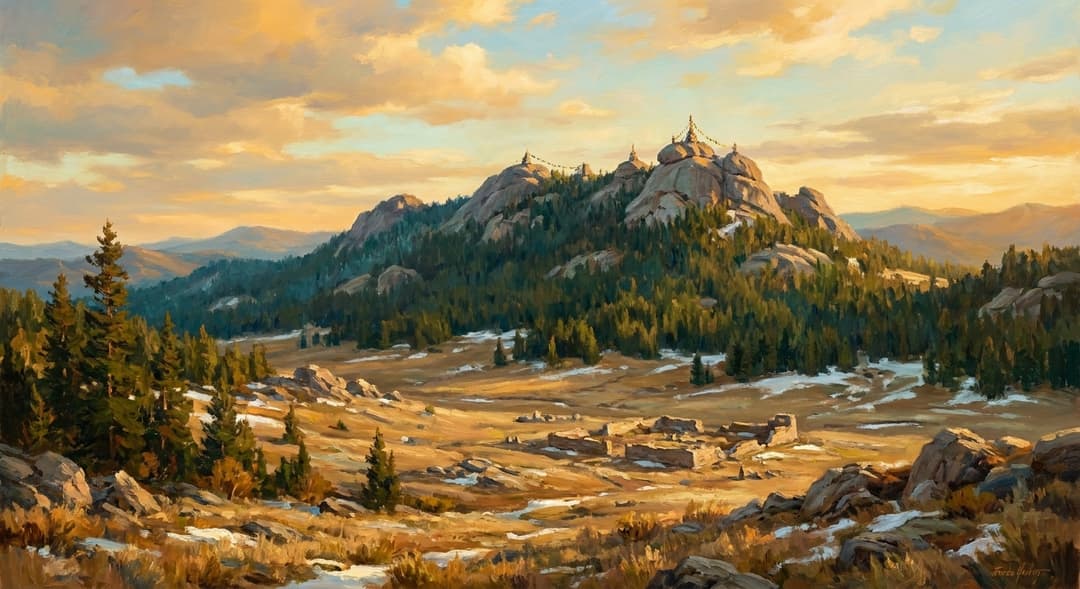
Ascending Bogd Khan Mountain offers an immersive journey through dense taiga forests and stark granite crags. Pilgrims and trekkers encounter ancient ritual cairns and panoramic vistas over the Mongolian capital basin.
Highlights
- Venerating the windswept Tsetsee Gun summit cairn at 2,261 meters elevation
- Exploring the historic stone foundations and cliffside reliefs of Manzushir Monastery
- Viewing the legendary two-ton cast bronze monastic feast cauldron
- Hiking through pristine Siberian larch groves across the Zaisan and Nukht trails
Things to Know
- Circumambulate all summit ovoo shrines strictly in a clockwise direction
- Pack out all waste, as littering is considered a spiritual offense against the mountain spirit
- Be prepared for severe temperature drops and icy winds on the higher granite ridges
Location

Bogd Khan Uul Strictly Protected Area, Töv Province, Mongolia
Hours: Open daily year-round during daylight hours
Getting There: Accessible from the northern trailheads near Zaisan and Nukht, or from the southern trailhead at Manzushir Monastery near Zuunmod.
Get DirectionsTips for Your Visit
Offer Stones Respectfully
When arriving at a summit cairn, circle it sunwise three times and place three clean stones from the path onto the mound.
Dress for Rapid Weather Shifts
Alpine conditions fluctuate drastically even during summer months; carry windproof thermal layers and sturdy hiking boots.
Observe Core Sanctuary Rules
Campfires, overnight camping, and tree harvesting are strictly prohibited throughout the inner strictly protected reserve.
About
Bogd Khan Mountain, traditionally known as Bogd Khan Uul, rises majestically over the southern flank of the Tuul River. As a premier sacred natural site, the mountain embodies centuries of nomadic reverence, uniting indigenous Mongolian Tengriism with Tibetan Buddhist monastic practice.
Its sanctuary status traces to medieval proscriptions enacted by Kerait rulers and early nomadic clans. In 1778, imperial decrees codified its absolute preservation, establishing it as the world's earliest legally recognized nature reserve, predating modern national parks by nearly a century.
Beyond its ecological role as a pristine taiga-steppe sanctuary, the mountain serves as an active pilgrimage hub. Hundreds of stone cairns, monastic ruins at Manzushir, and sacred summit rites continue to honor the enduring bond between the Eternal Blue Sky and the Earth.
Gallery
Symbolic Elements
The temple's exterior features intricate carvings, each rich with spiritual meaning:

Möngke Tengri Connection
The elevated granite crests serve as physical ladders linking terrestrial earth to the supreme Eternal Blue Sky.

The Mountain Ezen
The mountain's master spirit governs local climate, wildlife fecundity, and pastoral balance across the region.

Khangarid Garuda
The golden-winged eagle protector subdues negative forces and serves as the divine sentinel of the range.
Summit Ovoo Cairn
A monumental pile of stone and timber marking the communicative portal between pilgrims and nature spirits.

Blue Khadag Scarves
Sky-blue ceremonial silk strips symbolizing cosmic harmony, pure intent, and eternal devotion to ancestral oaths.
Tsagaan Ebuget
The White Old Man represents earth stewardship, pastoral longevity, and syncretic harmony with wildlife.

Rock-Carved Mañjuśrī
Polychrome granite carvings binding indigenous nature veneration to Buddhist ideals of transcendent wisdom.
Interesting Facts
Bogd Khan Uul predates Yellowstone National Park by nearly a century as a legally protected natural reserve (Tier A).
The capital city of Ulaanbaatar incorporates Khangarid, the mountain's guardian eagle spirit, into its official coat of arms (Tier A).
Mongolia's 1911 theocratic ruler derived his monarchical title of Bogd Khan directly from the holy mountain (Tier A).
A massive two-ton bronze cauldron preserved at the southern foot could prepare meals for a thousand monks simultaneously (Tier B).
Qing imperial penal law mandated public flogging and exile for unauthorized logging or hunting on the sacred slopes (Tier A).
Medieval chronicles record that Genghis Khan sheltered in the mountain's craggy ravines during his early conflicts (Tier B).
During twentieth-century communist purges, authorities secularized the massif and briefly renamed it Choibalsan Mountain (Tier B).
Despite its proximity to a city of 1.6 million people, the mountain shelters wild musk deer, brown bears, and lynx (Tier B).
Common Questions
Is Bogd Khan Uul really older than Yellowstone National Park?
Yes, its official state protection was codified in 1778, preceding Yellowstone by ninety-four years.
What is the proper ritual behavior when encountering an ovoo cairn?
Walk clockwise around the cairn three times while placing three stones upon the pile with silent prayer.
Can visitors tour the ruins of Manzushir Monastery?
Yes, the restored foundation platforms, rock reliefs, and site museum are accessible on the southern slope.
Are permits required to hike to the summit of Tsetsee Gun?
A small entry fee is collected by protected area rangers at the official trailheads.
Featured Stories
The Sanctuary Oath of Temüjin
1189
Fleeing rival Merkit horsemen across the Tuul basin, young Temüjin found salvation in the craggy labyrinth of Bogd Khan Uul. Emerged safely from its sheltered timber groves, the future Genghis Khan hung his belt around his neck and bowed toward the peak, pledging everlasting reverence to its guarding spirit.
Source: Secret History of the Mongols & Traditional Oral Accounts
The Qing Imperial Decree of 1778
1778
Seeking to formalize local nomadic veneration, Vice-Governor Sanzaidorj sent a petition to Beijing seeking state support for biannual sacrifices. The Qianlong Emperor granted imperial funds and damask silks, transforming ancient Tengriist mountain reverence into official administrative law.
Source: Lifan Yuan Archives & State Sacrificial Records
The Resilience of the Monastic Cauldron
1937
When the magnificent monastic city of Manzushir fell victim to totalitarian destruction in 1937, its twenty temples were reduced to ash and stone. Defying dynamite and looters, the two-ton bronze cauldron survived in the rubble, enduring as an unbroken witness to Mongolia's cultural revival.
Source: Töv Province Cultural Heritage Documentation
Timeline
Keraite Forest Ban
Ong Khan declares an absolute taboo on hunting and timber harvesting across the sacred mountain.
MilestoneMeditation of Zanabazar
Öndör Gegen Zanabazar conducts solitary tantric retreats in the forested Nukht Valley.
EventFoundation of Manzushir Gompa
Lama Luvsanjambaldanzan establishes Manzushir Monastery on the southern granite slope.
component.timeline.groundbreakingImperial Qing Protection Decree
The Qianlong Emperor approves formal state status and funding for biannual mountain sacrifice rituals.
MilestoneLifan Yuan Reserve Codification
Imperial authorities establish physical boundary markers and severe penal codes to protect forest resources.
MilestoneCoronation of the Bogd Khan
The 8th Jebtsundamba Khutuktu assumes the theocratic crown of Mongolia, taking his regal name from the peak.
MilestonePurge of Manzushir Monastery
Stalinist religious purges systematically dismantle the southern monastic complex and execute its monastic leaders.
EventState Forest Reserve Re-establishment
The Mongolian Council of Ministers passes Resolution 20, renewing ecological protection over the range.
RenovationStrictly Protected Area Elevation
The Mongolian Parliament officially designates the massif as a national Strictly Protected Area.
MilestoneUNESCO Biosphere Designation
UNESCO inscribes Bogd Khan Uul into the international network of Biosphere Reserves.
MilestoneHistory by Decade
1180s–1200s — The Medieval Nomadic Taboo
Under Keraite rule, nomadic leaders enacted absolute prohibitions against disturbing the wild ecology of the range. Temüjin reinforced these sanctified protections after finding shelter among its crags, establishing ancestral reverence that sustained nomadic harmony for centuries.
1680s–1730s — Monastic Integration
The arrival of Öndör Gegen Zanabazar introduced Tibetan Buddhist contemplative practice into the sacred ravines. By 1733, Lama Luvsanjambaldanzan founded Manzushir Monastery, weaving ancient rock spirits into the Buddhist cosmic order through enduring art and architecture.
1770s–1780s — Imperial Codification
In 1778, the Qing court ratified formal state sacrifice rituals and allocated treasury funds for biannual mountain ceremonies. Administrative edicts in 1783 instituted timber guards and severe penal sanctions, establishing the world's first codified nature reserve.
1910s–1920s — The Theocratic Era
With Mongolian independence in 1911, the 8th Jebtsundamba Khutuktu took the throne as the Bogd Khan, anchoring his monarchical legitimacy in the mountain. During the conflicts of 1921, the theocratic sovereign found refuge within Manzushir Monastery amid international upheaval.
1930s–1950s — Suppression and Secularization
The anti-religious campaigns of 1937 decimated Manzushir Monastery, executing its monastic leadership and dismantling its prayer halls. The state secularized the peak and renamed it Choibalsan Mountain before conservation decrees in 1957 re-established vital watershed protections.
1990s–Present — Democratic Revival and Global Recognition
Mongolia's democratic transition sparked the restoration of ancestral pilgrimage rites and state mountain offerings on Tsetsee Gun. Elevated to a Strictly Protected Area in 1995 and a UNESCO Biosphere Reserve in 1996, the mountain remains an enduring spiritual sanctuary.
Architecture & Facilities
Bogd Khan Mountain represents an indigenous sacred landscape where Tengriist geomantic mountain veneration intersects with Sino-Tibetan-Mongolian Buddhist monastic design. Rather than relying on a singular central monument, the site operates through natural topographical alignments, sacred cairns, and monastic foundations integrated directly into the granite landscape.
Building Materials
Local Granite Scree
Extracted naturally from hillside crags to assemble colossal ritual cairns and terrace walls.
Siberian Cedar and Larch
Harvested ancient timber frames utilized in constructing traditional temple beams and ritual poles.
Glazed Earthenware
High-fired ornamental roof tiles imported historically to cap monastic pavilions at Manzushir.
Cast Bronze
Heavy metallurgical alloy engineered to forge the monumental two-ton eighteenth-century assembly cauldron.
Interior Features
Togchin Temple Platform
A commanding elevated stone platform framing scenic panoramic vistas across the southern valley.
Granite Cliff Sanctuaries
Vertical rock walls bearing eighteenth-century polychrome mineral reliefs of wisdom and protector deities.
Tsetsee Gun Summit Sanctuary
A monumental open-air rock cairn interwoven with timber poles and vibrant ritual prayer scarves.
Manzushir Historical Museum
A preserved cultural facility exhibiting religious artifacts, historical photos, and monastic relics.
Temple Grounds
The vast sanctuary encompasses 41,651 hectares of core wild zone, featuring unbroken larch forests, alpine meadows, and stone cairn paths.
Additional Facilities
Ranger inspection checkpoints, rustic trail markers, educational visitor displays at Zaisan, and the Manzushir museum pavilion.
Religious Significance
Bogd Khan Uul is venerated as a conscious cosmic protector whose spiritual presence ensures balance across the Mongolian homeland.
To maintain harmonious ecological reciprocity between human communities, the natural environment, and the eternal sky.
Sacred Ordinances
Ovoo Circumambulation
Circling stone cairns three times sunwise while contributing three rocks and offering peaceful intentions.
State Sacrificial Rites
Official governmental ceremonies offering dairy products, prayers, and silks to petition peace and prosperity.
Khadag Dedication
Binding sky-blue silk scarves to sacred branches as an enduring oath of cosmic respect and spiritual devotion.
The Four Mountain Sentinels
Bogd Khan anchors the southern direction within the protective mandala of four sacred mountains safeguarding the capital basin.
Animist and Buddhist Syncretism
The peaceful integration of shamanic land spirits with Buddhist Dharma protectors created an enduring tradition of ecological stewardship.
Sources & Research
Every fact on Temples.org is backed by verified Sources & Research. Each piece of information is rated by source tier and confidence level.
View All Sources (8)
| Field | Source | Tier | Retrieved |
|---|---|---|---|
| About & Historical Background | UNESCO World Heritage Centre (opens in a new tab) | B | 2026-03-31 |
| Historical Timeline | Convention on Biological Diversity Clearing-House Mechanism (opens in a new tab) | A | 2026-03-31 |
| Sacred Landscape & Architecture | What Is Missing? Foundation (opens in a new tab) | B | 2026-03-31 |
| Religious Significance & Iconography | National Geographic Society (opens in a new tab) | B | 2026-03-31 |
| Visitor Insights & Geography | Discover Mongolia Travel (opens in a new tab) | D | 2026-03-31 |
| Monastic Ruins & Relics | View Mongolia Travel (opens in a new tab) | D | 2026-03-31 |
| Geographical Coordinates | Mapcarta Open Mapping Project (opens in a new tab) | C | 2026-03-31 |
| Field Observations & Heritage | Jenny Sandiford Cultural Archive (opens in a new tab) | D | 2026-03-31 |