Visitor Insights
Visiting Great Serpent Mound
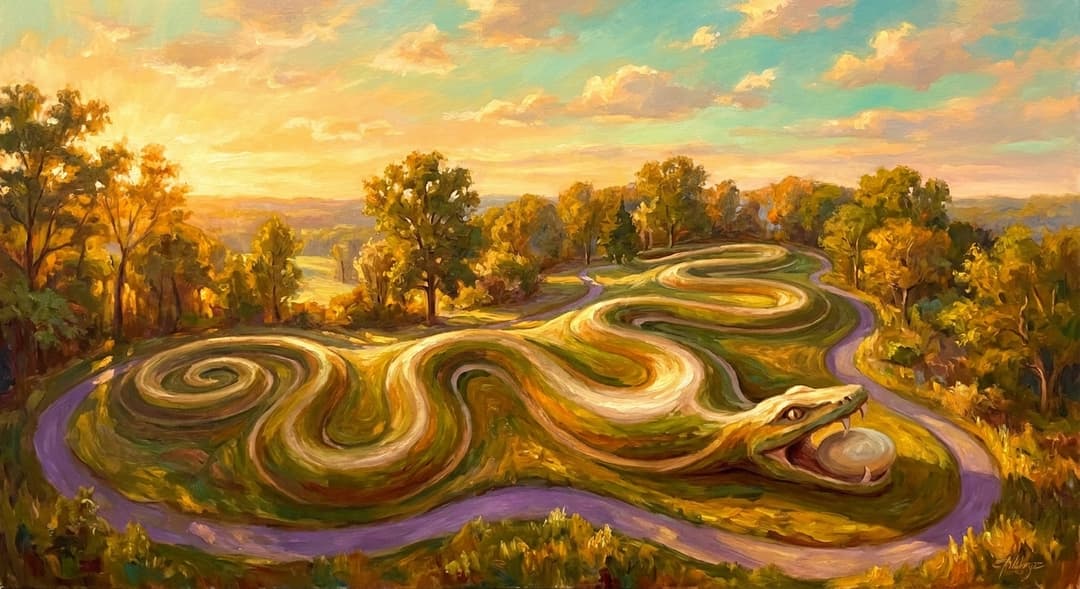
Visitors to Great Serpent Mound experience a tranquil park setting dominated by the winding 1,348-foot earthen effigy along a high forest cliff. A 25-foot observation tower and surrounding footpaths offer elevated views of the serpent's head, oval mound, and undulating body, while an onsite museum interprets the site's rich archaeological and astronomical legacy.
Highlights
- Ascending the historical 1908 steel observation tower for an elevated full view of the serpent coils.
- Observing the alignment of the serpent's open jaws toward the summer solstice sunset.
- Exploring the onsite museum with interactive archaeological exhibits and CCC-era stonework.
- Walking the cliffside trails overlooking Ohio Brush Creek and the ancient meteorite impact rim.
Things to Know
- Climbing or walking directly on the earthen mound embankment is strictly prohibited to prevent erosion.
- Drone photography and unauthorized commercial filming are prohibited across state memorial grounds.
- Vehicle parking requires an $8 state park fee payable at entry kiosks.
- Museum operating hours run Tuesday through Sunday, with the grounds closed on Mondays.
Location
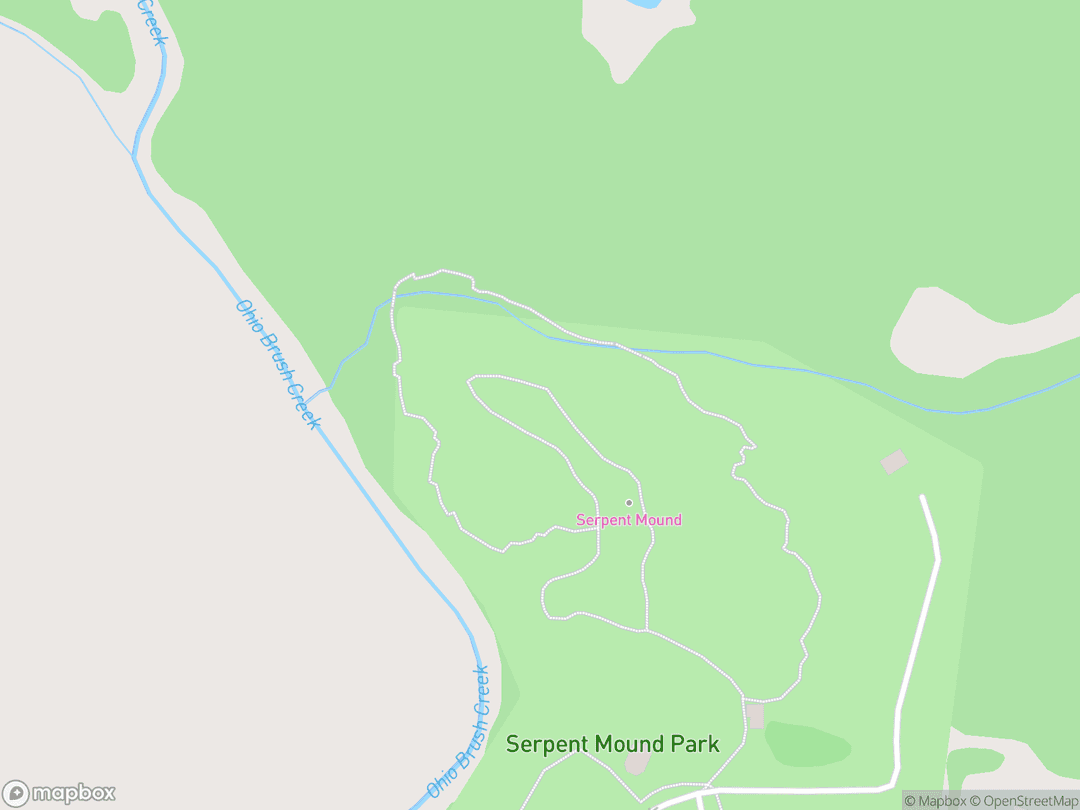
3850 State Route 73, Peebles, OH 45660
Hours: Tuesday–Saturday 10:00 AM–5:00 PM, Sunday 12:00 PM–5:00 PM, Closed Monday
Getting There: Located in Adams County, Ohio, approximately 73 miles east of Cincinnati via US-32 East and OH-73 North.
Get DirectionsTips for Your Visit
Best Celestial Viewing
Visit during the summer or winter solstices to witness how the earthen layout aligns with seasonal sunset points.
Tower Perspective
Climb the 25-foot observation tower near the serpent's tail for the best panoramic angle of the entire winding structure.
Seasonal Conditions
Late autumn through early spring offers clearer views through the forest canopy toward Ohio Brush Creek below.
About
High above Ohio Brush Creek on a dramatic dolomite ridge, Great Serpent Mound winds 1,348 feet across the landscape as the largest surviving prehistoric animal effigy earthwork on Earth. Sculpted out of clay, ash, river gravel, and topsoil, this ancient monument represents a masterwork of landscape engineering, astronomical precision, and sacred earth artistry created by Indigenous Woodland cultures.
First laid down by members of the Early Woodland Adena culture around 320 BCE and later refurbished by the Late Prehistoric Fort Ancient culture around 1070 CE, the earthen serpent incorporates solar, lunar, and cosmological alignments. The monument's open jaws cradle an oval mound, while its undulating coils mark the solstice sunrises and extreme standstill positions of the moon across an 18.6-year cycle.
Uniquely positioned along the rim of a 300-million-year-old meteorite impact crater, Great Serpent Mound stands as a powerful testament to the spiritual and scientific sophistication of North America's ancient earthwork builders. Today preserved as an Ohio State Memorial and National Historic Landmark, it continues to inspire awe and global research into ancient archaeoastronomy.
Gallery
Symbolic Elements
The temple's exterior features intricate carvings, each rich with spiritual meaning:

The Great Horned Serpent
Represents a powerful spiritual guardian associated with water, the underworld, and renewal in Eastern Woodlands cosmology.

The Oval Mound and Altar
Enclosed within the serpent's jaws, this egg-shaped earthwork symbolises creation, rebirth, or celestial consumption.

The Triple-Coiled Tail
A three-fold spiral at the southern terminus that embodies the soul's journey, water motion, and cyclical time.
Summer Solstice Alignment Axis
The primary centerline passing through the head and oval mound directly targets the summer solstice sunset on the horizon.

The Seven Undulating Body Bows
Seven sweeping curves carved along the ridge that trace solar solstices, equinoxes, and major lunar standstill rises.
Non-Funerary Sacred Sanctuary
The complete absence of interior burials inside the serpent body highlights its dedicated astronomical and ceremonial role.
Impact Crater Rim Topography
The strategic positioning atop a 300-million-year-old meteorite crater rim integrates natural geological energy into the design.
Interesting Facts
Great Serpent Mound is built directly on the outer rim of a 300-million-year-old meteorite impact crater. (Tier A)
Measuring 1,348 feet long, it is the largest surviving animal effigy earthwork in the world. (Tier A)
Purchased by Harvard University in 1887, it became North America's first preserved archaeological park. (Tier A)
The 1848 survey map of Serpent Mound was published as Plate XXXV in the Smithsonian's very first book. (Tier A)
Zero burials were placed inside the serpent body, proving it was designed strictly for ceremonial and astronomical use. (Tier A)
A 2014 soil-core study proved the core structure dates to 321 BCE, resolving a decades-long dating debate. (Tier A)
Fort Ancient repairs around 1070 CE coincided with the Crab Nebula supernova and Halley's Comet. (Tier B)
The serpent body coils align with solar solstices and the complex 18.6-year lunar standstill cycle. (Tier B)
Site preservation in 1887 was financed primarily by a fundraising campaign organized by Boston women. (Tier B)
A 25-foot steel observation tower built in 1908 still provides visitors an elevated panoramic view. (Tier A)
Common Questions
Who built Great Serpent Mound?
It was originally built by the Adena culture around 320 BCE and later refurbished by the Fort Ancient culture around 1070 CE.
Are there human burials inside the serpent mound?
No human remains or burial artifacts were placed inside the serpent effigy itself, confirming its purely ceremonial and astronomical function.
How long is Great Serpent Mound?
The total length of the serpent effigy measures 1,348 feet (411 meters) following its undulating coils.
Can visitors walk on the earthen mound?
Walking or climbing on the mound is strictly prohibited to preserve the fragile earthwork from erosion.
Why is the mound located on a meteorite impact crater?
Indigenous builders selected the elevated cliff rim above Ohio Brush Creek, taking advantage of its unique geological presence.
Featured Stories
The Rescue of America's First Archaeological Park
1887
When Harvard archaeologist Frederic Ward Putnam discovered Serpent Mound severely damaged by farm plowing in 1885, he launched an unprecedented preservation campaign. Partnering with Alice Carter Fletcher, he raised over $5,000 primarily from Boston women to purchase the property. Their visionary action created North America's first privately funded archaeological park, setting a precedent for American land conservation.
Source: Peabody Museum of Archaeology and Ethnology Historical Records
Witnesses to the Sky: Cosmic Events of 1070
c. 1070
Around 1070 CE, Fort Ancient villagers performed extensive ceremonial repairs on the ancient serpent earthwork. This restoration coincided with two extraordinary sky phenomena: the brilliant supernova of 1054 CE that formed the Crab Nebula and the dramatic 1066 passage of Halley's Comet. Inspired by these celestial wonders, the people reshaped the earthen monument as an active spiritual response to the changing sky.
Source: Ohio History Connection Archaeological Studies
Resolving a 1,400-Year Archaeological Mystery
2014
For decades, archaeologists debated whether Serpent Mound was built by the Adena culture around 300 BCE or the Fort Ancient culture around 1070 CE after conflicting carbon dates emerged. In 2014, a comprehensive multi-core soil study led by William Romain extracted undisturbed paleosol layers beneath the effigy. The analysis proved the core foundation was built by Adena craftspeople at 321 BCE, revealing that Fort Ancient people were actually restoring a 1,400-year-old sacred monument.
Source: Journal of Archaeological Science Research Findings
Timeline
Initial Adena Construction
Adena Culture earthwork builders construct the core 1,348-foot earthen serpent effigy on the dolomite ridge.
component.timeline.groundbreakingFort Ancient Ceremonial Refurbishment
Fort Ancient villagers perform extensive restoration and reshaping of the effigy during a period of cosmic sky events.
RenovationInaugural Scientific Mapping
Ephraim Squier and Edwin Davis complete the first detailed archaeological survey and floor plan of Serpent Mound.
EventSmithsonian Publication
The Squier and Davis survey map is published as Plate XXXV in the Smithsonian Institution's inaugural volume.
MilestoneFrederic Ward Putnam Visit
Harvard archaeologist Frederic Ward Putnam documents severe agricultural damage and launches a preservation campaign.
EventCreation of First Archaeological Park
Harvard's Peabody Museum purchases 60 acres around the mound, establishing North America's first preserved archaeological park.
MilestoneArchaeological Earthwork Restoration
Putnam completes multi-year excavations and meticulously restores the serpent embankment to its original height.
RenovationTransfer to Ohio Historical Society
Harvard University officially transfers ownership of Serpent Mound to the State of Ohio for public protection.
MilestoneObservation Tower Erection
A 25-foot steel observation tower is constructed near the tail to provide visitors an elevated perspective.
EventCivilian Conservation Corps Enhancements
The CCC constructs native stone shelter houses, walking paths, and the original park museum facility.
RenovationNational Historic Landmark Designation
The United States Department of the Interior designates Great Serpent Mound as a National Historic Landmark.
MilestoneAdena Origins Confirmed
Multi-core radiocarbon testing resolves century-long scholarly debate by confirming core construction at 321 BCE.
EventHistory by Decade
c. 320 BCE — Adena Origins
During the Early Woodland period around 320 BCE, members of the Adena culture broke ground on the bluff overlooking Ohio Brush Creek. Using wooden digging sticks and woven baskets, they transported native soil, clay, and river gravel to sculpt the 1,348-foot serpent effigy. Designed as a sky observatory and sacred monument, the original structure aligned with major solar cycles on the horizon.
c. 1070 — Fort Ancient Ceremonial Renewal
Fourteen centuries later, people of the Fort Ancient culture inhabited a nearby village south of the mound. Experiencing cosmic sky phenomena such as the 1054 CE supernova and Halley's Comet in 1066 CE, they performed major ceremonial repairs on the effigy. They reshaped portions of the serpent embankment, renewing its sacred function for their community.
1840s–1880s — Pioneer Mapping and Smithsonian Recognition
In 1846, Ephraim George Squier and Edwin Hamilton Davis conducted the first scientific survey of the mound. Published as Plate XXXV in the Smithsonian Institution's inaugural 1848 volume, their work made Serpent Mound famous globally. However, intensive farming and plowing over the following decades severely eroded the ancient earthwork.
1880s–1900s — Boston Philanthropy and Park Birth
Visiting in 1885, Harvard archaeologist Frederic Ward Putnam was appalled by the site's degradation. Supported by Alice Carter Fletcher and Boston women who raised over $5,000, Harvard's Peabody Museum bought the 60-acre property in 1887. Putnam excavated and restored the embankment between 1887 and 1889, creating America's first archaeological park before transferring it to Ohio in 1900.
1900s–1950s — State Memorial and CCC Infrastructure
Under state stewardship, a 25-foot iron observation tower was built in 1908 to allow elevated viewing of the entire effigy. During the 1930s, the Civilian Conservation Corps built native stone shelters, perimeter pathways, and an onsite museum. These enhancements transformed the monument into a dedicated Ohio State Memorial for public education.
1960s–Present — National Landmark and Modern Archaeoastronomy
Designated a National Historic Landmark in 1966, Serpent Mound became a primary site for archaeoastronomy research. Breakthrough radiocarbon studies in 2014 confirmed its Adena origins while honoring Fort Ancient restoration work. Today maintained on the UNESCO World Heritage Tentative List, it continues to welcome researchers and visitors from around the world.
Architecture & Facilities
Great Serpent Mound is the largest surviving animal effigy earthwork in the world, combining landscape sculpture, earthwork engineering, and horizon astronomy into a single sacred monument built along a high dolomite bluff.
Building Materials
Submound Clay Foundation
A prepared clay base spread across cleared bedrock to anchor the embankment layer.
Native Topsoil and Clay
Hundreds of tons of regional dark soil and cohesive clay carried in woven baskets.
Layered Ash and River Gravel
Incorporate organic ash and gravel layers that aided drainage and provided symbolic coloring.
Dolomite Bedrock Bluff
Natural weather-resistant stone formation supporting the high plateau above Ohio Brush Creek.
Interior Features
The Oval Mound Centerpiece
A 120-foot by 60-foot egg-shaped enclosure positioned directly between the open serpent jaws.
Ancient Central Altar Feature
A hearth-like heap of burned stones situated in the center of the oval mound.
Triple-Spiraled Tail Section
Inward concentric coils forming a 35-foot circular terminal feature at the southern end.
Seven Undulating Ridge Bows
Sweeping symmetrical earthen curves engineered to trace solar and lunar horizon extremes.
Temple Grounds
A 60-acre state memorial grounds comprising native oak and hickory woodland, cliffside trails, picnic shelters, and a 25-foot observation tower.
Additional Facilities
An onsite museum constructed during the CCC era provides archaeological exhibits, video presentations, and a gift shop.
Religious Significance
For the ancient Indigenous builders of the Ohio River Valley, land and sky were deeply unified. Sculpting living soil into celestial forms allowed communities to participate directly in the rhythms of the cosmos.
To serve as a sacred ceremonial sanctuary, horizon calendar, and cosmological monument harmonizing human culture with celestial power.
Sacred Ordinances
Solstice Ritual Observances
Ceremonial gatherings conducted during summer and winter solstices to track solar cycles and seasonal renewal.
Lunar Standstill Ceremonies
Astronomical observations timed to the 18.6-year lunar cycle to honor nighttime celestial forces.
Cosmic Renewal Offerings
Ceremonial fires and ritual maintenance performed at the central oval altar feature.
The Cosmic Serpent in Indigenous Cosmology
In Eastern Woodlands traditions, the Great Horned Serpent is a revered spirit of transformation, water, and deep earthly wisdom rather than a symbol of evil.
Astronomical Engineering
The precise alignments with solstice sunsets, equinox sunrises, and extreme lunar standstills turn the earthen serpent into an enduring horizon calendar.
Similar Temples
Sources & Research
Every fact on Temples.org is backed by verified Sources & Research. Each piece of information is rated by source tier and confidence level.
View All Sources (7)
| Field | Source | Tier | Retrieved |
|---|---|---|---|
| About & Historical Background | Ohio History Connection (opens in a new tab) | A | 2026-02-22 |
| Architecture & Astronomical Engineering | UNESCO World Heritage Centre (opens in a new tab) | B | 2026-02-22 |
| Symbolic Elements & Cosmology | National Park Service (opens in a new tab) | A | 2026-02-22 |
| Timeline & Preservation History | Peabody Museum of Archaeology and Ethnology (opens in a new tab) | B | 2026-02-22 |
| Historical Publications & Early Maps | Smithsonian Institution Archives (opens in a new tab) | B | 2026-02-22 |
| Radiocarbon Dating Research | Journal of Archaeological Science (opens in a new tab) | B | 2026-02-22 |
| Visitor Insights & Park Management | Ohio History Connection State Memorials (opens in a new tab) | A | 2026-02-22 |