Visitor Insights
Visiting Trần Quốc Pagoda
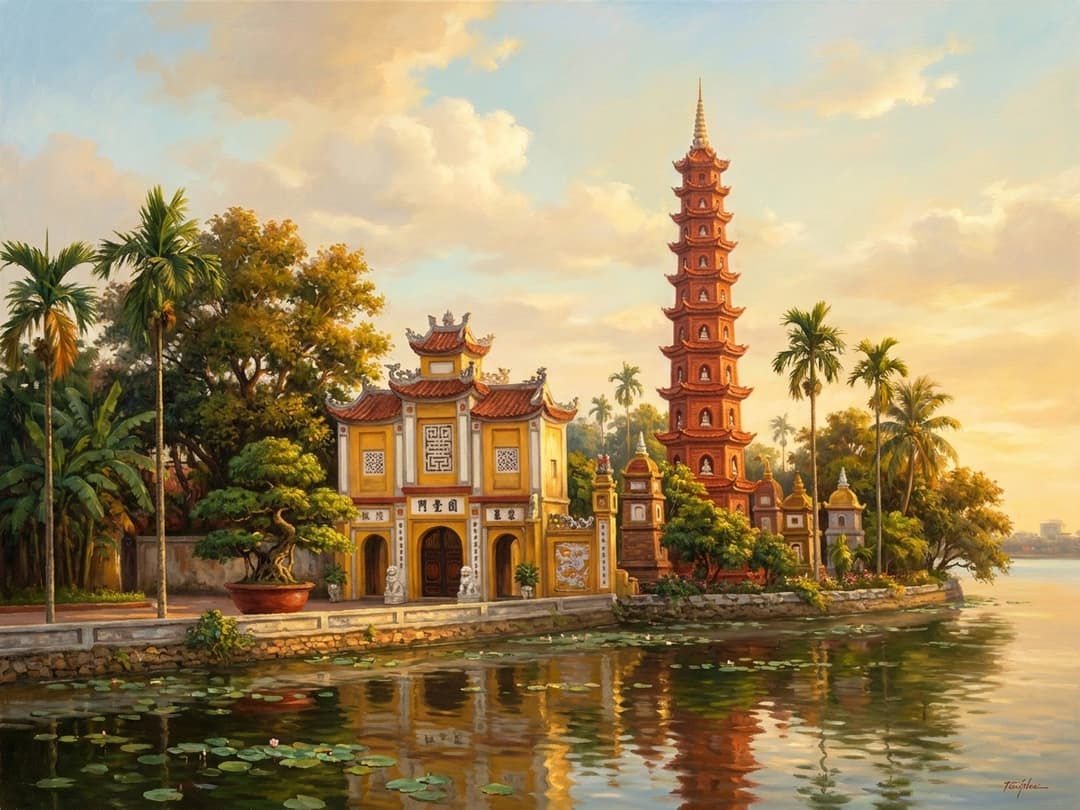
Trần Quốc Pagoda sits on Kim Ngư Islet along the Thanh Niên causeway separating West Lake and Trúc Bạch Lake. Visitors cross a picturesque stone causeway to enter an active monastic sanctuary filled with burning incense, ancient stupas, and shady Bodhi branches. The site offers a peaceful retreat from Hanoi's bustling streets while remaining an active center of Buddhist prayer and pilgrimage.
Highlights
- Marvel at the 15-meter tall red hexagonal Bảo Tháp stupa housing 66 gemstone Buddha statues.
- Pay respects beneath the sacred Bodhi tree planted in 1959 from a cutting taken at Bodh Gaya.
- Examine the historic 19th-century gilded wooden sculpture of the Reclining Buddha in the Upper Hall.
- Explore the Vườn Tháp tomb garden containing brick stupas of historical monastic abbots.
Things to Know
- Modest attire covering shoulders and knees is strictly required for entry into sanctuary halls.
- Remove shoes and hats before entering the main Upper Hall (Thượng Điện) altars.
- Early morning visits provide the quietest atmosphere before tourist buses arrive.
Location
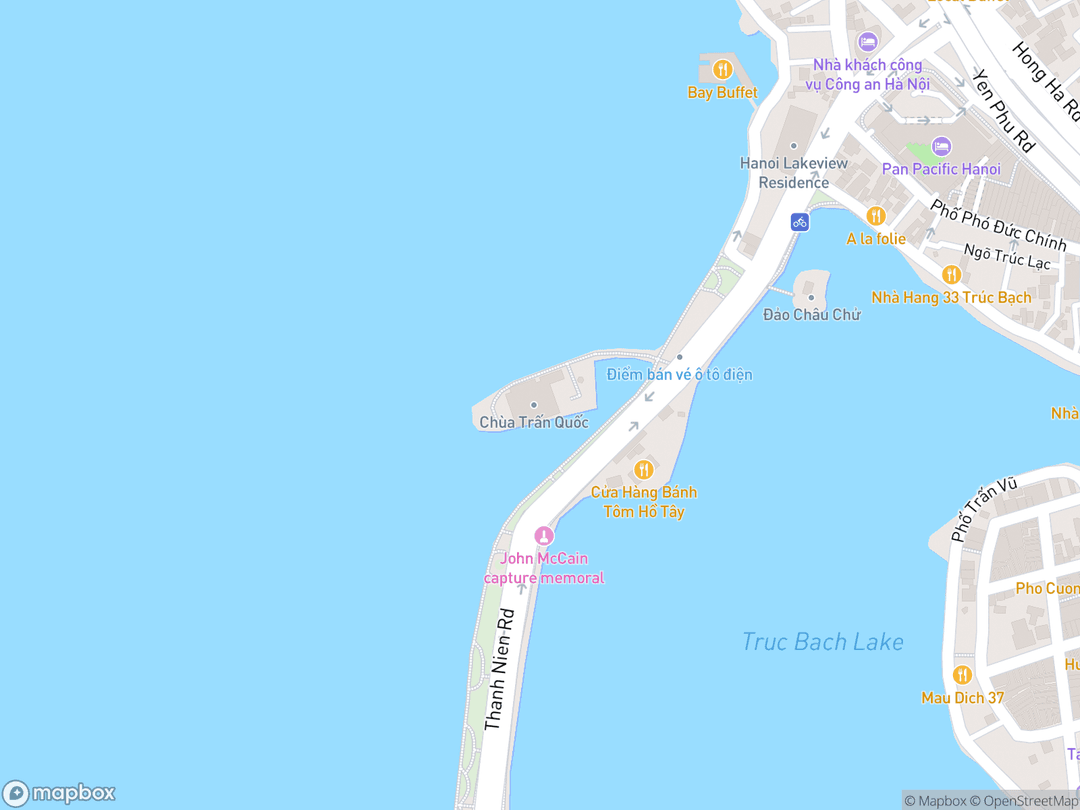
46 Thanh Niên Street, Yên Phụ Ward, Tây Hồ District, Hanoi, Vietnam
Hours: 7:30 AM – 5:30 PM daily (Extended hours on full moons and Lunar New Year)
Getting There: Located 10–15 minutes north of Hanoi's Old Quarter by taxi or ride-share along Thanh Niên Street; public bus routes #33 and #50 stop near the main entrance causeway.
Get DirectionsAbout
Founded between 541 and 545 CE under Emperor Lý Nam Đế, Trần Quốc Pagoda (Chùa Trấn Quốc) is the oldest Buddhist place of worship in Hanoi. Originally named Khai Quốc ('National Founding'), the temple was established on the banks of the Red River as a spiritual monument marking the creation of the independent Vạn Xuân kingdom. Relocated to Kim Ngư Islet on West Lake in 1615 to escape riverbank erosion, the pagoda evolved into a major center for Vietnamese Mahāyāna Buddhism.
As part of the broader Buddhist and Dharmic theological traditions, Trần Quốc Pagoda represents the path toward enlightenment (Nirvāṇa) through devotion, monastic discipline, and meditation. The physical layout reflects classical Sino-Vietnamese sacred geometry, harmonizing Earth, Humanity, and Heaven within a sanctuary dedicated to the Three Jewels: the Buddha, the Dharma, and the Saṅgha.
Throughout its 1,500-year history, the pagoda has been renamed four times to reflect shifting imperial prayers for peace and national defense, ultimately receiving the name Trấn Quốc ('National Defense') under King Lê Hy Tông. Today, the island complex stands as a National Cultural-Historical Monument, housing sacred relics, imperial statues, and an offshoot of the original Bodhi tree from Bodh Gaya.
Gallery
Symbolic Elements
The temple's exterior features intricate carvings, each rich with spiritual meaning:

Bảo Tháp Stupa
The 11-storey red hexagonal tower represents spiritual elevation and houses 66 white gemstone Amitābha Buddha statues.

Sacred Bodhi Tree
A direct cutting from the original Bodhi Tree at Bodh Gaya symbolizing Shakyamuni Buddha's supreme enlightenment.

Công Script Floor Plan
The traditional three-part architectural layout forms the Chinese character 'Công' to harmonize Earth, Humanity, and Heaven.

Reclining Buddha Statue
A masterwork gilded wooden statue depicting Shakyamuni Buddha entering Parinirvāṇa, the ultimate liberation from rebirth.

Gemstone Lotus Apex
The nine-tiered carved gemstone lotus atop the stupa symbolizes purity and ascension into the Pure Land.

Vườn Tháp Tomb Stupas
A secluded courtyard garden of red brick stupas preserving the relics (*śarīra*) of revered monastic abbots.
Mother Goddess Altars
Courtyard shrines dedicated to the Three Holy Mothers (*Thánh Mẫu*) illustrating the syncretism of Vietnamese folk traditions with Buddhism.

Incense Burning Spire
The central connecting hall where aromatic smoke conveys prayers and devotion to the Buddhist pantheon.
Interesting Facts
Founded in 541 CE, Trần Quốc Pagoda predates the establishment of Hanoi as Vietnam's capital by nearly 500 years. (Tier A)
The entire temple complex was physically relocated to Kim Ngư Islet in 1615 due to Red River erosion. (Tier A)
The pagoda rests directly atop the foundations of 11th-century Lý and 13th-century Trần dynasty royal palaces. (Tier B)
The Bodhi tree in the main courtyard is an offshoot directly gifted from Bodh Gaya in 1959. (Tier A)
The 11-storey red brick stupa contains 66 gemstone Amitābha Buddha statues inside its arched windows. (Tier B)
Its famous wooden Reclining Buddha sculpture is considered one of Vietnam's finest 19th-century works of art. (Tier B)
The temple has changed official names four times to reflect major political and defense eras in Vietnamese history. (Tier A)
In addition to Buddhist altars, the grounds host shrines dedicated to indigenous Vietnamese Mother Goddesses. (Tier B)
Major international media outlets including National Geographic have listed it among the world's most stunning pagodas. (Tier B)
Common Questions
What is the age of Trần Quốc Pagoda?
Founded in 541 CE, Trần Quốc Pagoda is the oldest Buddhist temple in Hanoi with over 1,500 years of history.
Is there an entry fee to visit Trần Quốc Pagoda?
Entry to the pagoda complex and its sanctuaries is free for all visitors.
What is the dress code for visitors?
Visitors must wear modest clothing covering shoulders and knees and remove shoes before entering inner altars.
Why is the Bodhi tree in the courtyard significant?
The tree was grown from a cutting of the sacred Bodhi Tree at Bodh Gaya presented by India's President in 1959.
When was the 11-storey red stupa built?
The 11-storey Bảo Tháp stupa was erected in 1998 under the leadership of Abbot Thích Thanh Nhã.
Featured Stories
The Imperial Relocation Across West Lake
1615
When Red River erosion threatened the original 6th-century Khai Quốc Pagoda in 1615, monks and local citizens moved the sacred complex to Kim Ngư Islet on West Lake. Constructing the new sanctuary over the historic foundation of 11th-century royal palaces preserved the temple's continuous lineage while placing it at Hanoi's scenic heart.
Source: Vietnam Ministry of Culture & National Monument Records
A Gift from Bodh Gaya
March 24, 1959
During an official state visit to Hanoi in March 1959, Indian President Dr. Rajendra Prasad presented President Hồ Chí Minh with a sacred cutting from the original Bodhi Tree at Bodh Gaya. Planted together in the pagoda's central courtyard, the thriving tree stands as a living symbol of international Buddhist solidarity.
Source: Hanoi Cultural Heritage Association
Erecting the Precious Stupa
1998
In 1998, Abbot Thích Thanh Nhã directed the construction of the iconic 11-storey Bảo Tháp stupa to honor ancient monk reliquaries. Traditional master artisans hand-carved 66 gemstone Amitābha Buddha statues and crowned the 15-meter spire with a gemstone lotus, establishing a modern architectural landmark.
Source: Trần Quốc Monastic Management Board
Timeline
Initial Construction
Emperor Lý Nam Đế founds the pagoda as Khai Quốc on the banks of the Red River.
component.timeline.groundbreakingRenamed An Quốc
King Lê Thái Tông renames the temple An Quốc to offer royal prayers for national pacification.
MilestoneRelocation to West Lake
Monks relocate the pagoda complex to Kim Ngư Islet to escape riverbank erosion.
RenovationSeventeenth-Century Expansion
Lord Trịnh Tùng constructs surrounding corridors, a bell tower, and monastic guest quarters.
RenovationRenamed Trần Quốc
King Lê Hy Tông renames the temple Trấn Quốc to invoke spiritual protection for the realm.
MilestoneNguyễn Dynasty Restoration
Reconstruction under the Nguyễn Dynasty rebuilds the main sanctuary and ancestral hall layout.
RenovationImperial Visit
Emperor Thiệu Trị visits the pagoda, bestows gold coins, and designates it Trấn Bắc.
EventBodhi Tree Presentation
Indian President Rajendra Prasad presents a Bodhi tree cutting alongside President Hồ Chí Minh.
EventNational Monument Designation
The Ministry of Culture formally classifies Trần Quốc Pagoda as a National Cultural Monument.
MilestoneBảo Tháp Stupa Erection
Abbot Thích Thanh Nhã oversees the completion of the 11-storey red brick stupa.
RenovationGlobal Heritage Recognition
International publications feature Trần Quốc Pagoda among the world's most beautiful temples.
MilestoneArchitecture & Facilities
Trần Quốc Pagoda exemplifies traditional Northern Vietnamese Buddhist monastic architecture structured around the classic 'Công' script (工) floor plan. This architectural tradition arranges three primary worship spaces in sequence—Front Hall, Incense Burning Hall, and Upper Sanctuary—joined by covered lateral corridors. Steep roofs feature traditional red terra-cotta fish-scale tiles and sweeping eaves decorated with stylized dragons and phoenixes, harmonizing with the natural lake landscape.
Building Materials
Structural Timber
Heavy ironwood (gỗ lim) posts and tie-beams support sweeping roof trusses.
Roofing Tilework
Red terra-cotta fish-scale tiles (ngói mũi hài) cap all temple pavilions.
Masonry & Plaster
Hand-molded red brick walls are finished in gold and earth-toned plaster.
Gilded Woodwork
Lacquered woodwork heavily embellished with gold leaf adorns interior altars.
Interior Features
Tiền Đường (Front Hall)
Welcomes pilgrims with broad altars and statues of guardian deities.
Nhà Thiêu Hương (Incense Burning Hall)
Serves as the central hall for daily prayer and incense burning.
Thượng Điện (Upper Sanctuary)
Houses the principal Buddhist pantheon including the historic Reclining Buddha.
Ancestral Hall (Nhà Tổ)
Dedicated to venerating past abbots and monastic founders across generations.
Temple Grounds
The island grounds feature stone-paved walkways surrounding the central Bodhi tree courtyard, flanked by the Vườn Tháp monk tomb garden and sweeping West Lake viewpoints.
Additional Facilities
Visitor facilities include an entry gate with cultural information, donation offices, monastic living quarters, and shaded lakeside benches.
Religious Significance
Within the Dharmic and Buddhist traditions, Trần Quốc Pagoda serves as a living microcosm of the cosmos where devotees seek wisdom, spiritual refuge, and liberation (Nirvāṇa).
To provide a sanctuary for monastic contemplation, public prayer, and the preservation of Vietnamese Mahāyāna Buddhist heritage.
Sacred Ordinances
Tụng Kinh (Sutra Chanting)
Daily liturgical recitations of Mahāyāna sutras conducted by monks and lay devotees.
Dâng Hương (Incense Offering)
Lighting aromatic incense as a physical symbol of purification and devotional intent.
Tắm Phật (Buddha Bathing Ritual)
Annual ceremonial washing of the infant Buddha sculpture during Vesak celebrations.
Cầu An (Prayers for Peace)
Special seasonal chanting services praying for national well-being, health, and ancestral merit.
Pure Land & Zen Synthesis
The temple's devotional life reflects the characteristic Vietnamese synthesis of Thiền (Zen) mindfulness practice and Pure Land devotion to Amitābha Buddha.
Syncretic Sacred Spaces
Alongside orthodox Buddhist altars, shrines honoring Mother Goddesses (Đạo Mẫu) illustrate the historical integration of indigenous spirituality within monastic spaces.
Similar Temples
Sources & Research
Every fact on Temples.org is backed by verified Sources & Research. Each piece of information is rated by source tier and confidence level.
View All Sources (7)
| Field | Source | Tier | Retrieved |
|---|---|---|---|
| About & Historical Background | Hanoi People's Committee Official Portal (opens in a new tab) | A | 2026-02-18 |
| Architecture & Layout | National Geographic (opens in a new tab) | B | 2026-02-18 |
| Architecture & Layout | The Daily Mail (opens in a new tab) | B | 2026-02-18 |
| Religious Significance & Symbols | Hoa Sen Buddhist Library & Heritage Archive (opens in a new tab) | B | 2026-02-18 |
| Timeline & Imperial Records | Vietnam Pictorial - Vietnam News Agency (opens in a new tab) | B | 2026-02-18 |
| Visitor Insights & Cultural Monument Status | Ministry of Culture, Sports and Tourism of Vietnam (opens in a new tab) | A | 2026-02-18 |
| Symbolic Elements & Relic Preservation | Voice of Vietnam Media Network (opens in a new tab) | B | 2026-02-18 |