The Heaven-Earth Connection
For millennia, the night sky was the primary map of order, time, and the divine. To build a temple was not merely to construct a shelter for worship, but to ground the cosmic order on earth. Archeoastronomy—the study of how ancient cultures understood and aligned their structures with celestial phenomena—reveals that temple architecture is frequently a precise astronomical clock.
By aligning physical gates, pillars, and chambers with the movements of the sun, moon, and stars, builders sought to synchronize their sacred rituals with the cosmic calendar. This connection reminded worshippers that their earthly devotion was part of an eternal, celestial system.
Solstices, Equinoxes, and Solar Paths
The sun is the most common astronomical focus for sacred architecture. The ancient Egyptian temple of Abu Simbel is famously oriented so that twice a year—on the pharaoh's birthday and coronation day—the sun's rays penetrate the deep sanctuary to illuminate the seated statues of the gods.
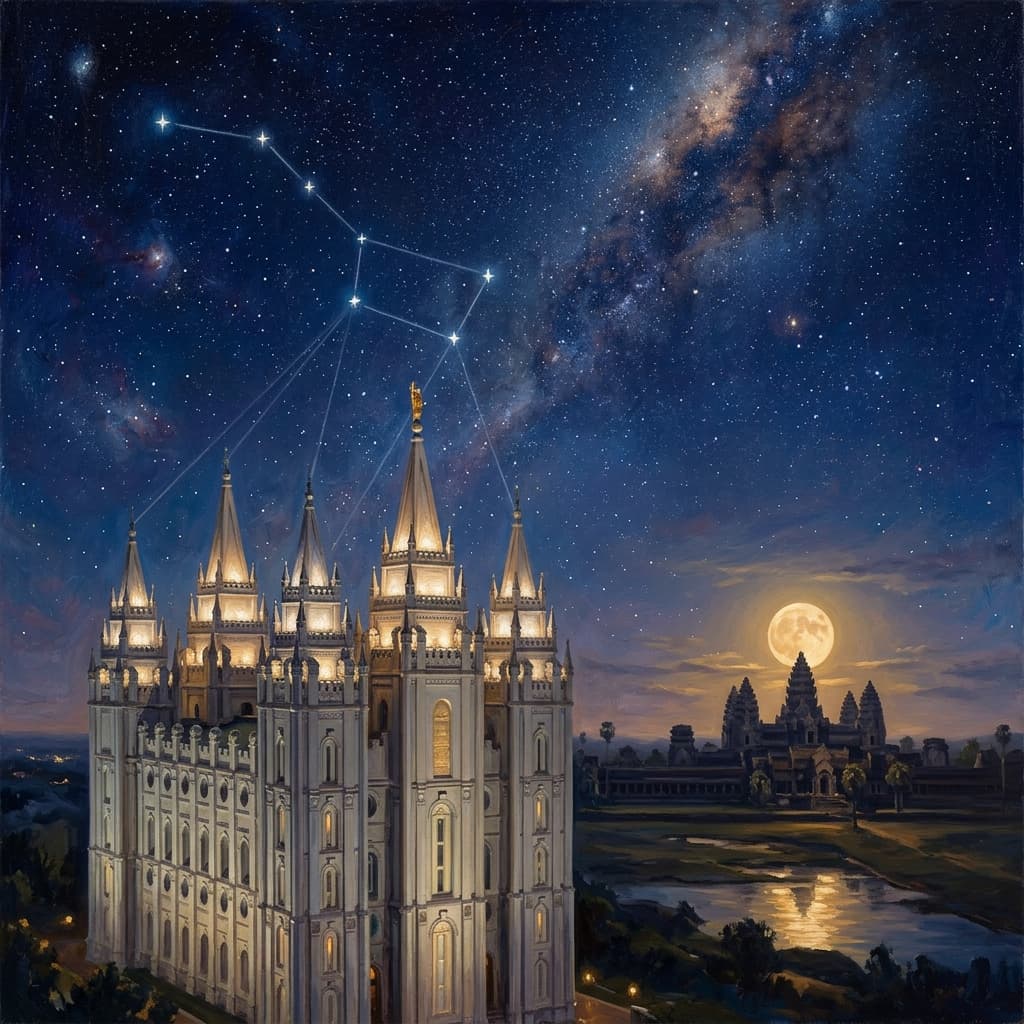
In Cambodia, the towering spires of Angkor Wat are perfectly aligned to witness the sun rise directly over the central peak on the spring equinox. In the Americas, Mayan structures like El Castillo at Chichen Itza create the dramatic visual illusion of a feathered serpent slithering down the pyramid staircase, formed by shadows cast during the equinoxes. These alignments served as dramatic public markers of seasonal cycles and divine presence.
Latter-day Saint Temples: Navigating by the Stars
In Latter-day Saint theology, celestial symbolism is deeply integrated into temple architecture, representing eternal progression and the degrees of glory. The Salt Lake Temple, designed by Truman O. Angell under the direction of Brigham Young, stands as a prime example of this astronomical integration.
The spires and stones of the Salt Lake Temple feature detailed carvings of the sun, moon (depicting its monthly phases), and stars. Most notably, the three towers on the west side are aligned to represent the Ursa Major constellation (the Big Dipper) pointing toward the North Star (Polaris). This configuration symbolizes the temple's role as a moral compass, guiding the lost traveler back to their heavenly home.
Lunar and Stellar Portals in Eastern Faiths
While solar alignments are prominent, lunar and stellar movements also dictate sacred architecture. Islamic mosques are oriented toward Mecca (the qibla), but the timing of holy days is determined by the lunar calendar. Hindu temples (mandirs) incorporate cosmic geography in their design through the Vastu Purusha Mandala, aligning structural proportions with specific lunar mansions (Nakshatras) and planetary directions.
These guidelines ensure that the temple acts as an energetic conduit. The physical structure matches the subtle flow of cosmic forces, allowing worshippers to achieve harmony with the universe.
A Universe in Miniature
Whether tracking the cycles of the moon, the descent of the sun, or the alignment of the stars, temples have always functioned as models of the cosmos. They represent a universe in miniature—an ordered, sacred space carved out of the chaotic world.
As we visit these ancient and modern landmarks, understanding their celestial connections helps us appreciate the scientific precision and profound spiritual devotion of the architects who built them.
Related Temples



Sources & Research
Every fact on Temples.org is backed by verified Sources & Research. Each piece of information is rated by source tier and confidence level.
View All Sources (3)
| Field | Source | Tier | Retrieved |
|---|---|---|---|
| Angkor Wat solar alignments | Science Magazine (opens in a new tab) | B | 2026-05-28 |
| Astronomical symbolism on the Salt Lake Temple | The Church of Jesus Christ of Latter-day Saints (opens in a new tab) | A | 2026-05-28 |
| Abu Simbel solar alignment details | Encyclopædia Britannica (opens in a new tab) | B | 2026-05-28 |