
Architecture as Cosmic Science
To walk through a traditional Hindu temple is to walk through a physical diagram of the universe. Unlike modern buildings designed primarily around human utility, traditional Hindu temples (known as mandirs) are conceived as physical embodiments of the cosmos and residences of the divine. This cosmic projection is achieved using the Shilpa Shastras—an ancient body of Sanskrit design manuals composed between the fifth and fifteenth centuries.
The Shastras function as both artistic guidelines and rigorous mathematical algorithms. They treat architecture as an exact science, outlining how to manifest unseen cosmic principles into three-dimensional stone. Every measurement, angle, and sculptural element is calculated using sacred mathematics, ensuring that the temple resonates in harmony with universal forces.
The Vastu Purusha Mandala: The Divine Grid
At the heart of every Shastric design lies the Vastu Purusha Mandala. The Mandala is a geometric grid—most commonly a square divided into 64 (8x8) or 81 (9x9) smaller squares—that maps cosmic order onto a physical plot of land. In Hindu cosmology, the grid represents the Vastu Purusha, a cosmic deity pinned to the earth by Brahma and other deities.
Each square in the mandala belongs to a specific deity representing distinct aspects of nature and the cosmos. The exact center of the grid, known as the Brahmasthana, is the most sacred zone. It is here that the garbhagriha, or the dark "womb chamber," is built. This inner sanctum houses the consecrated image (murti) of the deity. The surrounding layers of the grid dictate the placement of temple walls, pillars, gateways, and auxiliary shrines, ensuring the physical layout mirrors the hierarchy of the spiritual realm.
Nakshatras and Astronomy in Stone
The orientation and proportions of a traditional mandir are closely tied to the movement of the stars. The measurements of the temple's structural elements—from the height of the foundation plinth to the curvature of the shikara (the towering spire)—are determined using complex mathematical equations that correspond to solar and lunar cycles, and the geometries of specific Nakshatras (lunar constellations).
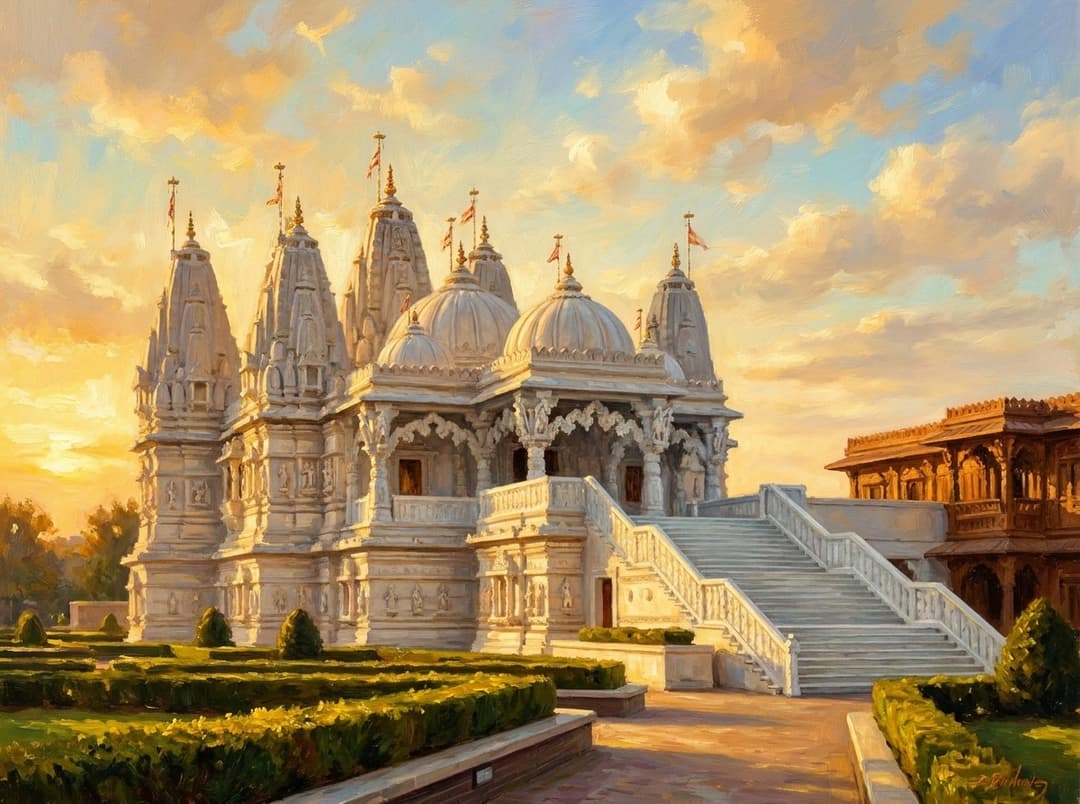
For example, during the design of the BAPS Shri Swaminarayan Mandir in London (the Neasden Temple), the layout was calculated to align with the Revati Nakshatra, a lunar constellation associated with protection and journeys. By aligning the building's physical proportions with these celestial coordinate systems, Shastric architects believe they create a spiritual bridge, aligning the physical building with the energies of the cosmos.
Tala: Proportional Ratios and Rhythm
To achieve visual and spiritual harmony, the Shilpa Shastras utilize a fractional proportional system called Tala. In this system, all dimensions of the temple and its sculptures are derived from a single modular unit, often based on the dimensions of the primary deity's face or hand.
This proportional mathematics is akin to musical rhythm. Just as a musical composition relies on a steady tempo and repeating beats, a Shastric temple uses repeating geometric ratios. Each pillar, molding, and dome stands in a strict mathematical relationship to the whole. This is why traditional Hindu temples, despite their dense and complex ornamentation, convey a deep sense of visual peace and equilibrium.
Built for the Millennia
A critical structural principle of the Shastras is the use of load-bearing masonry. Traditional mandirs are built entirely of stone blocks—such as pink sandstone, granite, or marble—that interlock using complex mortise-and-tenon joints, without structural steel or iron frames.
While steel frames are fast to build, they are highly susceptible to corrosion over time, limiting the lifespan of most modern buildings to 50 or 100 years. By relying solely on the gravity and compression of interlocking stone, temples built according to the Shastras are designed to stand for thousands of years. Today, modern projects like the BAPS Hindu Mandir in Abu Dhabi continue this legacy, combining these ancient masonry rules with digital seismic simulations to ensure their longevity in the 21st century.
Related Temples


Sources & Research
Every fact on Temples.org is backed by verified Sources & Research. Each piece of information is rated by source tier and confidence level.
View All Sources (3)
| Field | Source | Tier | Retrieved |
|---|---|---|---|
| Vastu Shastra and Hindu temple architecture | Encyclopædia Britannica (opens in a new tab) | B | 2026-05-26 |
| Astronomy and Mathematics in Indian Temple Architecture | World History Encyclopedia (opens in a new tab) | B | 2026-05-26 |
| BAPS Hindu Mandir Abu Dhabi: Architecture & Symbolism | BAPS Swaminarayan Sanstha (opens in a new tab) | A | 2026-05-26 |