Visitor Insights
Visiting Brisbane Australia Temple
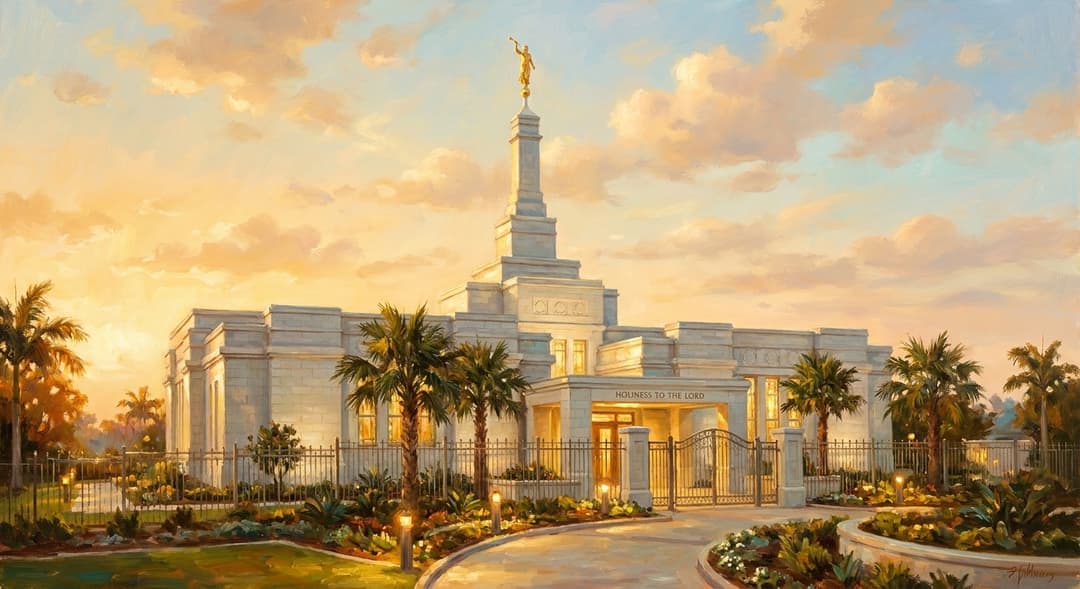
Visiting the Brisbane Australia Temple offers a serene and deeply spiritual experience, elevated by its dramatic cliffside position at Kangaroo Point. The beautifully landscaped grounds are open to the public, providing a peaceful sanctuary where visitors can escape the bustle of the city. Guests can stroll along the manicured pathways, sit by the cascading water fountains, and enjoy breathtaking, panoramic views of the Brisbane River and the central business district skyline. While the interior is reserved for sacred worship by Church members, the exterior and surrounding gardens offer a welcoming atmosphere of quiet contemplation for people of all faiths.
Highlights
- Stunning panoramic views of the Brisbane River and central business district from the cliffside overlook.
- Beautifully manicured gardens featuring native Australian flora, palm trees, and cascading water fountains.
- The dramatic golden hour sunset, which beautifully illuminates the light-gray granite exterior.
Things to Know
- The interior of the temple is reserved for members of the Church holding active temple recommends.
- There is no public visitors' center on-site, but the adjacent meetinghouse is open for Sunday worship.
- Modest attire and respectful behavior are requested while walking the sacred temple grounds.
Location
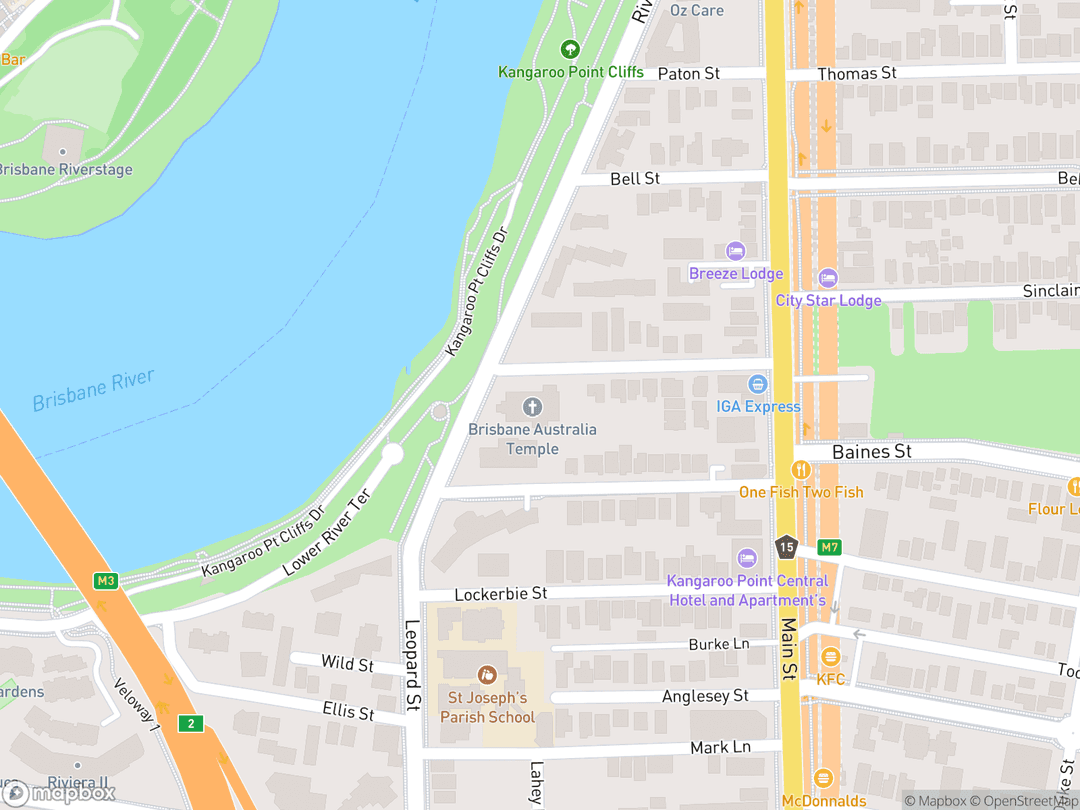
200 River Terrace, Kangaroo Point, Queensland 4169, Australia
Hours: Grounds are open daily from sunrise to 9:00 PM. Temple interior hours vary for patron ordinances.
Getting There: Located at 200 River Terrace, Kangaroo Point. Free parking is available in the secure underground parking lot beneath the temple complex. The site is also a short walk from the Thornton Street and Holman Street ferry terminals, with multiple bus routes running along nearby Main Street.
Get DirectionsTips for Your Visit
Visit at Sunset
Plan your visit during the golden hour just before sunset. The setting sun casts a warm glow on the light-gray granite walls, and the city lights across the river begin to sparkle, offering an unmatched photographic opportunity.
Utilize Public Transit
Avoid city traffic by taking a scenic ferry ride to the Thornton Street or Holman Street terminal. The short, pleasant walk up to River Terrace provides beautiful views of the cliffs and the temple spire.
Explore the Cliffside Paths
Take time to walk the public pathways along the Kangaroo Point cliffs adjacent to the temple grounds. It is one of Brisbane's most iconic scenic walks, combining natural beauty with spiritual tranquility.
About
According to The Church of Jesus Christ of Latter-day Saints, the Brisbane Australia Temple stands as a sacred monument of faith and devotion, perched dramatically on the volcanic cliffs of Kangaroo Point. Serving Latter-day Saints across Queensland and northern New South Wales, this holy house represents a physical manifestation of the Restoration of the gospel of Jesus Christ in the Southern Hemisphere. Its light-gray granite exterior and single soaring spire serve as a prominent spiritual landmark, visible from across the Brisbane River and the city's central business district.
Rooted firmly in the broader Judeo-Christian and Abrahamic traditions, the temple is a modern-day House of the Lord, analogous to the ancient tabernacle of Moses and the temple of Solomon. Within its walls, members of the Church participate in sacred ordinances that bind families together for eternity, bridging the gap between the earthly and the divine. The temple's design and purpose emphasize the eternal nature of the soul and the central role of Jesus Christ as the Savior of mankind.
The journey to establish this sacred sanctuary was marked by years of patient negotiation and community dialogue. Following its announcement in 1998, local Church leaders worked closely with the Brisbane City Council and Kangaroo Point residents to ensure the structure would harmonize with its historic urban environment. Today, the temple grounds offer a peaceful refuge of manicured gardens, native Australian flora, and cascading water fountains, welcoming visitors of all faiths to experience its serene atmosphere.
Gallery
Symbolic Elements
The temple's exterior features intricate carvings, each rich with spiritual meaning:

The Temple as a Sacred Mountain
Perched high on the Kangaroo Point cliffs, the physical elevation of the Brisbane Temple symbolically represents leaving the worldly sphere to ascend to a higher, holier plane of spiritual clarity. This mirrors the ancient biblical tradition of prophets climbing mountains to commune directly with God.

The Angel Moroni Statue
The gold-leafed statue of the Angel Moroni atop the spire is a key symbol of the Restoration of the gospel. Holding a trumpet to his lips, he represents the herald of the Second Coming of Jesus Christ and the gathering of the faithful from all corners of the earth.

The Baptismal Font Oxen
The temple's baptismal font rests on the backs of twelve life-sized sculpted oxen, directly mirroring the 'molten sea' of Solomon's Temple described in the Old Testament. These oxen represent the twelve tribes of Israel, symbolizing the strength, foundation, and burden-bearing nature of the covenant community.

The Sealing Room Mirrors
In the sealing rooms, where marriages are solemnized for eternity, mirrors are placed on directly opposing walls to create an endless corridor of reflections. This visual symbol represents the concept of eternity, the endless progression of generations, and the perpetual nature of family covenants.

Light-Gray Granite Walls
The exterior walls are clad in durable light-gray granite, a material chosen for its longevity and symbolic purity. This stone represents the enduring nature of temple covenants and the spiritual strength required to withstand the trials of mortality.

The Celestial Sky Dome
The magnificent overhead dome in the Celestial Room is painted with a soft sky and cloud mural, drawing the eyes of patrons upward in contemplation. This architectural feature symbolizes the expanse of heaven and the ultimate peace of dwelling in the presence of God.

The Glasshouse Mountains Mural
A hand-painted mural of the Glasshouse Mountains adorns one of the instruction rooms, grounding the sacred space in its local Australian context. This representation of local natural beauty symbolizes the divine creation of the earth and the sacredness of the land upon which the temple stands.
Interesting Facts
Although announced as the second temple in Australia, planning delays made it the fifth to be dedicated.
The temple is built directly on the edge of the historic Kangaroo Point cliffs, offering dramatic views.
The interior features hand-painted murals of local landmarks, including the Glasshouse Mountains.
For over twenty years, the temple has served as a spiritual lifeline for members in Papua New Guinea.
The gold leaf on the Angel Moroni statue was restored by a local Gold Coast couple who trained in England.
The historic Brisbane Australia Stake Center was completely demolished to make way for the temple complex.
To maximize the tight 0.86-acre site, a massive secure parking garage was constructed entirely underground.
The Celestial Room features a rare painted sky dome, which is unusual for smaller temples of its era.
With the 2024 announcement of a second temple, Brisbane became the first Australian city to host two temples.
During the 2003 open house, a grieving Hungarian visitor felt such profound peace in the Celestial Room that he joined the Church.
Common Questions
Can non-members of the Church visit the Brisbane Australia Temple?
Yes, everyone is welcome to visit and walk the beautifully landscaped temple grounds, enjoy the cliffside views of the Brisbane River, and experience the peaceful atmosphere. However, the interior of the temple is reserved for sacred worship by members of the Church who hold active temple recommends.
Why was the temple built on the Kangaroo Point cliffs?
The Kangaroo Point cliffs location was chosen for its prominent, beautiful, and symbolic elevation. In Judeo-Christian theology, mountains and high places have historically been associated with communing with God. The cliffside setting provides a dramatic, peaceful sanctuary that overlooks the city while remaining physically elevated above the busy urban environment.
What is the significance of the Angel Moroni statue on the spire?
The gold-leafed statue of the Angel Moroni represents the Restoration of the gospel of Jesus Christ. Moroni was an ancient American prophet whose modern-day visitation to Joseph Smith led to the translation of the Book of Mormon. The trumpet held to his lips symbolizes the spreading of the gospel to all nations and the herald of the Second Coming of Christ.
How does the Brisbane Temple serve members outside of Australia?
Due to its geographic location, the Brisbane Australia Temple serves as the closest temple for Latter-day Saints living in Papua New Guinea. For over two decades, faithful members have saved for years to make the 1,300-mile flight to Brisbane to participate in sacred temple ordinances.
Featured Stories
The Hungarian Visitor's Witness
May 2003
During the public open house in May 2003, a non-member visitor from Hungary who had recently lost his beloved wife walked through the temple doors. As he entered the Celestial Room, he was suddenly overcome by a profound and unexpected feeling of closeness to her, as if the veil between heaven and earth had grown thin. Deeply moved by this experience of divine peace, he immediately approached the tour guides to request missionary lessons, stating that he had never felt such a sacred presence in any other house of worship. His experience stands as a powerful testament to the temple's purpose as a place of healing, comfort, and eternal connection.
Source: Open House Volunteer Records
The Cliffside Planning Battle
1998–1999
The announcement of the Brisbane Temple in 1998 was met with significant resistance from local residents and the Brisbane City Council, who raised concerns about the building's height, nighttime floodlighting, and potential traffic congestion on River Terrace. Rather than pushing forward regardless of local sentiment, Church leaders engaged in a prolonged period of respectful negotiation and community dialogue. To address the neighborhood's feedback, the Church agreed to lower the temple's foundation platform and reduce the roof pitch of the adjacent meetinghouse. This collaborative effort transformed potential conflict into a story of mutual respect, ensuring the temple would be welcomed as a harmonious addition to the Kangaroo Point skyline.
Source: Brisbane City Council Planning Archives
The Papua New Guinea Pilgrimage
2010–Present
For more than two decades, the Brisbane Australia Temple has served as the closest temple for Latter-day Saints living in Papua New Guinea, a journey spanning over 1,300 miles across the Coral Sea. Many of these faithful members live in remote villages and must save their meager earnings for years just to afford the airfare to Queensland. Upon arrival, they are welcomed by local members who host them, translate ordinances, and support them during their sacred stay. These pilgrimages are filled with deep emotional resonance, as families are sealed together for eternity, demonstrating the global reach and profound personal sacrifice associated with temple worship.
Source: Australia Area Temple Patron Services
Timeline
Temple Announcement
The First Presidency of the Church formally announces the intent to build a temple in Brisbane, making it the second temple announced for the Australian continent.
MilestonePlanning Approvals Secured
Following extensive negotiations with the Brisbane City Council regarding height and traffic, modified plans are approved to lower the foundation platform.
EventGroundbreaking Ceremony
Elder Kenneth Johnson of the Seventy presides over the groundbreaking ceremony. The historic Brisbane Australia Stake Center is razed to clear the site.
component.timeline.groundbreakingHeavy Construction Begins
Excavation and heavy construction commence on the compact cliffside site, including the excavation of a massive underground parking structure.
EventPublic Open House Commences
The completed temple opens its doors to the general public, allowing visitors of all faiths to tour the sacred interior rooms.
EventOpen House Concludes
The public open house concludes after 28 days, having welcomed more than 55,000 visitors, including prominent civic and religious leaders.
EventTemple Dedication
President Gordon B. Hinckley dedicates the Brisbane Australia Temple in four sessions, petitioning for blessings of religious tolerance across the nation.
DedicationFirst Ordinances Performed
The temple officially opens for regular patron ordinance work, serving Latter-day Saints throughout Queensland and northern New South Wales.
MilestonePapua New Guinea Patron Milestone
The temple establishes regular hosting programs for members traveling over 1,300 miles from Papua New Guinea to receive sacred ordinances.
EventTemporary Pandemic Closure
In compliance with global health guidelines and government mandates, the temple temporarily suspends all patron operations.
EventReturn to Full Operations
Following a phased reopening process, the temple successfully returns to full operational capacity for all patron ordinances.
MilestoneAngel Moroni Statue Restored
Local Gold Coast artisans Debbie and Mike Wilkin complete a meticulous restoration and regilding of the Angel Moroni statue.
Renovation20th Anniversary Celebration
Local Latter-day Saints gather to celebrate the 20th anniversary of the temple's dedication, reflecting on two decades of spiritual service.
EventHistory by Decade
1990s — Announcement and Local Negotiations
The formal announcement of the Brisbane Australia Temple on July 20, 1998, marked a historic milestone as the second temple planned for the Australian continent. However, the announcement was quickly followed by a complex period of negotiations with the Brisbane City Council and local Kangaroo Point residents. Concerns regarding the building's height, nighttime floodlighting, and potential traffic congestion on River Terrace led to significant planning delays. To address community feedback, the Church demonstrated a commitment to being a good neighbor by modifying the architectural plans. The Church agreed to lower the temple's foundation platform and reduce the roof pitch of the adjacent meetinghouse, successfully securing the necessary planning approvals by late 1999.
2000s — Construction and Dedication
With approvals in hand, Elder Kenneth Johnson of the Seventy presided over the groundbreaking ceremony on May 26, 2001. To make way for the new temple complex, the historic Brisbane Australia Stake Center, which had stood on the site for decades, was razed. Heavy construction began in November 2001, utilizing local contractors working alongside international specialists to execute the precise granite cladding and underground parking structure. Upon completion, the temple was opened to the public for a highly successful 28-day open house from May 10 to June 7, 2003, welcoming over 55,000 visitors. On June 15, 2003, President Gordon B. Hinckley dedicated the Brisbane Australia Temple in four sessions, offering a dedicatory prayer that petitioned for blessings of freedom and religious tolerance across Australia.
2010s — Regional Expansion and Service
Throughout the 2010s, the Brisbane Australia Temple operated as a vital spiritual hub for Latter-day Saints in Queensland and northern New South Wales. The temple's geographic location also made it a crucial sanctuary for members traveling from Papua New Guinea. These patrons often saved for years to make the 1,300-mile journey to Brisbane, creating a deep bond of fellowship between the local Australian members and the visiting saints from the Pacific islands. The temple's patron housing and volunteer staff expanded their services during this decade to accommodate these regular international pilgrimages.
2020s — Modern Preservation
The 2020s brought both challenges and remarkable growth to the Brisbane temple district. After navigating temporary closures and restricted operations during global health protocols, the temple returned to full operations in 2021. In December 2022, local Gold Coast artisans Debbie and Mike Wilkin completed a meticulous restoration of the exterior Angel Moroni statue, applying fresh gold leaf to protect the figure from the humid Queensland climate.
Architecture & Facilities
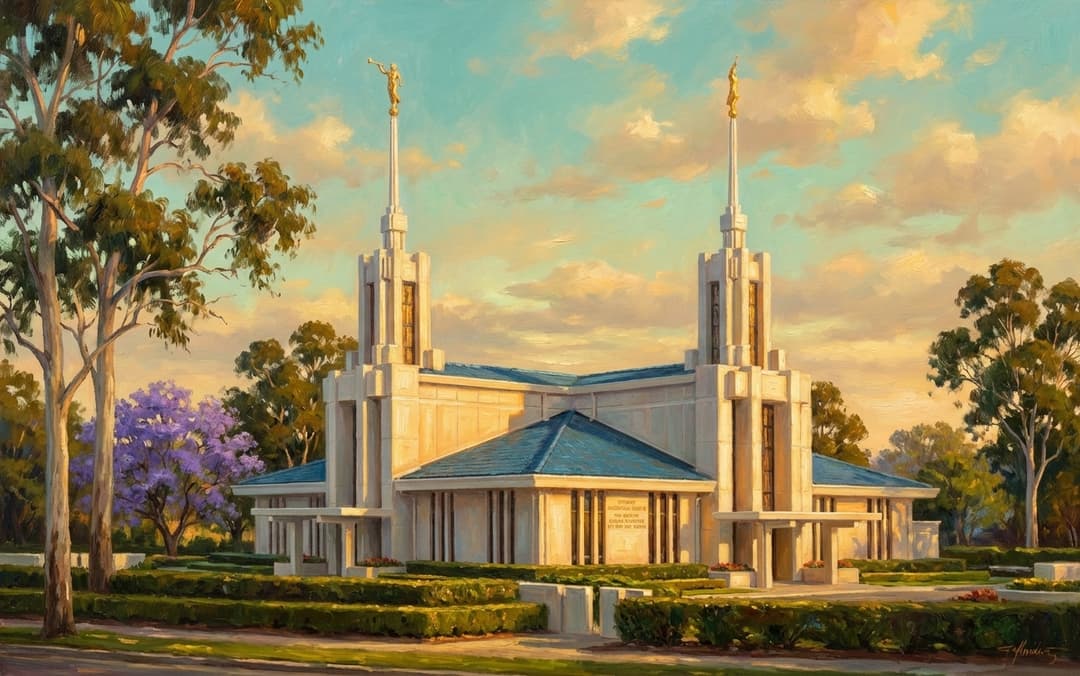
The Brisbane Australia Temple features a classic modern architectural style, blending traditional ecclesiastical symmetry with clean, contemporary lines. It represents the generation of smaller temples initiated by President Gordon B. Hinckley, designed to bring sacred ordinances closer to global members. The building's vertical emphasis is highlighted by a single, elegant spire that rises 71 feet into the sky, terminating in a gold-leafed statue of the Angel Moroni, creating a striking silhouette against the Brisbane River.
Building Materials
Exterior Cladding
The exterior walls are clad in high-quality light-gray granite, chosen for its exceptional durability, low maintenance, and symbolic purity under the bright Queensland sun.
Angel Moroni Statue
The statue atop the spire is crafted from durable fiberglass and finished with micro-thin sheets of 22-karat gold leaf, meticulously applied by local Gold Coast artisans.
Interior Woodwork
The interior features fine imported hardwoods, beautifully carved and finished to create a warm, reverent atmosphere throughout the sacred instruction and sealing rooms.
Stone and Tile
The entry foyer and baptistry are adorned with polished imported marble and custom-designed ceramic tiles, selected to withstand high traffic while maintaining a sacred aesthetic.
Interior Features
The Entry Foyer
A welcoming reception space featuring polished marble floors, detailed woodwork, and a custom oil painting of Mt. Mitchell, grounding the temple in its local Queensland context.
The Instruction Rooms
Two sacred rooms configured for a progressive presentation of the endowment ceremony, one of which features a stunning, hand-painted mural of the Glasshouse Mountains.
The Celestial Room
The spiritual heart of the temple, representing heaven on earth, featuring a magnificent overhead dome painted with a soft sky and cloud mural, custom crystal chandeliers, and plush carpeting.
The Sealing Rooms
Two beautifully appointed rooms where marriages are performed for eternity, featuring opposing infinite mirrors and a central altar crafted from fine wood and upholstered in soft fabric.
The Baptistry
A sacred space featuring a large baptismal font constructed of fine materials, resting on the backs of twelve life-sized sculpted oxen representing the twelve tribes of Israel.
Temple Grounds
The temple's setting is exceptionally dramatic, positioned directly on the Kangaroo Point cliffs. The landscaped grounds are designed to harmonize with the natural beauty of the Brisbane River below, featuring stepped gardens, native Australian flora, manicured palm trees, and cascading water fountains that create a transition zone of quiet reflection between the busy urban environment and the sacred interior.
Additional Facilities
To maximize space on the compact 0.86-acre site, a secure underground parking garage was constructed directly beneath the temple and the adjacent meetinghouse, providing convenient access for patrons.
Religious Significance
In harmony with ancient Judeo-Christian and Abrahamic traditions, the Brisbane Australia Temple is a literal House of the Lord. It stands as a modern-day successor to the biblical tabernacle of Moses and the temple of Solomon, serving as a sacred space set apart from the world where humanity can commune directly with the Divine. Within this sanctuary, the covenants established with Abraham, Isaac, and Jacob are renewed and extended to modern believers, emphasizing the eternal progression of the soul and the central role of Jesus Christ as the Savior of the world.
To provide a sacred, dedicated space where Latter-day Saints can participate in holy ordinances that bind families together for eternity and foster a deeper, personal relationship with God through Jesus Christ.
Sacred Ordinances
The Endowment
A sacred ceremony where patrons receive instruction regarding the creation of the earth, the fall of Adam and Eve, the redemption through the Atonement of Jesus Christ, and covenants of obedience, sacrifice, and consecration.
Eternal Marriage and Sealings
A holy ordinance performed in the sealing rooms where couples and families are bound together by priesthood authority for eternity, transcending the barrier of physical death.
Baptism for the Dead
A vicarious ordinance performed in the temple baptistry, where living members are baptized on behalf of their deceased ancestors, offering them the opportunity to accept the gospel of Jesus Christ in the spirit world.
The Abrahamic Covenant in the Modern Era
According to Latter-day Saint belief, the promises made to Abraham—including the blessing of an endless posterity and the keys of the priesthood to bless all nations—are actively realized through temple ordinances. The sealing power exercised within the Brisbane Temple binds generations together in an unbroken chain, fulfilling the ancient prophecy of Malachi that the hearts of the fathers would turn to their children, and the hearts of the children to their fathers.
Christ-Centered Worship and Symbolism
Every aspect of the temple's design and ritual is intended to point patrons toward Jesus Christ. From the white clothing worn by all participants to symbolize purity and equality, to the progressive instruction rooms that represent the journey back to the presence of God, the temple serves as a physical and spiritual compass guiding believers toward the Savior's teachings and His redemptive grace.
Similar Temples

Sources & Research
Every fact on Temples.org is backed by verified Sources & Research. Each piece of information is rated by source tier and confidence level.
View All Sources (5)
| Field | Source | Tier | Retrieved |
|---|---|---|---|
| About & Historical Background | The Church of Jesus Christ of Latter-day Saints (opens in a new tab) | A | 2026-02-18 |
| Timeline & Dedication | The Church of Jesus Christ of Latter-day Saints Newsroom (opens in a new tab) | A | 2026-02-18 |
| Visitor Insights & General Information | ChurchofJesusChristTemples.org (opens in a new tab) | C | 2026-02-18 |
| Architecture & Interior Craftsmanship | ChurchofJesusChristTemples.org (opens in a new tab) | C | 2026-02-18 |
| Gallery & Visual Assets | Photogent Temple Photography (opens in a new tab) | C | 2026-02-18 |