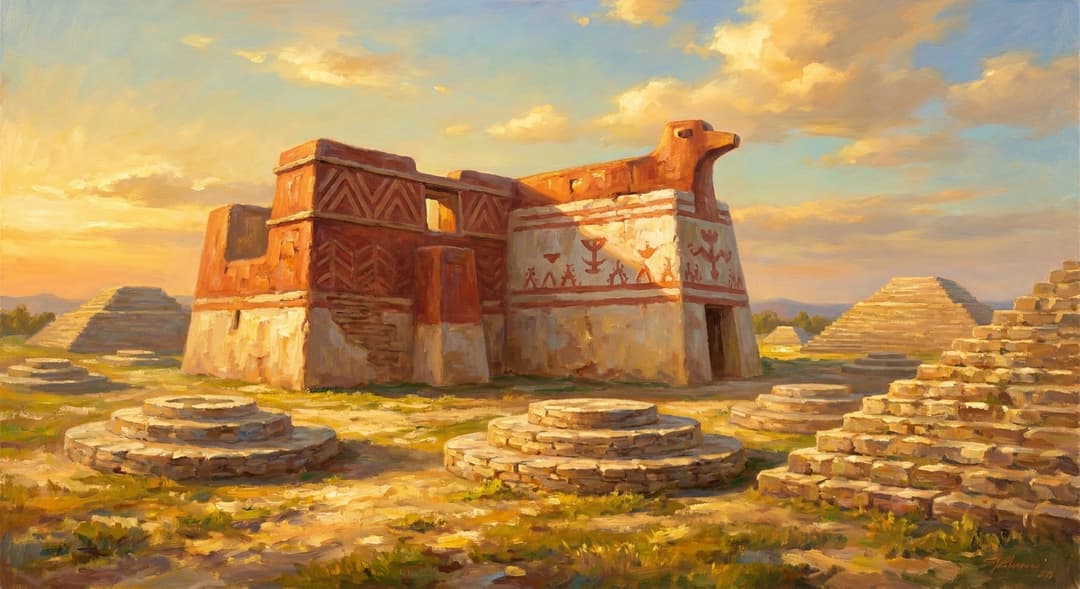
Visitor Insights
Visiting Niuheliang Goddess Temple & Hongshan Site
Visitors to Niuheliang can explore East Asia's earliest monumental ritual architecture across an expansive mountain ridge landscape. Protective display canopies showcase the excavated Goddess Temple foundations and the three-tiered circular Heaven Altar, while an onsite museum displays original nephrite jade artifacts.
Highlights
- Life-sized replica and fragments of the 5,500-year-old terracotta Goddess Head with jade eyes
- Protective canopy enclosing the semi-subterranean Goddess Temple foundations at Spot 1
- Three-tiered concentric stone altar representing the oldest known prototype of Heaven worship at Spot 2
- Comprehensive museum featuring carved Xiuyan jade pig-dragons, cloud pendants, and ritual ceramics
Things to Know
- The site covers 50 square kilometers, requiring the internal park shuttle bus to travel between excavation spots
- Brisk mountain winds occur on exposed ridges; comfortable walking shoes and warm layering are advised
- Photography of certain original jade artifacts inside museum display cases may have lighting restrictions
Location
Border of Lingyuan City and Jianping County, Chaoyang City, Liaoning Province, China
Hours: Daily 08:30 – 17:00 (Last entry at 16:00)
Getting There: Located roughly 50 km southwest of Chaoyang Railway Station or 25 km from Lingyuan Railway Station; private taxi or hired car is recommended.
Get DirectionsTips for Your Visit
Purchase the Park Shuttle Ticket
Take the internal sightseeing shuttle bus because key excavation spots and the main museum hall are separated by several kilometers of mountain road.
Visit in Early Autumn
Travel during September or October for mild temperatures, clear skies, and optimal mountain scenery across the Nuluerhu Range.
About
The Niuheliang Goddess Temple and Hongshan Archaeological Site represents East Asia's oldest known purpose-built sacred architecture, dating to the late Hongshan Culture between 3500 BC and 3000 BC. Situated across 50 square kilometers of mountain ridges in Liaoning Province, this prehistoric sanctuary operated as a dedicated ritual capital detached from residential settlements.
Excavated in 1983, the site revealed a semi-subterranean timber and clay goddess temple, painted plaster walls, and a life-sized terracotta head of a female deity with inlaid green jade eyes. Surrounding the sanctuary are three-tiered circular stone altars and step-pyramidal cairn tombs containing exquisite Xiuyan nephrite jade pig-dragons and cloud pendants.
As the earliest known prototype combining a deity temple, sacrificial sky altars, and ancestral mausoleums, Niuheliang established the foundational triad of traditional Chinese monumental ritual design five millennia ago. Today, the complex is preserved within the Niuheliang National Archaeological Site Park and is inscribed on China's UNESCO World Heritage Tentative List.
Interesting Facts
The terracotta Goddess Head retained its shining green Xiuyan jade eyes intact after remaining buried for over 5,000 years. (Tier A)
Archaeological surveys found zero domestic residences across 50 square kilometers, indicating the mountains were reserved strictly for sacred rites. (Tier A)
Clay shoulder and limb fragments inside the shrine suggest colossal deity statues up to three times human size once stood within the sanctum. (Tier B)
The jade pig-dragon discovered at Niuheliang is recognized as one of the earliest structural ancestors of the Chinese dragon motif. (Tier A)
The three-tiered circular stone altar at Spot 2 predates Beijing's imperial Temple of Heaven by more than 4,500 years. (Tier B)
Construction of Niuheliang's Goddess Temple occurred contemporary with the earliest earthwork phases at Stonehenge in England. (Tier B)
Sculptors used internal wooden branch armatures wrapped in straw ropes to support the heavy clay deity statues before plastering. (Tier A)
Seven ritual fire pits excavated at Spot 1 were arranged precisely to mirror the stars of the Big Dipper constellation. (Tier A)
Nearly all ritual jade artifacts found at Niuheliang were carved from locally mined Xiuyan nephrite quarried 200 kilometers away. (Tier A)
Common Questions
What is the historical significance of the Niuheliang Goddess Temple?
It is East Asia's oldest known deity shrine, establishing China's earliest combined temple, altar, and mausoleum layout over 5,000 years ago.
Who was the female deity represented by the clay head?
The terracotta head represents a supreme matriarchal ancestral figure or fertility deity revered by the Hongshan people.
Why were jade pig-dragons buried in the stone cairns?
Carved from Xiuyan nephrite, pig-dragons served as shamanic totems symbolizing rain, agricultural vitality, and spiritual authority.
Did ancient people live inside the Niuheliang complex?
No domestic houses or cooking hearths were found, proving the entire 50-square-kilometer zone was dedicated exclusively to sacred rituals.
Featured Stories
Unearthing the Green-Eyed Goddess
1983
In October 1983, archaeologists excavating Locus 1 brushed away centuries of mountain loam to reveal a life-sized clay face with glassy green eyes. The inlaid Xiuyan jade spheres caught the afternoon light, offering modern researchers their first direct glimpse into the matriarchal spiritual world of Neolithic East Asia. The discovery redefined China's early cultural timeline and established Niuheliang as a major cradle of prehistoric ritual art.
Source: Liaoning Provincial Institute of Cultural Relics and Archaeology
Aligning Architecture with Sacred Mountains
c. 3500 BC
Hongshan ritual architects specifically chose Niuheliang's high ridges to harmonize their sanctuary with surrounding topography. Spatial analysis demonstrates that the structural north-south axis of the temple targets Zhushan, or Pig Mountain, while the inner sanctuary mirrors Bear-Headed Mountain. This intentional layout integrated natural landforms directly into the sacred spatial geometry of the temple complex.
Source: Institute of Archaeology, Chinese Academy of Social Sciences
The Shamanic Power of the Jade Pig-Dragon
c. 3400 BC
Inside the stone-cist graves of Spot 16, high-ranking shamans were interred with smooth Xiuyan nephrite jades resting on their chests. Among these ornaments was the iconic pig-dragon, a creature blending domestic boar strength with rain-bringing serpent mythology. These sacred carvings served as powerful spiritual keys, bridging the earthly authority of Hongshan leaders with divine cosmic forces.
Source: Guo Dashun, Hongshan Cultural Research Center
Timeline
Sanctuary Construction Begins
Hongshan ritual builders construct the semi-subterranean Goddess Temple and initial stone cairn tombs on Niuheliang's ridges.
MilestoneGolden Age of Ritual Architecture
The site operates as a regional ceremonial capital with step-pyramidal stone cairns, jade burials, and sacrificial altars.
EventClimatic Shift and Site Abandonment
Cooling environmental conditions disrupt Hongshan agriculture, leading to the systematic closure and abandonment of the sacred complex.
EventInitial Archaeological Survey
The Liaoning Provincial Cultural Relics Survey Team identifies prehistoric stone cairns and ceramic sherds across Niuheliang.
EventUnearthing of the Goddess Temple
Archaeologists Su Bingqi and Guo Dashun uncover the subterranean temple structure and the iconic terracotta Goddess Head.
MilestoneExcavation of Concentric Stone Altars
Excavations at Spot 2 reveal a three-tiered circular stone platform held by vertical painted ceramic cylinders.
EventNational Heritage Designation
The State Council of China designates Niuheliang a Major Historical and Cultural Site Protected at the National Level.
MilestoneDiscovery of Royal Tomb Spot 16
Excavators unearth an elite cairn burial containing a 19.7-centimeter Xiuyan jade pig-dragon and ritual ornaments.
EventUNESCO Tentative Listing
Niuheliang is officially inscribed on China's Tentative List for UNESCO World Heritage status.
MilestoneNational Archaeological Site Park Opening
Modern protective canopies and upgraded exhibition facilities open to the public within Niuheliang Site Park.
MilestoneBig Dipper Hearth Array Discovery
Archaeologists excavate seven ritual fire pits at Spot 1 arranged in the shape of the Ursa Major constellation.
EventHistory by Decade
c. 3500 BC — Sanctuary Foundation
Late Hongshan ritual leaders select the uninhabited ridges of Niuheliang as a dedicated pan-regional sanctuary. Builders construct the semi-subterranean timber and clay Goddess Temple along with initial stone cairn graves and sacrificial altars.
c. 3400 BC–3100 BC — Peak Ceremonial Era
Niuheliang operates as the primary ceremonial capital for Hongshan polities across northeastern China. Elite shamans are interred inside step-pyramidal stone cairns accompanied by polished nephrite jade pig-dragons, cloud pendants, and ritual vessels.
c. 3000 BC — Climate Change and Site Abandonment
A cooling and drying climatic shift disrupts regional agricultural systems, prompting the systematic closure and abandonment of the mountain sanctuary. The mud-brick structure collapses softly, sealing the goddess sculptures beneath mountain soil for nearly five millennia.
1980s — Rediscovery and Landmark Excavation
The Niuheliang Goddess is the female ancestor of the Hongshan people—and the common grandmother of the Chinese nation.
Archaeologists Su Bingqi and Guo Dashun supervise formal excavations at Locus 1 and Spot 2, unearthing the painted plaster temple walls, terracotta goddess head, and circular stone sky altars. The discoveries establish Niuheliang as a Major Historical Site Protected at the National Level.
2000s–2010s — Conservation and World Heritage Listing
Major excavations at Spot 16 reveal wealthy royal tombs containing extraordinary jade artifacts. In 2013, China officially inscribes Niuheliang on its UNESCO World Heritage Tentative List while constructing initial protective enclosures over key excavation spots.
2020s — Archaeological Site Park and Astronomical Discoveries
China invests in modern protective canopy structures and upgraded museum facilities to establish the Niuheliang National Archaeological Site Park. Excavations at Spot 1 uncover seven ritual fire pits arranged in the shape of the Big Dipper constellation, proving ancient astronomical alignments.
Architecture & Facilities
The Niuheliang Goddess Temple represents East Asia's oldest known purpose-built sacred shrine architecture, characterized by semi-subterranean timber-framed mud-plaster structures integrated into a 50-square-kilometer sacred mountain landscape.
Building Materials
Subterranean Clay Foundations
Trenches carved directly into native loam and reinforced with dense rammed clay and mud mortar.
Timber and Wattle-and-Daub
Heavy wooden structural posts interwoven with straw-and-reed wattle finished in thick coats of clay plaster.
White Kaolin and Red Ochre Pigment
Interior plaster walls coated in fine white kaolin clay and painted with bold red Z-shaped geometric motifs.
Unshaped Fieldstone Quarried Locally
Granite and basalt stones dry-laid to construct three-tiered circular sky altars and massive step-pyramidal cairn mounds.
Interior Features
Main Sanctuary Hall
The primary central chamber housing life-sized and colossal terracotta deity statues along with animal sculptures.
Northern Inner Sanctum
An elevated northern annex dedicated to venerating bear mandibles and sacred shamanic totems.
East and West Side Chambers
Symmetrical wing rooms utilized for preparing sacrificial offerings and storing painted ceramic cylinders.
Southern Entrance Passage
A narrow subterranean corridor restricting physical entry and orienting visitor sightlines toward the main shrine.
Temple Grounds
The 50-square-kilometer sanctuary encompasses sacred mountain ridges, three-tiered circular stone sky altars at Spot 2, step-pyramidal cairn tombs at Spot 16, and seven Big Dipper hearth pits at Spot 1.
Additional Facilities
The site features climate-controlled protective canopy structures over key excavation loci, the Niuheliang Heritage Site Museum, an archaeological research center, and internal park shuttle transit.
Religious Significance
Niuheliang served as the supreme ceremonial center of the Hongshan Culture, expressing a sophisticated prehistoric worldview centered on matriarchal ancestor reverence, shamanic animal totems, and cosmic geometry.
To serve as a detached mountain sanctuary for communal shamanic rites, honoring divine ancestors, and aligning human society with heaven and earth.
Sacred Ordinances
Ancestor Deification & Offerings
Ritual veneration of the supreme terracotta Goddess through ceramic offerings and clay statue consecration.
Celestial Sky Worship
Sacrificial rites performed on concentric circular stone altars to communicate with celestial forces and stars.
Shamanic Jade Interments
Burying high ritual leaders with Xiuyan jade pig-dragons and cloud pendants to ensure spiritual immortality.
Cosmological Geometry: Round Heaven and Square Earth
The three-tiered circular stone altar at Spot 2 and adjacent square platforms represent the earliest known manifestation of the Chinese cosmological principle Tianyuan Difang (Round Heaven, Square Earth), establishing a philosophical archetype 4,500 years before imperial Beijing.
Sources & Research
Every fact on Temples.org is backed by verified Sources & Research. Each piece of information is rated by source tier and confidence level.
View All Sources (8)
| Field | Source | Tier | Retrieved |
|---|---|---|---|
| About & Historical Background | UNESCO World Heritage Centre (opens in a new tab) | B | 2026-02-17 |
| About & Historical Background | National Cultural Heritage Administration of China (opens in a new tab) | A | 2026-02-17 |
| Architecture & Ritual Site Layout | Institute of Archaeology, Chinese Academy of Social Sciences (opens in a new tab) | B | 2026-02-17 |
| Archaeological History & Discoveries | Archaeology Magazine, Archaeological Institute of America (opens in a new tab) | B | 2026-02-17 |
| Symbolic Elements & Artifacts | Antiquity Journal, Cambridge University Press (opens in a new tab) | B | 2026-02-17 |
| Featured Stories & Research History | China Daily Culture (opens in a new tab) | B | 2026-02-17 |
| Timeline & Cultural Chronology | Liaoning Provincial Museum (opens in a new tab) | A | 2026-02-17 |
| Visitor Insights & Access | Chaoyang Municipal People's Government (opens in a new tab) | C | 2026-02-17 |