Visitor Insights
Visiting Cobán Guatemala Temple
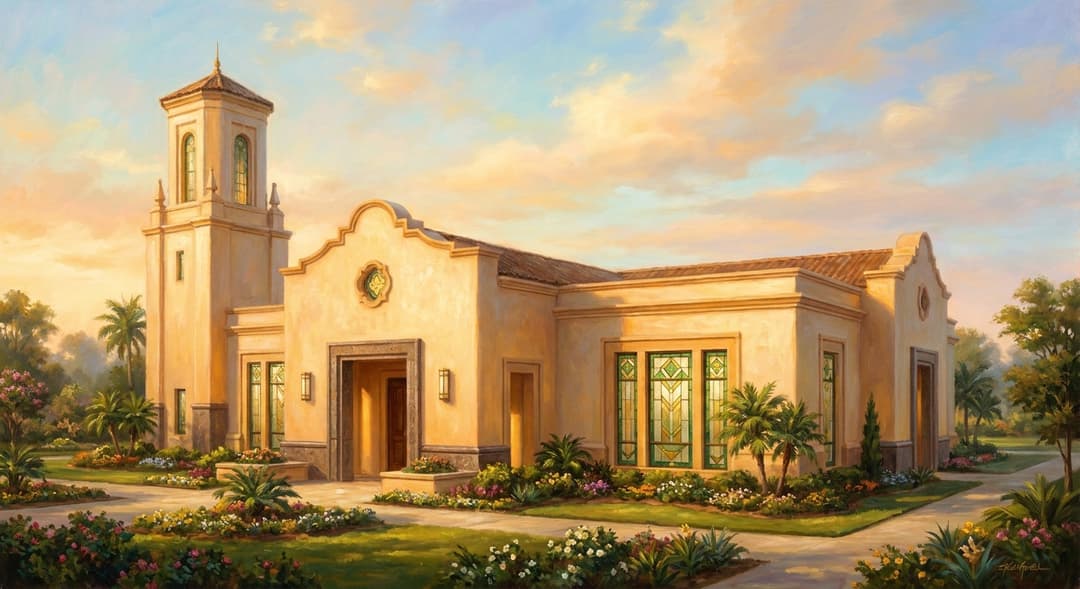
The Cobán Guatemala Temple grounds offer a serene and deeply spiritual experience for all who visit. Nestled in the temperate, humid highlands of Alta Verapaz, the site is frequently enveloped in a gentle mist known locally as "between clouds," creating a peaceful, ethereal atmosphere. Visitors are welcome to walk the beautifully landscaped concrete pathways, sit on the quiet benches, and admire the elegant Spanish Colonial architecture. The temple complex is designed to be a welcoming sanctuary of peace and reflection for both local residents and international travelers.
Highlights
- Stunning Spanish Colonial architecture featuring hand-troweled stucco and a majestic 80-foot tower.
- Beautifully manicured grounds with native palm trees, lush lawns, and vibrant local flora.
- A unique bilingual monument sign inscribed in both Spanish and the indigenous Q'eqchi' language.
- Peaceful, mist-shrouded mountain setting offering panoramic views of the surrounding Alta Verapaz highlands.
Things to Know
- The interior of the temple is reserved exclusively for patron worship; however, the public is welcome to enjoy the exterior grounds.
- Cobán is famous for its damp, humid climate and frequent light rain, so carrying an umbrella or light jacket is highly recommended.
- Modest attire is appreciated when walking the sacred temple grounds.
Location
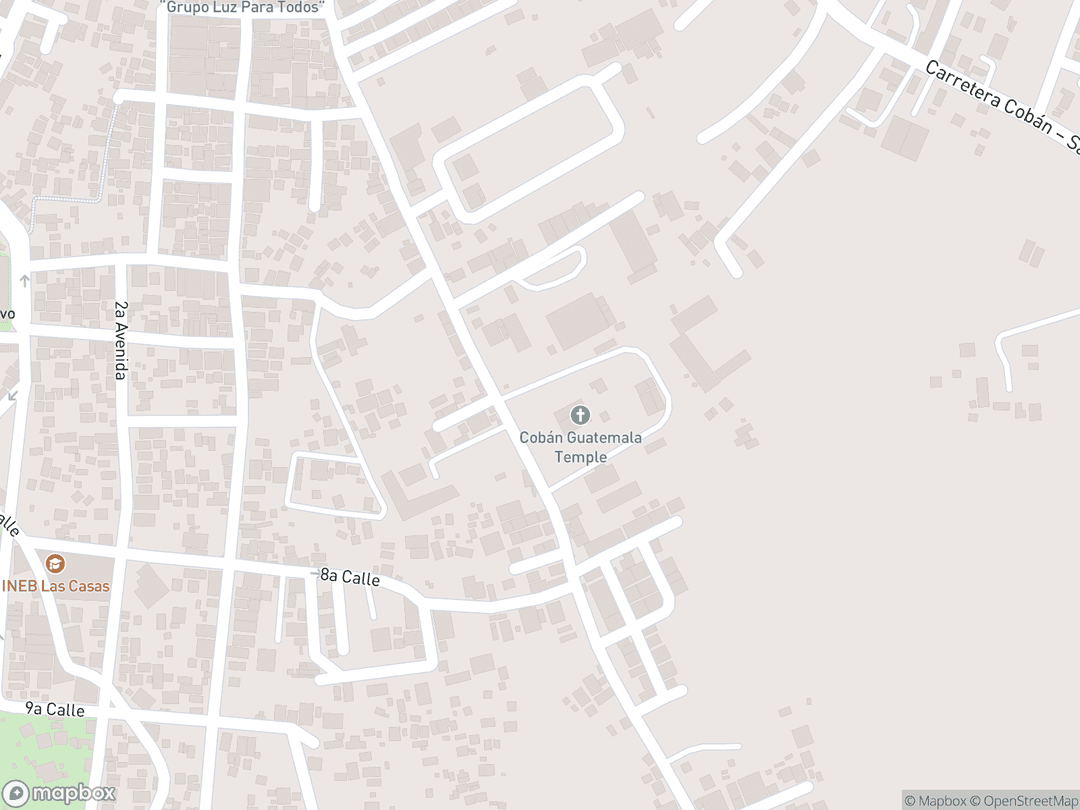
4ª. Avenida 4-48 Zona 8, Barrio Bella Vista, Cobán, Alta Verapaz, Guatemala
Hours: The exterior grounds are open daily to the public from 8:00 a.m. to 8:00 p.m.
Getting There: The temple is located at 4ª. Avenida 4-48 Zona 8, Barrio Bella Vista, Cobán, Alta Verapaz. It is easily accessible via the main roads of Cobán. Visitors traveling from Guatemala City can take CA-9 North and then CA-14 North directly into Cobán, a scenic journey of approximately 4 to 5 hours.
Get DirectionsTips for Your Visit
Prepare for the Weather
Cobán's unique highland climate means sudden mists and light rain are common. Dress in layers and bring wet-weather gear.
Observe the Bilingual Sign
Take a moment to view the monument sign at the entrance, which honors the local Q'eqchi' heritage alongside Spanish.
Visit at Dusk
The temple's exterior lighting system is beautifully designed, casting a warm, reverent glow over the Spanish Colonial facade as night falls.
About
The Cobán Guatemala Temple stands as a magnificent beacon of faith in the cloud-shrouded highlands of Alta Verapaz. Dedicated in June 2024, this sacred edifice represents a monumental milestone for the Latter-day Saint community in northern Guatemala, particularly the indigenous Q'eqchi' people. For decades, faithful members in this region undertook arduous journeys of up to eight hours over treacherous mountain roads to reach the nearest temple in Guatemala City. The establishment of this temple brings sacred ordinances directly to their homeland, serving as a physical manifestation of their devotion and spiritual resilience.
In harmony with the broader Christian and Abrahamic traditions, the temple is designed as a literal "House of the Lord"—a holy sanctuary set apart from the world where individuals can commune directly with the Divine. While traditional Christian chapels host weekly congregational worship and community gatherings, the temple is reserved for sacred, quiet contemplation and the performance of eternal covenants. This theological distinction traces its roots back to the biblical tabernacles of Moses and the ancient Temple of Solomon, emphasizing a physical space of ultimate holiness where heaven and earth meet.
Architecturally, the temple is a masterpiece of Spanish Colonial design, seamlessly blending historic regional aesthetics with modern Latter-day Saint temple architecture. The single-story structure features a striking 80-foot end tower that points toward the heavens, symbolizing the upward focus of Christian discipleship. Surrounded by lush, manicured gardens, native palms, and a spacious north lawn, the temple complex serves as a peaceful community landmark that invites all visitors to experience a sense of tranquility and reverence.
Interesting Facts
[Tier B] The dedication of the temple fulfilled a 45-year-old prophecy made by President Boyd K. Packer in 1979, who stated that temples would eventually stand in Guatemala City, Quetzaltenango, and Cobán.
[Tier B] During the dedicatory sessions on June 9, 2024, messages were delivered in Spanish, English, and Q'eqchi', and patrons recited the Hosanna Shout in the Q'eqchi' language.
[Tier B] The stone monument sign at the entrance is inscribed in both Spanish and Q'eqchi', making it one of the few temples globally to feature an indigenous Mayan language on its primary sign.
[Tier B] Elder Dale G. Renlund highlighted the standard Q'eqchi' greeting, 'Ma sa laa ch'ool' ('How is your heart?'), as a metaphor for the spiritual transformation of temple worship.
[Tier B] The interior and exterior design motifs—including the art glass, carpet patterns, and furniture carvings—are directly inspired by the geometric weaving patterns of local Cobán textiles.
[Tier B] Before the temple was built, members in northern Guatemala and Belize had to travel four to eight hours through dangerous, winding mountain roads to reach Guatemala City.
[Tier C] Early converts in the late 1970s faced severe persecution; pioneer Alberto Coy Yaxcal lost his job and had his house burned down, yet remained fiercely faithful.
[Tier C] To improve the temple's visibility, the Church demolished an existing meetinghouse on a prominent knoll north of the temple in 2023, leveling the area into a beautiful north lawn.
[Tier A] The temple district serves the Senahú Guatemala Stake, which was organized in 2017 as the first entirely Q'eqchi'-speaking stake in the Church.
[Tier B] John Bringhurst, one of the first two missionaries to enter Senahú in 1977, returned to Guatemala years later to help translate the Book of Mormon into the Q'eqchi' language.
Common Questions
Why is the monument sign written in two languages?
The monument sign is inscribed in both Spanish (Santuario al Señor / La Casa del Señor) and Q'eqchi' (Santilal Ochoch Re Li Qaawa' / Li Rochoch Li Qaawa'). This bilingual inscription honors the rich heritage of the local indigenous Mayan population and symbolizes the universal reach of God's love to all nations, kindreds, and tongues.
What is the significance of the temple's architectural style?
The temple features a Spanish Colonial architectural style, which was carefully chosen to harmonize with the historic religious and governmental buildings of the Alta Verapaz region. This classic style is blended with traditional Latter-day Saint design elements, creating a structure that feels both locally integrated and universally sacred.
How did the local climate influence the temple's design?
Cobán is famous for its humid, misty climate, often described as 'between clouds.' The temple's exterior utilizes painted hand-troweled stucco and durable granite accents along the roofline and foundation, which are engineered to withstand the high humidity and seismic activity of Central America while maintaining their pristine beauty.
What facilities are located on the temple site?
The 5.4-acre temple complex includes the temple itself, a newly constructed meetinghouse for weekly Sunday worship, a patron housing facility to accommodate members traveling from distant regions like Belize or Petén, and a distribution center where scriptures and temple clothing can be purchased.
How does this temple benefit the local community?
Before the temple's completion, faithful members in northern Guatemala had to travel four to eight hours through dangerous, winding mountain roads to reach the temple in Guatemala City. The Cobán Guatemala Temple eliminates this difficult journey, allowing local families to participate in sacred ordinances much more frequently and safely.
Featured Stories
The 45-Year-Old Prophecy
July 1979
In July 1979, President Boyd K. Packer, then serving as a member of the Quorum of the Twelve Apostles, visited the faithful Saints in Guatemala. During his visit, he made a bold and inspiring prophecy, declaring that the day would come when temples would stand in Guatemala City, Quetzaltenango, and Cobán. At the time, there were no temples in Central America, and the local membership was small and faced significant challenges. For forty-five years, the Saints of Alta Verapaz held this prophecy close to their hearts, working and praying for its fulfillment. The dedication of the Cobán Guatemala Temple in June 2024 marked the literal and glorious realization of President Packer's prophetic words.
Source: The Church News
The Faith of Alberto Coy Yaxcal
May 6, 1978
Alberto Coy Yaxcal was one of the earliest pioneers of the Church in the municipality of Senahú, being baptized alongside his family in May 1978. His conversion to the restored gospel of Jesus Christ was met with intense local opposition and severe persecution. Alberto lost his employment, and hostile neighbors went so far as to burn down his family home in an attempt to force him to recant his faith. Despite these devastating trials, Alberto and his family remained fiercely devoted to their covenants, meeting secretly with other believers and helping the Church grow in the region. His legacy of unwavering faith laid the foundation for the strong, indigenous Q'eqchi' membership that now worships in the Cobán Temple.
Source: LDS Church History Department
A Sacred Shout in Q'eqchi'
June 9, 2024
The dedication of the Cobán Guatemala Temple was a deeply emotional event that celebrated the rich cultural heritage of the local indigenous people. During the dedicatory sessions presided over by Elder Dale G. Renlund, messages of faith and gratitude were delivered in Spanish, English, and Q'eqchi'. The most profound moment of the services came when the congregation stood to perform the sacred Hosanna Shout, a traditional Latter-day Saint ritual of praise. For the first time in temple history, the Saints had the unique privilege of reciting this sacred shout in their native Q'eqchi' language. This powerful moment brought many to tears, symbolizing that the Lord truly hears and values the prayers of all His children in their own tongue.
Source: The Church News
Timeline
First Pioneer Baptism
Candelaria Tot is baptized at age 18 in the Chixoy River, marking the earliest roots of Latter-day Saint history in Alta Verapaz.
EventFirst Missionaries Arrive
Full-time missionaries John Bringhurst and Raúl Zelaya arrive in the Polochic Valley to begin formal proselytizing.
EventMissionary Work in Chulac
Elders John Bringhurst and Óscar Delgado begin preaching in Chulac, using Miguel Chub as a Q'eqchi' translator.
EventFirst Q'eqchi' Baptisms
The first baptisms of Q'eqchi' members occur in Chulac, bringing seven complete families into the Church.
EventSenahú Branch Roots
Alberto Coy Yaxcal and his family are baptized in Senahú, establishing the Church's presence in the municipality.
EventChulac Branch Organized
The Chulac Branch is formally organized with 160 members, securing a permanent ecclesiastical foothold.
EventGuatemala City Temple Dedicated
The dedication of Guatemala's first temple begins a 40-year era of long, mountainous travel for Cobán Saints.
EventQ'eqchi' Book of Mormon Translation
John Bringhurst returns to assist native translators in translating the Book of Mormon into the Q'eqchi' language.
EventGuatemala Cobán Mission Created
The creation of the Guatemala Cobán Mission accelerates local leadership growth and missionary outreach.
EventFirst Q'eqchi' Stake Organized
The Senahú Guatemala Stake is organized as the first entirely Q'eqchi'-speaking stake in the Church.
Event50th Stake in Guatemala
The Chulac Guatemala Stake is organized, marking the 50th stake in the country and demonstrating spiritual maturity.
EventTemple Announcement
President Russell M. Nelson announces plans to construct the Cobán Guatemala Temple during General Conference.
MilestoneRendering and Site Released
The First Presidency releases the official exterior rendering and site location for the new temple.
MilestoneGroundbreaking Ceremony
Elder Brian K. Taylor presides over the groundbreaking ceremony, officially commencing construction.
component.timeline.groundbreakingSite Visibility Enhanced
The existing Cobán 2nd Ward meetinghouse is demolished and leveled to create a beautiful, open north lawn.
EventPublic Open House Begins
The temple opens its doors to the public, welcoming over 100,000 visitors to tour the sacred interior.
EventTemple Dedication
Elder Dale G. Renlund of the Quorum of the Twelve Apostles dedicates the temple in two sacred sessions.
DedicationHistory by Decade
1950s — The First Seeds of Faith
The history of the Church in the Alta Verapaz region began with quiet, individual acts of faith. On September 17, 1958, an 18-year-old indigenous woman named Candelaria Tot was baptized in the Chixoy River. Her conversion represented the very first Latter-day Saint baptism in the region, planting a tiny seed of faith in a mountainous area that was deeply rooted in traditional Mayan and colonial Catholic customs. For nearly two decades, this seed lay dormant, waiting for the arrival of formal missionary efforts to cultivate a lasting community of believers.
1970s — Pioneers and Persecution
In July 1977, the first full-time missionaries, John Bringhurst and Raúl Zelaya, arrived in the Polochic Valley, officially opening the region to proselytizing. They quickly expanded their efforts to Chulac, utilizing Miguel Chub as a Q'eqchi' translator to bridge the language barrier. By December 1977, the first group of Q'eqchi' families was baptized, and in 1979, the Chulac Branch was organized with 160 members. This rapid growth was met with severe local opposition; early converts like Alberto Coy Yaxcal faced job loss and arson, while missionaries were pelted with stones, yet the community of Saints continued to multiply.
1980s–1990s — The Long Journey and the Written Word
With the dedication of the Guatemala City Guatemala Temple in December 1984, local members finally had access to temple blessings, but at a great cost. The journey from Cobán to the capital required four to eight hours of travel over dangerous, unpaved mountain roads, a financial and physical impossibility for many. To strengthen the local Saints, former missionary John Bringhurst returned to Guatemala in the 1990s to assist native translators in translating the Book of Mormon into Q'eqchi'. Having the scriptures in their native tongue deeply anchored the faith of the indigenous members and prepared them for future leadership.
2010s — Growth and Prophetic Announcement
The 2010s saw an explosion of growth and organization in northern Guatemala. In 2013, the Guatemala Cobán Mission was created, followed by the organization of the Senahú Guatemala Stake in 2017—the Church's first entirely Q'eqchi'-speaking stake. In May 2019, the Chulac Guatemala Stake was organized as the 50th stake in Guatemala. This spiritual maturity culminated on October 5, 2019, when President Russell M. Nelson announced plans to construct the Cobán Guatemala Temple, bringing tears of joy to Saints who had waited forty-five years for this blessing.
2020s — Construction and Dedication
Construction began on November 14, 2020, with a groundbreaking ceremony presided over by Elder Brian K. Taylor. Despite the challenges of the global pandemic, construction progressed steadily. In 2023, the Church made the strategic decision to demolish an existing meetinghouse on a knoll north of the temple, leveling the land to create a spacious north lawn that dramatically enhanced the temple's visibility. Following a highly successful public open house that drew over 100,000 visitors, Elder Dale G. Renlund dedicated the temple on June 9, 2024, ushering in a new era of spiritual strength for the region.
Architecture & Facilities
The Cobán Guatemala Temple represents a beautiful adaptation of Spanish Colonial architecture, designed to harmonize with the historic religious and civic buildings of the Alta Verapaz region. This traditional aesthetic is seamlessly integrated with modern Latter-day Saint temple design, resulting in a low-profile, single-story structure with a single attached end tower that rises 80 feet. The building's elegant silhouette and warm, hand-troweled stucco exterior reflect the quiet, natural beauty of the surrounding misty highlands.
Building Materials
Exterior Walls
Constructed of cast-in-place concrete engineered for seismic durability, finished with painted hand-troweled stucco reflecting traditional Guatemalan colonial craftsmanship.
Exterior Accents
High-quality granite accents run along the roofline, foundation, and exterior doors, providing structural definition and a refined, elegant finish.
Millwork
Premium Guatemalan mahogany is used extensively for both exterior and interior doors, showcasing the rich natural resources and woodworking traditions of the country.
Art Glass
Custom art-glass windows feature geometric Mayan textile motifs in shades of green, gold, and soft white, beautifully filtering natural light into the sacred interior.
Interior Features
Grand Entry and Corridors
Finished with warm Crema Marfil marble stone flooring, accented with rich borders of Emperador Claro and Rojo Alicante marble in geometric patterns.
Celestial Room
A quiet, sacred space featuring custom wool area rugs with local textile-inspired patterns, elegant mahogany millwork, and custom brass and crystal lighting fixtures.
Sealing Rooms
Rooms dedicated to eternal marriage covenants, featuring beautiful mirrors, soft lighting, and custom-carved mahogany altars reflecting local geometric motifs.
Baptistry
A sacred font supported by twelve sculpted oxen, representing the twelve tribes of Israel, finished with elegant stone tiling and custom art glass.
Temple Grounds
The temple stands on a beautifully landscaped 2.1-acre parcel, which is part of a larger 5.4-acre Church-owned site. The grounds are filled with native palm trees, lush grass fields, and manicured hedges. Oblong concrete sidewalks encircle the temple, providing peaceful pathways for contemplation. The north lawn features a leveled, open green space that acts as a visual buffer and enhances the temple's prominence from the street.
Additional Facilities
The larger 5.4-acre complex hosts a newly constructed meetinghouse located south of the temple for weekly Sunday worship, a temple patron housing facility located east of the temple to provide overnight accommodations for travelers, and an on-site distribution center where members can purchase scriptures and temple clothing.
Religious Significance
In the grand tapestry of Christian and Abrahamic theology, sacred spaces have always served as physical sanctuaries where humanity seeks direct communion with the Divine. Drawing from the biblical heritage of ancient tabernacles and temples—such as those built by Solomon—Latter-day Saints view temples not as regular chapels for weekly Sunday worship, but as literal "Houses of the Lord." Within these holy walls, the common Christian aspiration of drawing closer to God is realized through specific, sacred covenants that bind individuals to the Savior Jesus Christ.
To provide a sacred, dedicated space where members can make eternal covenants with God and participate in saving ordinances that unite families for eternity.
Sacred Ordinances
The Endowment
A sacred presentation of instructions and covenants where members receive spiritual power and promise to live according to the teachings of Jesus Christ.
The Sealing
A sacred ordinance that binds husbands, wives, and children together for eternity, ensuring that family relationships continue beyond death.
Proxy Baptisms
A practice where members are baptized on behalf of ancestors who passed away without receiving this essential sacrament, extending Christ's saving grace to all.
A Sanctuary for the Q'eqchi' People
The Cobán Guatemala Temple stands as a powerful testament to the universal reach of the gospel of Jesus Christ. By bringing these sacred ordinances directly to the indigenous Q'eqchi' people in their native land and language, the temple bridges cultural and geographic divides, fulfilling the biblical promise that God will gather His children from every nation, kindred, and tongue.
Similar Temples
Sources & Research
Every fact on Temples.org is backed by verified Sources & Research. Each piece of information is rated by source tier and confidence level.
View All Sources (5)
| Field | Source | Tier | Retrieved |
|---|---|---|---|
| About & Historical Background | The Church of Jesus Christ of Latter-day Saints (opens in a new tab) | A | 2026-02-18 |
| Timeline & Pioneer History | Latter-day Saint Church History Department (opens in a new tab) | A | 2026-02-18 |
| Timeline & Early Baptisms | La Iglesia de Jesucristo de los Santos de los Últimos Días (opens in a new tab) | A | 2026-02-18 |
| Timeline & Chulac Branch | La Iglesia de Jesucristo de los Santos de los Últimos Días (opens in a new tab) | A | 2026-02-18 |
| Visitor Insights & Site Layout | ChurchofJesusChristTemples.org (opens in a new tab) | C | 2026-02-18 |