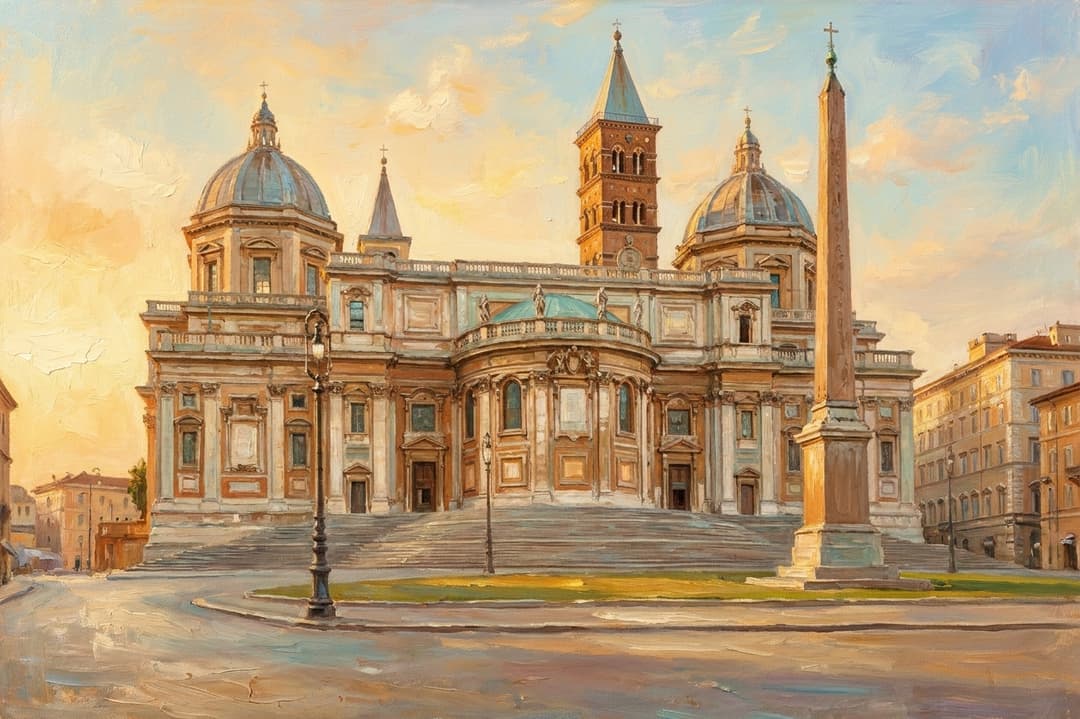
Visitor Insights
Visiting Basilica of Saint Mary Major
Visiting Saint Mary Major offers an unforgettable journey through sixteen centuries of Christian art and Roman architectural evolution. As an active Papal basilica, entry requires respectful dress and security clearance.
Highlights
- Fifth-century mosaic cycles along the central nave walls and triumphal arch
- The venerated Salus Populi Romani icon inside the lavish Borghese Chapel
- The sunken Confessio crypt housing the Sacra Culla relic of the Nativity manger
- Giuliano da Sangallo's Renaissance ceiling gilded with early New World gold
Things to Know
- Strict Catholic dress code enforced; shoulders and knees must be covered
- Airport-style security screening at portico entrances may cause queues during peak hours
- Liturgical services run throughout the day; photography is restricted during Mass
Location
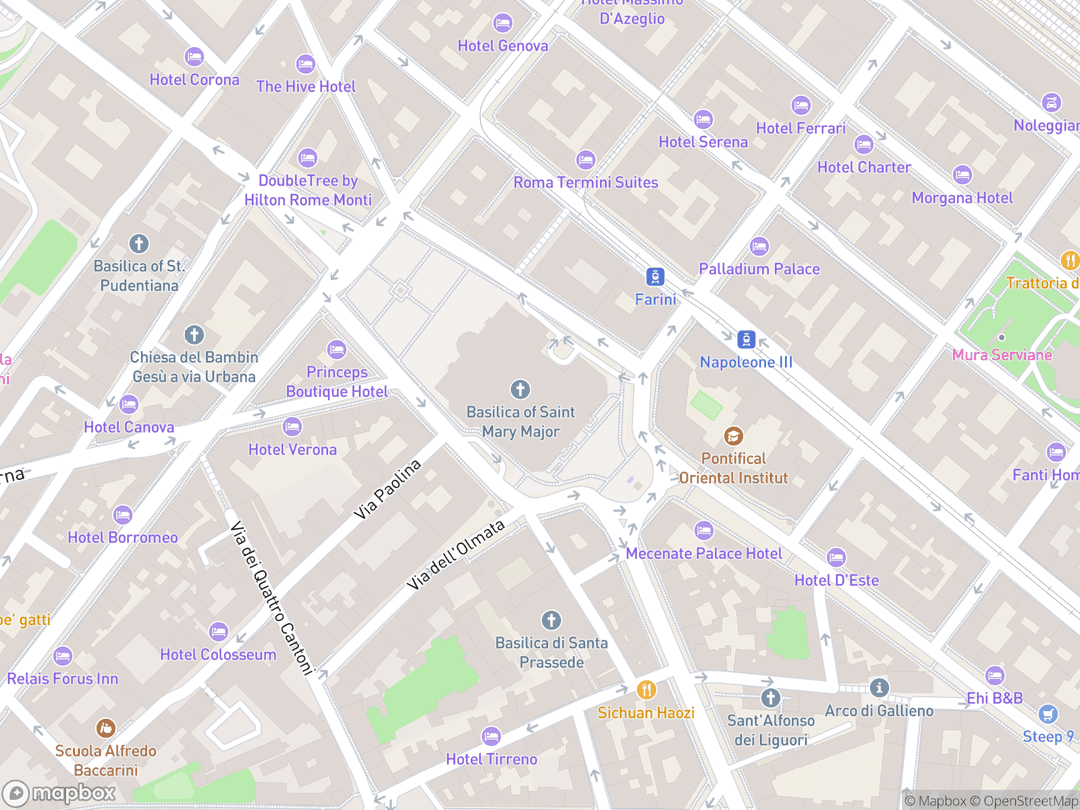
Piazza di Santa Maria Maggiore, 42, 00185 Roma RM, Italy
Hours: Daily 7:00 AM – 6:45 PM (Basilica); 9:00 AM – 6:15 PM (Museum & Loggia)
Getting There: Located 400 meters southwest of Roma Termini Station. Easily reached via Metro Lines A or B to Termini, or Line B to Cavour.
Get DirectionsTips for Your Visit
Arrive Early for Serenity
Visit between 7:00 AM and 8:30 AM to experience quiet morning light on the nave mosaics without crowd queues.
Explore the Historical Museum
Book tickets for the museum complex to access the Loggia of Blessings and Bernini's famous spiral staircase.
Attend the August 5 Snow Festival
Experience the annual August 5 feast day when thousands of white rose petals fall from the ceiling during High Mass.
About
The Basilica of Saint Mary Major (Santa Maria Maggiore) is one of the four Papal Major Basilicas of Rome and the primary Marian shrine in Western Christianity. Founded in the fifth century, the shrine embodies the Catholic theological bridge connecting Old Testament biblical prophecy to the New Covenant Incarnation.
Erected following the 431 AD Council of Ephesus—which proclaimed Mary as Theotokos (Mother of God)—the basilica preserves its original Early Christian interior structure. Adorned with fifth-century mosaic cycles, Renaissance gilded ceilings, and Baroque chapels, it holds extraterritorial status under the Holy See.
Housing revered relics including the Sacra Culla (Holy Manger) and the miraculous Salus Populi Romani icon, the basilica serves as an active center of papal devotion, international pilgrimage, and daily liturgical life atop Rome's Esquiline Hill.
Gallery
Symbolic Elements
The temple's exterior features intricate carvings, each rich with spiritual meaning:
Icon of Salus Populi Romani
A Byzantine-style encaustic painting revered for centuries as the miraculous protectress and health of the Roman people.

Relic of the Sacra Culla
Five wooden slats believed to be fragments of Christ's Bethlehem manger, preserved in a crystal and silver reliquary.
Theotokos Triumphal Arch Mosaics
Fifth-century mosaic cycles portraying Christ's infancy to dogmatically proclaim Mary's title as the Mother of God.

Fifth-Century Old Testament Mosaics
Nave wall panels depicting patriarchal narratives from Abraham to Joshua, illustrating Old Testament salvation history.
The Holy Door (Porta Santa)
A bronze ceremonial door sculpted by Luigi Enzo Mattei, opened exclusively during Papal Jubilee Years for pilgrim grace.

Cosmatesque Geometric Floor
An intricate twelfth-century pavement crafted from inlaid porphyry, marble, and serpentine by Roman Cosmati craftsmen.

Miraculous Snow Petal Shower
An annual liturgical tradition dropping white rose petals from the dome to commemorate the fourth-century August snowfall.
Column of Peace
A massive ancient Roman column surmounted by a bronze Virgin Mary, standing as a landmark of peace in the front piazza.
Interesting Facts
Saint Mary Major is the only one among Rome's four Papal Major Basilicas to preserve its original fifth-century interior floor plan intact. (Tier A)
Gold used to gild the Renaissance coffered ceiling was among the first shipments brought to Europe from the Americas by Christopher Columbus. (Tier B)
Master Baroque sculptor Gian Lorenzo Bernini is buried inside the basilica under a humble marble floor plaque. (Tier A)
The 75-meter fourteenth-century Romanesque brick campanile is the tallest bell tower in the city of Rome. (Tier A)
Pope Francis chose to break century-long papal tradition by designating Saint Mary Major as his final burial site rather than Saint Peter's. (Tier A)
Saint Ignatius of Loyola celebrated his very first Mass as a priest inside the Nativity chapel here on Christmas Night in 1538. (Tier B)
The basilica contains its own historic Cappella Sistina built in 1585, distinct from the famous Vatican chapel of the same name. (Tier A)
Under the 1929 Lateran Treaty, the basilica enjoys full extraterritorial rights and sovereign immunity belonging to the Holy See. (Tier A)
The central granite column standing in the piazza outside was moved from the ancient Roman Basilica of Maxentius in 1614. (Tier B)
Common Questions
Is admission to the Basilica of Saint Mary Major free?
Yes, entrance to the main basilica for prayer and sightseeing is free, though tickets are required for the historical museum complex.
What is the dress code for entering the basilica?
Visitors must cover shoulders and knees; sleeveless tops, short skirts, and shorts are strictly prohibited.
Why is the basilica called Santa Maria della Neve?
The title commemorates the fourth-century legend of a miraculous August snowfall designating where the church should be built.
Where is master sculptor Gian Lorenzo Bernini buried?
Bernini is buried in a simple family grave marked by a floor plaque near the right side of the High Altar.
Why does Saint Mary Major have extraterritorial status?
The 1929 Lateran Treaty recognized the basilica as full sovereign property of the Holy See despite standing in central Rome.
Featured Stories
The Miracle of Our Lady of the Snows
August 5, 358
According to tradition, Pope Liberius and a patrician named John experienced simultaneous dreams in 358 AD wherein the Virgin Mary asked for a church where snow fell. On the sweltering morning of August 5, snow covered the peak of the Esquiline Hill, tracing the outline of the original shrine. This miraculous snowfall is celebrated annually with a dropping of white rose petals inside the basilica.
Source: Vatican Historical Archives & Liber Pontificalis
New World Gold and the Borgia Ceiling
May 20, 1498
During the 1490s, Pope Alexander VI commissioned Giuliano da Sangallo to construct an opulent coffered wooden ceiling over the nave. Monarchs Ferdinand and Isabella of Spain donated the very first shipment of gold brought back by Christopher Columbus to gild the structural coffers. The shimmering heraldic ceiling remains a tangible monument linking European religious history with the Age of Discovery.
Source: Holy See Cultural Heritage Commission
Pope Francis and Veneration of the Protectress
March 27, 2020
Pope Francis established a profound spiritual relationship with Saint Mary Major, visiting the Salus Populi Romani icon before and after every international voyage. During the height of the COVID-19 pandemic in 2020, he made a solemn pilgrimage to pray before the icon for global healing. In late 2023, he announced his choice to break papal custom by selecting this basilica as his final burial site.
Source: Vatican Press Office
Timeline
Miraculous Snowfall Legend
A legendary August snowfall on the Esquiline Hill leads Pope Liberius to build the initial Liberian shrine.
MilestoneConsecration by Pope Sixtus III
Following the Council of Ephesus, Pope Sixtus III dedicates the monumental three-nave Marian basilica.
DedicationArrival of the Sacra Culla
Relics of the Bethlehem Nativity manger arrive in Rome and are enshrined beneath the altar.
EventApse Mosaics Executed
Pope Nicholas IV commissions Jacopo Torriti to complete the Gothic apse mosaic of Mary's Coronation.
RenovationCampanile Completed
Pope Gregory XI builds the 75-meter Romanesque brick bell tower following the return from Avignon.
RenovationGilded Coffered Ceiling Installed
Pope Alexander VI installs the coffered ceiling gilded with Columbus's initial New World gold.
RenovationCappella Sistina Built
Architect Domenico Fontana constructs the Mannerist Sistine Chapel for Pope Sixtus V.
RenovationCappella Paolina Dedicated
Pope Paul V dedicates the Borghese Chapel to enshrine the Salus Populi Romani icon.
DedicationBaroque Rear Apse Exterior
Carlo Rainaldi completes the majestic Baroque portico facade surrounding the rear apse.
RenovationNeoclassical Façade Completed
Ferdinando Fuga completes the double-decker portico facade for Pope Benedict XIV.
RenovationLateran Treaty Sovereign Rights
The Holy See secures extraterritorial legal status for the basilica complex from Italy.
MilestoneHistoric Pandemic Prayer
Pope Francis prays before the Salus Populi Romani icon during global health emergency.
EventHistory by Decade
5th Century — Conciliar Foundation
Following the 431 AD Council of Ephesus, which proclaimed Mary as Theotokos (God-Bearer), Pope Sixtus III constructed a grand basilica on the Esquiline Hill. Designed on an imperial Roman civil layout, it established the primary Marian sanctuary of the Western Church.
13th–14th Centuries — Medieval Transformations
During the thirteenth century, Pope Nicholas IV commissioned master artist Jacopo Torriti to execute the shimmering Coronation of the Virgin apse mosaic. Following the papacy's return from Avignon, Pope Gregory XI erected Rome's tallest Romanesque bell tower in 1376.
15th–16th Centuries — Renaissance Splendor
In the late fifteenth century, Pope Alexander VI added the magnificent gilded wooden coffered ceiling using early gold brought from the Americas. In 1585, Pope Sixtus V added the Mannerist Cappella Sistina to shelter the Nativity crypt.
17th–18th Centuries — Baroque Magnificence
Pope Paul V built the lavish Cappella Paolina in 1613 to enshrine the Salus Populi Romani icon. In 1743, architect Ferdinando Fuga added the Neoclassical double-tiered entrance portico, shielding earlier thirteenth-century mosaics.
20th–21st Centuries — Extraterritorial Modern Era
The 1929 Lateran Treaty granted extraterritorial rights to the Holy See for the basilica complex. Modern popes maintain continuous devotion at the shrine, with Pope Francis selecting the basilica as his final resting place.
Architecture & Facilities
The Basilica of Saint Mary Major represents an extraordinary architectural continuum, preserving a core 5th-century Early Christian basilica plan seamlessly wrapped in layers of Romanesque, Gothic, High Renaissance, Baroque, and Neoclassical design across sixteen centuries.
Building Materials
Ancient Marble Spolia Columns
Forty monolithic columns of Proconnesian marble and granite reused from classical Roman civic structures.
Mosaic Tesserae & Gold
Vibrant glass smalti and gold leaf used across fifth-century wall panels and thirteenth-century apse mosaics.
Travertine & Porphyry
Roman travertine stone exterior facing combined with rare red porphyry columns framing the High Altar.
Cosmatesque Pavement Marbles
Inlaid geometric floor carpets utilizing serpentine, Carrara marble, and imperial porphyry.
Interior Features
Central Nave & Colonnade
An expansive 92-meter hall flanked by classical marble columns and fifth-century Old Testament mosaics.
Cappella Paolina (Borghese Chapel)
A Baroque masterpiece lined with polychrome marbles housing the Salus Populi Romani icon.
Cappella Sistina
A Mannerist Greek-cross chapel containing a gilded bronze tabernacle supported by angels.
The Confessio Crypt
A sunken marble shrine housing the crystal reliquary of the Sacra Culla under the High Altar.
Apse & Choir
A vaulted sanctuary dominated by Jacopo Torriti's thirteenth-century Coronation of the Virgin mosaic.
Temple Grounds
Situated atop the Esquiline Hill, the basilica grounds encompass Piazza di Santa Maria Maggiore with its 1614 Column of Peace, and the sweeping Baroque rear steps on Piazza dell'Esquilino.
Additional Facilities
The historic complex houses a museum featuring sacred treasures, the Hall of the Popes, Bernini's spiral staircase, and the accessible Loggia of Blessings.
Religious Significance
Rooted in the Abrahamic covenant recorded in the Old Testament, Christianity sees God's ongoing revelation culminating in the Incarnation of Jesus Christ. Saint Mary Major serves as a physical witness to this theological progression, using fifth-century mosaics of Abraham, Moses, and Joshua to ground the Christian faith within its sacred Hebrew origins.
To honor Mary as Theotokos (Mother of God), safeguard holy relics of the Nativity, and offer a Papal sanctuary of Eucharistic worship and reconciliation.
Sacred Ordinances
Eucharistic High Mass & Confession
Daily celebrations of the Holy Mass alongside continuous sacrament of Reconciliation offered in multiple languages.
Marian Veneration & Rosary
Pilgrim prayers and solemn devotions before the miraculous Salus Populi Romani icon.
Feast of Our Lady of the Snows
Annual August 5 solemnity featuring the symbolic white rose petal shower over the sanctuary.
Jubilee Pilgrimage & Indulgences
Passage through the Holy Door during Papal Jubilee Years for pilgrim spiritual renewal.
Old Testament Covenant Continuity
The nave mosaics created under Pope Sixtus III depict pivotal Old Testament events, illustrating how Patriarchs and prophets prepared the way for the Messiah, connecting Catholic doctrine with ancient Abrahamic heritage.
The Dogma of Theotokos
Proclaimed at the Council of Ephesus in 431 AD, the title Theotokos affirms Christ's true divinity and humanity from conception. Saint Mary Major stands as the first and greatest Western monument erected to proclaim this dogma.
Similar Temples


Sources & Research
Every fact on Temples.org is backed by verified Sources & Research. Each piece of information is rated by source tier and confidence level.
View All Sources (5)
| Field | Source | Tier | Retrieved |
|---|---|---|---|
| About & Historical Background | The Holy See — Vatican Web Portal (opens in a new tab) | A | 2026-02-22 |
| Iconography & Salus Populi Romani | Dicastery for Communication (opens in a new tab) | A | 2026-02-22 |
| UNESCO World Heritage Listing | UNESCO World Heritage Centre (opens in a new tab) | B | 2026-02-22 |
| Architecture & Historical Survey | Catholic Encyclopedia (opens in a new tab) | B | 2026-02-22 |
| Art Historical & Architectural Documentation | Enciclopedia Italiana Treccani (opens in a new tab) | B | 2026-02-22 |