Visitor Insights
Visiting Wazir Khan Mosque
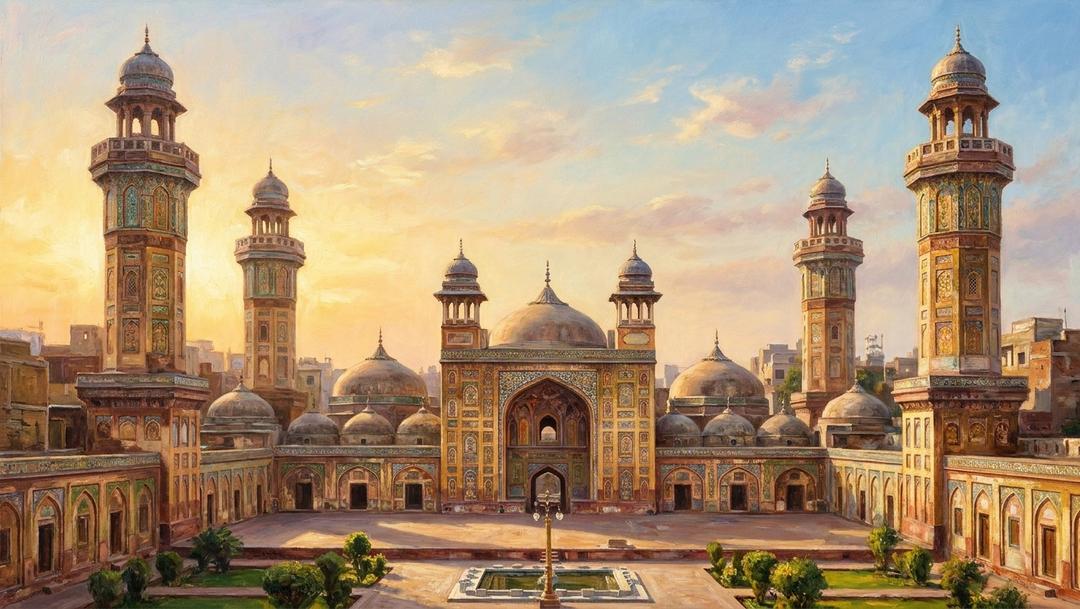
Masjid Wazir Khan offers an immersive spiritual journey into the historic heart of Old Lahore. Visitors transition from the vibrant bazaar into a tranquil brick courtyard bordered by grand minarets and intricate faience tilework. The monument continues to function as an active house of prayer, demanding reverence, quiet conduct, and modest attire.
Highlights
- Dazzling 17th-century kashi-kari glazed mosaic tiles adorning the facades
- Four soaring 107-foot octagonal minarets with panoramic views of the Walled City
- Subterranean crypt of the 14th-century Iranian Sufi saint Miran Badshah
- The restored 22-shop Calligraphers' Bazaar inside the monumental eastern portal
Things to Know
- Conservative dress covering shoulders and legs is strictly mandatory for all guests
- Women must cover their heads with a scarf prior to crossing the entrance threshold
- Shoes must be removed and checked with attendants before stepping onto the courtyard
- Tourist visits are paused during congregational prayer times, especially on Fridays
Location
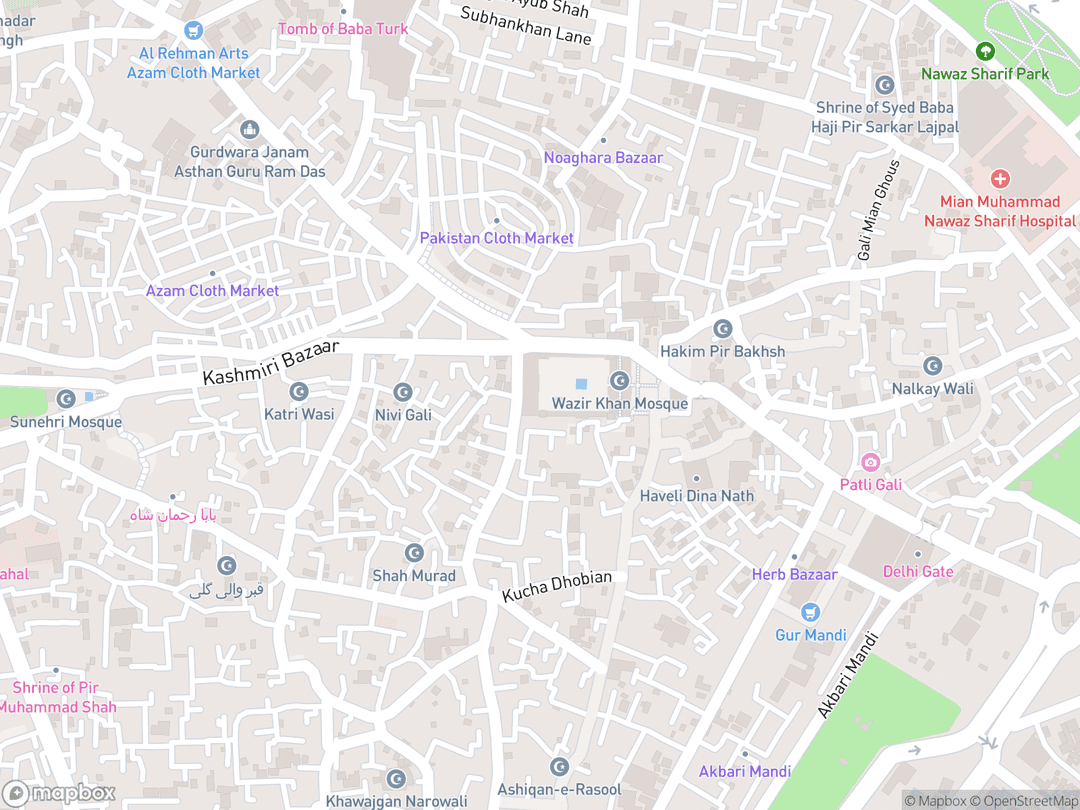
Shahi Guzargah, Dabbi Bazar, Walled City of Lahore, Lahore, Punjab 54000, Pakistan
Hours: Daily from dawn to dusk (05:00 AM to 08:00 PM), outside prayer assemblies
Getting There: Arrive at Delhi Gate via Circular Road and walk 260 meters westward along the pedestrianized Shahi Guzargah.
Get DirectionsTips for Your Visit
Golden Hour Lighting
Visit in the late afternoon to see the cobalt and saffron tiles catch the warm setting sun.
Friday Prayer Protocols
Plan your visit outside the Friday Jumu'ah hours between 12:30 PM and 02:30 PM.
Socks for Courtyard Walking
Bring a thick pair of socks, as the brick paving can become hot under the midday sun.
About
Within the shared Abrahamic lineage, sacred architecture establishes a terrestrial precinct dedicated to the divine creator, demarcating the profane from the sacred. In Islamic theology, the mosque serves as a pure sanctuary of prostration where the doctrine of Tawhid, or divine oneness, is proclaimed without figural representation. The divine presence is invoked through crystalline geometric harmonies, luminous courtyards, and the sanctified word of the Quran.
Commissioned in 1634 by court physician Shaikh Ilm-ud-din Ansari during the reign of Emperor Shah Jahan, Masjid Wazir Khan represents the zenith of Mughal decorative craftsmanship. Constructed of indigenous kiln-fired brick rather than imperial stone, the complex harmonizes Persian structural vaulting with vibrant Punjabi decorative idioms.
Uniquely integrated into the urban fabric of Lahore's Walled City, the sanctuary was purposefully planned to embrace commerce and sacred learning. It incorporates an internal bookbinders' bazaar, thirty-two monastic study cloisters, and the venerated subterranean shrine of fourteenth-century Sufi mystic Syed Muhammad Ishaq Gazruni.
Celebrated for four centuries for its brilliant kashi-kari glazed tile mosaics and delicate buon fresco wall paintings, the mosque remains an active congregational sanctuary. It stands today as an enduring testament to spiritual devotion and artistic synthesis.
Gallery
Symbolic Elements
The temple's exterior features intricate carvings, each rich with spiritual meaning:

The Mihrab
The arched prayer niche directs all worship toward Mecca, symbolizing the unity of believers.

The Minbar
The stepped pulpit embodies prophetic tradition and provides the station for the Friday sermon.

Four Corner Minarets
Rising 107 feet, the octagonal towers broadcast the call to prayer across the city.

Central Ablution Pool
The square masonry reservoir provides clean water for the ritual cleansing required before prayer.

Cypress and Blossom Motifs
Evergreen cypresses and flowering trees represent eternal paradise and earthly renewal.

Geometric Arabesques
Infinite repeating patterns visually convey the boundless and unrepresentable nature of God.

Ribbed Celestial Domes
The five domical ceilings transition from cubic masonry to represent the celestial spheres.

Subterranean Sufi Crypt
The resting place of Miran Badshah roots the imperial monument in organic local devotion.
Interesting Facts
The mosque founder was an imperial physician who gained royal favor by curing royal illnesses. (Tier A)
A covered market of 22 shops was integrated into the entrance to fund scripture calligraphers. (Tier A)
Historical poets referred to the colorful sanctuary as the beauty mark on Lahore's cheek. (Tier B)
Unlike the marble monuments of Delhi, the building relies on lightweight kiln-fired brick. (Tier B)
The walls house an unparalleled library of Arabic Quranic verses and Persian mystical poetry. (Tier A)
John Lockwood Kipling prepared extensive plaster casts of the mosque tiles during the 1880s. (Tier B)
Decades of street resurfacing buried the historic entrance steps under two meters of silt. (Tier A)
The grand mosque was intentionally built directly over the older tomb of a 14th-century mystic. (Tier A)
The minarets taper slightly outward to ensure seismic tremors would not topple them inward. (Tier B)
Common Questions
Is Wazir Khan Mosque an active place of worship?
Yes, it functions daily as a vibrant congregational mosque hosting the five daily prayers.
Why is the mosque constructed of brick rather than marble?
Local kiln-fired brick provided structural flexibility and an ideal mortar base for tile mosaics.
Who was Nawab Wazir Khan?
He was an imperial court physician who rose to become the Mughal Governor of Punjab.
Are non-Muslim visitors permitted to enter?
Non-Muslim visitors are welcome outside prayer times provided they follow modest dress codes.
Featured Stories
The Physician's Sacred Legacy
1634
Nawab Wazir Khan leveraged his vast personal wealth as governor and royal physician to endow this monument. Rather than depending on state coffers, he dedicated the nearby Shahi Hammam bathhouse to fund scholars and maintenance in perpetuity. His vision produced an enduring urban oasis balancing civic life with sublime spiritual contemplation.
Source: Walled City of Lahore Authority Archives
Unearthing the Lost Forecourt
2017
Over three centuries of road resurfacing and municipal drainage blockages buried the grand eastern steps beneath two meters of earth. Conservators carefully excavated the surrounding plaza to reveal the monument's true architectural proportions and historical street grade. This dramatic intervention rescued the ancient foundations from subterranean moisture.
Source: Aga Khan Historic Cities Programme
An Open-Air Calligraphic Academy
1641
Master epigraphers Haji Muhammad Jafar and Mir Muhammad Salih transformed the sanctuary into a monumental library of sacred scripts. Intricate Persian quatrains were interwoven with sacred Quranic surahs along the brick arcades. An adjoining covered market provided affordable stalls for manuscript copyists to flourish beside the prayer hall.
Source: Punjab Auqaf Department Historical Ledger
Timeline
Interment of Miran Badshah
Iranian Sufi mystic Syed Muhammad Ishaq Gazruni is laid to rest in the subterranean crypt.
MilestoneGroundbreaking by Wazir Khan
Nawab Wazir Khan commences construction of the congregational mosque under Shah Jahan.
component.timeline.groundbreakingEndowment of the Shahi Hammam
Revenues from the nearby royal bathhouse are formally designated as a perpetual waqf.
EventSanctuary Formal Opening
The mosque complex and calligraphers' bazaar open for public prayer and religious study.
DedicationContinuity Under Sikh Rule
The mosque retains its liturgical role for Muslim worship during Maharaja Ranjit Singh's reign.
EventKipling's Architectural Survey
John Lockwood Kipling extensively documents the faience tile panels for preservation studies.
MilestoneLiterary Prominence in Kim
Rudyard Kipling features the immediate surroundings of the mosque in his renowned novel.
EventTransfer to Auqaf Department
The Punjab Auqaf Department assumes administrative and custodial control of the property.
MilestoneUNESCO Tentative Inscription
The Government of Pakistan lists the monument on the UNESCO World Heritage Tentative List.
MilestoneStructural Minaret Stabilization
The Aga Khan Trust for Culture initiates technical underpinning of the corner minarets.
RenovationExcavation of Wazir Khan Chowk
Archaeological work restores the forecourt plaza to its historical 17th-century street level.
RenovationPrayer Hall Conservation
Artisans complete delicate buon fresco plaster restoration within the main prayer sanctuary.
RenovationHistory by Decade
1380s — The Shrine of Miran Badshah
Syed Muhammad Ishaq Gazruni arrived from Persia during the Tughlaq period to spread Islamic teachings across the Punjab. Upon his death, he was interred in a subterranean tomb that became an enduring focal point for regional Sufi pilgrims. This sacred crypt established the spiritual foundation upon which the imperial mosque would later arise.
1630s–1640s — Foundation and Dedication
Nawab Wazir Khan commenced construction of the expansive congregational sanctuary in 1634 to honor the saint's crypt. Master tilemakers and calligraphers completed the five-bay prayer hall and surrounding cloisters over seven years of intensive labor. Dedicated in 1641, the mosque immediately became the premier educational center of Mughal Lahore.
1750s–1790s — Regional Invasions and Sanctuary
The decline of central Mughal control led to repeated military incursions and political instability across the Punjab plains. Safely sheltered behind the fortified brick ramparts of Old Lahore, the mosque was spared the widespread plundering of suburban monuments. Congregational prayers and daily services continued uninterrupted throughout the tumultuous era.
1800s–1840s — Survival in the Sikh Empire
Under the rule of Maharaja Ranjit Singh, several imperial Muslim landmarks were adapted for military storage and stables. Wazir Khan Mosque was respected as an active Muslim house of worship and remained open to its community. Surrounding commercial shops gradually encroached upon the entrance portals during this period of dense urban growth.
1880s–1920s — Documentation and Colonial Care
Educator John Lockwood Kipling spearheaded rigorous architectural documentation of the mosque's unrivaled faience tile revetments and frescoes. Recognizing its extraordinary artistic significance, the Archaeological Survey of India declared the building a protected monument. Repair initiatives addressed masonry stabilization and chronic water infiltration across the domed roof.
1960s–1990s — Public Auqaf Management
The Punjab Auqaf and Religious Affairs Department assumed direct oversight of the property in 1960 to administer worship and historical endowments. Rapid modern urban expansion increased street runoff and drainage complications around the perimeter. In 1993, the Government of Pakistan formally inscribed the site onto the UNESCO World Heritage Tentative List.
2010s–Present — Renaissance and Urban Regeneration
A comprehensive multi-phase conservation project was launched in partnership with the Aga Khan Trust for Culture and international partners. Teams stabilized the four corner minarets, excavated the buried Wazir Khan Chowk, and restored delicate prayer hall frescoes. Today, the complex thrives as both a revered house of prayer and a pinnacle of world cultural heritage.
Architecture & Facilities
The Wazir Khan Mosque embodies a masterful synthesis of 17th-century Imperial Mughal design, Timurid Persian vaulting systems, and indigenous Punjabi brick-masonry craftsmanship. Rather than relying on imported white marble and red sandstone, the complex uses local kiln-fired brick revetted in kaleidoscopic faience tile mosaic and fresco plasterwork.
Building Materials
Kiln-Fired Pucca Brick
Structural core composed of local baked bricks laid in kankar lime mortar.
Kashi-Kari Faience Tiles
Hand-cut glazed earthenware tesserae forming elaborate vegetal and epigraphic mosaics.
Chuna Lime Plaster
Fine burnished slaked-lime plaster used as a durable canvas for buon fresco paintings.
Sandstone and Marble Accents
Carved stone fittings utilized for minaret pavilions, water drains, and floor borders.
Interior Features
Central Sanctuary Bay
The primary prayer hall chamber surmounted by a ribbed dome and adorned with Quranic frescoes.
Central Mihrab Niche
Gilded concave prayer niche indicating the Qibla and amplifying the recitation of the imam.
Flanking Prayer Chambers
Four interconnected vaulted bays providing spacious prayer areas under low-profile domes.
Miran Badshah Crypt
Subterranean vaulted burial chamber housing the historic tomb of the revered Sufi saint.
Temple Grounds
The complex centers on a vast paved courtyard measuring 160 feet by 130 feet, oriented toward Mecca. A square ablution pool sits at the heart of the enclosure, surrounded by 32 monastic study cloisters.
Additional Facilities
Features an integrated 22-shop Calligraphers' Bazaar inside the entrance portal and a pedestrianized public chowk.
Religious Significance
Rooted in the Abrahamic monotheistic tradition, the mosque stands as a sanctuary consecrated solely to the remembrance of God, where physical ornamentation elevates the human spirit without competing with the divine presence.
To serve as a congregational house of prayer, a theological academy, and a spiritual oasis uniting secular urban commerce with timeless contemplative worship.
Sacred Ordinances
Salah (Daily Prayers)
The five daily ritual prayers performed in coordinated rows facing the Kaaba in Mecca.
Jumu'ah (Friday Assembly)
The weekly congregational service incorporating a liturgical sermon and communal prostration.
Taharah (Ritual Purification)
Ablution performed at the central pool to achieve physical and ritual cleanliness before standing in prayer.
Tilawat (Quranic Recitation)
The rhythmic vocal recitation and memorization of revealed scripture conducted in the surrounding cloisters.
Theology of Non-Figural Sacred Art
In adherence to the core Islamic doctrine of Tawhid, the sanctuary eschews figurative imagery. The infinite nature of God is expressed through mathematically generated geometric interlace, botanical arabesques evoking the gardens of paradise, and monumental calligraphic displays of sacred scripture.
Sufism and Civic Unity
By building the congregational mosque directly over the fourteenth-century tomb of Miran Badshah, Wazir Khan structurally linked formal orthodox Islamic jurisprudence with mystical Sufi devotion, creating a harmonious spiritual refuge open to all segments of society.
Similar Temples
Sources & Research
Every fact on Temples.org is backed by verified Sources & Research. Each piece of information is rated by source tier and confidence level.
View All Sources (8)
| Field | Source | Tier | Retrieved |
|---|---|---|---|
| About & Historical Background | Walled City of Lahore Authority (opens in a new tab) | A | 2026-02-28 |
| Religious Significance & Living Worship | Punjab Auqaf and Religious Affairs Department (opens in a new tab) | A | 2026-02-28 |
| Architecture & Structural Restoration | Aga Khan Development Network (opens in a new tab) | A | 2026-02-28 |
| Conservation History & Monument Status | Directorate General of Archaeology, Government of Punjab (opens in a new tab) | A | 2026-02-28 |
| UNESCO Tentative List Documentation | UNESCO World Heritage Centre (opens in a new tab) | B | 2026-02-28 |
| Restoration Projects & Cultural Preservation | U.S. Ambassadors Fund for Cultural Preservation (opens in a new tab) | A | 2026-02-28 |
| Architectural Survey & Spatial Layout | Aga Khan Documentation Center at MIT (opens in a new tab) | B | 2026-02-28 |
| Historical Overview & Mughal Heritage | Encyclopaedia Britannica (opens in a new tab) | B | 2026-02-28 |