Visitor Insights
Visiting Al-Masjid an-Nabawi (Prophet's Mosque)
Visiting Al-Masjid an-Nabawi is a deeply spiritual experience for Muslims. The mosque is open 24 hours a day, offering a serene environment for prayer and reflection. Millions of pilgrims visit each year, especially during Ramadan and Hajj.
Highlights
- Praying in the Rawdah ash-Sharifah, considered a part of paradise.
- Visiting the tomb of Prophet Muhammad (peace be upon him).
- Experiencing the grandeur of the mosque's architecture and design.
Things to Know
- Non-Muslims are not allowed inside the main prayer hall.
- Modest dress is required for both men and women.
- Shoes must be removed before entering the mosque.
Location
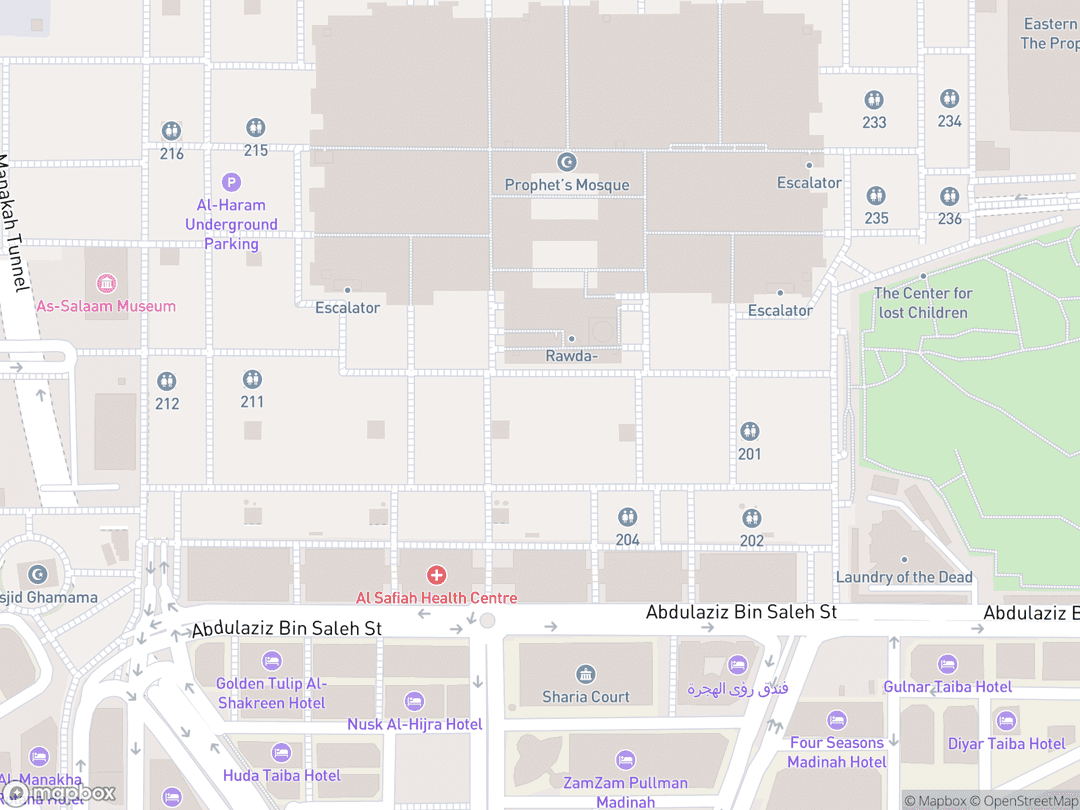
Al Haram, Al-Medinah 42311, Saudi Arabia
Hours: Open 24 hours daily
Getting There: Easily accessible by taxi or bus from Medina's city center and the airport.
Get DirectionsTips for Your Visit
Best Times to Visit
Visit just after Fajr (dawn prayer) or during mid-morning on weekdays for a quieter experience.
Dress Code
Ensure modest dress: women should cover their hair, and both men and women should wear loose-fitting clothing.
Respectful Conduct
Maintain a respectful and quiet demeanor inside the mosque.
About
Al-Masjid an-Nabawi, also known as the Prophet's Mosque, stands as one of Islam's most sacred and historically significant mosques. Located in Medina, Saudi Arabia, it holds immense spiritual importance for Muslims worldwide as the second holiest site in Islam, after the Masjid al-Haram in Mecca. The mosque is revered as the final resting place of Prophet Muhammad (peace be upon him), and its establishment marks a pivotal moment in Islamic history.
The mosque's origins trace back to 622 CE (1 AH) when Prophet Muhammad arrived in Medina after the Hijrah (migration from Mecca). He personally oversaw the construction of the original mosque, a simple structure made of mud bricks, palm trunks, and a thatched roof. This humble building served not only as a place of worship but also as a community center, a court, and a religious school, laying the foundation for the flourishing Muslim community in Medina.
Over the centuries, Al-Masjid an-Nabawi has undergone numerous expansions and renovations, reflecting the evolving architectural styles and the devotion of successive Islamic rulers. From the Umayyad and Abbasid caliphs to the Ottoman sultans and the Saudi monarchs, each era has left its mark on the mosque's design and grandeur. Today, the mosque stands as a vast complex, blending historical elements with modern amenities to accommodate millions of worshippers annually.
Al-Masjid an-Nabawi continues to be a vibrant center of Islamic life, attracting pilgrims and visitors from all corners of the globe. Its serene atmosphere, rich history, and profound spiritual significance make it an essential destination for Muslims seeking to connect with their faith and honor the legacy of Prophet Muhammad. The mosque serves as a reminder of the enduring values of Islam: peace, compassion, and devotion to Allah.
Gallery
Symbolic Elements
The temple's exterior features intricate carvings, each rich with spiritual meaning:

The Green Dome
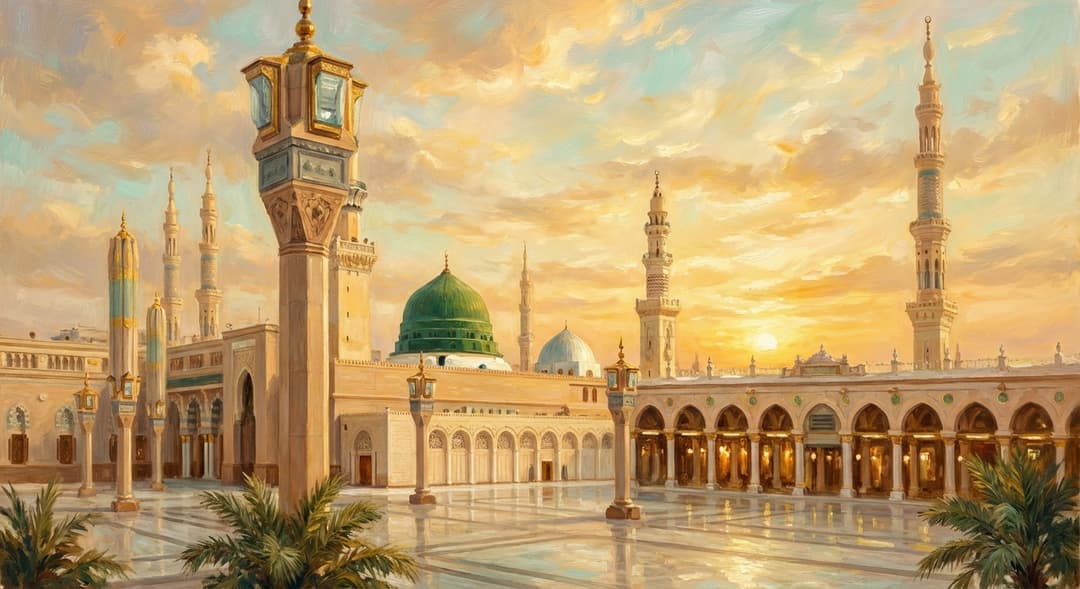
The Green Dome is a distinctive feature of Al-Masjid an-Nabawi, located in the southeast corner of the mosque. It marks the tomb of Prophet Muhammad (peace be upon him) and early Muslim Caliphs, Abu Bakr and Umar. The dome is a symbol of Medina and a focal point of reverence for Muslims.
The Minarets
Al-Masjid an-Nabawi features ten towering minarets, each soaring over 100 meters in height. These minarets serve as guiding beacons for worshippers and symbolize a connection to Allah and the call to prayer that unites Muslims worldwide. They are architectural marvels that enhance the mosque's grandeur.
The Rawdah ash-Sharifah
The Rawdah ash-Sharifah, also known as Riyad-ul-Jannah (Garden of Paradise), is a particularly sacred area within the mosque. Located between the Prophet's tomb and his pulpit (minbar), it is considered a part of paradise. Praying in this area is believed to bring great blessings and spiritual rewards.

The Mihrab
The Mihrab is a niche in the wall of the mosque that indicates the direction of the Kaaba in Mecca, towards which Muslims pray. It is an essential architectural element in mosques, symbolizing the unity of the Muslim community in their devotion to Allah. The Mihrab in Al-Masjid an-Nabawi is richly decorated and holds great significance.

The Courtyard Umbrellas
The large retractable umbrellas in the courtyard of Al-Masjid an-Nabawi provide shade and comfort for visitors, especially during hot weather. These umbrellas are not only functional but also add to the aesthetic appeal of the mosque. They symbolize the care and consideration given to the comfort of worshippers.

The Qibla Wall
The Qibla Wall is the wall in the mosque that faces the Kaaba in Mecca, indicating the direction of prayer for Muslims. It is a central element in the mosque's design and orientation. The Qibla Wall in Al-Masjid an-Nabawi is adorned with intricate designs and calligraphy, reflecting its importance.

The Sliding Domes
Al-Masjid an-Nabawi features 27 sliding domes on its roof, which can be opened to allow natural light and ventilation. These domes are an innovative architectural feature, blending traditional design with modern technology. They symbolize the mosque's adaptability and commitment to providing a comfortable environment for worshippers.

The Marble Columns
The interior of Al-Masjid an-Nabawi is adorned with numerous marble columns, which support the structure and add to its grandeur. These columns are crafted with intricate designs and reflect the mosque's rich architectural heritage. They symbolize strength, stability, and the enduring nature of the Islamic faith.
Interesting Facts
Al-Masjid an-Nabawi is the second-largest mosque in the world.
It can accommodate more than 3.2 million worshippers during peak seasons.
The land where the mosque was built was purchased from two orphan brothers.
The Green Dome was first painted green in 1837.
In 1909, it was the first place in the Arabian Peninsula to have electric lights.
The mosque features 27 movable domes with technologies like ventilation and light management.
The mosque has ten minarets, each 104 meters high.
It is believed that Allah rewards pilgrims for praying at Al-Masjid an-Nabawi a thousand times more than praying at other mosques.
The world's largest hand-knotted carpet, weighing around 35 tons, can be witnessed at the mosque.
The Prophet's Mosque is equipped with 1000 speakers, allowing the Azaan to be heard for up to 6.2 miles (10 kilometers).
Common Questions
What is the significance of Al-Masjid an-Nabawi?
Al-Masjid an-Nabawi is the second holiest site in Islam, revered as the final resting place of Prophet Muhammad (peace be upon him). It holds immense spiritual importance for Muslims worldwide and is a major pilgrimage destination.
Are non-Muslims allowed inside Al-Masjid an-Nabawi?
Non-Muslims are generally not allowed inside the main prayer hall of Al-Masjid an-Nabawi. However, they may be permitted in certain areas outside the prayer hall.
What is the dress code for visiting Al-Masjid an-Nabawi?
Modest dress is required for both men and women. Women should cover their hair and wear loose-fitting clothing that covers their arms and legs. Men should also avoid wearing shorts and sleeveless shirts.
What is the Rawdah ash-Sharifah?
The Rawdah ash-Sharifah (also known as Riyad-ul-Jannah) is a particularly sacred area located between the Prophet's tomb and his pulpit (minbar). It is considered a part of paradise, and praying here is a great blessing.
What are the best times to visit Al-Masjid an-Nabawi for a quieter experience?
The best times to visit for a quieter experience are just after Fajr (dawn prayer) or during mid-morning on weekdays.
How accessible is Al-Masjid an-Nabawi?
Al-Masjid an-Nabawi is easily accessible by taxi or bus from Medina's city center and the airport, making it convenient for visitors from around the world.
Related Stories
Explore the rich history, traditions, and people connected to this sacred site.
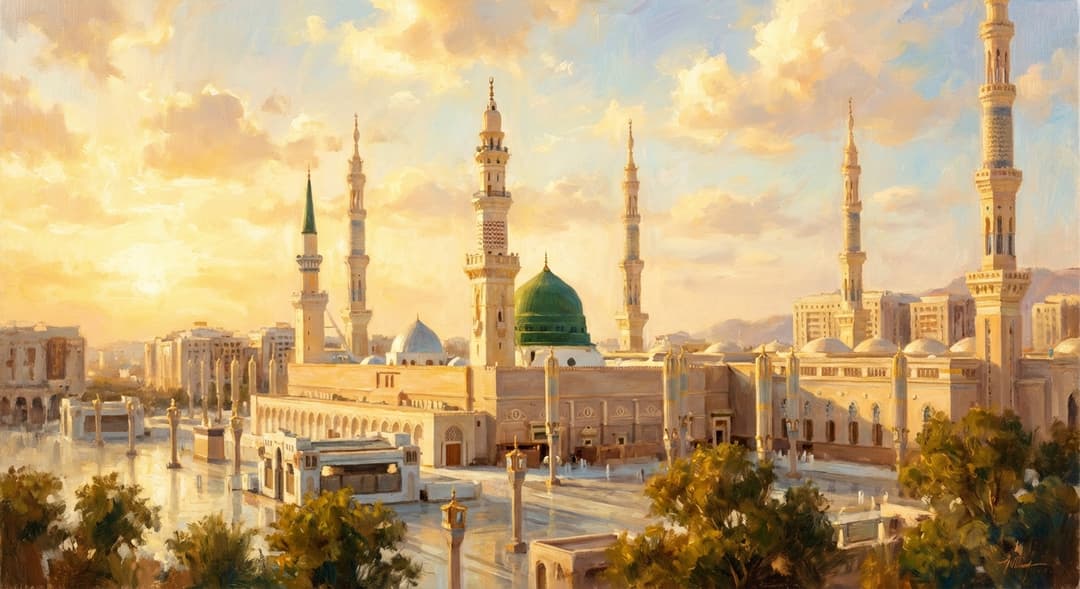 Notable Figure
 The Life of Prophet Muhammad
A comprehensive overview of the Prophet's life, teachings, and legacy, shaping the foundations of Islam.
Explore Story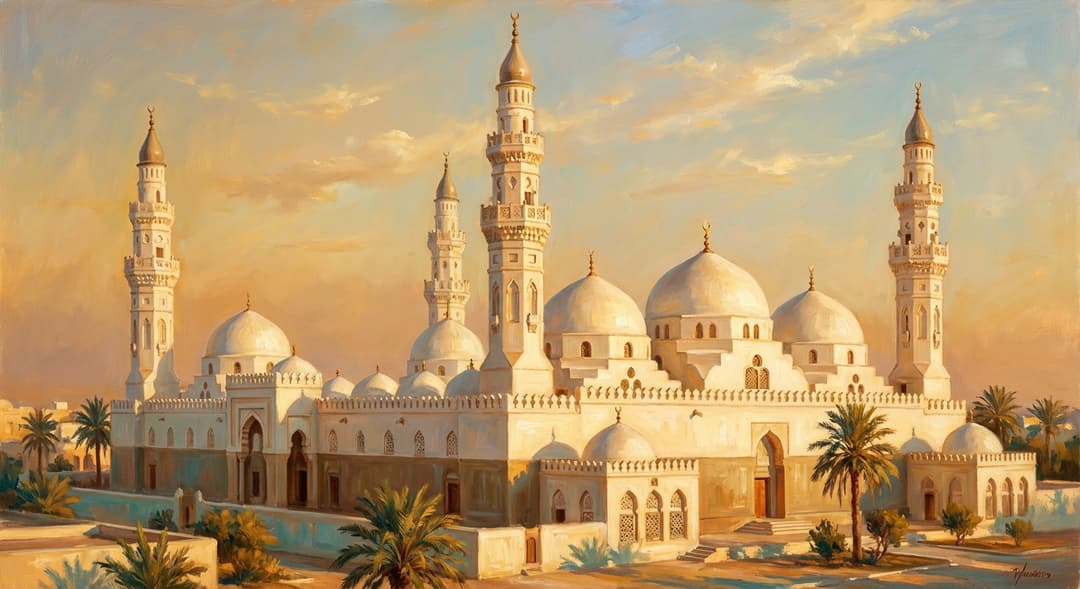 Location
 Construction of the Quba Mosque
The first mosque built by Prophet Muhammad upon his arrival in Medina, symbolizing the beginning of Islamic architecture.
Explore Story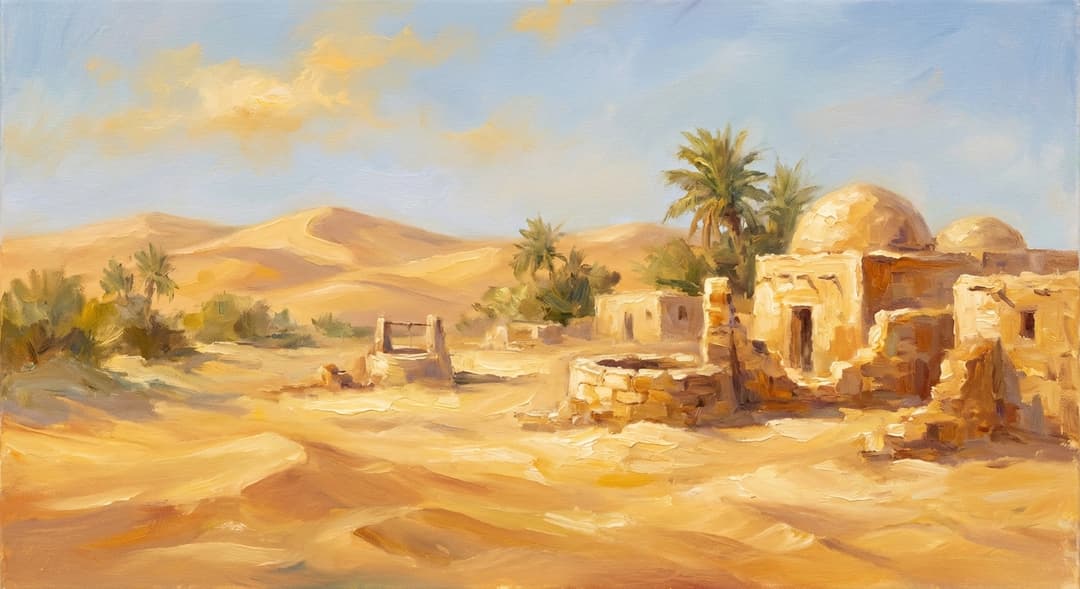 Historic Event
 The Battle of Badr
A pivotal battle in Islamic history that took place near Medina, shaping the early Muslim community.
Explore StoryFeatured Stories
The Hijrah and the Founding of the Mosque
622 CE (1 AH)
In the year 622 CE, Prophet Muhammad (peace be upon him) and his followers embarked on the Hijrah, a pivotal migration from Mecca to Medina. Upon arriving in Medina, the Prophet sought to establish a place of worship and community gathering. He purchased land from two young orphans, Sahl and Suhayl, and personally participated in the construction of the first mosque. This humble structure, built with mud bricks, palm trunks, and a thatched roof, marked the beginning of Al-Masjid an-Nabawi and the foundation of the Muslim community in Medina.
The construction of the mosque was a collaborative effort, with the Prophet and his companions working side by side. The mosque served not only as a place of prayer but also as a center for social, political, and educational activities. It was here that the Prophet delivered sermons, resolved disputes, and guided the early Muslims in their faith. The establishment of Al-Masjid an-Nabawi transformed Medina into a thriving Islamic center and laid the groundwork for the spread of Islam.
Source: Madainproject.com
The Expansion under Caliph Umar ibn al-Khattab
638–639 CE (17 AH)
As the Muslim community grew in Medina, the original mosque became too small to accommodate the increasing number of worshippers. During the caliphate of Umar ibn al-Khattab, the mosque underwent its first major expansion. Umar recognized the need to provide more space for the faithful and initiated a project to enlarge the mosque's area. This expansion involved acquiring adjacent land and incorporating it into the mosque's structure. The expansion under Umar ibn al-Khattab significantly increased the mosque's capacity and enhanced its role as a central gathering place for the Muslim community.
The expansion was carefully planned and executed, preserving the original character of the mosque while adding new features to accommodate the growing number of worshippers. The project reflected Umar's commitment to serving the needs of the Muslim community and ensuring that Al-Masjid an-Nabawi remained a vibrant center of Islamic life. This expansion set a precedent for future renovations and expansions, ensuring that the mosque could continue to serve its vital role in the Muslim world.
Source: Visitalmadinah.com
The Introduction of Electric Lights in 1909
1909 CE
In 1909, during the reign of Ottoman Sultan Abdul Hamid II, Al-Masjid an-Nabawi became the first place in the Arabian Peninsula to be provided with electric lights. This marked a significant milestone in the mosque's history, bringing it into the modern era. The introduction of electric lights not only enhanced the mosque's aesthetic appeal but also improved its functionality, allowing worshippers to pray and visit the mosque at any time of day. The installation of electric lights was a testament to the mosque's enduring importance and its ability to adapt to changing times.
The introduction of electric lights was met with great enthusiasm by the Muslim community in Medina. The lights illuminated the mosque's intricate designs and created a serene atmosphere for prayer and reflection. The event symbolized progress and modernization, demonstrating the mosque's commitment to providing the best possible experience for its visitors. The electric lights transformed Al-Masjid an-Nabawi into a beacon of light, both literally and figuratively, shining brightly as a symbol of faith and progress.
Source: Islamiclandmarks.com
Timeline
Establishment of the Mosque
Prophet Muhammad (peace be upon him) establishes and builds the original mosque upon arriving in Medina after the Hijrah.
MilestoneReplacement of the Minbar
A three-stepped minbar (pulpit) with a backboard replaces the original wood block minbar.
EventFirst Expansion
The first expansion of the mosque occurs under Caliph Umar ibn al-Khattab to accommodate the growing Muslim population.
RenovationReconstruction by Uthman ibn Affan
Caliph Uthman ibn Affan reconstructs the mosque, replacing palm trunks with stone columns and using better quality materials.
RenovationExpansion by Al-Walid I
During the Umayyad Caliph Al-Walid I, Umar ibn Abd al-Aziz vastly expands the mosque, adding the houses of the Prophet's wives and the house of Lady Fatima.
RenovationExpansion by Al-Mahdi
The Abbasid caliph Al-Mahdi expands the mosque by 2,450 square meters and increases the number of columns and gates.
RenovationConstruction of the First Dome
The first dome is built over the tomb of Prophet Muhammad by Mamluk Sultan Al Mansur Qalawun.
MilestoneFire Damage and Restoration
A major fire damages the mosque and dome, prompting a restoration project initiated by Sultan Qaitbay.
RenovationRebuilding of the Dome
The dome is rebuilt in brick and painted green during the reign of Ottoman Sultan Mahmud II.
RenovationIntroduction of Electric Lights
Under the reign of Ottoman Sultan Abdul Hamid II, the Prophet's Mosque becomes the first place in the Arabian Peninsula to be provided with electric lights.
MilestoneUpgrades under King Abdulaziz Al Saud
Upgrades to Masjid al Nabawi occur under the reign of Saudi King Abdulaziz Al Saud, and the dome is replaced with a silver one.
RenovationFirst Saudi Expansion
The first Saudi expansion of Masjid al-Nabawi takes place, doubling the area of the earlier Ottoman mosque.
RenovationModern Reconstruction
The current plan of the mosque dates back to the early years of this decade, incorporating constructions from the late Ottoman era to early and modern Saudi periods.
RenovationMinaret Construction
Renovation project leads to the mosque having ten minarets in total which are 104 metres (341 feet) high.
RenovationContinuous Improvements
Continuous improvements and expansions are made to accommodate the growing number of visitors and enhance the facilities.
RenovationHistory by Decade
620s CE — Founding Era
The best of you are those who learn the Quran and teach it.
In 622 CE, Prophet Muhammad (peace be upon him) arrived in Medina and established the original mosque. This simple structure served as a community center, court, and religious school. The land was purchased from two orphans, Sahl and Suhayl, marking the beginning of Al-Masjid an-Nabawi's rich history.
630s CE — Early Expansions
I have seen the Messenger of Allah (ﷺ) praying in this mosque.
Following the Prophet's death in 632 CE, the mosque continued to serve as a central place of worship and community gathering. In 638-639 CE, Caliph Umar ibn al-Khattab initiated the first expansion to accommodate the growing Muslim population. This expansion solidified the mosque's importance in the expanding Islamic world.
640s CE — Reconstruction and Enhancement
He who builds a mosque for Allah, Allah will build for him likewise in Paradise.
In 649-650 CE, Caliph Uthman ibn Affan reconstructed the mosque, replacing palm trunks with stone columns and using better quality materials. This reconstruction enhanced the mosque's durability and aesthetic appeal, reflecting the growing prosperity of the Muslim community.
700s CE — Umayyad Expansion
We must expand this mosque to accommodate all the worshippers.
During the Umayyad Caliph Al-Walid I, Umar ibn Abd al-Aziz vastly expanded the mosque between 706 and 712 CE. The houses of the Prophet's wives and the house of Lady Fatima were added to the mosque, further enhancing its significance and historical value.
770s CE — Abbasid Additions
Let us make this mosque a grand symbol of our faith.
The Abbasid caliph Al-Mahdi expanded the mosque by 2,450 square meters between 777 and 779 CE, increasing the number of columns and gates. This expansion reflected the Abbasid dynasty's commitment to supporting Islamic institutions and promoting religious devotion.
1270s CE — Dome Construction
A dome shall be built to honor the Prophet's tomb.
In 1279-1280 CE, the first dome was built over the tomb of Prophet Muhammad by Mamluk Sultan Al Mansur Qalawun. This dome marked a significant architectural addition, symbolizing the reverence and respect for the Prophet's final resting place.
Architecture & Facilities
Islamic architecture spanning 1,400 years of continuous expansion and renovation, evolving from Prophet Muhammad's original simple mud-brick, palm-trunk, and thatched-roof structure (622 CE) into one of the world's largest mosques. The current complex features a rectangular two-level design crowned by 27 mechanically sliding domes on square bases and flanked by ten minarets each soaring 104 meters high. The iconic Green Dome — first built in 1279 by Mamluk Sultan Al Mansur Qalawun and painted green in 1837 under Ottoman Sultan Mahmud II — marks the tomb chamber of Prophet Muhammad, Abu Bakr, and Umar. The Rawdah ash-Sharifah (Garden of Paradise), between the Prophet's tomb and minbar, is among Islam's most revered spaces. Successive Ottoman and Saudi expansions have blended traditional Islamic motifs with modern engineering, including automated climate-controlled dome mechanisms.
Building Materials
Exterior
Marble, stone, and concrete, reflecting a blend of historical and modern construction techniques.
Interior
Marble columns, intricate mosaics, and ornate calligraphy, creating a serene and awe-inspiring atmosphere.
Interior Features
The Rawdah ash-Sharifah
A sacred area between the Prophet's tomb and his pulpit, adorned with green carpets and revered as a part of paradise.
The Main Prayer Hall
A vast space with high ceilings, marble floors, and intricate decorations, accommodating thousands of worshippers.
Temple Grounds
Expansive courtyards with retractable umbrellas, providing shade and comfort for visitors.
Additional Facilities
Modern facilities for conferences and educational programs, promoting Islamic knowledge and understanding.
Religious Significance
Al-Masjid an-Nabawi holds immense religious significance for Muslims as the second holiest site in Islam and the final resting place of Prophet Muhammad (peace be upon him).
To provide a sacred space for prayer, reflection, and community gathering, honoring the legacy of Prophet Muhammad and promoting Islamic values.
Sacred Ordinances
Prayer
Praying in Al-Masjid an-Nabawi is considered a great blessing, with rewards multiplied compared to praying in other mosques.
Visiting the Prophet's Tomb
Paying respects at the tomb of Prophet Muhammad is a deeply spiritual experience for Muslims, connecting them to the Prophet's teachings and legacy.
The Importance of Medina
Medina is revered as the city that welcomed Prophet Muhammad and his followers after the Hijrah, becoming the center of the early Muslim community. Al-Masjid an-Nabawi symbolizes Medina's pivotal role in Islamic history.
The Significance of the Rawdah
The Rawdah ash-Sharifah is considered a part of paradise, and praying in this area is believed to bring great blessings and spiritual rewards. It is a focal point of reverence and devotion for Muslims visiting the mosque.
Similar Temples
Sources & Research
Every fact on Temples.org is backed by verified Sources & Research. Each piece of information is rated by source tier and confidence level.
View All Sources (10)
| Field | Source | Tier | Retrieved |
|---|---|---|---|
| General Information | Madainproject.com (opens in a new tab) | B | 2026-02-13 |
| Historical Significance | csmadinah.com (opens in a new tab) | A | 2026-02-13 |
| Architectural Details | Riwaya.co.uk (opens in a new tab) | C | 2026-02-13 |
| Visitor Information | Roamsaudi.com (opens in a new tab) | C | 2026-02-13 |
| Expansion History | Visitalmadinah.com (opens in a new tab) | A | 2026-02-13 |
| Religious Importance | Learnreadquran.com (opens in a new tab) | A | 2026-02-13 |
| Modern Amenities | Callforumrah.com (opens in a new tab) | C | 2026-02-13 |
| Establishment Date | Wafyapp.com (opens in a new tab) | C | 2026-02-13 |
| General Overview | Audiala.com (opens in a new tab) | B | 2026-02-13 |
| Mosque Details | Thepilgrim.co (opens in a new tab) | C | 2026-02-13 |