Visitor Insights
Visiting St. Paul's Cathedral
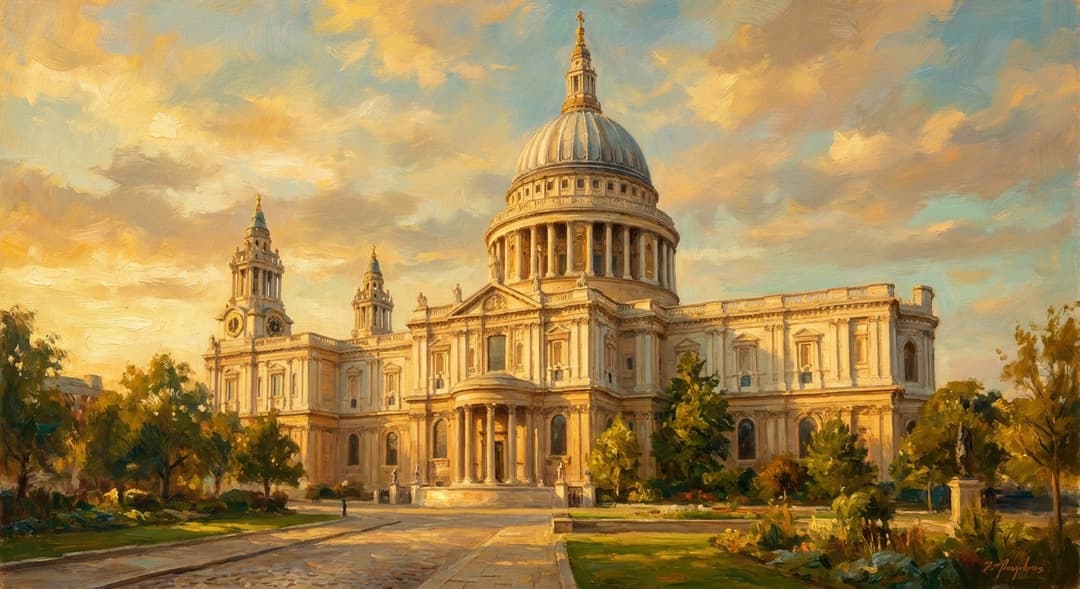
Visitors to St. Paul's Cathedral can explore the light-filled nave, historic crypt, and climb to the dome galleries. The site offers rich architectural history, sacred monuments, and sweeping views of London.
Highlights
- Climb 257 steps to the Whispering Gallery for famous acoustic reflections.
- Ascend to the outdoor Stone and Golden Galleries for panorama views of London.
- Explore the crypt, the final resting place of Sir Christopher Wren, Nelson, and Wellington.
- Attend Choral Evensong to experience the cathedral's acoustic grandeur.
Things to Know
- Sightseeing is closed on Sundays for religious worship services.
- Climbing the upper dome galleries requires walking narrow spiral stone stairs.
Location
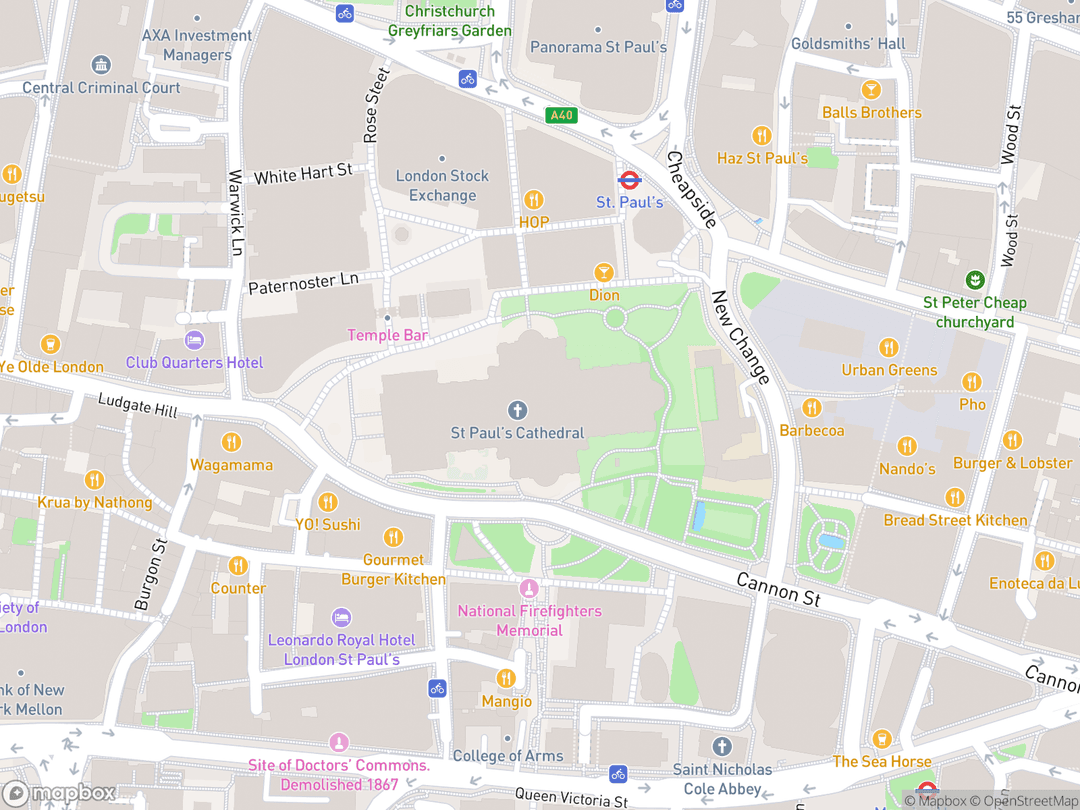
Ludgate Hill, City of London, London EC4M 8AD, United Kingdom
Hours: Monday–Saturday: 8:30 AM – 4:30 PM (Wednesdays open at 10:00 AM); Sunday: Worship only
Getting There: Located at Ludgate Hill. Nearest Tube stations are St. Paul's (Central Line) and Mansion House (District & Circle Lines).
Get DirectionsTips for Your Visit
Attend Evensong
Choral Evensong takes place late afternoon and is free to attend without a entry ticket.
Early Morning Visits
Arrive at 8:30 AM on weekday mornings to view the nave and crypt before tour groups arrive.
About
St. Paul's Cathedral stands as an enduring emblem of London's spiritual life and architectural triumph. Designed by Sir Christopher Wren following the Great Fire of London in 1666, this English Baroque landmark crowns Ludgate Hill, the highest point in the City of London. Its iconic dome has defined the skyline for over three centuries.
Serving as the mother church of the Diocese of London and the seat of the Bishop of London, the cathedral blends grand Classical proportions with Protestant liturgical purpose. Beyond its role in regular Anglican worship, St. Paul's has hosted royal weddings, state funerals, and national thanksgiving ceremonies throughout British history.
Gallery
Symbolic Elements
The temple's exterior features intricate carvings, each rich with spiritual meaning:

Golden Cross and Orb
Perched atop the lantern, the orb and cross symbolize Christ's dominion over the earthly world.

The Phoenix Resurgam
Carved into the South Door pediment, the rising phoenix signifies Christ's Resurrection and rebirth from ashes.

Triple-Shell Dome Structure
Wren's engineering innovation nested three domes to achieve both interior proportions and skyline height.

Whispering Gallery
An acoustic circular gallery where sound waves reflect continuously along smooth stone walls.

Geometrical Staircase
A cantilevered stone spiral staircase projecting directly from wall masonry without central pillars.

High Altar Baldachino
A gilded oak canopy erected above the altar to symbolize divine shelter and protective presence.

Grinling Gibbons Choir Carvings
Detailed lime-wood cherubs and foliage expressing creation praising God during cathedral liturgy.
Interesting Facts
Sir Christopher Wren's epitaph in the crypt reads 'Reader, if you seek his monument, look around you'. (Tier A)
Wren was inspired to carve the word RESURGAM after a workman brought him a broken tombstone fragment. (Tier A)
The dome's 365-foot height was chosen by Wren to symbolize the days of a calendar year. (Tier B)
Volunteer watchmen extinguished 28 incendiary bombs on the cathedral roof during the 1940 Blitz. (Tier A)
The cathedral's Great Paul bell weighs 16.5 metric tons and is the heaviest church bell in the UK. (Tier A)
St. Paul's includes an American Memorial Chapel honoring 28,000 U.S. service personnel killed in WWII. (Tier A)
The current structure is the fifth cathedral built on Ludgate Hill after four predecessors burned. (Tier B)
Protected planning sightlines legally prevent London skyscrapers from blocking views of the dome. (Tier B)
Common Questions
How tall is St. Paul's Cathedral?
The total height from street level to the cross atop the lantern is 365 feet (111 meters).
Who built St. Paul's Cathedral?
It was designed by Master Architect Sir Christopher Wren following the Great Fire of London.
Can you climb to the top of the dome?
Yes, visitors can climb 528 steps through internal staircases to reach the Golden Gallery.
Is St. Paul's an active church?
St. Paul's is an active Anglican cathedral hosting daily services and special national events.
Featured Stories
St. Paul's Watch and the Blitz
December 29, 1940
During World War II, Prime Minister Winston Churchill declared that St. Paul's Cathedral must be saved at all costs. A civilian volunteer corps called St. Paul's Watch patrolled the roofs night after night, extinguishing 28 incendiary bombs that struck the dome. Their courage preserved Wren's cathedral as an iconic symbol of resilience during London's darkest hours.
Source: St. Paul's Cathedral Official History
The Omen of the Resurgam Stone
June 21, 1675
While laying out the dimensions of the new central dome amidst medieval ruins, Christopher Wren asked a worker to fetch a stone from the rubble. The piece returned was a broken gravestone containing a single Latin word: RESURGAM, meaning 'I shall rise again'. Wren adopted the phrase as a guiding theme, enshrining it above the cathedral's southern portico.
Source: Cathedral Archives
The Royal Wedding of 1981
July 29, 1981
St. Paul's Cathedral hosted the historic royal wedding of Prince Charles and Lady Diana Spencer, broadcast to over 750 million viewers worldwide. Chosen for its unmatched seating capacity and majestic nave aisles, the cathedral provided a spectacular setting for the grand procession. The event highlighted St. Paul's modern role as the ceremonial heart of the United Kingdom.
Source: Diocese of London Historical Records
Timeline
First Saxon Cathedral
King Æthelberht of Kent builds the first wooden cathedral on Ludgate Hill dedicated to Paul the Apostle.
component.timeline.groundbreakingOld St. Paul's Construction Begins
Bishop Maurice initiates a massive Norman Romanesque cathedral following a destructive fire.
EventMedieval Spire Completed
A soaring lead-clad timber spire is added, making Old St. Paul's one of Europe's tallest structures.
MilestoneSpire Destroyed by Lightning
A lightning strike ignites the wooden spire, destroying it permanently prior to the Great Fire.
EventThe Great Fire of London
The Great Fire guts Old St. Paul's, clearing the way for Sir Christopher Wren's modern rebuilding.
EventFoundation Stone Laid
Construction begins on Wren's approved English Baroque design following site clearance.
component.timeline.groundbreakingFirst Service in Choir
The cathedral choir opens for divine service on Thanksgiving for the Peace of Ryswick.
DedicationFinal Stone Placed
Wren's son lays the top stone on the lantern, completing the outer cathedral structure.
MilestoneBlitz Preservation
Volunteer watchmen protect the cathedral roof from dozens of incendiary bombs during World War II.
EventRoyal Wedding
Prince Charles and Lady Diana Spencer marry at St. Paul's before a global TV audience of 750 million.
EventHistory by Decade
600s–1000s — Early Saxon and Viking Foundations
The first cathedral was built in timber on Ludgate Hill in 604 by King Æthelberht of Kent for St. Mellitus. After repeated fires and destructive Viking raids, successive stone structures were built to maintain the seat of London's bishop.
1080s–1310s — The Era of Old St. Paul's
Following the fire of 1087, Bishop Maurice initiated construction of a massive Norman Romanesque cathedral. Expanded with a Gothic choir and completed in 1315 with a 488-foot spire, Old St. Paul's stood among medieval Europe's tallest buildings.
1560s–1650s — Spire Loss and Civil War Neglect
In 1561, lightning destroyed the cathedral spire, which was never rebuilt despite Classical porch additions by Inigo Jones in the 1630s. During the English Civil War, Parliamentarians confiscated revenues and stabled cavalry horses inside the nave.
1660s–1710s — Reconstruction under Christopher Wren
The Great Fire of London in September 1666 ruined Old St. Paul's, prompting King Charles II to commission Sir Christopher Wren. Wren designed an English Baroque landmark featuring a triple-shell dome, culminating in completion in October 1710.
1940s — Survival in the London Blitz
During World War II, St. Paul's became a symbol of British defiance as the volunteer St. Paul's Watch extinguished incendiary bombs falling on the roof. Although direct bomb strikes destroyed the Victorian altar, the dome remained standing.
1980s–Present — Modern Restoration and National Ceremonies
The cathedral hosted major national events including the 1981 wedding of Prince Charles and Lady Diana Spencer and royal jubilees. A comprehensive £40-million restoration completed in 2011 cleaned the Portland stone facade and internal mosaic vaults.
Architecture & Facilities
St. Paul's Cathedral represents the pinnacle of English Baroque architecture. Designed by Sir Christopher Wren, the church blends Italian High Renaissance geometry with French Classical proportions and ancient Roman details, creating an open auditory floor plan centered around a massive triple-shell dome.
Building Materials
Portland Limestone
Quarried in Dorset and used for all exterior facade walls, columns, and structural decorative carvings.
Oxfordshire Stone and Brick
Utilized for inner wall cores, crypt vaulting, and the internal load-bearing brick cone.
Wrought Iron
Formed into a structural tension chain around the dome drum and forged into decorative Tijou gates.
English Oak and Lead
Constructs the outer dome timber framing clad entirely in protective sheets of milled lead.
Interior Features
The Choir and High Altar
Features carved lime-wood stalls by Grinling Gibbons and a gilded oak baldachino canopy.
The Crypt
A vast underground stone vault containing the tombs of Sir Christopher Wren, Lord Nelson, and Wellington.
The Whispering Gallery
A circular internal walkway at the dome base famous for acoustic sound reflections.
The Central Dome Oculus
An opening in the inner masonry dome revealing Sir James Thornhill's frescoes depicting St. Paul's life.
Temple Grounds
The cathedral is surrounded by paved plazas and churchyard gardens on Ludgate Hill, offering public walking paths aligned with London's urban street network.
Additional Facilities
Includes an underground visitor center, crypt exhibition galleries, souvenir shop, and the Wren restaurant located in the crypt vault.
Religious Significance
St. Paul's Cathedral serves as the seat of the Bishop of London and the mother church of the Anglican Diocese of London. Its theological design emphasizes open communion, clear preaching, and public engagement.
To offer daily prayer, celebrate the Sacraments, proclamation of the Gospel, and host services of national thanksgiving.
Sacred Ordinances
Holy Communion
Celebrated daily at the central altar as the principal act of Anglican worship.
Choral Evensong
A daily liturgical service combining scripture readings, psalmody, and cathedral choir singing.
Holy Baptism and Confirmation
Sacramental rites performed regularly for members of the local and diocesan community.
The Anglican Via Media
Wren designed St. Paul's as an auditory church where clear sightlines to the altar and unhindered acoustics reflect the Reformed Anglican synthesis of Word and Sacrament.
Similar Temples
Sources & Research
Every fact on Temples.org is backed by verified Sources & Research. Each piece of information is rated by source tier and confidence level.
View All Sources (9)
| Field | Source | Tier | Retrieved |
|---|---|---|---|
| About & Historical Background | St. Paul's Cathedral (opens in a new tab) | A | 2026-02-01 |
| Timeline & Key Events | London Museum (opens in a new tab) | B | 2026-02-01 |
| Architecture & Facilities | Encyclopædia Britannica (opens in a new tab) | B | 2026-02-01 |
| Architecture & Facilities | Buffalo Architecture and History (opens in a new tab) | B | 2026-02-01 |
| Religious Significance & Symbols | Carleton College (opens in a new tab) | B | 2026-02-01 |
| Timeline & Key Events | RTF Media (opens in a new tab) | C | 2026-02-01 |
| Featured Stories | The Guardian (opens in a new tab) | C | 2026-02-01 |
| Architecture & Facilities | Studio MatRx (opens in a new tab) | C | 2026-02-01 |
| Visitor Insights | Tootbus London (opens in a new tab) | D | 2026-02-01 |