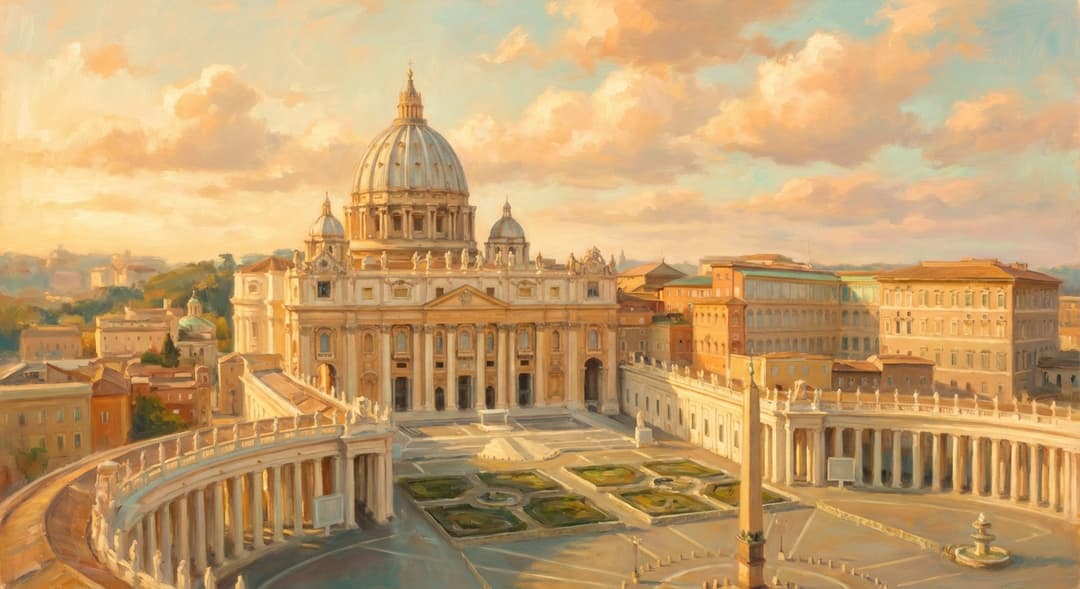
The Sacred Hill Across Centuries
Rising on the right bank of the Tiber River in Rome, Vatican Hill (known in Latin as Mons Vaticanus) has stood as a geographic anchor of religious devotion for over two millennia. Today, it is recognized globally as the Vatican City State — the smallest independent nation in the world and the spiritual and administrative headquarters of the Roman Catholic Church.
However, long before the rise of Christianity, the hill held a sacred mystique. Ancient Etruscans associated the area with a prophetic deity named Vatika, using it for divination and grazing. Under the Roman Empire, the hill was developed into a place of imperial leisure, featuring the gardens of Agrippina and the famous Circus of Caligula and Nero. It was this imperial circus that would set the course of Christian history, serving as the site of early Christian martyrdom, including the crucifixion of Saint Peter.
Constantine's Old Basilica
Following the legalization of Christianity under Emperor Constantine I in 313 CE, the emperor ordered the construction of a grand basilica over the burial site of Saint Peter. Consecrated in 324 CE, Old Saint Peter's Basilica was a monumental five-aisled structure that redefined Christian architecture, serving as the primary pilgrimage destination in Western Europe for over a thousand years.
The construction was a triumph of early engineering, requiring the leveling of the Roman necropolis on the hillside to build a stable foundation. For centuries, the Constantinian basilica stood as a physical manifestation of imperial patronage and Christian victory, hosting historic events like the coronation of Charlemagne as Holy Roman Emperor on Christmas Day in 800 CE.
The Renaissance Rebirth and Bramante's Plan
By the 15th century, the ancient Constantinian basilica had fallen into severe structural decay, prompting Pope Julius II to make the radical decision to demolish the thousand-year-old landmark and build a new, grander basilica. In 1506, he laid the foundation stone for the present Saint Peter's Basilica, commissioning Donato Bramante to design the new monument.
Bramante's original plan was a Greek cross (equal arms) crowned by a massive central dome inspired by the Pantheon. His design focused on perfect geometric symmetry, representing the harmony and order of the divine cosmos. While the plan was modified by subsequent architects, the four massive central piers Bramante constructed remain the structural core supporting the basilica's dome today.
Michelangelo's Dome and Bernini's Piazza
In 1546, at the age of 71, Michelangelo Buonarroti was appointed chief architect of the basilica. He simplified Bramante's plan, return to the centralized Greek cross, and designed the basilica's defining feature: the soaring double-shelled dome. Standing 136 meters tall, it remains the tallest dome in the world and serves as a beacon of faith visible across the Rome skyline.
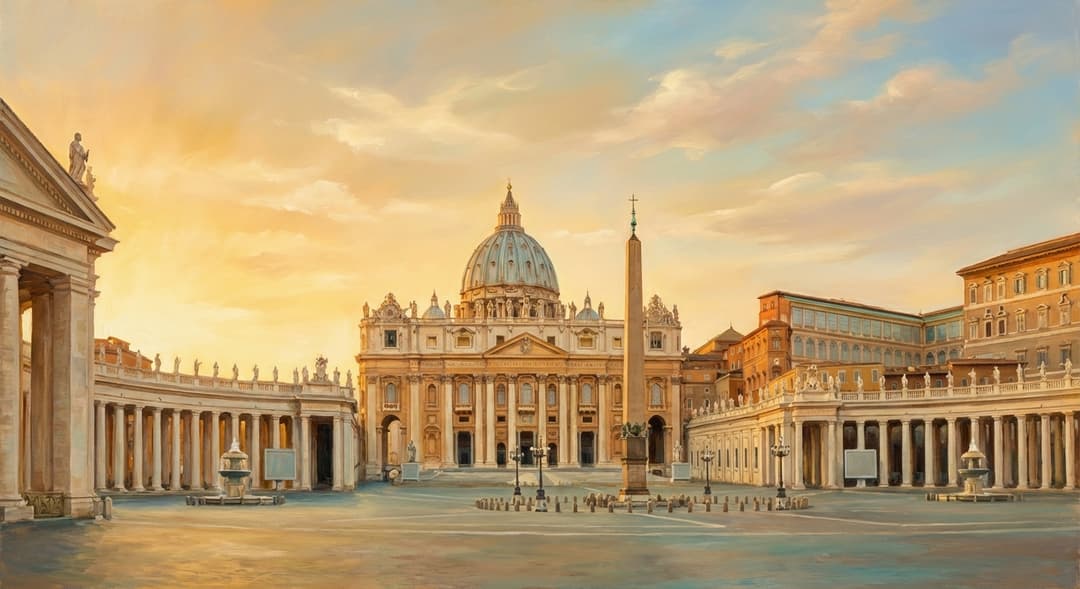
In the 17th century, Carlo Maderno extended the nave to create a Latin cross plan, accommodating larger congregations, and built the monumental travertine facade. Shortly after, Gian Lorenzo Bernini spent a decade designing Saint Peter's Square (Piazza San Pietro). His sweeping colonnade of 284 Doric columns was designed to represent the "motherly arms of the Church," welcoming pilgrims from around the world into a sacred enclosure.
Extraterritorial Extensions: St. Paul's
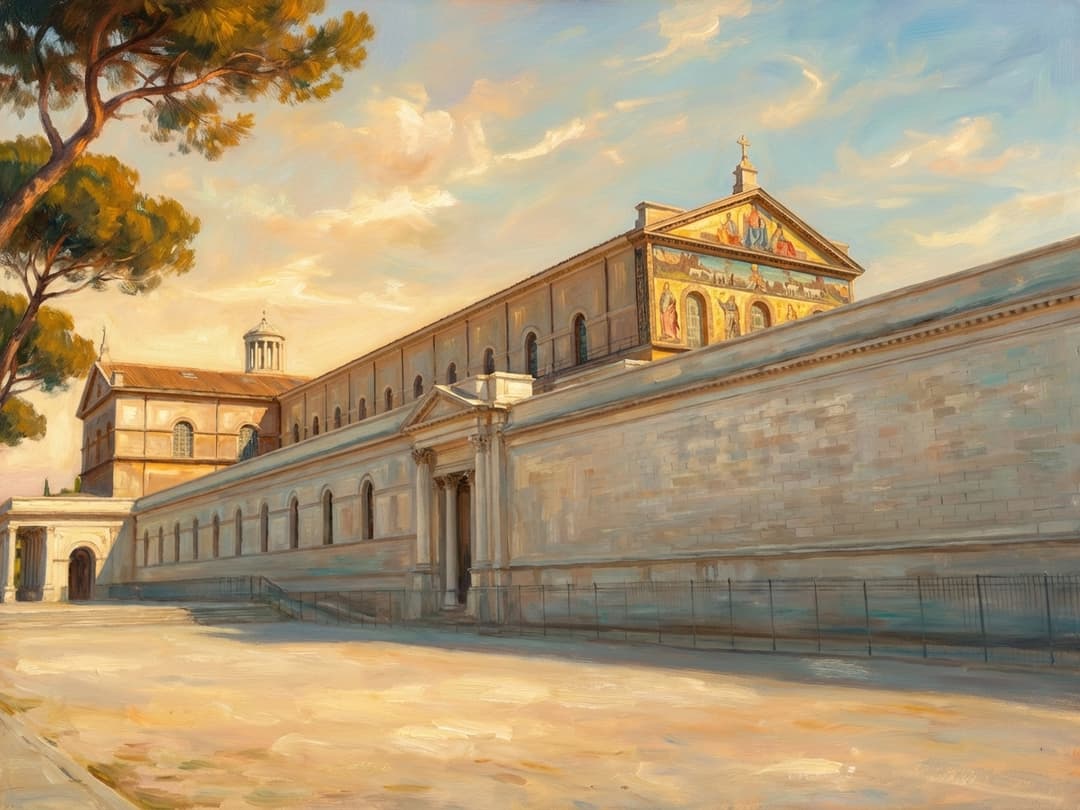
Vatican City's architectural influence extends beyond the walls of the city-state itself. Under the Lateran Treaty of 1929, several properties in Rome enjoy extraterritorial status, including the Basilica of Saint Paul Outside the Walls (San Paolo Fuori le Mura).
Originally built by Constantine over the tomb of Paul the Apostle, this major papal basilica mirrors the architectural grandness of Saint Peter's. Rebuilt in the Neoclassical style after a devastating fire in 1823, it features a vast nave with 80 granite columns and beautiful mosaic portraits of every pope. Together, Saint Peter's and Saint Paul's form a monumental architectural diptych, representing the foundational pillars of Roman Catholicism.
Related Temples
Sources & Research
Every fact on Temples.org is backed by verified Sources & Research. Each piece of information is rated by source tier and confidence level.
View All Sources (4)
| Field | Source | Tier | Retrieved |
|---|---|---|---|
| Architectural History of St. Peter's Basilica | Fabbrica di San Pietro in Vaticano (opens in a new tab) | A | 2026-05-28 |
| Vatican City: UNESCO World Heritage Listing | UNESCO World Heritage Centre (opens in a new tab) | B | 2026-05-28 |
| The Architecture of Gian Lorenzo Bernini | Encyclopaedia Britannica (opens in a new tab) | B | 2026-05-28 |
| Reconstruction of Saint Paul Outside the Walls | Holy See (opens in a new tab) | A | 2026-05-28 |