Visitor Insights
Visiting Santuário Nacional de Nossa Senhora Aparecida
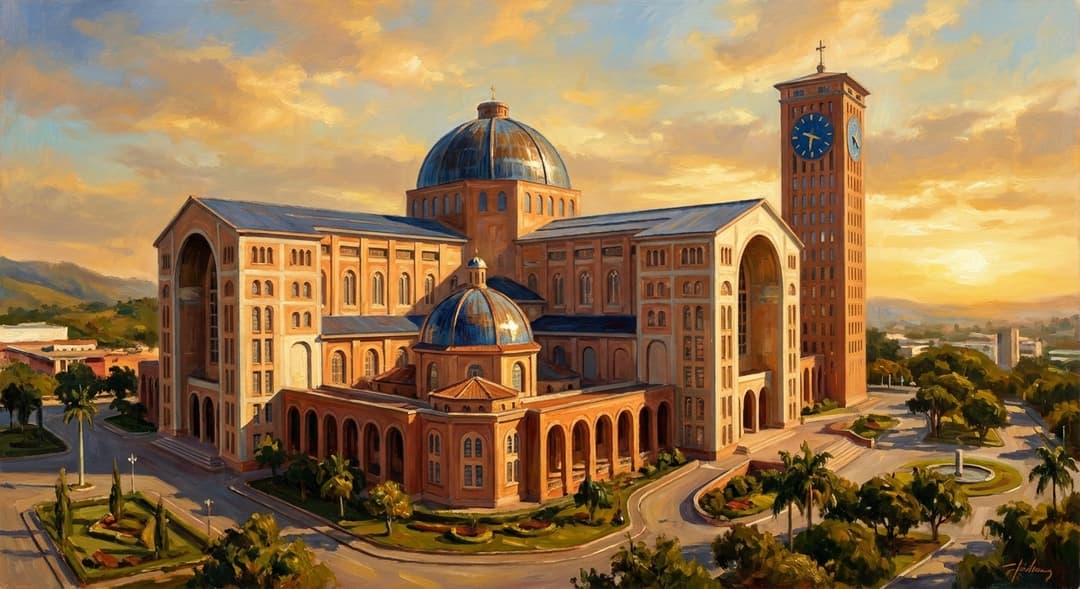
The National Sanctuary offers a profound pilgrimage experience with extensive infrastructure designed to serve millions of visitors. Pilgrims can view the miraculous original statue, explore sacred art, and visit underground prayer centers.
Highlights
- Nicho da Imagem housing the original 1717 terracotta statue of Our Lady of Aparecida
- The monumental 70-meter central dome adorned with Cláudio Pastro's Tree of Life mosaic
- Torre Brasília observation deck and museum offering panoramic views of the Paraíba Valley
- The 392-meter Passarela da Fé pedestrian bridge connecting the new and old basilicas
Things to Know
- October 12 is the national feast day, bringing over 200,000 pilgrims on a single day
- Weekdays (Tuesday to Thursday) offer shorter queues and a quieter atmosphere for reflection
Location
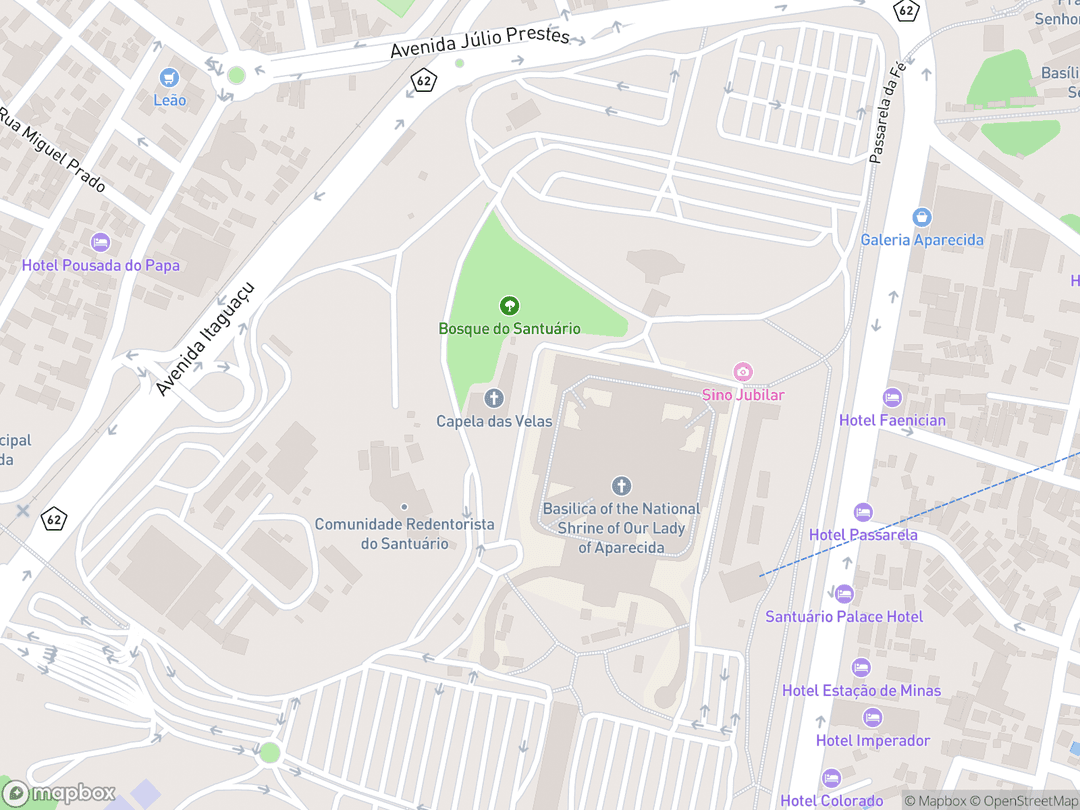
Av. Dr. Júlio Prestes, s/n – Centro, Aparecida - SP, 12570-000, Brazil
Hours: Monday to Friday: 6:00 AM – 8:00 PM; Saturday and Sunday: 5:00 AM – 8:00 PM
Getting There: Located along Rodovia Presidente Dutra (BR-116) midway between São Paulo and Rio de Janeiro; accessible via express bus to Aparecida bus terminal.
Get DirectionsTips for Your Visit
Statue Niche Queueing
Visit the statue niche early in the morning on weekdays to avoid extended wait times.
Exploring the Subsoil
Visit the lower floor to see the Sala dos Promessas museum and access visitor amenities.
Passarela da Fé Walk
Cross the pedestrian bridge on foot for a historic connection to the Old Basilica.
About
The Santuário Nacional de Nossa Senhora Aparecida stands as the spiritual heart of Brazilian Catholicism and the largest Marian shrine in the world. Rooted in the Abrahamic monotheistic tradition, this cathedral honors the Virgin Mary as an intercessor before Jesus Christ.
The sanctuary originated in October 1717 when three local fishermen retrieved a small, dark terracotta statue of the Virgin Mary from the Paraíba do Sul River. Their subsequent miraculous catch of fish sparked centuries of deep regional and national veneration.
Designed by architect Benedito Calixto de Jesus Neto in a monumental Neo-Romanesque Greek cross plan, the modern basilica was consecrated in 1980 by Pope John Paul II. It welcomes over 12 million pilgrims annually to its sacred halls.
Gallery
Symbolic Elements
The temple's exterior features intricate carvings, each rich with spiritual meaning:

Terracotta Image of Our Lady
The 36-centimeter dark terracotta statue symbolizes divine solidarity with Brazil's humble and oppressed populations.

Imperial Crown and Mantle
The jeweled gold crown and blue velvet mantle express Mary's royal patronage over the nation of Brazil.

Tree of Life Dome Mosaic
Cláudio Pastro's dome mosaic depicts the biblical Tree of Life surrounded by native South American fauna.

Torre Brasília Carillon
Thirteen bronze bells atop the 109-meter tower proclaim the apostolic witness across the valley.

Passarela da Fé Bridge
The curved footbridge symbolizes the enduring bridge of faith connecting centuries of Brazilian pilgrimage.

Native Granite High Altar
A single block of native Brazilian granite serves as the altar, grounding the Eucharist in local soil.

Exposed Red Clay Brickwork
Millions of unplastered red bricks reflect the earthy simplicity of the original miraculous terracotta image.
Interesting Facts
It is the second-largest Catholic church in the world by internal floor space after St. Peter's Basilica. (Tier A)
The statue was retrieved in two casts: first the headless body, then the head in the subsequent net pull. (Tier A)
Master conservator Maria Helena Chartuni restored the statue from 163 terracotta fragments over nine weeks in 1978. (Tier A)
The sanctuary has hosted three consecutive pontiffs: Pope John Paul II, Pope Benedict XVI, and Pope Francis. (Tier A)
Princess Isabel donated the diamond-set gold crown in 1888 to fulfill a personal vow made while seeking an heir. (Tier B)
A rubber-padded lane runs along the 392-meter Passarela da Fé for pilgrims traversing on their knees. (Tier B)
The sanctuary complex features the world's largest church parking lot, accommodating 2,000 buses and 6,000 cars. (Tier A)
With over 12 million annual visitors, it is the most visited religious pilgrimage site in the Americas. (Tier A)
The exterior walls are built with millions of unplastered custom red clay bricks honoring the humble statue. (Tier B)
Common Questions
What is the capacity of the Santuário Nacional de Aparecida?
The inner floor area accommodates between 45,000 and 75,000 worshippers, expanding to over 100,000 including outer plazas.
Why is the statue dark in color?
The terracotta statue darkened naturally over decades from river silt exposure and candle smoke.
How large is the basilica compared to other Catholic churches?
It is the second-largest Catholic church in the world by interior floor area after St. Peter's Basilica.
Can visitors see the original 1717 statue?
Yes, the original restored image is permanently displayed inside a climate-controlled golden niche.
Featured Stories
The Miracle in the Paraíba River
October 12, 1717
In October 1717, three fishermen tasked with obtaining fish for a royal governor's banquet pulled up a headless terracotta statue from the riverbed, followed by its head. Upon reuniting the fragments of Our Lady of Aparecida, their empty nets immediately overflowed with an extraordinary catch. This moment transformed a modest river discovery into the foundational miracle of Brazilian national devotion.
Source: Archdiocese of Aparecida Historical Records
The Restoration of 163 Fragments
May 16, 1978
When a disturbed visitor shattered the 18th-century statue into 163 fragments in 1978, grief swept across Brazil. Conservator Maria Helena Chartuni worked for nine intense weeks at the São Paulo Museum of Art using dental tools and specialized adhesives to reconstruct the fragile clay figure. Her seamless restoration allowed the beloved image to return safely to its sanctuary, renewed for future generations.
Source: São Paulo Museum of Art (MASP)
The Papal Consecration on Brazilian Soil
July 4, 1980
Pope John Paul II made history when he consecrated the massive unfinished basilica during his inaugural trip to Brazil. Speaking before hundreds of thousands of gathered faithful, he declared the shrine a Minor Basilica and a beacon of hope for South America. This papal visit cemented the sanctuary's global standing within the international Catholic Church.
Source: Vatican Publishing House
Timeline
Discovery in the Paraíba River
Three fishermen retrieve the dark terracotta statue of Our Lady of Aparecida from the river.
MilestoneFirst Chapel Dedication
The first formal public chapel built of rammed earth is dedicated on Morro dos Coqueiros.
DedicationOld Basilica Consecration
The historic Old Basilica opens following Princess Isabel's gift of a diamond-encrusted gold crown.
DedicationCanonical Coronation
Pope Pius X decrees the formal canonical coronation of the statue of Our Lady of Aparecida.
MilestoneDeclared Patroness of Brazil
Pope Pius XI officially proclaims Our Lady of Aparecida as the primary Patroness of Brazil.
MilestoneGroundbreaking for New Basilica
Construction begins on the monumental Neo-Romanesque Greek cross basilica designed by Calixto Neto.
component.timeline.groundbreakingFirst Golden Rose Bestowed
Pope Paul VI presents a Golden Rose to the sanctuary on the 250th anniversary of the discovery.
MilestoneStatue Restoration Begins
Following accidental damage, conservator Maria Helena Chartuni meticulously restores the statue from 163 pieces.
RenovationConsecration by Pope John Paul II
Pope John Paul II consecrates the main basilica during his first papal tour of Brazil.
DedicationCELAM Conference and Second Golden Rose
Pope Benedict XVI inaugurates the Latin American Bishops Conference and bestows a second Golden Rose.
EventVisit of Pope Francis
Pope Francis visits the sanctuary during World Youth Day and presents a third Golden Rose.
EventTricentennial Jubilee
The sanctuary celebrates 300 years since the river discovery and completes the central dome mosaic.
MilestoneHistory by Decade
1710s–1740s — River Discovery and Early Devotion
Following the 1717 discovery by three fishermen in the Paraíba River, the statue was venerated in family homes where local neighbors gathered to pray the Rosary. Growing regional reports of miracles led to the construction of a small public chapel on Morro dos Coqueiros in 1745.
1830s–1880s — Growth of the Imperial Shrine
Pilgrims from across Brazil traveled to Aparecida throughout the nineteenth century, prompting the construction of a larger colonial-style church. In 1888, Princess Isabel presented the image with a gold crown and blue mantle shortly after signing the decree abolishing slavery in Brazil.
1900s–1940s — Coronation and National Patronage
Pope Pius X decreed the canonical coronation of the statue in 1904, and Pope Pius XI officially proclaimed Our Lady of Aparecida the Patroness of Brazil in 1930. Rising visitor numbers required ambitious plans for a monumental national sanctuary.
1950s–1980s — Construction and Consecration
Ground was broken for the new Neo-Romanesque basilica in 1955 under architect Benedito Calixto de Jesus Neto. Pope John Paul II officially consecrated the shrine in 1980, establishing it as a Minor Basilica and Brazil's National Sanctuary.
1990s–2010s — Iconographic Masterplan and Papal Visits
Sacred artist Cláudio Pastro directed a comprehensive interior masterplan from 1999, adding tile mosaics and native granite elements. Popes Benedict XVI in 2007 and Francis in 2013 visited the sanctuary, each bestowing a papal Golden Rose.
Architecture & Facilities
Designed by Benedito Calixto de Jesus Neto, the basilica features a monumental Neo-Romanesque architecture adapted for modern concrete engineering. Built in a symmetric Greek Cross layout with four equal arms radiating from a central dome, the structure maximizes interior visibility and natural airflow for tens of thousands of worshippers.
Building Materials
Exposed Red Clay Brick
Millions of custom-baked, unplastered red clay bricks cover the exterior walls to reflect the earthy terracotta of the miraculous statue.
Reinforced Concrete
Massive concrete arches and barrel vaults create the wide structural spans of the four symmetrical Greek cross arms.
Native Brazilian Granite
Polished native yellow granite forms the central high altar and interior floor pathways across the vast nave.
Copper and Mosaics
Exterior dome cladding uses weather-resistant copper plates, while the interior features gold-leaf ceramic tile mosaics.
Interior Features
Nicho da Imagem
A bulletproof golden niche mounted on a 37-meter mosaic tower houses the original 18th-century terracotta image.
Central High Altar
A massive block of native yellow granite sits directly beneath the apex of the central dome for major liturgical services.
Central Dome Sanctuary
The interior canopy displays Cláudio Pastro's Tree of Life mosaic in rich shades of blue, green, and gold.
Sala dos Promessas
An underground hall containing ex-voto offerings, photos, and testimonies left by pilgrims in gratitude for divine favors.
Temple Grounds
The 1.35 million square meter sanctuary complex includes broad paved plazas, a 270,000 m² parking facility, cable car connections, and the 392-meter Passarela da Fé footbridge.
Additional Facilities
The underground level hosts emergency medical clinics, dining halls, commercial shopping galleries, broadcasting studios, and lost child support stations.
Religious Significance
As part of the Abrahamic and Christian heritage, Catholic theology distinguishes between sacrificial worship reserved for God alone and veneration accorded to holy figures. Mary is revered as the Mother of Jesus Christ and an intercessor for believers.
The sanctuary serves as a national house of prayer, pilgrimage center, and cathedral for the Archdiocese of Aparecida, welcoming millions seeking spiritual solace and renewal.
Sacred Ordinances
Eucharistic Celebration
Daily Mass services held continuously in the main nave provide the central sacramental liturgy for visiting pilgrims.
Sacraments of Reconciliation
Dedicated confession chapels offer ongoing spiritual counseling and absolution to pilgrims throughout the day.
Devotional Pilgrimage and Vows
Pilgrims perform acts of thanksgiving and penance, including processing across the Passarela da Fé bridge.
The Sacramental Presence in Brazilian History
In Catholic thought, physical objects and sacred places mediate divine grace. The recovery of the modest clay image from the river in 1717 provided an enduring symbol of spiritual hope and inclusion for all social classes in Brazil.
Similar Temples
Sources & Research
Every fact on Temples.org is backed by verified Sources & Research. Each piece of information is rated by source tier and confidence level.
View All Sources (6)
| Field | Source | Tier | Retrieved |
|---|---|---|---|
| About & Historical Background | Santuário Nacional de Nossa Senhora Aparecida (opens in a new tab) | A | 2026-02-22 |
| About & Historical Background | Conferência Nacional dos Bispos do Brasil (opens in a new tab) | A | 2026-02-22 |
| Architecture & Art | Holy See (Vatican News) (opens in a new tab) | A | 2026-02-22 |
| Timeline & Featured Stories | Encyclopædia Britannica (opens in a new tab) | B | 2026-02-22 |
| Architecture & Art | ArchDaily Brasil (opens in a new tab) | B | 2026-02-22 |
| Timeline & Featured Stories | Museu de Arte de São Paulo (MASP) (opens in a new tab) | B | 2026-02-22 |