Visitor Insights
Visiting Metropolitan Cathedral of São Paulo
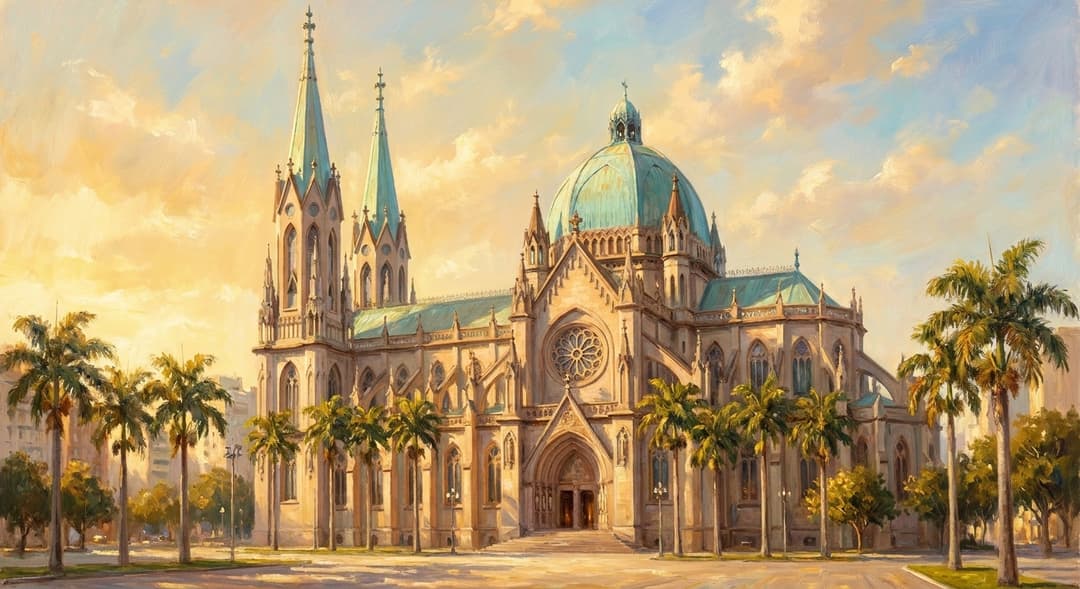
Catedral da Sé is an active place of worship and a central landmark in São Paulo's historic core. Visitors can attend daily masses, explore the expansive five-aisled nave, or take guided tours of the cavernous subterranean crypt.
Highlights
- Marvel at the 92-meter spires and green copper Renaissance dome from Praça da Sé.
- Inspect the hand-carved interior pillar capitals featuring Brazilian pineapples, coffee branches, and native fauna.
- Descend into the 619-square-meter underground crypt containing historical tombs and marble sculptures.
Things to Know
- Praça da Sé is a busy urban square; keep valuables safe and stay aware of surroundings.
- A modest admission fee is required for guided subterranean crypt visits.
Location
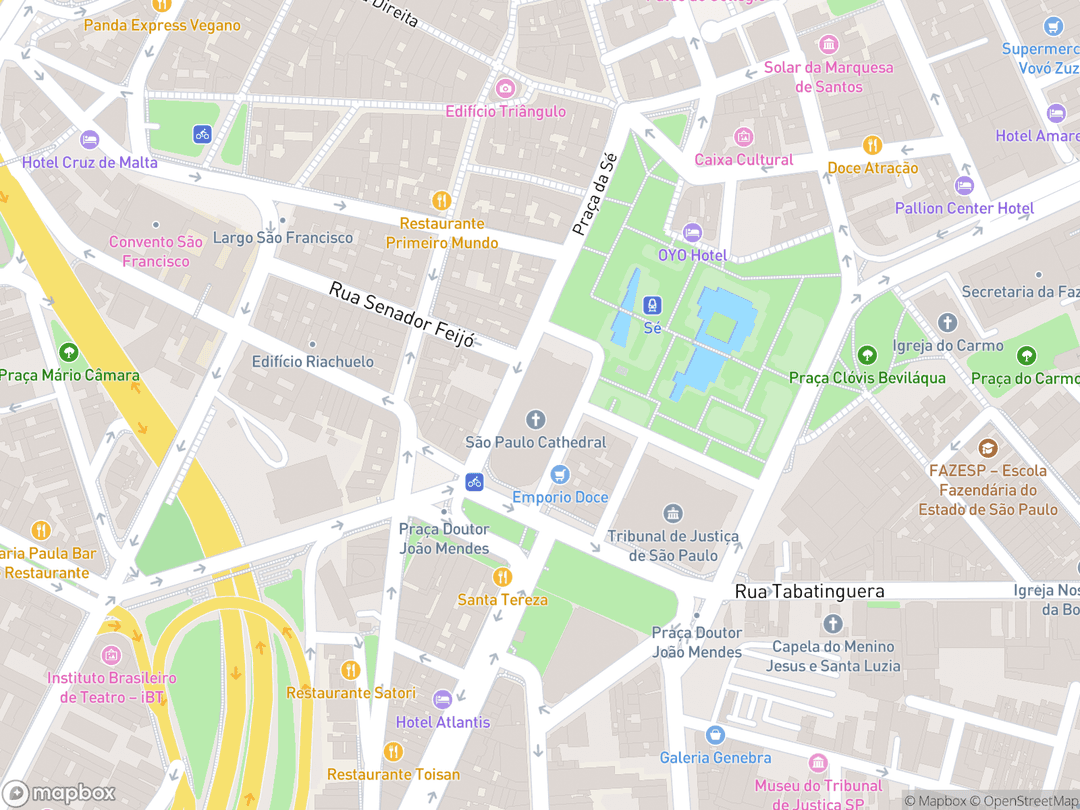
Praça da Sé, s/n - Sé, São Paulo - SP, 01001-000, Brazil
Hours: Open daily from 8:00 AM to 5:00 PM; Crypt tours run daily from 9:00 AM to 5:00 PM.
Getting There: Accessible directly via Sé Station (Estação da Sé), connecting Metro Lines 1-Blue and 3-Red.
Get DirectionsTips for Your Visit
Organ Concerts
Check the archdiocesan schedule for recitals on the 12,000-pipe Balbiani-Vegezzi-Bossi organ.
Crypt Guided Tours
Join a local guide to learn about historical figures buried beneath the high altar, including Chief Tibiriçá.
Photography Etiquette
Flash photography and loud noise are restricted during official Catholic liturgical services.
About
The Metropolitan Cathedral of Our Lady of the Assumption and Saint Paul, popular known as the Catedral da Sé, stands as the mother church of the Archdiocese of São Paulo. Situated at the exact geographical center of South America's largest metropolis, the cathedral functions as a sanctuary dedicated to the worship of God within the Christian Abrahamic tradition.
Designed by German-Brazilian engineer Maximilian Emil Hehl, the cathedral blends northern European Gothic Revival verticality with a massive Renaissance Revival dome inspired by Florence's Santa Maria del Fiore. Construction began in 1913 and spanned four decades, resulting in one of the largest Neo-Gothic structures in the world.
Beyond its architectural majesty, Catedral da Sé played a critical role in modern Brazilian history. Under Cardinal Archbishop Paulo Evaristo Arns during the 1970s, the cathedral transformed into an international beacon of civil rights and interfaith resistance against military dictatorship, embodying the defense of human dignity.
Gallery
Symbolic Elements
The temple's exterior features intricate carvings, each rich with spiritual meaning:

Archbishop's Cathedra
The solid marble episcopal seat symbolizing shepherd authority and apostolic teaching continuity.

Indigenous Fauna and Flora Capitals
Hand-carved column capitals depicting coffee branches, pineapples, armadillos, and native Brazilian birds.
Salvation History Stained Glass
European stained-glass windows detailing the life of Christ, the Apostles, and Saint Paul.

Brunelleschi-Inspired Renaissance Dome
A 30-meter copper-clad outer dome synthesizing Italian Renaissance geometry with Gothic verticality.

Subterranean Crypt Vaults
Gothic rib vaults and massive granite columns supporting the underground funeral church.

Sculpture of Suffering Job
A life-sized white marble crypt statue depicting Job, symbolizing patient trust in Divine Providence.

Tomb of Chief Tibiriçá
The crypt sarcophagus honoring the 16th-century Guaianás chief who facilitated São Paulo's founding.

Balbiani Pipe Organ Console
The five-manual console governing Latin America's largest pipe organ with 12,000 pipes.
Interesting Facts
Catedral da Sé ranks among the four largest Gothic Revival cathedrals in the world by floor area. (Tier A)
Its interior column capitals uniquely feature sculpted Brazilian coffee branches, pineapples, and armadillos. (Tier A)
Architect Maximilian Emil Hehl was a German engineering professor at the Polytechnic School of São Paulo. (Tier B)
The central 30-meter copper dome is modeled directly on Brunelleschi's Florence Cathedral dome. (Tier B)
The underground crypt functions as an independent subterranean church with 7-meter vaulted ceilings. (Tier A)
The crypt contains the tomb of Chief Tibiriçá, the 16th-century leader who welcomed the first Jesuits. (Tier A)
In October 1975, the cathedral hosted an historic ecumenical memorial for murdered journalist Vladimir Herzog. (Tier A)
The 1954 Italian organ contains five keyboards, 120 stops, and nearly 12,000 individual pipes. (Tier A)
Restoration workers found Hehl's original 1912 construction blueprints hidden inside an interior wall. (Tier B)
The cathedral towers house a Dutch carillon of 61 bronze bells, the largest system in South America. (Tier A)
Common Questions
When was Catedral da Sé dedicated?
The cathedral was consecrated on January 25, 1954, during São Paulo's quadricentennial celebration.
What is the architectural style of Catedral da Sé?
It is primarily Neo-Gothic with a central Renaissance Revival dome modeled on Florence Cathedral.
Can visitors tour the underground crypt?
Yes, guided crypt tours run daily between 9:00 AM and 5:00 PM for a small admission fee.
Who is buried inside the cathedral crypt?
The crypt contains bishops of São Paulo alongside historic figures like Chief Tibiriçá and Father Bartolomeu de Gusmão.
How do I get to Catedral da Sé using public transit?
Take the Metro directly to Sé Station, which exits onto the Praça da Sé public square.
Featured Stories
The Quadricentennial Consecration
January 25, 1954
On January 25, 1954, São Paulo celebrated the 400th anniversary of its founding by Jesuit missionaries. Cardinal Carlos Carmelo de Vasconcelos Motta solemnly consecrated the unfinished Catedral da Sé before thousands of joyous citizens. The event marked a turning point, transforming a decades-long construction project into the spiritual crown of Brazil's economic heartland.
Source: Archdiocese of São Paulo Historical Records
Interfaith Resistance Against Oppression
October 25, 1975
Following the murder of journalist Vladimir Herzog by the military regime, Cardinal Paulo Evaristo Arns refused official censorship. He joined Rabbi Henry Sobel and Pastor Jaime Wright inside a packed Catedral da Sé for an unprecedented ecumenical memorial. Surrounding the cathedral despite armed military police, thousands gathered in quiet defiance, establishing the cathedral as a historic fortress for human rights.
Source: Archdiocese of São Paulo Archives
Blueprints Hidden Within the Walls
2000
During preliminary restoration work in 2000, technicians dismantling damaged interior masonry discovered a sealed wall cavity. Inside lay architect Maximilian Emil Hehl's original 1912 architectural blueprints, preserved for nearly nine decades. This incredible find enabled restoration architects to reconstruct missing exterior pinnacles and stone carvings with exact historical authenticity.
Source: Conselho de Defesa do Patrimônio Histórico (CONDEPHAAT)
Timeline
Initial Chapel Plans
Portuguese settlers establish plans for the principal church of São Paulo de Piratininga.
MilestoneFirst Church Completion
The original wattle-and-daub church is completed on land granted by Chief Tibiriçá.
MilestoneElevation to Diocesan Seat
Pope Benedict XIV elevates São Paulo to a diocese, making the church a cathedral.
MilestoneBaroque Cathedral Dedicated
A second cathedral built in the Portuguese Baroque style is completed.
DedicationBaroque Cathedral Demolition
Archbishop Duarte Leopoldo e Silva orders demolition of the old church to build a new cathedral.
EventGroundbreaking
Construction begins on architect Maximilian Emil Hehl's Neo-Gothic design.
component.timeline.groundbreakingCrypt Inauguration
The subterranean crypt is consecrated and opened beneath the rising nave foundation.
MilestoneCathedral Consecration
Cardinal Carlos Carmelo de Vasconcelos Motta consecrates the cathedral during São Paulo's 400th anniversary.
DedicationSpire Completion
Construction officially concludes as the twin 92-meter spires are finished.
MilestoneHistoric Interfaith Rally
Cardinal Arns leads an ecumenical service defending human rights during the dictatorship.
EventRestoration Reopening
The cathedral reopens after a massive multi-year restoration project that restored 800 tons of marble.
RenovationHistory by Decade
1589–1764 — The Colonial Predecessors
The original principal church (Igreja Matriz) of São Paulo was established in 1589 on land granted by Guaianás leader Chief Tibiriçá. Completed in 1616 using wattle-and-daub techniques, this modest chapel served the early settlement for over a century. In 1745, when Pope Benedict XIV created the Diocese of São Paulo, the aging chapel was demolished and replaced by a Portuguese Baroque cathedral completed in 1764.
1911–1919 — Vision and Subterranean Crypt
By 1911, the Baroque structure was crumbling and inadequate for the rapidly expanding coffee metropolis. Archbishop Duarte Leopoldo e Silva commissioned German-Brazilian engineering professor Maximilian Emil Hehl to design a grand cathedral. Groundbreaking took place in 1913, and by 1919 the monumental subterranean crypt was inaugurated.
1920–1949 — Decades of Craftsmanship
World War I interrupted imports of European materials, slowing structural work during the 1920s. Following Hehl's death, local engineers strictly followed his original master plans. Italian-immigrant sculptors worked through the 1930s and 1940s carving native Brazilian fruits and animals into granite capitals across the soaring nave.
1950–1967 — Consecration and Completion
On January 25, 1954, Cardinal Carlos Carmelo de Vasconcelos Motta consecrated the unfinished cathedral to celebrate the quadricentennial of São Paulo's founding. The landmark 12,000-pipe Balbiani-Vegezzi-Bossi organ was installed the same year. Exterior work concluded in 1967 with the elevation of the twin 92-meter spires.
1970–1985 — Beacon of Civil Rights
Under Cardinal Archbishop Paulo Evaristo Arns, Catedral da Sé became a world-renowned sanctuary for human rights during Brazil's military regime. In October 1975, following the murder of journalist Vladimir Herzog, Cardinal Arns joined Jewish and Protestant leaders inside the filled cathedral for an historic ecumenical memorial that galvanized national democratic opposition.
2000–Present — Restoration and Modern Era
Between 2000 and 2002, the cathedral underwent comprehensive restoration. Workers cleaned over 800 tons of interior marble and fortuitously discovered Hehl's lost 1912 blueprints hidden inside a wall cavity. Today, Catedral da Sé stands fully restored as the spiritual heart of São Paulo.
Architecture & Facilities
The Catedral da Sé represents an ambitious synthesis of Gothic Revival architecture combined with a prominent Renaissance Revival dome. Built on a traditional Latin cross floor plan with a five-aisled nave, double side aisles, and a radial ambulatory, the building emphasizes soaring vertical lines through pointed arches and compound pillars. The central crossing is crowned by a 30-meter copper-clad dome modeled directly on Filippo Brunelleschi's famous Renaissance dome for the Cathedral of Florence.
Building Materials
Exterior Envelope
Solid Brazilian granite quarried locally in the state of São Paulo.
Interior Finishes
Over 800 tons of rare Italian and Brazilian marble covering altars and crypt walls.
Roof and Dome Structure
Structural steel framing clad with copper plates that have developed a green patina.
Stained Glass
Custom stained-glass windows imported from glassmaking workshops in Germany and Italy.
Interior Features
Main Sanctuary
A five-aisled central nave with compound cluster pillars accommodating up to 8,000 worshipers.
The Cathedra
The white marble episcopal throne representing the archbishop's teaching authority.
Subterranean Crypt
A 619-square-meter underground vaulted church with marble tombs and Biblical sculptures.
Balbiani Pipe Organ
A 1954 Italian organ featuring 5 keyboards, 120 stops, and nearly 12,000 pipes.
Temple Grounds
Situated at Praça da Sé, a public square marked by palm trees and the 'Marco Zero' monument representing the central point of São Paulo.
Additional Facilities
Includes the 619-square-meter underground crypt church, archdiocesan administrative offices, parish gift store, and choir rehearsal halls.
Religious Significance
As a Christian place of worship in the Catholic tradition, the Catedral da Sé functions primarily as a sanctuary for prayer, the proclamation of Sacred Scripture, and the celebration of the Eucharist. Embedded within the broader monotheistic family of Abrahamic faith, the building serves as a house of God where the community gathers in communal adoration.
Serves as the episcopal seat (cathedra) of the Metropolitan Archbishop of São Paulo, uniting the regional Catholic faithful in sacramental life.
Sacred Ordinances
The Holy Sacrifice of the Mass
Daily celebration of the Eucharist, the source and summit of Catholic Christian spiritual life.
Sacrament of Holy Orders
Solemn ordination ceremonies for priests and bishops performed by the Metropolitan Archbishop.
Sacrament of Confirmation
Archdiocesan celebrations where candidates receive the seal of the Holy Spirit.
The Cathedra and Episcopal Authority
The marble throne in the sanctuary gives the cathedral its name (cathedra). It symbolizes apostolic succession, doctrinal teaching authority, and pastoral unity connecting São Paulo's local church with the See of Rome.
Marian and Apostolic Patronage
Dedicated jointly to Our Lady of the Assumption and Saint Paul the Apostle, the cathedral honors Mary as patroness of heaven and Saint Paul as the evangelist who inspired the naming of the city.
Similar Temples
Sources & Research
Every fact on Temples.org is backed by verified Sources & Research. Each piece of information is rated by source tier and confidence level.
View All Sources (8)
| Field | Source | Tier | Retrieved |
|---|---|---|---|
| About & Historical Background | Archdiocese of São Paulo (opens in a new tab) | A | 2026-02-15 |
| About & Historical Background | Catedral Metropolitana de São Paulo (opens in a new tab) | A | 2026-02-15 |
| Architecture & Crypt Design | Conselho de Defesa do Patrimônio Histórico (CONDEPHAAT) (opens in a new tab) | A | 2026-02-15 |
| Architecture & Crypt Design | Enciclopédia Itaú Cultural (opens in a new tab) | B | 2026-02-15 |
| Timeline & Featured Stories | Prefeitura Municipal de São Paulo (opens in a new tab) | A | 2026-02-15 |
| Timeline & Featured Stories | Instituto Brasileiro de Geografia e Estatística (IBGE) (opens in a new tab) | A | 2026-02-15 |
| Religious Significance & Iconography | Folha de S.Paulo (opens in a new tab) | B | 2026-02-15 |
| Visitor Insights & Access | O Estado de S. Paulo (opens in a new tab) | B | 2026-02-15 |