Visitor Insights
Visiting Calgary Alberta Temple
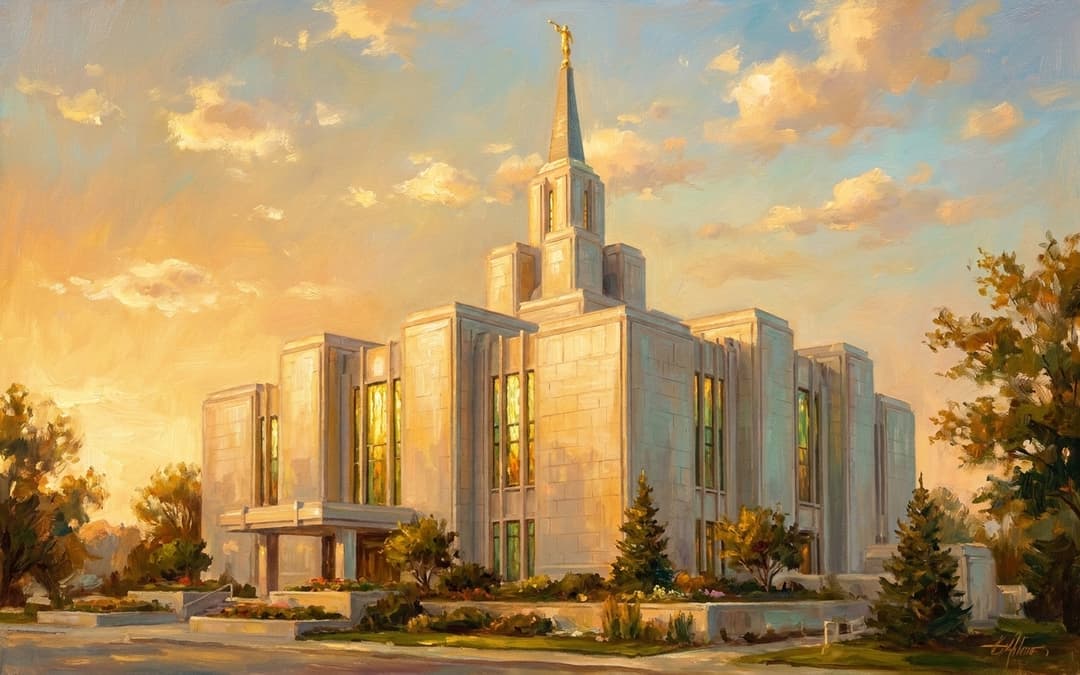
The Calgary Alberta Temple grounds offer a serene and deeply spiritual environment for all visitors. Situated on an elevated ridge in northwest Calgary, the site provides a peaceful escape from the bustling city with panoramic views of the Canadian Rockies. While the interior is reserved for sacred ordinances, the beautifully manicured gardens and pathways are open to the public. Visitors often describe the atmosphere as one of profound quietude, perfect for personal reflection and prayer.
Highlights
- Stunning panoramic views of the Calgary skyline and the Canadian Rockies
- Beautifully manicured 10.17-acre grounds with native shrubs and seasonal flowers
- Intricate exterior architecture featuring gray granite and a single soaring spire
- Peaceful reflection areas with benches along paved walking pathways
Things to Know
- The interior of the temple is accessible only to members with an active recommend
- Modest dress is encouraged when walking the sacred temple grounds
- Photography is permitted on the outdoor grounds but strictly prohibited inside
- Winters in Calgary can be extremely cold; dress warmly for outdoor walks
Location
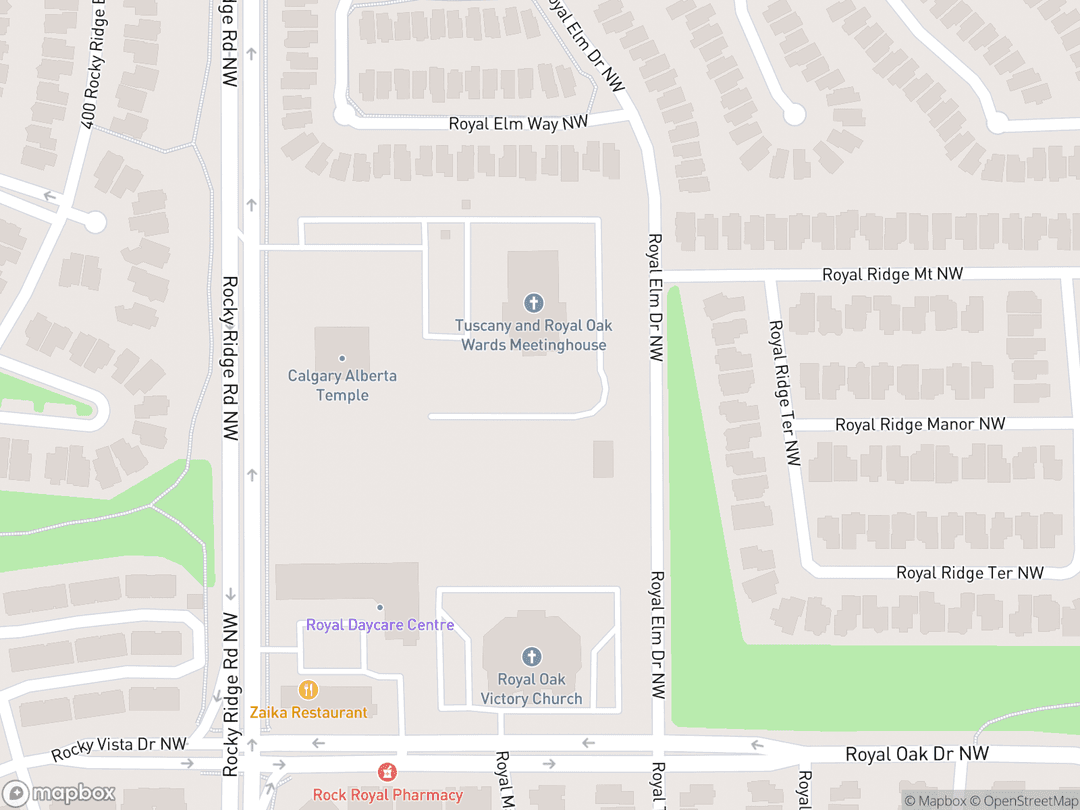
9802 Rocky Ridge Road NW, Calgary, Alberta, T3G 5J7, Canada
Hours: The temple grounds are open daily from sunrise to 10:00 PM.
Getting There: Located at 9802 Rocky Ridge Road NW, the temple is easily accessible via Crowchild Trail NW or Stoney Trail NW. Visitors can take Country Hills Boulevard NW directly to Rocky Ridge Road NW. For those utilizing public transit, the Tuscany CTrain Station (Red Line) is located nearby, with connecting bus routes stopping near the temple site.
Get DirectionsTips for Your Visit
Best Time for Photography
Visit during twilight when the temple's exterior floodlights illuminate the gray granite against the Alberta night sky, or during the summer months when the flower beds are in full bloom.
Public Transit Access
Take the Red Line CTrain to Tuscany Station, which is the closest transit hub, and catch a connecting bus or enjoy a short walk to the temple grounds.
Attend Sunday Services
Visitors wishing to experience a Latter-day Saint worship service are welcome to attend the adjacent Royal Oak Chapel on Sundays.
About
The Calgary Alberta Temple stands as a magnificent spiritual landmark in northwest Calgary, Alberta, Canada. Dedicated in 2012 as the 140th operating temple of The Church of Jesus Christ of Latter-day Saints, it serves as a sacred sanctuary for thousands of Latter-day Saints in Calgary and surrounding communities, stretching from Banff in the west to Drumheller in the east. The temple's presence is a testament to the growth of the Church in the region, which traces its roots back to the arrival of early pioneers in the early twentieth century.
Rooted in the broader Christian and Abrahamic traditions, the temple shares a profound devotion to Jesus Christ as the Savior and Redeemer of humanity. Just as ancient Israelites constructed the Tabernacle in the wilderness and King Solomon built the temple in Jerusalem to experience the presence of the Almighty, Latter-day Saints view this temple as a literal "House of the Lord." It is a space set apart from the world, dedicated entirely to sacred worship, personal reflection, and communion with God.
Within its beautifully adorned walls, faithful members participate in sacred covenants that bridge the earthly and the eternal. These ordinances include the endowment—a progressive instruction on the plan of salvation—and eternal sealings, which reflect the doctrine that family relationships endure beyond death. The temple stands as a physical manifestation of faith, inviting all who look upon it to contemplate the eternal nature of the soul and the universal reach of Christ's grace.
Gallery
Symbolic Elements
The temple's exterior features intricate carvings, each rich with spiritual meaning:

The Wheat Motif
The wheat stalk represents the agricultural heritage of the Alberta prairies. In a Christian context, it also symbolizes Jesus Christ as the 'Bread of Life' and the spiritual harvest of souls, etched into stained glass, woodwork, and custom bronze doorknobs.

The Angel Moroni
Standing atop the 115-foot central spire, the gold-leafed statue of the angel Moroni symbolizes the spreading of the restored gospel to all nations. Facing east, it represents the anticipation of the Second Coming of Jesus Christ.

The Twelve Oxen
The baptismal font rests upon the backs of twelve sculpted oxen, representing the twelve tribes of ancient Israel. This design directly mirrors the 'molten sea' described in the biblical construction of King Solomon's Temple.

The Progressive Rooms
The physical movement of patrons from the first instruction room to the second, and finally into the Celestial Room, symbolically represents the progressive journey of a Christian striving to return to the presence of God.
Single Spire
The soaring single spire draws the eyes of onlookers upward toward heaven, serving as a visual reminder of humanity's connection to the divine and the upward reach of the soul.

Gray Granite Facade
The durable gray granite cladding represents endurance, strength, and eternal progression. Its reflective surface changes appearance with the shifting Alberta skies, symbolizing the divine light reflecting in daily life.

Stained Glass Windows
The custom stained-glass windows filter soft, natural light into the sacred spaces while maintaining privacy. The gold, green, and cream color palette symbolizes purity, growth, and the light of Christ.

Crystal Chandeliers
Hanging in the sealing and Celestial rooms, the elegant crystal chandeliers symbolize the light of heaven and the clarity of eternal truth, casting a warm and reverent glow throughout the sacred spaces.
Interesting Facts
The temple stands on a lot that originally housed only a local meetinghouse, fulfilling a decades-old municipal permit that allowed for two structures on the site. [Tier C]
Canada's Prime Minister at the time of the groundbreaking, Stephen Harper, lived nearby and sent a warm personal letter praising the temple as an 'inspiring landmark'. [Tier A]
During the October dedication, Calgary's chilly autumn weather required a heated tent to be pitched over the cornerstone area to prevent the mortar from freezing. [Tier A]
On the freezing morning of January 12, 2012, hundreds of youth gathered in blankets and pajamas to watch the angel Moroni statue being raised while singing hymns. [Tier C]
The baptistry features a hand-painted mural of the Canadian Rockies by Leon Parson, which was so admired that a replica was commissioned for the Payson Utah Temple. [Tier A]
The custom art glass throughout the temple utilizes thousands of individual panes, creating intricate mosaic patterns of wheat and local prairie flora. [Tier C]
The wheat motif is so detailed that it is even cast into the custom bronze doorknobs of the temple, reminding patrons of the region's agricultural roots. [Tier B]
The dedication of the Calgary Alberta Temple marked the third temple in the province of Alberta, joining Cardston and Edmonton. [Tier A]
Over 100,000 visitors from various faith backgrounds toured the temple's interior during the three-week public open house in the fall of 2012. [Tier A]
Positioned on an elevated ridge, the temple site offers breathtaking views of the Calgary city skyline to the east and the Canadian Rockies to the west. [Tier B]
Common Questions
Can non-members go inside the Calgary Alberta Temple?
While the interior of the temple is reserved for members of the Church holding active temple recommends for sacred ordinances, the public is warmly invited to visit the beautifully landscaped grounds, take photographs, and enjoy the peaceful atmosphere.
What is the significance of the wheat motif found throughout the temple?
The wheat stalk motif represents the rich agricultural heritage of the Alberta prairies. In a Christian context, it also symbolizes Jesus Christ as the 'Bread of Life' and the spiritual harvest of souls. It is integrated into the stained glass, woodwork, and custom bronze doorknobs.
How does this temple differ from a regular Latter-day Saint meetinghouse?
Meetinghouses (chapels) are used for weekly Sunday worship services, youth activities, and community gatherings, and are open to everyone. Temples are sacred spaces dedicated for special ordinances, such as eternal marriages and baptisms for ancestors, and are closed on Sundays.
Is there an admission fee to visit the temple grounds?
No, visiting the temple grounds is completely free. Paved pathways, gardens, and benches are open to the public during daytime hours for quiet contemplation and enjoyment.
Where can I attend Sunday worship services near the temple?
Visitors are welcome to attend Sunday services at the adjacent Royal Oak Chapel, which sits on the same lot as the temple. Services are open to all faith backgrounds.
Featured Stories
The Pajama-Clad Choir
January 12, 2012
On a freezing winter morning in January 2012, hundreds of local youth and seminary students gathered in the temple parking lot. They came to witness a historic milestone: the raising of the gold-leafed angel Moroni statue to the top of the temple's central spire.
Despite the biting cold, the atmosphere was filled with warmth and excitement. Many of the youth were wrapped in heavy blankets and wearing colorful pajamas, having rushed from their homes early in the morning to not miss the event.
As the crane slowly lifted the statue into place, the youth spontaneously began to sing 'The Spirit of God like a Fire is Burning'. Their voices echoed across the ridge, creating a deeply emotional and memorable moment for everyone present.
The statue was successfully bolted into place, standing as a beacon of faith for the city of Calgary and a testament to the dedication of the rising generation of Latter-day Saints.
Source: The Church News, January 2012
The Fulfilled Permit
October 2012
The Calgary Alberta Temple stands on a beautiful 10.17-acre lot in northwest Calgary that originally housed only a local meetinghouse. Decades before the temple was announced, the original municipal building permit issued by the City of Calgary allowed for two structures on the property.
For years, local members held a quiet faith and anticipation that the second structure would eventually be a temple. They preserved the open space on the lot, waiting for the day when the growth of the Church would warrant such a sacred building.
This quiet hope was realized in 2008 when President Thomas S. Monson announced the Calgary Alberta Temple. The existing permit streamlined the municipal approval process, allowing construction to begin smoothly.
Today, the temple and the meetinghouse stand side-by-side, fulfilling a decades-long anticipation and serving as a dual-use property that meets both the weekly and eternal spiritual needs of the community.
Source: Church of Jesus Christ Temples, 2012
A Prime Minister's Congratulations
May 15, 2010
During the groundbreaking ceremony on May 15, 2010, local members and community leaders gathered to celebrate the official start of construction. Among the highlights of the event was a personal letter of congratulations from Canada's Prime Minister, Stephen Harper.
Prime Minister Harper, whose personal residence was located just a few miles from the temple site, expressed his warm wishes and praised the temple as an 'inspiring landmark' for the city of Calgary.
His letter highlighted the positive impact of the Latter-day Saint community in Alberta and welcomed the addition of the beautiful structure to the northwest Calgary skyline.
The recognition from the nation's leader underscored the temple's role not only as a sacred space for Church members but also as a respected architectural and cultural asset for the broader community.
Source: Deseret News, May 2010
Timeline
First Pioneer Families Arrive
The first Latter-day Saint families arrive in Calgary, establishing roots in the growing prairie city.
EventFirst Formal Branch Organized
The Church establishes its first formal presence in Calgary with the organization of a dependent branch.
EventCalgary Ward Established
The Calgary Ward is officially organized to accommodate the steady influx of members, coinciding with the dedication of the Cardston Alberta Temple.
EventFirst Dedicated Meetinghouse
Despite the economic hardships of the Great Depression, local members raise funds to construct Calgary's first dedicated meetinghouse.
MilestoneCalgary Stake Organized
Following a postwar population boom, the Calgary Stake is organized, marking a major milestone in regional Church leadership.
MilestoneEdmonton Temple Dedicated
The Edmonton Alberta Temple is dedicated, becoming the second temple in the province and reducing travel times for Calgary members.
EventTemple Announcement
President Thomas S. Monson announces the construction of the Calgary Alberta Temple during General Conference.
MilestoneLand Use Application
Abbarch Architecture formally applies for a land use amendment with the City of Calgary for the Royal Oak site.
EventLand Use Approval
The Calgary Planning Commission officially approves the land use amendment, clearing the way for construction.
EventGroundbreaking Ceremony
Elder Donald L. Hallstrom presides over the groundbreaking. Prime Minister Stephen Harper sends a letter of congratulations.
component.timeline.groundbreakingAngel Moroni Raised
Hundreds of local members gather on a freezing winter morning to witness the raising of the gold-leafed statue atop the central spire.
MilestonePublic Open House Begins
The public open house commences, welcoming over 100,000 visitors from various faith backgrounds to tour the interior.
EventYouth Cultural Celebration
A vibrant celebration is held at the Calgary Stampede Corral, featuring 1,643 local youth performing dances of Alberta's history.
EventTemple Dedication
President Thomas S. Monson formally dedicates the Calgary Alberta Temple in three sacred sessions, making it the 140th operating temple.
DedicationTemporary Pandemic Closure
The temple temporarily suspends operations due to the COVID-19 pandemic, later transitioning through phased reopenings.
EventNew Temple President Called
G. Lawrence Spackman is called to serve as the new temple president, succeeding John Wayne Munster Swendsen.
EventPresident Cameron Lee Olson Called
Cameron Lee Olson is called to serve as temple president, overseeing the sacred ordinances and operations of the temple.
EventHistory by Decade
1910s–1950s — Pioneer Foundations
The faith of the early pioneers laid the foundation for the strength of the Church we see in Calgary today.
The history of the Church in Calgary began in 1910 when the first Latter-day Saint families arrived, including John H. Sheppard and his family, who emigrated from England. A dependent branch was organized in 1913, followed by the official organization of the Calgary Ward in 1923, the same year the landmark Cardston Alberta Temple was dedicated in southern Alberta. Despite the severe economic hardships of the Great Depression, local members raised enough funds to construct Calgary's first dedicated meetinghouse in 1939. Following a postwar population boom and a steady migration of members from southern Alberta, the Calgary Stake was organized in 1953, marking a major milestone in regional Church leadership and setting the stage for future growth.
2000s — Announcement and Approvals
On October 4, 2008, President Thomas S. Monson announced the construction of the Calgary Alberta Temple during the 178th Semiannual General Conference, sparking immense joy among the local membership. Following the announcement, Abbarch Architecture formally applied for a land use amendment with the City of Calgary on August 7, 2009, to accommodate a 'Place of Worship' at the designated Royal Oak site. The Calgary Planning Commission officially approved the land use amendment on November 26, 2009, clearing the way for construction to begin. The approval was met with gratitude from local members, who had long anticipated a temple in their city to reduce travel times to the Cardston and Edmonton temples.
2010s — Construction and Dedication
This temple will be a beacon of light and hope to all who look upon it.
Elder Donald L. Hallstrom presided over the groundbreaking ceremony on May 15, 2010. Construction progressed steadily, and on January 12, 2012, the gold-leafed angel Moroni statue was raised atop the temple's central spire. A public open house was held from September 29 to October 13, 2012, welcoming over 100,000 visitors to tour the interior. On October 27, 2012, a vibrant youth cultural celebration featuring 1,643 local youth was held at the Calgary Stampede Corral. The following day, October 28, 2012, President Thomas S. Monson formally dedicated the Calgary Alberta Temple in three sacred sessions, designating it as the 140th operating temple of the Church.
2020s — Modern Service and New Leadership
Along with all other temples worldwide, the Calgary Alberta Temple temporarily suspended operations on March 26, 2020, due to the COVID-19 pandemic. It later transitioned through phased reopenings to resume full operations, continuing to serve as a sacred sanctuary for the saints of Calgary and surrounding areas. In February 2022, G. Lawrence Spackman was called to serve as the new temple president, succeeding John Wayne Munster Swendsen. In 2025, Cameron Lee Olson was called to serve as temple president, overseeing the sacred ordinances and operations of the temple as it continues its mission of providing eternal covenants.
Architecture & Facilities
The Calgary Alberta Temple features a Classic Modern design with a contemporary single-spire structure. The three-story building exhibits clean, vertical lines and geometric symmetry, blending traditional temple majesty with modern architectural sensibilities to create an elegant, upward-reaching profile that harmonizes with the surrounding Alberta landscape.
Building Materials
Exterior Cladding
Clad in high-quality gray granite quarried in China, providing a durable, reflective facade capable of withstanding extreme temperature fluctuations of Albertan winters.
Interior Woodwork
Features rich, dark African mahogany alongside refined oak and maple woodwork, creating a warm, reverent atmosphere in the instructional and administrative spaces.
Interior Stone
High-grade Spanish marble, Turkish travertine, and Brazilian granite are utilized for the flooring, wall bases, plinths, and columns throughout the entryways.
Art Glass
Custom stained-glass windows feature a color palette of gold, green, and cream, designed to filter soft, natural light into the sacred rooms while maintaining privacy.
Interior Features
The Baptistry
Located on the lower level, featuring a large font resting on the backs of twelve sculpted oxen and adorned with a hand-painted woodland mural of a scenic Alberta landscape by Leon Parson.
Instruction Rooms
Contains two instruction rooms designed for a two-stage progressive presentation of the endowment ceremony, symbolizing the spiritual progression of the soul.
Sealing Rooms
Three sealing rooms equipped with sacred altars for eternal marriages, decorated with elegant crystal chandeliers and dark wood accents.
The Celestial Room
The spiritual heart of the temple, representing the peace and beauty of heaven, furnished with exquisite carpets, comfortable seating, and soft lighting.
Temple Grounds
Situated on a beautifully landscaped 10.17-acre site in northwest Calgary, featuring manicured lawns, native shrubs, vibrant seasonal flower beds, and mature trees on an elevated ridge offering views of the Rockies.
Additional Facilities
An adjacent Latter-day Saint meetinghouse (the Royal Oak Chapel) sits on the same lot, fulfilling a decades-long anticipation of a dual-use property.
Religious Significance
The Calgary Alberta Temple is rooted in the broader Christian and Abrahamic traditions, sharing a profound devotion to Jesus Christ as the Savior and Redeemer of humanity. Like the ancient temples of biblical times, it is dedicated as a literal House of the Lord, set apart from the world for sacred communion with God.
To provide a sacred space where Latter-day Saints can make eternal covenants with God, participate in saving ordinances for themselves and their ancestors, and seek spiritual peace.
Sacred Ordinances
Baptism for the Dead
Proxy baptisms performed on behalf of deceased ancestors, reflecting the universal reach of Christ's grace and the opportunity for all of God's children to accept the gospel.
The Endowment
A progressive instruction on the plan of salvation, detailing the Creation, the Fall, and the infinite Atonement of Jesus Christ, accompanied by sacred covenants of obedience and service.
Eternal Sealing
Sacred ordinances that unite husbands, wives, and children in family relationships that endure beyond death, reflecting the eternal nature of love and family.
The House of the Lord in the Christian Tradition
Latter-day Saints view the temple as a modern continuation of the biblical tradition of sacred spaces. Just as ancient Israel sought the presence of God in the Tabernacle and Solomon's Temple, modern patrons enter the Calgary Alberta Temple to withdraw from the world, contemplate eternity, and draw closer to the Savior Jesus Christ.
Similar Temples
Sources & Research
Every fact on Temples.org is backed by verified Sources & Research. Each piece of information is rated by source tier and confidence level.
View All Sources (8)
| Field | Source | Tier | Retrieved |
|---|---|---|---|
| About & Historical Background | The Church of Jesus Christ of Latter-day Saints (opens in a new tab) | A | 2026-02-18 |
| Timeline & Featured Stories | Deseret News (opens in a new tab) | B | 2026-02-18 |
| Architecture & Materials | Stone World Magazine (opens in a new tab) | B | 2026-02-18 |
| Pioneer Roots & Regional Growth | Brigham Young University (opens in a new tab) | B | 2026-02-18 |
| Temple Construction & Open House | ChurchofJesusChristTemples.org (opens in a new tab) | C | 2026-02-18 |
| Visual Assets & Photography | Photogent (opens in a new tab) | C | 2026-02-18 |
| Wheat Motif & Symbolism | LDS Living (opens in a new tab) | B | 2026-02-18 |
| Temple Presidency & Leadership | The Church of Jesus Christ of Latter-day Saints (opens in a new tab) | A | 2026-02-18 |