Visitor Insights
Visiting Royal Chapel of Versailles
Visitors experience the Royal Chapel from both ground level and the famous upper royal gallery during general palace admission. Exceptional guided tours offer intimate access to the nave, sanctuary, sacristy, and historical pipe organ.
Highlights
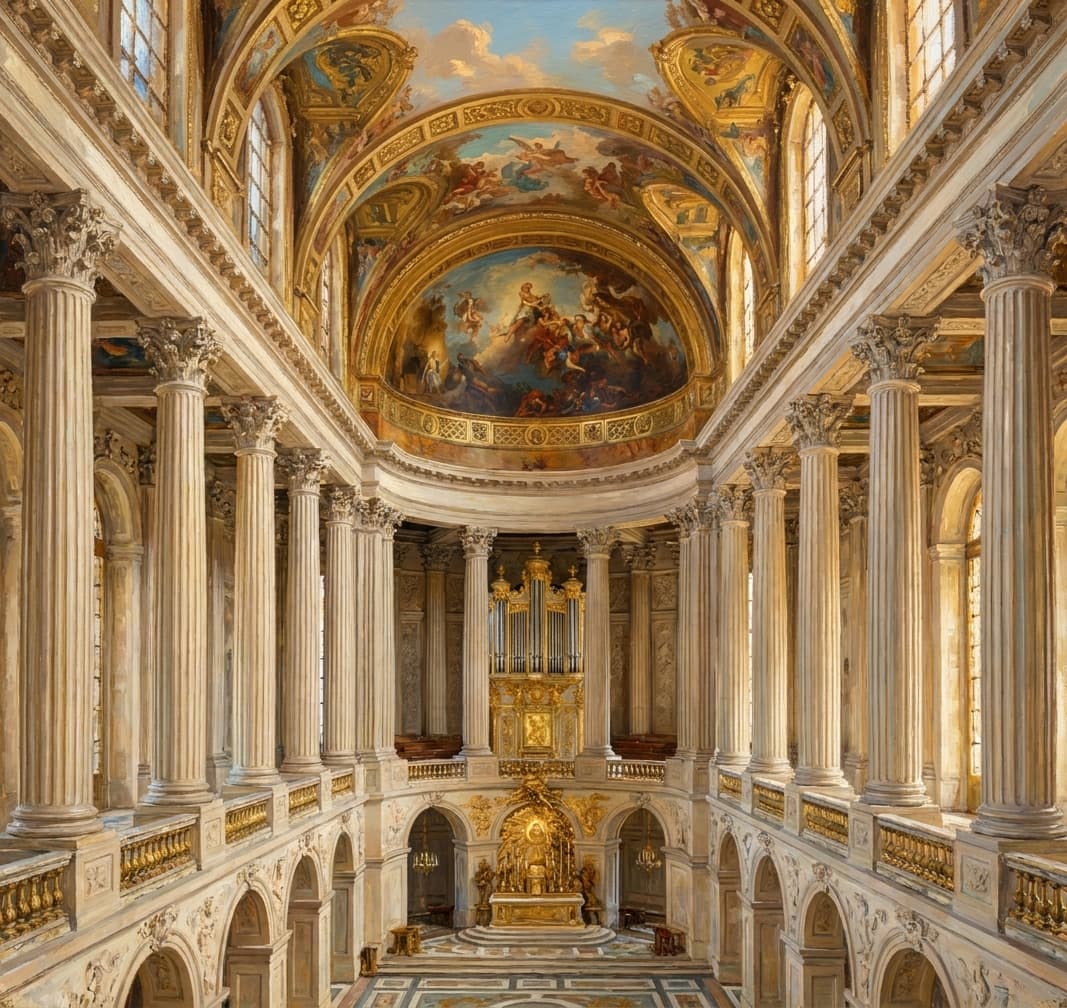
- Soaring Corinthian colonnade encircling the upper royal tribune
- Unbroken vault frescoes depicting the Holy Trinity by Coypel, La Fosse, and Jouvenet
- Reconstructed 1710 Clicquot pipe organ raised above the gilded High Altar
- Polychromatic inlaid marble floor featuring geometric Christian motifs
Things to Know
- General admission ticket permits viewing from designated gallery thresholds
- Special guided tours are required to physically walk inside the nave and sacristy
- Photography is allowed without flash; dress respectfully inside sacred areas
Location
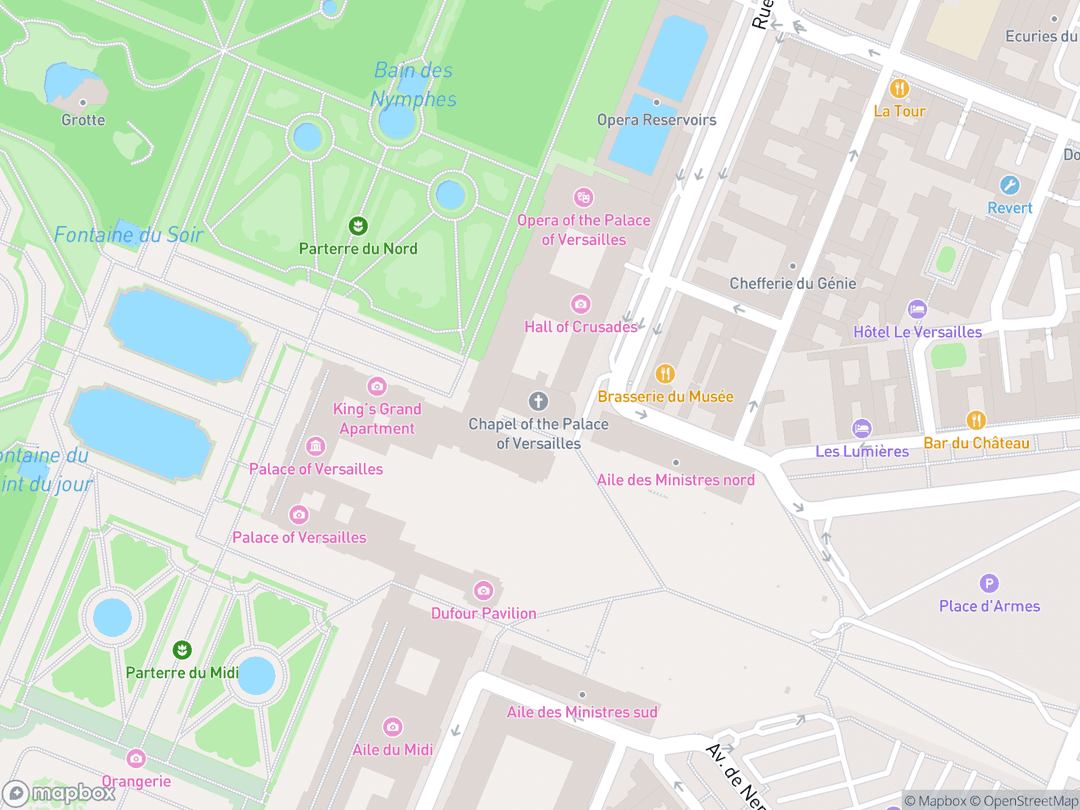
Place d'Armes, 78000 Versailles, Yvelines, Île-de-France, France
Hours: Tuesday – Sunday, 9:00 AM – 6:30 PM (Closed Mondays)
Getting There: Take RER Line C from central Paris to Versailles Chateau Rive Gauche station, then walk 10 minutes to the main palace gates.
Get DirectionsTips for Your Visit
Best Viewing Spot
Stand at the center of the upper gallery entrance for the ideal perspective of the Trinity ceiling frescoes.
Sacred Concerts
Book tickets for evening Baroque sacred music concerts to experience the original 1710 organ acoustics.
About
The Royal Chapel of Versailles (La Chapelle Royale) is the fifth and definitive palatine chapel erected within the Palace of Versailles. Commissioned by King Louis XIV as his ultimate architectural testament, the chapel was designed by Chief Royal Architect Jules Hardouin-Mansart and completed post-mortem by Robert de Cotte in 1710.
Rooted in Roman Catholic theology and the broader Christian and Abrahamic traditions, the chapel functions as a dedicated sanctuary for divine encounter, liturgical prayer, and sacral monarchy. Its architecture synthesizes classical Antiquity with soaring Gothic verticality, establishing a sacred space that subordinated temporal French royal authority beneath the sovereignty of God.
Dedicated to Saint Louis IX, the canonized 13th-century King of France, the chapel stands as a masterpiece of French Baroque art. Today, while preserved as a deconsecrated historic monument under the Palace of Versailles, it continues to echo its original sacred purpose through performances of classical religious music and international cultural pilgrimage.
Gallery
Symbolic Elements
The temple's exterior features intricate carvings, each rich with spiritual meaning:
Royal Tribune
Elevated gallery where French monarchs worshipped overlooking the central sanctuary below.

Corinthian Colonnade
Soaring fluted colonnade on the upper level pioneering classical French sacred design.
Ribless Vault Frescoes
Unbroken ceiling painting depicting the Holy Trinity across three continuous illusionistic vaults.

Royal Organ Loft
Historic Clicquot pipe organ positioned directly above the High Altar in the eastern apse.

Monogram of Saint Louis
Inlaid marble monogram combining interlaced 'L' motifs representing King Louis XIV and Saint Louis IX.
Passion Bas-Reliefs
Sculpted stone reliefs along ground floor pillars depicting episodes from Christ's Passion.
Roofline Apostle Statues
Thirty stone figures of Apostles and Church Fathers encircling the exterior roof balustrade.
Gilded Bronze Altarpiece
High Altar relief depicting the Lamentation over the Dead Christ in gilded bronze.
Interesting Facts
During daily Mass, court members turned their backs to the altar to face King Louis XIV in the upper gallery. (Tier A)
The chapel featured the first free-standing Corinthian colonnade in French sacred architecture. (Tier B)
The historical 1710 organ survived the French Revolution because it was used for patriotic civic songs. (Tier A)
Fourteen-year-old Marie-Antoinette married the future Louis XVI inside the chapel on May 16, 1770. (Tier A)
Architect Hardouin-Mansart removed transverse masonry ribs to create a single unbroken ceiling canvas. (Tier B)
The Clicquot organ is tuned to historical French Royal pitch at 392 Hertz in meantone temperament. (Tier B)
Under Louis XIV, the lead roof ridge and exterior urns were covered in brilliant gold leaf. (Tier A)
An original roof lantern was removed in 1765 to protect the wooden roof trusses from structural strain. (Tier B)
Louis XIV changed the proposed site of his permanent royal chapel four times before selecting this location. (Tier A)
Common Questions
Is the Royal Chapel of Versailles still a consecrated Catholic church?
No, it is a deconsecrated historic monument, though it hosts sacred music concerts and formal cultural ceremonies.
Why is the roof of the chapel so much taller than the rest of the palace?
The elevated roofline was designed to visually signal the supremacy of divine authority over temporal royal power.
Can visitors walk inside the chapel nave?
Standard palace tickets view the interior from gallery doors, while specialized guided tours permit access to the floor.
Why is the organ located above the main altar?
Placing the organ above the altar visually integrated sacred liturgical music into the heart of the Eucharist.
Featured Stories
The Consecration of Louis XIV's Masterpiece
June 5, 1710
On June 5, 1710, Cardinal Louis-Antoine de Noailles consecrated the Royal Chapel in the presence of an aging Louis XIV. The ceremony fulfilled the Sun King's lifelong dream of establishing a grand sacred sanctuary at the heart of his court. Daily Mass and royal liturgies commenced immediately, marking the spiritual peak of absolute French monarchy.
Source: Etablissement public du chateau de Versailles
The Royal Wedding of Marie-Antoinette
May 16, 1770
Over five thousand distinguished guests packed the royal chapel to witness the marriage of fourteen-year-old Archduchess Marie-Antoinette of Austria to the Dauphin, future Louis XVI. The lavish ceremony celebrated peace between the Habsburg and Bourbon dynasties. The chapel's soaring colonnades provided a breathtaking backdrop for one of the eighteenth century's most iconic royal nuptials.
Source: Etablissement public du chateau de Versailles
Revolutionary Survival of the Clicquot Organ
1790s
While Revolutionary mobs stripped gold leaf and royal insignia from the chapel, the magnificent 1710 Clicquot pipe organ was spared from destruction. Local officials utilized the deconsecrated space for patriotic assemblies where organ music accompanied civic songs. This unexpected secular function preserved one of the finest French Baroque instruments intact for modern restoration.
Source: Centre de recherche du chateau de Versailles
Timeline
Second Chapel Construction
Architect Louis Le Vau completes the second palatine chapel inside the Chateau Neuf.
MilestoneThird Chapel Opening
A third chapel opens near the Salon de Diane to accommodate the growing royal court.
MilestoneVersailles Becomes Royal Seat
Louis XIV transfers the official seat of French government to Versailles and plans a monumental chapel.
EventSite Selection
The King selects the present site at the junction of the main Chateau and the North Wing.
MilestoneConstruction Commences
Chief Architect Jules Hardouin-Mansart begins construction on the fifth palatine chapel.
component.timeline.groundbreakingArchitectural Transition
Jules Hardouin-Mansart dies and his brother-in-law Robert de Cotte assumes supervision.
EventChapel Consecration
Cardinal Louis-Antoine de Noailles consecrates the chapel to Saint Louis IX.
DedicationNuptials of Louis XVI and Marie-Antoinette
The future Louis XVI marries Archduchess Marie-Antoinette of Austria in the Royal Chapel.
EventRevolutionary Deconsecration
French Revolutionaries strip royal symbols and convert the space into a secular assembly hall.
EventUNESCO Designation
The Palace and Royal Chapel of Versailles are designated a UNESCO World Heritage Site.
MilestoneClicquot Organ Reconstruction
Master organ builders complete the historical restoration of the original 1710 pipe organ.
RenovationExterior Restoration Completion
A major three-year restoration of the chapel roof, lead statues, and gilded cresting finishes.
RenovationHistory by Decade
1660s–1680s — Predecessor Chapels
During early palace expansions, Louis XIV utilized three successive temporary chapels within the growing chateau complex. In 1682, upon establishing Versailles as the official seat of government, the King selected a permanent north-wing location for a monumental sanctuary.
1690s–1700s — Design and Construction
Chief Royal Architect Jules Hardouin-Mansart initiated construction in 1699, combining classical Roman colonnades with Gothic verticality. Following Hardouin-Mansart's death in 1708, Robert de Cotte supervised the interior decoration, organ installation, and painted vaulting.
1710s–1780s — Consecration and Royal Splendor
Consecrated in 1710 to Saint Louis IX, the chapel served as the spiritual heart of the French court for eight decades. It hosted daily royal Masses, Order of the Holy Spirit ceremonies, and famous royal weddings including that of Louis XVI and Marie-Antoinette.
1790s–1800s — Revolution and Preservation
During the French Revolution, the chapel was deconsecrated, its gold leaf stripped, and altarpieces dismantled. However, the architectural structure and Clicquot pipe organ survived intact through secular use as a public assembly hall.
1900s–Present — UNESCO Heritage and Restoration
Designated a UNESCO World Heritage Site in 1979, the chapel underwent extensive preservation during the late twentieth and early twenty-first centuries. A major three-year restoration completed in 2021 returned the roof gilding and lead statues to their original French Baroque magnificence.
Architecture & Facilities
The Royal Chapel exemplifies French Baroque architecture, brilliantly combining classical Roman Antiquity with structural lessons drawn from French High Gothic sacred design. It features a traditional two-story palatine layout, where an arcaded ground level supports an upper tribune surrounded by a soaring Corinthian colonnade. The elevated roofline, clearstory lancet windows, and exterior buttresses deliberate break with the horizontal lines of the palace to emphasize divine transcendence.
Building Materials
Facade Stone
Fine-grained French white freestone providing precise sculptural carving.
Marble Flooring
Polychromatic inlaid marble in intricate geometric pavement patterns.
Bronzes and Gilding
Gilded bronze altarpiece relief and cast metallic balcony balustrades.
Roofing Materials
Slate roof adorned with sculpted lead statues and gold leaf cresting.
Interior Features
Royal Tribune
First-floor royal gallery positioned directly facing the high altar.
Holy Trinity Frescoes
Continuous ceiling fresco depiction painted by Coypel, La Fosse, and Jouvenet.
High Altar and Organ Loft
Gilded bronze altarpiece surmounted directly by the 1710 pipe organ.
Ground Floor Arcades
Pillared nave arcades featuring sculpted stone bas-reliefs of Christ's Passion.
Temple Grounds
Situated inside the main Chateau complex at the junction of the central building and the North Wing, surrounded by formal French courtyards.
Additional Facilities
Includes the historical royal vestibule (Salon de la Chapelle), lower sacristy rooms, and specialized concert backstage areas.
Religious Significance
Within the broader Abrahamic tradition shared across Judaism, Christianity, and Islam, a consecrated sanctuary represents a dedicated space set apart for encountering the Divine. The Royal Chapel embodies this spiritual heritage by linking human governance to divine accountability, echoing ancient biblical monarchs who constructed sanctuaries for prayer and public worship.
To serve as a dedicated sanctuary for Catholic Eucharistic worship, royal sacraments, and the public expression of divine right monarchy under the patronage of Saint Louis IX.
Sacred Ordinances
Holy Mass
Daily Catholic Eucharistic celebration attended by the King, royal family, and court.
Royal Baptisms
Sacramental initiation ceremonies performed for children of the French royal house.
Order of the Holy Spirit
Religious ceremonies and solemn knighthood investitures dedicated to the Holy Spirit.
Eucharistic Adoration
Veneration of the Real Presence of Christ centered upon the gilded bronze High Altar.
Divine Right Monarchy (*Droit Divin*)
In French Catholic political theology, the King was considered God's earthly lieutenant. The chapel's architecture manifests this doctrine: the monarch worshipped on the elevated gallery level in full view of the court, submitting his temporal crown beneath the painted vault of the Heavenly King.
The Holy Trinity Ceiling
The three central ceiling frescoes explicitly portray the Triune Godhead—God the Father, God the Son in His Resurrection, and God the Holy Spirit at Pentecost—affirming foundational Nicene theology.
Patronage of Saint Louis
Dedicated to Saint Louis IX, the 13th-century canonized King of France, the chapel emphasizes saintly intercession. Interlaced monograms at the altar step link King Louis XIV directly with his holy royal ancestor.
Similar Temples


Sources & Research
Every fact on Temples.org is backed by verified Sources & Research. Each piece of information is rated by source tier and confidence level.
View All Sources (8)
| Field | Source | Tier | Retrieved |
|---|---|---|---|
| About & Historical Background | Etablissement public du chateau, du musee et du domaine national de Versailles (opens in a new tab) | A | 2026-02-18 |
| About & Historical Background | Centre de recherche du chateau de Versailles (opens in a new tab) | A | 2026-02-18 |
| Architecture & Design | Ministere de la Culture de la Republique Francaise (opens in a new tab) | A | 2026-02-18 |
| Architecture & Design | Centre des monuments nationaux (opens in a new tab) | A | 2026-02-18 |
| Visitor Insights & Conservation | UNESCO World Heritage Centre (opens in a new tab) | B | 2026-02-18 |
| About & Historical Background | Encyclopaedia Britannica (opens in a new tab) | B | 2026-02-18 |
| Religious & Theological Significance | The Catholic Encyclopedia (opens in a new tab) | C | 2026-02-18 |
| Architecture & Design | Society for French Historical Studies (opens in a new tab) | B | 2026-02-18 |