Visitor Insights
Visiting Basilique du Sacré-Cœur de Montmartre
Sacré-Cœur offers visitors a unique dual experience of profound spiritual devotion inside the sanctuary and sweeping panoramas of Paris from its outdoor terraces. Silence is strictly maintained in the main nave to honor pilgrims engaged in continuous prayer.
Highlights
- Continuous 24/7 Perpetual Adoration of the Blessed Sacrament
- Massive 474-square-meter apse mosaic depicting Christ in Majesty
- Panoramical views across Paris from the central dome lantern
- La Savoyarde, one of the heaviest functioning bells in Europe
Things to Know
- Strict silence and modesty standards apply inside the nave
- Photography and video recording are strictly prohibited indoors
- Dome access involves climbing 300 steps with no elevator
Location
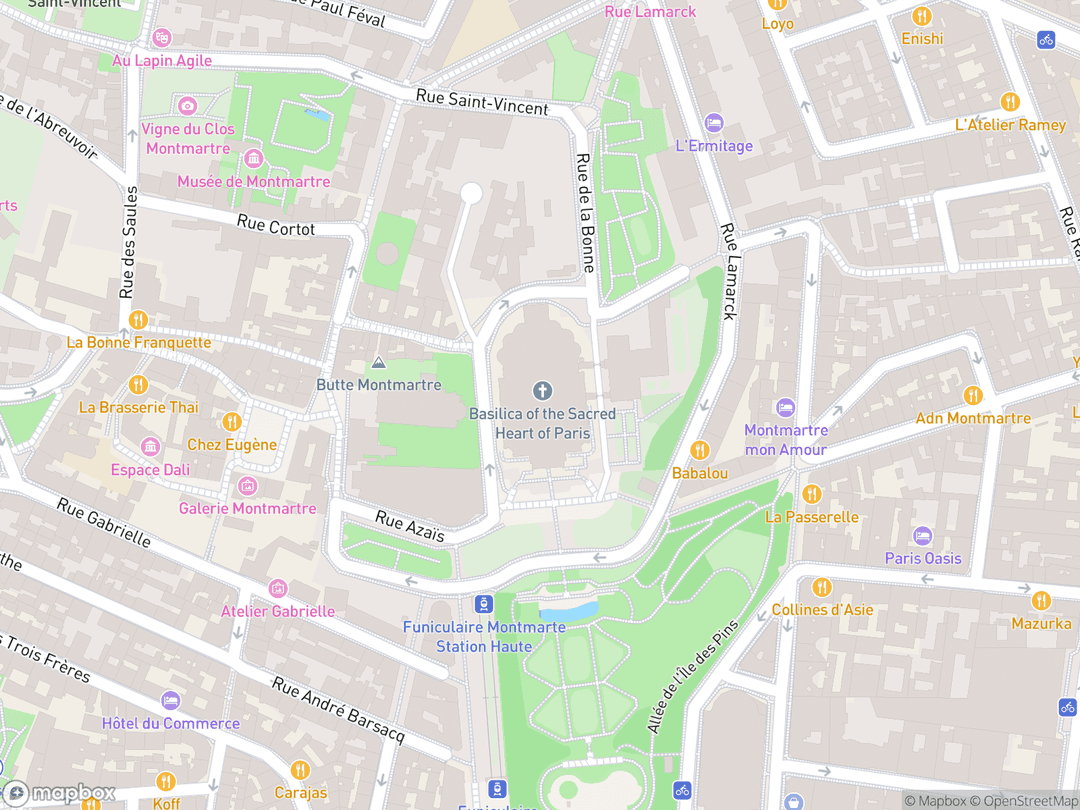
35 Rue du Chevalier de la Barre, 75018 Paris, France
Hours: Sanctuary open daily from 6:00 AM to 10:30 PM; Admission is free.
Getting There: Take Metro Line 2 to Anvers or Line 12 to Abbesses, then walk up the hill steps or ride the Montmartre Funicular.
Get DirectionsTips for Your Visit
Early Morning Reflection
Visit between 6:00 AM and 8:30 AM to experience the sanctuary in deep tranquility before tourist crowds arrive.
Respectful Attire
Ensure shoulders and knees are covered when entering the sacred worship spaces.
Dome Climb Preparation
Wear comfortable shoes if climbing the dome, as the narrow spiral stairs do not have elevator access.
About
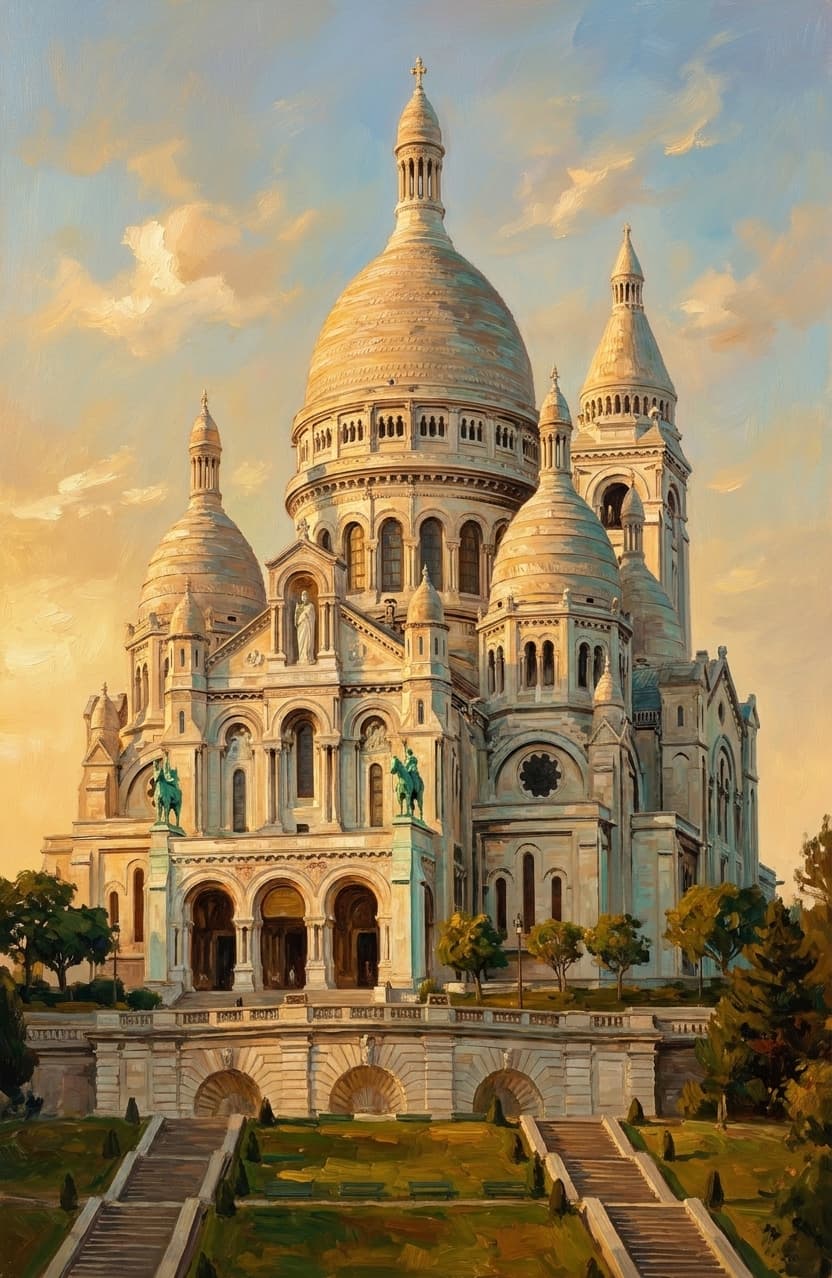
The Basilique du Sacré-Cœur de Montmartre (Basilica of the Sacred Heart of Montmartre) is a landmark Roman Catholic minor basilica and sanctuary located atop the highest natural point in Paris. Commissioned in the wake of the Franco-Prussian War and the Paris Commune as a national votive offering, the sanctuary stands as a solemn symbol of spiritual renewal, peace, and penance.
Rooted in the broader Christian tradition within the Abrahamic family of monotheistic faiths, Sacré-Cœur functions as a dedicated holy space set apart for divine worship, intercession, and personal reflection. Its iconic travertine domes draw millions of pilgrims and visitors from around the world into an atmosphere of quiet prayer and sacred beauty.
The basilica is internationally renowned for its unbroken tradition of Perpetual Adoration of the Blessed Sacrament, which has continued silently day and night since 1885. Perched 130 meters above the Seine River, its gleaming white Romano-Byzantine silhouette remains one of the most recognizable spiritual monuments in Europe.
Gallery
Symbolic Elements
The temple's exterior features intricate carvings, each rich with spiritual meaning:
The Sacred Heart Mosaic
A monumental 474-square-meter apse mosaic depicting Christ opening His arms to reveal a glowing heart symbolizing divine mercy.

Statue of Saint Joan of Arc
An equestrian bronze statue of Saint Joan of Arc standing guard at the main entrance portal representing maidenly courage and national faith.
Statue of King Saint Louis IX
An equestrian bronze depiction of France's saintly king holding a crown of thorns and sword to embody Christian justice.

Statue of Saint Denis
A stone statue depicting the 3rd-century martyr Saint Denis holding his head to commemorate early Christian witness on Montmartre.

High Altar Monstrance
A magnificent golden monstrance elevated above the main sanctuary altar to display the Eucharistic Host for round-the-clock adoration.

Central Dome and Lantern Cross
The sweeping central dome surmounted by a gilded lantern cross signifying the vault of heaven and Christ's supreme sovereignty.

La Savoyarde Bourdon Bell
A colossal 18.8-ton bell cast in Annecy whose deep voice rings across Paris during major ecclesiastical solemnities.

Travertine Stone Facade
Luminous white Château-Landon limestone that continuously bleaches itself in rainwater as an architectural symbol of purity.
Interesting Facts
The travertine stone naturally secretes calcite when exposed to rain, continually cleaning the facade white over time. (Tier A)
Housed in the campanile, 'La Savoyarde' weighs over 18.8 metric tons and is the heaviest functioning bell in France. (Tier A)
The practice of silent 24-hour Perpetual Adoration has continued uninterrupted every single day since December 1, 1885. (Tier A)
Construction was financed entirely by over ten million small donations from French citizens purchasing individual bricks. (Tier B)
Because Montmartre was honeycombed with ancient gypsum mines, engineers sank 83 stone shafts 33 meters deep to anchor foundations. (Tier B)
The summit of the central dome stands over 213 meters above sea level, offering panoramic views extending up to 30 kilometers. (Tier A)
The apse ceiling mosaic of Christ in Majesty covers 474 square meters and is one of the largest ceiling mosaics in the world. (Tier A)
Thirteen heavy bombs struck the complex during World War II in 1944, but the subterranean pillars prevented structural collapse. (Tier B)
The name Montmartre originates from 'Mons Martyrum', commemorating Saint Denis and his companions martyred on the hill around 250 AD. (Tier B)
Common Questions
Why is Sacré-Cœur so unusually white?
The travertine stone releases calcite when washed by rainwater, naturally cleaning and bleaching the exterior white.
Is admission to the basilica free?
Yes, entrance to the main sanctuary and floor is completely free year-round.
What is Perpetual Adoration?
It is an unbroken chain of silent prayer before the Blessed Sacrament that has continued 24/7 since 1885.
Can visitors take photos inside?
No, interior photography is strictly forbidden to maintain an atmosphere of reverent prayer.
Featured Stories
The National Vow and Foundation Engineering
1870s–1880s
In the aftermath of national defeat and civil conflict in 1871, Catholic leaders organized a national vow to erect a sanctuary dedicated to Christ's Sacred Heart. To support the massive superstructure above unstable ancient gypsum mines, engineers executed an astounding technical feat by sinking 83 deep concrete shafts into solid bedrock.
Source: Archdiocese of Paris Historical Archives
La Savoyarde: The Great Bell's Journey
1895
Cast in Annecy-le-Vieux in 1891, the massive 18.8-ton bourdon bell named 'La Savoyarde' arrived at the foot of Montmartre in late 1895. Crowds lined the streets of Paris as a team of 28 heavy horses dragged the giant bronze instrument up the steep slope of the hill to its permanent home in the campanile.
Source: Sanctuary of Sacré-Cœur Archives
Unbroken Adoration Through War and Crisis
1885–Present
On December 1, 1885, worshippers began a continuous relay of silent prayer before the Blessed Sacrament exposed above the altar. This unbroken chain of Perpetual Adoration has endured without a single hour's interruption through two World Wars, blackouts, and air raids.
Source: Sanctuary of Sacré-Cœur Archives
Timeline
National Assembly Approval
The French National Assembly votes a law declaring the construction of a public utility votive church.
Paul Abadie Selected
Architect Paul Abadie wins the design competition among 78 contestants.
Cornerstone Laid
The cornerstone of the basilica is solemnly laid atop Montmartre hill.
Perpetual Adoration Begins
Uninterrupted 24-hour intercessory prayer commences in a temporary chapel on site.
La Savoyarde Arrives
The giant 18.8-ton bourdon bell is hauled up Montmartre hill by a team of 28 horses.
Church-State Separation Law
Ownership of the basilica transfers to the City of Paris while securing permanent Church usage rights.
Construction Completed
Exterior and structural work reaches final completion on the eve of World War I.
Solemn Consecration
Cardinal Louis-Ernest Amette consecrates the basilica following the conclusion of World War I.
Apse Mosaic Dedicated
Luc-Olivier Merson's monumental ceiling mosaic of Christ in Majesty is finished in the apse.
World War II Bombing Survival
Thirteen bombs hit the basilica complex during air raids without compromising structural stability.
Papal Visit
Pope John Paul II makes a historic pilgrimage to Sacré-Cœur and joins in perpetual adoration.
Monument Historique Designation
The French Ministry of Culture officially classifies Sacré-Cœur as a Monument Historique.
History by Decade
1870s — The Vow and Conception
At the summit of Montmartre, a sanctuary of prayer and penance rises to speak of hope and peace.
Following the Franco-Prussian War and Paris Commune, Catholic leaders established the National Vow to build an expiatory sanctuary. Architect Paul Abadie won the public design contest in 1874, and the cornerstone was laid atop Montmartre in 1875.
1880s — Engineering deep Foundations
Construction presented immense engineering challenges due to honeycombed underground gypsum quarries. Workers sank 83 stone columns 33 meters deep to reach bedrock, while perpetual adoration began in a temporary chapel in 1885.
1890s–1900s — Rising Domes and Bells
The grand arches and outer domes took shape over the Parisian skyline. In 1895, the giant bell La Savoyarde was installed, and the 1905 Church-State separation law preserved perpetual religious usage for the sanctuary.
1910s–1920s — Completion and Consecration
Structural work finished in 1914, but WWI delayed official dedication until October 1919. In 1923, Luc-Olivier Merson's vast apse mosaic of Christ in Majesty was completed and unveiled.
1930s–1940s — Sanctuary in Times of War
During World War II, Sacré-Cœur served as a beacon of spiritual refuge. Despite 13 bombs striking the grounds during a 1944 air raid, perpetual adoration continued without stopping.
1980s–Present — Papal Visits and Heritage Recognition
Pope John Paul II visited in 1980 to join pilgrims in adoration. Following extensive interior restoration, the French Ministry of Culture classified Sacré-Cœur as an official Monument Historique in 2022.
Architecture & Facilities
The Basilique du Sacré-Cœur is designed in an eclectic Romano-Byzantine Revival style that intentionally breaks with classical French Gothic traditions. Drawing inspiration from monuments such as Hagia Sophia in Istanbul and Saint Mark's Basilica in Venice, the building features a symmetrical Greek cross floor plan surmounted by five domed structures. The central dome reaches an exterior height of 83 meters, flanked by a 91-meter square campanile, creating an elevated white crown across the northern horizon of Paris.
Building Materials
Travertine Exterior
Durable mineral limestone quarried from Souppes-sur-Loing that bleaches white when washed by rain.
Subterranean Shafts
Eighty-three deep stone masonry columns anchored 33 meters underground into solid bedrock.
Apse Mosaic Glass
Millions of hand-cut gold leaf and enamel glass tesserae executed by Atelier Guilbert-Martin.
Bronze Portico Statues
Cast equestrian statues of Saint Joan of Arc and King Saint Louis IX crafted by Hippolyte Lefèbvre.
Interior Features
Apse of Christ in Majesty
A vast 474-square-meter ceiling mosaic depicting the glorified Christ revealing His Sacred Heart.
High Altar Sanctuary
A elevated marble altar crowned with a golden monstrance for Perpetual Adoration.
Cavaillé-Coll Organ
A historic 1898 pipe organ featuring 4 manual keyboards and over 3,250 pipes.
Subterranean Crypt
A large underground sanctuary containing side chapels, burial vaults, and historic relics.
Temple Grounds
Situated atop the Butte Montmartre, the sanctuary grounds feature sweeping stone terrace steps, formal gardens in Square Louise-Michel, and the historic Montmartre Funicular.
Additional Facilities
Includes a pilgrim reception center (Maison d'Accueil), a religious bookstore, public prayer chapels, and dome terrace access.
Religious Significance
In alignment with the monotheistic traditions of the broader Abrahamic heritage, Sacré-Cœur stands as a holy place dedicated to divine communion, silent intercession, and personal transformation. As a major Catholic votive shrine, the sanctuary expresses a unique theology of divine love through Eucharistic devotion and perpetual prayer.
To serve as a national sanctuary of expiation, Eucharistic adoration, and continuous intercession for peace across France and the world.
Sacred Ordinances
Perpetual Adoration
Continuous day-and-night silent intercessory prayer before the exposed Blessed Sacrament.
Holy Mass and Eucharist
Daily celebration of the Catholic Mass highlighting Christ's real presence and sacrificial love.
Sacrament of Reconciliation
Regular availability of individual confession for pilgrims seeking forgiveness and spiritual renewal.
Shared Monotheistic Heritage and Sacred Space
Like sacred mountains and houses of prayer across Abrahamic traditions, Sacré-Cœur provides a dedicated refuge set apart from worldly distractions where humanity seeks divine mercy and offers heart-felt prayer.
Devotion to the Sacred Heart of Jesus
In Roman Catholic doctrine, the Sacred Heart represents the living emblem of Christ's infinite love for humanity, inviting believers into acts of repair, reconciliation, and compassionate service.
Similar Temples


Sources & Research
Every fact on Temples.org is backed by verified Sources & Research. Each piece of information is rated by source tier and confidence level.
View All Sources (7)
| Field | Source | Tier | Retrieved |
|---|---|---|---|
| About & Historical Background | Basilique du Sacré-Cœur de Montmartre Sanctuary (opens in a new tab) | A | 2026-03-30 |
| Architecture & Facilities | Ministère de la Culture (POP Mérimée Database) (opens in a new tab) | A | 2026-03-30 |
| Timeline & Featured Stories | Holy See Press Office (opens in a new tab) | A | 2026-03-30 |
| Architecture & Materials | Structurae International Structural Database (opens in a new tab) | B | 2026-03-30 |
| History & Construction | Centre des Monuments Nationaux (opens in a new tab) | B | 2026-03-30 |
| Religious History | The Catholic Encyclopedia (opens in a new tab) | C | 2026-03-30 |
| Visitor Insights | Île-de-France Regional Tourism Board (opens in a new tab) | D | 2026-03-30 |