Visitor Insights
Visiting Gurdwara Bangla Sahib
Visiting Gurdwara Bangla Sahib is a deeply enriching experience, offering a glimpse into Sikh culture and spirituality. The Gurdwara is open to all, regardless of background, and provides a welcoming atmosphere for visitors to learn, reflect, and participate in the community.
Highlights
- Experience the Langar, the community kitchen serving free meals to all.
- Take a dip in the sacred Sarovar, believed to have healing properties.
- Admire the stunning architecture, including the golden dome and white marble structure.
Things to Know
- Dress modestly and cover your head with a scarf or handkerchief.
- Remove your shoes before entering the Gurdwara.
- Maintain silence and respect within the prayer hall.
Location
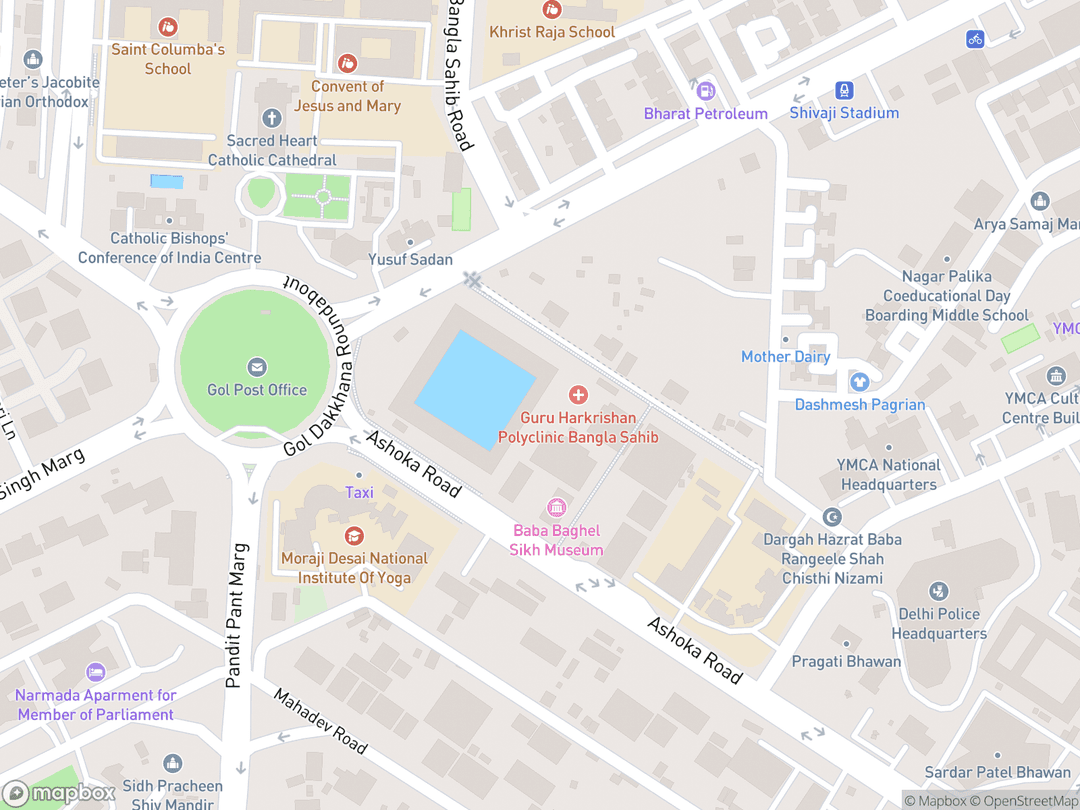
Ashok Road, Hanuman Road Area, Connaught Place, New Delhi, Delhi - 110001
Hours: Open 24/7, all days of the week
Getting There: Nearest metro stations are Rajiv Chowk and Patel Chowk (Yellow Line).
Get DirectionsTips for Your Visit
Dress Code
Dress modestly and cover your head with a scarf or handkerchief. Scarves are available for free at the entrance.
Langar Experience
Participate in the Langar by volunteering to help prepare or serve the food. It's a great way to experience Sikh community spirit.
Sarovar Etiquette
If you wish to take a dip in the Sarovar, ensure you are appropriately dressed and maintain cleanliness.
About
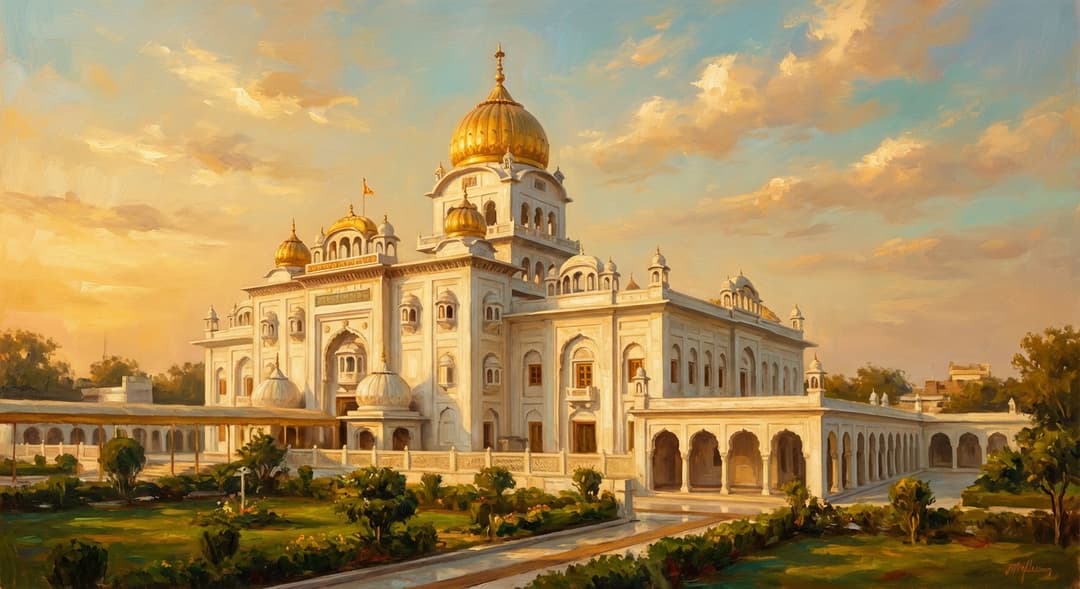
Gurdwara Bangla Sahib is one of the most significant Sikh Gurdwaras in Delhi, India, revered for its deep connection to the eighth Sikh Guru, Guru Har Krishan. The Gurdwara stands as a beacon of faith, compassion, and selfless service, drawing countless visitors from diverse backgrounds who seek spiritual solace and community. Its iconic golden dome and the sacred pool (Sarovar) are instantly recognizable symbols of Sikhism in the heart of the nation's capital.
The Gurdwara's origins trace back to 1664 when Guru Har Krishan stayed at the bungalow owned by Raja Jai Singh. During a severe smallpox and cholera epidemic in Delhi, Guru Har Krishan selflessly provided aid and fresh water from the well at the house to the suffering, embodying the Sikh principle of selfless service (Seva). This act of compassion is central to the Gurdwara's historical and spiritual significance.
Today, Gurdwara Bangla Sahib is not only a place of worship but also a center for community service. The Langar, a community kitchen, offers free meals to all, regardless of background, embodying the Sikh values of equality and sharing. The Gurdwara also houses a hospital, a museum, and a library, further extending its commitment to serving the community.
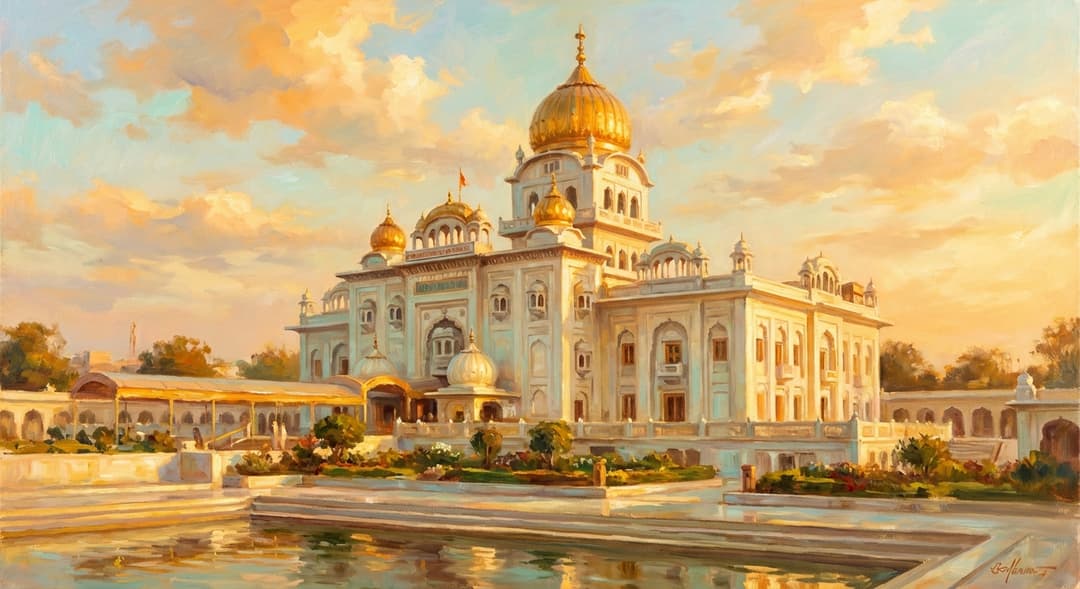
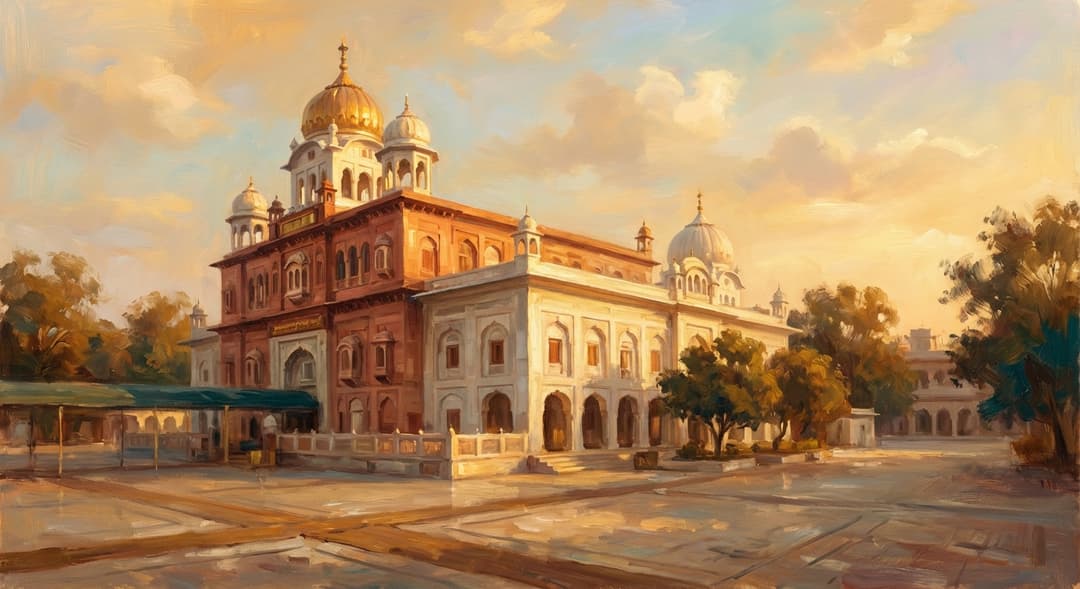
The architecture of Gurdwara Bangla Sahib is a harmonious blend of Sikh, Rajput, and Mughal styles, featuring a large prayer hall made of white marble, a golden dome symbolizing the divine, and the sacred Sarovar. The Gurdwara continues to be a symbol of spiritual solace, attracting devotees and tourists alike, and stands as a testament to the enduring values of Sikhism.
Gallery
Symbolic Elements
The temple's exterior features intricate carvings, each rich with spiritual meaning:

Khanda
The Khanda is the central symbol of Sikhism, consisting of a double-edged sword (Khanda) representing divine justice, a circular chakra symbolizing the eternal cycle of life and death, and two crossed daggers (Kirpans) representing spiritual and temporal authority. It embodies the core tenets of Sikhism and is prominently displayed at Gurdwara Bangla Sahib.

Guru Granth Sahib
The Guru Granth Sahib is the holy scripture of Sikhism, revered as the living Guru. It is placed on a throne under a canopy in the prayer hall and treated with utmost respect. Sikhs consider the Guru Granth Sahib the Supreme Spiritual Authority, guiding them in their daily lives.

Sarovar (Holy Pond)
The Sarovar is a large, sacred pool that symbolizes purity and spiritual purification. The water is believed to have healing properties and is distributed as Amrit (nectar) to devotees. Taking a dip in the Sarovar is considered a spiritually cleansing experience.

Golden Dome
The golden dome is one of the most iconic features of Gurdwara Bangla Sahib, visible from a distance. It symbolizes the spiritual and divine aspect of the Gurdwara and is covered with gold leaf, reflecting the Gurdwara's significance.

Nishan Sahib
The Nishan Sahib is a tall flagpole with the Sikh flag, bearing the Sikh symbol. It stands prominently within the Gurdwara complex, symbolizing the Sikh presence and identity. The flag is regularly replaced and honored with a special ceremony.
Langar Hall
The Langar Hall is the community kitchen where free meals are served to all visitors, regardless of religion, caste, or status. It embodies the Sikh values of equality, sharing, and selfless service. The Langar operates 24 hours a day, serving thousands of people daily.

White Marble
The main hall of Gurdwara Bangla Sahib is constructed with white marble, giving it a serene and pure appearance. The marble symbolizes cleanliness, peace, and spiritual enlightenment. The smooth, reflective surface enhances the overall ambiance of the prayer hall.
Arches and Pillars
The architecture of Gurdwara Bangla Sahib features high ceilings supported by pillars and arches, reflecting a blend of Sikh, Rajput, and Mughal styles. These architectural elements provide structural support and add to the aesthetic beauty of the Gurdwara.
Interesting Facts
Gurdwara Bangla Sahib was originally a bungalow belonging to Raja Jai Singh, a nobleman in the Mughal court. [A]
The eighth Sikh Guru, Guru Har Krishan, stayed at this bungalow in 1664. [A]
Guru Har Krishan helped people suffering from a deadly epidemic of cholera and smallpox by giving them water from a well in the bungalow. [A]
The water from the Sarovar is considered to have healing properties. [C]
The Gurdwara complex includes a hospital, a museum, and a library. [C]
The Langar (community kitchen) operates 24 hours a day and serves free meals to all visitors, regardless of religion, caste, or status. [A]
The kitchen is highly automated and serves thousands of people daily. [C]
Guru Har Krishan was the youngest of the Sikh Gurus, assuming the role at the age of five. [C]
In 1984, the Gurdwara provided sanctuary to Sikhs during the anti-Sikh riots. [B]
The Gurdwara is instantly recognizable by its golden dome and tall flagpole (Nishan Sahib). [C]
The Delhi Sikh Gurdwara Management Committee operates a hospital in the basement of the Gurdwara. [A]
The Gurdwara is a symbol of spiritual solace and draws devotees and tourists alike. [C]
Muslims of Delhi referred to Guru Har Krishan as 'Bala Pir' or the Child prophet. [C]
Common Questions
What is Gurdwara Bangla Sahib known for?
Gurdwara Bangla Sahib is known for its association with Guru Har Krishan, the eighth Sikh Guru, and the sacred pool (Sarovar) within its complex. It is also famous for its Langar, a community kitchen that offers free meals to all.
What is the significance of the Sarovar?
The Sarovar is a large, sacred pool that symbolizes purity and spiritual purification. The water is believed to have healing properties and is distributed as Amrit (nectar) to devotees.
What is Langar?
Langar is a community kitchen that offers free meals to all visitors, regardless of religion, caste, or status. It embodies the Sikh values of equality and sharing.
What are the visiting hours for Gurdwara Bangla Sahib?
Gurdwara Bangla Sahib is open 24/7, all days of the week, including national holidays.
Is there an entry fee to visit Gurdwara Bangla Sahib?
No, there is no entry fee to visit Gurdwara Bangla Sahib. It is open to all, free of charge.
What is the dress code for visiting Gurdwara Bangla Sahib?
Visitors must dress modestly and cover their heads with a scarf or handkerchief. Scarves are available for free at the entrance. Shoes must be removed before entering.
How can I reach Gurdwara Bangla Sahib?
The nearest metro stations are Rajiv Chowk and Patel Chowk (Yellow Line). From there, you can take a short taxi or auto-rickshaw ride to the Gurdwara.
Related Stories
Explore the rich history, traditions, and people connected to this sacred site.
Featured Stories
Guru Har Krishan's Compassion
1664
In 1664, during a severe smallpox and cholera epidemic in Delhi, Guru Har Krishan demonstrated profound compassion by providing aid and fresh water from the well at Raja Jai Singh's bungalow to the suffering. This selfless act of service became a defining moment in the Gurdwara's history, symbolizing the Sikh principle of Seva (selfless service) and inspiring generations to come.
The Guru's dedication to alleviating the suffering of others, regardless of their background, showcased the core values of Sikhism. His actions transformed the bungalow into a sanctuary of hope and healing, laying the foundation for the Gurdwara's future role as a center for community service and spiritual solace.
Source: Incredible India (Government of India)
The Healing Waters of the Sarovar
Ongoing
The Sarovar, or holy pool, at Gurdwara Bangla Sahib is believed to possess healing properties, drawing devotees from far and wide seeking physical and spiritual purification. The water, blessed by the memory of Guru Har Krishan's compassionate service, is distributed as Amrit (nectar) to those who visit the Gurdwara.
Taking a dip in the Sarovar is considered a sacred ritual, symbolizing the cleansing of sins and the renewal of faith. The Sarovar serves as a constant reminder of the Guru's selfless actions and the transformative power of compassion, embodying the Sikh belief in the interconnectedness of physical and spiritual well-being.
Source: Delhi Sikh Gurdwara Management Committee
The Langar: A Community Kitchen for All
Ongoing
The Langar at Gurdwara Bangla Sahib is a testament to the Sikh values of equality, sharing, and selfless service. Operating 24 hours a day, the community kitchen provides free meals to all visitors, regardless of their religion, caste, or status. This tradition, rooted in the teachings of Guru Nanak, emphasizes the importance of breaking down social barriers and fostering a sense of unity and belonging.
The Langar is not only a place to receive nourishment but also a space for community interaction and service. Volunteers from all walks of life come together to prepare and serve the meals, embodying the spirit of Seva and creating a welcoming environment for all who enter. The Langar stands as a powerful symbol of Sikh hospitality and the commitment to serving humanity.
Source: Holidify
Timeline
Guru Har Krishan's Visit
Guru Har Krishan stayed at Raja Jai Singh's bungalow during his visit to Delhi.
MilestoneEpidemic Relief
Guru Har Krishan helped people suffering from a deadly epidemic by providing water from the well.
EventShrine Construction
Sikh General Sardar Baghel Singh built a small shrine on the spot where the palace once stood.
MilestoneCurrent Structure Built
The current structure of Gurdwara Bangla Sahib was mostly built.
MilestoneSarovar Construction
A beautiful Sarovar (tank) was built adjacent to the Gurdwara.
MilestoneSanctuary During Riots
During the anti-Sikh riots, around 150 Sikhs took shelter inside the Gurdwara.
EventDiagnostic Center Inaugurated
The Gurdwara inaugurated a diagnostic center to provide healthcare for the poor.
EventRaja Jai Singh's Bungalow
The site was originally a bungalow owned by Raja Jai Singh, a Rajput ruler.
MilestoneSardar Baghel Singh's Contribution
Sardar Baghel Singh supervised the construction/reconstruction of nine Sikh shrines in Delhi.
MilestoneHindu Mob Driven Back
A Hindu mob tried to storm the temple but was driven back.
EventGuru Har Krishan's Stay
Guru Har Krishan stayed at this bungalow during his visit to Delhi.
EventSmallpox and Cholera Epidemic
During this time, a smallpox and cholera epidemic broke out in Delhi.
EventSmall Shrine Built
Sikh General Sardar Baghel Singh built a small shrine on the spot where the palace once stood.
MilestoneCurrent Structure
The current structure of Gurdwara Bangla Sahib was mostly built.
MilestoneHistory by Decade
1660s — Guru Har Krishan's Visit
There is no higher religion than to serve suffering humanity.
In 1664, Guru Har Krishan, the eighth Sikh Guru, visited Delhi and stayed at the bungalow owned by Raja Jai Singh. During this time, a severe smallpox and cholera epidemic broke out in the city. Guru Har Krishan selflessly provided aid and fresh water from the well at the bungalow to the suffering, embodying the Sikh principle of selfless service (Seva). This act of compassion is central to the Gurdwara's historical and spiritual significance.
1780s — Shrine Construction
The spirit of selfless service is the essence of Sikhism.
In 1783, Sikh General Sardar Baghel Singh built a small shrine on the spot where Raja Jai Singh's bungalow once stood. Sardar Baghel Singh was a prominent military leader who played a significant role in establishing Sikh control over Delhi. He also supervised the construction and reconstruction of nine Sikh shrines in Delhi, including Gurdwara Bangla Sahib.
Post 1947 — Modern Gurdwara
Gurdwara Bangla Sahib is a beacon of faith, compassion, and selfless service.
After India gained independence in 1947, the current structure of Gurdwara Bangla Sahib was mostly built. The Gurdwara complex was expanded to include a larger prayer hall, a museum, a library, and a hospital. The Sarovar (holy pool) was also renovated and beautified. Today, Gurdwara Bangla Sahib is one of the most prominent Sikh Gurdwaras in Delhi, attracting countless visitors from all walks of life.
Architecture & Facilities
A harmonious blend of Sikh, Rajput, and Mughal architectural styles, centered on a large rectangular prayer hall constructed in white marble with a high ceiling supported by pillars and arches. The iconic gold-leafed dome, visible from across Delhi, symbolizes the divine aspect of the Gurdwara. The complex is anchored by the sacred Sarovar (holy pool) measuring 225 by 235 feet, whose waters are believed to have healing properties dating to Guru Har Krishan's ministry during Delhi's 1664 epidemic. A towering Nishan Sahib flagpole bearing the Sikh Khanda symbol marks the entrance. The current structure was largely rebuilt post-1947, with roots tracing to a shrine erected by Sikh General Sardar Baghel Singh in 1783.
Building Materials
Exterior
White marble is the primary material used for the exterior of Gurdwara Bangla Sahib, giving it a serene and pure appearance.
Interior
The interior features intricate designs and decorations, with a focus on creating a peaceful and spiritual atmosphere.
Interior Features
Prayer Hall
The prayer hall is a large rectangular structure with a high ceiling supported by pillars and arches. It is made of white marble and provides a spacious area for devotees to gather and pray.
Temple Grounds
The Gurdwara complex includes a large courtyard, a museum, a library, a hospital, and the sacred Sarovar (holy pool).
Religious Significance
Gurdwara Bangla Sahib holds immense religious significance for Sikhs due to its association with Guru Har Krishan, the eighth Sikh Guru, and the sacred Sarovar (holy pool) within its complex.
The Gurdwara serves as a place of worship, community service, and spiritual solace for Sikhs and people of all faiths.
Sacred Ordinances
Amrit Ceremony
The Amrit Ceremony is a Sikh initiation ceremony in which devotees are initiated into the Khalsa, a community of initiated Sikhs.
The Significance of Seva
Seva (selfless service) is a core tenet of Sikhism, and Gurdwara Bangla Sahib embodies this principle through its Langar (community kitchen) and other charitable activities.
Similar Temples
Sources & Research
Every fact on Temples.org is backed by verified Sources & Research. Each piece of information is rated by source tier and confidence level.
View All Sources (3)
| Field | Source | Tier | Retrieved |
|---|---|---|---|
| About & Historical Background | Delhi Sikh Gurdwara Management Committee (opens in a new tab) | A | 2026-02-16 |
| History, Architecture & Visitor Insights | Incredible India (Government of India) (opens in a new tab) | A | 2026-02-16 |
| Facts, Timeline & Visitor Tips | Holidify (opens in a new tab) | D | 2026-02-16 |