Visitor Insights
Visiting Mexico City Metropolitan Cathedral
Visitors to the Metropolitan Cathedral encounter one of the Western Hemisphere's most significant religious monuments. Entry to the main sanctuary is free, offering access to grand naves, historic side chapels, and breathtaking Baroque altarpieces.
Highlights
- Marvel at the monumental gold-leaf Altar of the Kings in the apse.
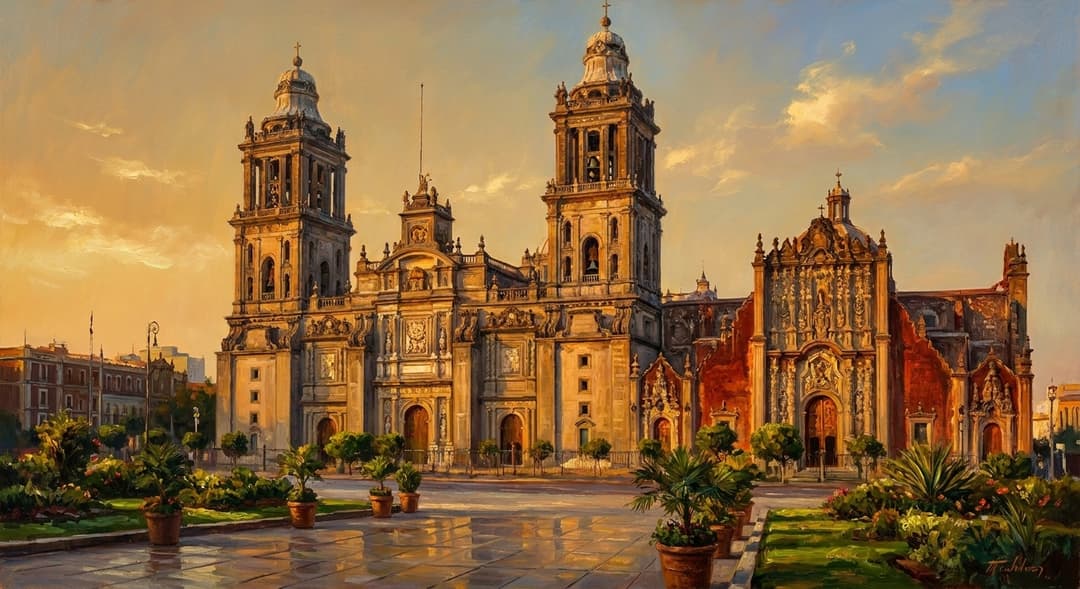
- Observe the striking contrast between the main gray facade and the attached red volcanic Sagrario Metropolitano.
- View the venerated black crucifix known as the Lord of Poison.
- Examine the three Theological Virtues statues carved by Manuel Tolsá atop the main clock.
Things to Know
- Active place of worship; maintain quiet reverence during services.
- Avoid wandering the central nave during major Sunday High Masses held around noon.
- Specialized tours of the bell towers and sacristy require small local fees.
Location
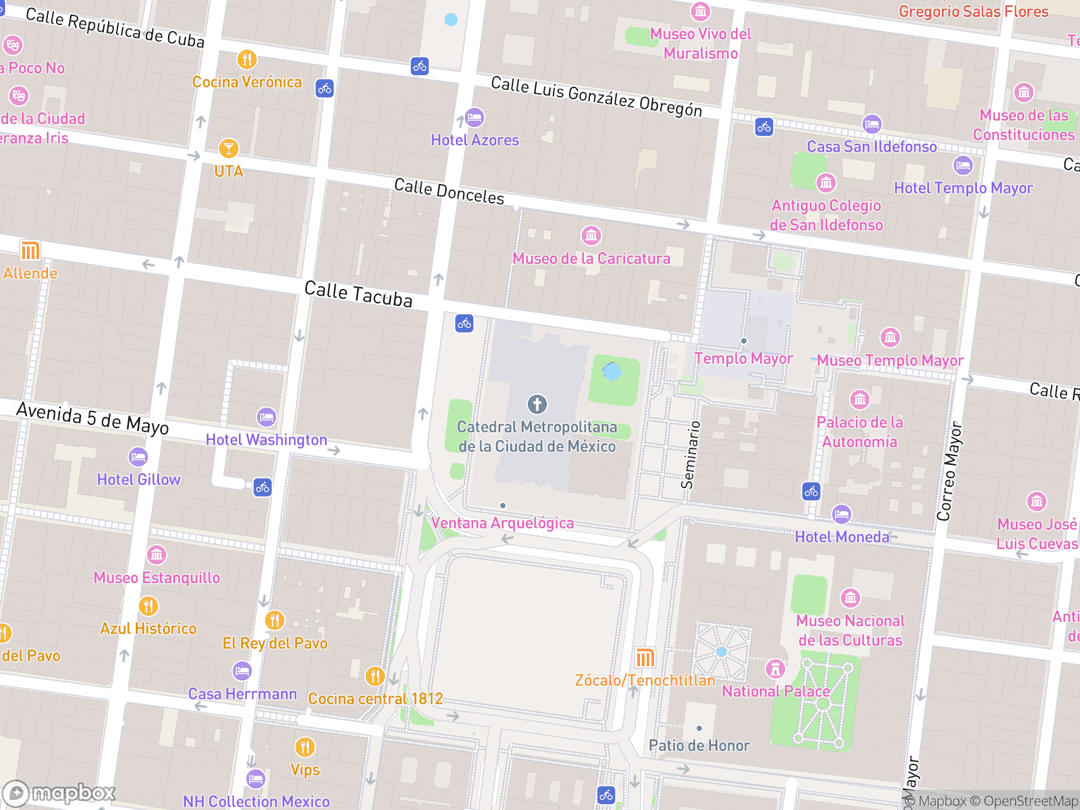
Plaza de la Constitución S/N, Centro Histórico, Cuauhtémoc, 06000 Mexico City, CDMX, Mexico
Hours: Daily 8:00 AM – 8:00 PM
Getting There: Take Metro Line 2 directly to Zócalo / Tenochtitlan Station, exiting onto the Plaza de la Constitución.
Get DirectionsTips for Your Visit
Optimal Viewing Times
Visit during morning hours (8:30 AM – 10:30 AM) to experience quiet interior contemplation and sunlight streaming through clerestory windows.
Architectural Detail Photography
Late afternoon light illuminates the main southern sandstone facade facing the Zócalo plaza with a deep golden tone.
About
The Metropolitan Cathedral of the Assumption of the Most Blessed Virgin Mary into Heaven stands at the historic heart of Mexico City on the northern side of the Zócalo plaza. Built between 1573 and 1813, this monumental sanctuary reflects four centuries of Spanish colonial architecture, blending Renaissance, Baroque, Churrigueresque, and Neoclassical styles over a grand Latin cross footprint.
Grounded in the Christian theology of the Abrahamic tradition, the cathedral serves as a physical 'House of God' (Bethel) and a sacramental sanctuary of the New Covenant. As the seat of the Roman Catholic Archdiocese of Mexico, it functions as both an active site of Episcopal governance and a spiritual refuge housing historic relics, monumental altars, and world-renowned sacred art.
Gallery
Symbolic Elements
The temple's exterior features intricate carvings, each rich with spiritual meaning:
Assumption of Mary Relief
A marble facade carving showing Mary's bodily assumption, prefiguring human resurrection at the threshold of salvation.
Altar of the Kings
A 25-meter gold-leaf retable representing the ultimate subordination of earthly monarchs to Christ's divine sovereignty.

Estípite Columns
Inverted pyramid pillars whose anti-gravitational form symbolizes the ascending human soul freed from earthly burdens.

Lord of Poison Crucifix
A revered black wooden crucifix representing Christ absorbing human sin and spiritual toxicity.
Episcopal Cathedra
The official chair of the Archbishop symbolizing unbroken apostolic succession and pastoral oversight.

Tezontle Volcanic Stone
Porous red stone forming the Sagrario facade, embodying earthly humility and practical subsoil weight mitigation.

Virtue Statues by Tolsá
Neoclassical crown figures depicting Faith, Hope, and Charity guiding Christian pilgrimage toward eternal life.

Central Octagonal Dome
An elevated lantern dome symbolizing the bridge between finite earth and infinite heaven.
Interesting Facts
The cathedral foundations contain carved stone blocks repurposed directly from the Aztec Templo Mayor after the conquest of Tenochtitlan.
Construction spanned nearly two and a half centuries under more than two dozen chief architects.
World-renowned geotechnical engineers successfully halted a severe 2.4-meter foundation tilt using subsoil grout injections in the 1990s.
The bell towers house Santa María de Guadalupe, a massive 13-ton bell cast in 1791.
Two monumental 18th-century Spanish organs containing thousands of metal pipes dominate the central choir enclosure.
A subterranean crypt beneath the Altar of the Kings holds the tombs of Mexico City archbishops dating back to the 16th century.
The attached Sagrario Metropolitano features an independent Greek Cross floor plan built with red volcanic tezontle stone.
A major electrical fire in 1967 damaged historic choir stalls and led to a decade-long restoration effort.
Master sculptor Manuel Tolsá carved the three allegorical statues representing Faith, Hope, and Charity atop the main clock.
A large soil-monitoring pendulum hung for decades beneath the central dome to trace building inclination in real time.
Common Questions
Why was the cathedral built on top of Aztec ruins?
Spanish conquerors repurposed stones from the Templo Mayor to establish political and religious dominance on Mexico City's primary sacred precinct.
Is the Mexico City Metropolitan Cathedral still sinking?
Major geotechnical interventions in the 1990s stabilized the foundation and successfully halted differential sinking.
Why does the cathedral blend so many architectural styles?
Because construction spanned 240 years (1573–1813), successive chief architects incorporated Renaissance, Baroque, Churrigueresque, and Neoclassical styles.
Is general admission free to visitors?
Yes, general entry to the main sanctuary and side chapels is free, though small fees apply for specialized bell tower tours.
Featured Stories
Building Upon Ancient Foundations
1520s–1570s
Following the fall of Tenochtitlan in 1521, Spanish authorities dismantled the sacred Aztec precinct of Templo Mayor. Carved basalt blocks from the ancient pyramids were repurposed directly into the foundation and lower walls of the cathedral. This physical recycling created a symbolic transition of sacred space from indigenous mesoamerican rites to Christian worship.
Source: World Monuments Fund & Historic Surveys
The Great Subsoil Engineering Intervention
1990s
Built over the soft lacustrine clay beds of Lake Texcoco, the massive stone cathedral developed a perilous 2.4-meter differential tilt over centuries. In a ground-breaking engineering effort during the 1990s, international teams excavated targeted subterranean clay pockets beneath the high point to gently settle the structure. This delicate intervention stabilized the cathedral without disturbing its fragile historic vaults.
Source: World Monuments Fund Technical Reports
Tragedy and Renewal in the 1967 Fire
January 17, 1967
A catastrophic fire sparked by an electrical short swept through the interior in early 1967, destroying the historic Altar of Forgiveness and severely burning the 18th-century choir stalls. The tragic destruction prompted a meticulous decade-long restoration project by Mexican artisans. During the cleanup, experts uncovered hidden colonial manuscripts and structural records concealed within the interior walls for centuries.
Source: Archdiocesan Historical Records
Timeline
Original Church Built
Hernán Cortés orders construction of the first small church using stones from the destroyed Aztec Templo Mayor.
Cathedral Elevation
Pope Paul III elevates the church to cathedral status, later establishing it as a Metropolitan See in 1546.
Groundbreaking for Current Cathedral
Architect Claudio de Arciniega initiates construction on the current monumental cathedral plan.
The Great Flood
Subsoil waterlogging and severe citywide flooding halt construction and induce early differential sinking.
Interior Consecration
Archbishop Mateo de Sagade Bugueiro officially consecrates the interior vaults for public divine service.
Demolition of Predecessor Church
The original 1520s church inside the construction boundary is completely removed to clear the main nave.
Altar of the Kings Completed
Jerónimo de Balbás finishes the monumental gold-leaf retable introducing Churrigueresque style to the New World.
Sagrario Metropolitano Completed
Lorenzo Rodríguez completes the attached Ultra-Baroque parish church built from red volcanic tezontle.
Bell Towers Finished
Architect José Damián Ortiz de Castro completes the 67-meter bell towers and raises the 13-ton Guadalupe bell.
Final Neoclassical Completion
Manuel Tolsá completes the central dome, clock tower, and Theological Virtues statues, ending 240 years of construction.
Catastrophic Interior Fire
An electrical short causes a severe fire destroying the Altar of Forgiveness and historic choir stalls.
Foundation Stabilization Miracle
Engineers successfully complete subsoil clay extraction, leveling the structure and arresting catastrophic sinking.
History by Decade
1520s–1540s — Initial Church & Bishopric
Hernán Cortés ordered the construction of a modest parish church on the Aztec sacred precinct using dismantled stones from Templo Mayor. Elevated to cathedral status by Pope Paul III in 1530, the structure quickly proved too small for the rapidly expanding colonial metropolis.
1570s–1620s — Renaissance Groundbreaking & Subsoil Floods
Spanish architect Claudio de Arciniega drafted plans inspired by Spanish Renaissance cathedrals, breaking ground for the current structure in 1573. Progress slowed severely due to soft lakebed subsoil and the Great Flood of 1629, which submerged the city for five years and caused uneven settling.
1650s–1660s — Interior Consecration & Original Demolition
The central roof vaults were completed, allowing Archbishop Mateo de Sagade Bugueiro to officially consecrate the cathedral interior on February 2, 1656. In 1667, the original 1520s church that had remained standing inside the perimeter was fully demolished to clear the central nave.
1710s–1760s — Baroque Masterpieces & Sagrario Addition
Jerónimo de Balbás carved the magnificent Churrigueresque Altar of the Kings between 1718 and 1737, introducing estípite columns to the Americas. Lorenzo Rodríguez constructed the attached Sagrario Metropolitano (1749–1768) with a red tezontle facade creating a striking contrast with the main gray structure.
1780s–1810s — Towers & Neoclassical Completion
Architect José Damián Ortiz de Castro designed the distinctive bell towers capped with bell-shaped domes in 1791. Neoclassical architect Manuel Tolsá completed the central dome, high balustrades, and main facade clock with the statues of Faith, Hope, and Charity in 1813.
1960s–1970s — The Great Fire & Interior Restoration
A devastating electrical fire in 1967 destroyed the central Altar of Forgiveness and ruined hand-carved cedar choir stalls. Meticulous restoration over the following decade repaired the monumental organs and led to significant historical discoveries within the walls.
1990s–2000s — Geotechnical Stabilization
Engineering teams initiated a major subsoil extraction project between 1993 and 1998 to correct a 2.4-meter differential tilt. By carefully extracting clay beneath high points, the foundation was stabilized and the rate of uneven sinking halted.
Architecture & Facilities
The Mexico City Metropolitan Cathedral represents an extraordinary synthesis of four major architectural eras spanning 240 years of construction. The interior structure follows a Spanish Renaissance plan with Gothic rib-vaulting principles in the ceiling vaults. High Baroque and Ultra-Baroque Churrigueresque styles dominate the interior altarpieces and the Sagrario facade, while the exterior towers and upper crowning dome display refined Neoclassical proportions.
Building Materials
Tezontle Volcanic Basalt
Porous red volcanic stone used for non-load-bearing wall fields and the Sagrario facade to minimize overall structural weight.
Chiluca and Cantera Sandstone
Dense light-gray and cream volcanic sandstones utilized for structural columns, carved portals, doorways, and arches.
Tepeaca Marble
Polished natural marble tiles lining the expansive interior processional naves and side chapel floors.
Cedar and Gold Leaf
Carved aromatic cedar wood overlaid with fine gold leaf forming the massive Churrigueresque retables.
Interior Features
Altar of the Kings (Altar de los Reyes)
A 25-meter-tall golden retable occupying the apse, featuring estípite columns and statues of canonized Christian monarchs.
Choir Enclosure (Coro)
A central choir area housing hand-carved cedar stalls and two monumental 18th-century Spanish pipe organs.
Altar of Forgiveness (Altar del Perdón)
A magnificent forward altarpiece facing the main portal, housing the venerated Lord of Poison crucifix.
Subterranean Archbishops' Crypt
An underground burial chamber situated beneath the main altar containing tombs of Mexican archbishops since the 16th century.
Temple Grounds
The cathedral anchors the northern side of the Plaza de la Constitución (Zócalo), featuring a stone atrium, exterior statues, and direct integration into the historic pedestrian center.
Additional Facilities
Public visitor center, historical archives office, parish administration in the Sagrario, and dedicated tour access points for the bell towers.
Religious Significance
Grounded in the shared Abrahamic tradition of consecrated sacred space, the Metropolitan Cathedral stands as a Christian 'House of God' (Bethel) where the earthly realm connects with divine transcendence. Within Roman Catholic ecclesiology, a cathedral is the principal sanctuary of a diocese, housing the bishop's throne (cathedra) as a symbol of spiritual teaching authority and unbroken apostolic continuity.
Serves as the seat of the Archdiocese of Mexico, conducting Episcopal liturgies, administering sacraments, and preserving sacred art for believers.
Sacred Ordinances
Holy Sacrifice of the Mass
Daily Eucharistic liturgy celebrated as the central act of Catholic worship and sacramental grace.
Sacrament of Holy Orders
Ordination ceremonies conferring priesthood and deaconate roles within the local Archdiocese.
Sacrament of Reconciliation
Confessional rites offered continuously throughout the day in specialized interior chapels.
Episcopal Blessings
Solemn liturgical blessings pronounced by the Archbishop during major feast days and holy seasons.
Marian Devotion & The Assumption
Dedicated to the Assumption of Mary into Heaven, the cathedral emphasizes her role in Catholic theology as the first believer to experience the full bodily promise of Christ's resurrection.
Sacramental Heart of the Archdiocese
As the principal mother church of Mexico, the cathedral hosts major diocesan gatherings, international interfaith dialogues, and public acts of faith uniting millions of believers.
Similar Temples
Sources & Research
Every fact on Temples.org is backed by verified Sources & Research. Each piece of information is rated by source tier and confidence level.
View All Sources (8)
| Field | Source | Tier | Retrieved |
|---|---|---|---|
| About & Historical Background | World Monuments Fund (opens in a new tab) | B | 2026-02-23 |
| Architectural Overview & Dimensions | Encyclopaedia Britannica (opens in a new tab) | B | 2026-02-23 |
| Data Verification & Alternate Names | Wikidata Project (opens in a new tab) | B | 2026-02-23 |
| Visitor Insights & Travel Logistics | AroundUs Travel Guide (opens in a new tab) | D | 2026-02-23 |
| Exterior Features & Structural Dimensions | Griven Architectural Lighting (opens in a new tab) | D | 2026-02-23 |
| Engineering & Foundation Tilt History | DOZR Engineering & Construction (opens in a new tab) | D | 2026-02-23 |
| Architectural History & Timeline | Rethinking the Future Architecture (opens in a new tab) | D | 2026-02-23 |
| Cultural & Visitor Information | Discover Walks Mexico City (opens in a new tab) | D | 2026-02-23 |