Visitor Insights
Visiting Wat Arun (Temple of Dawn)
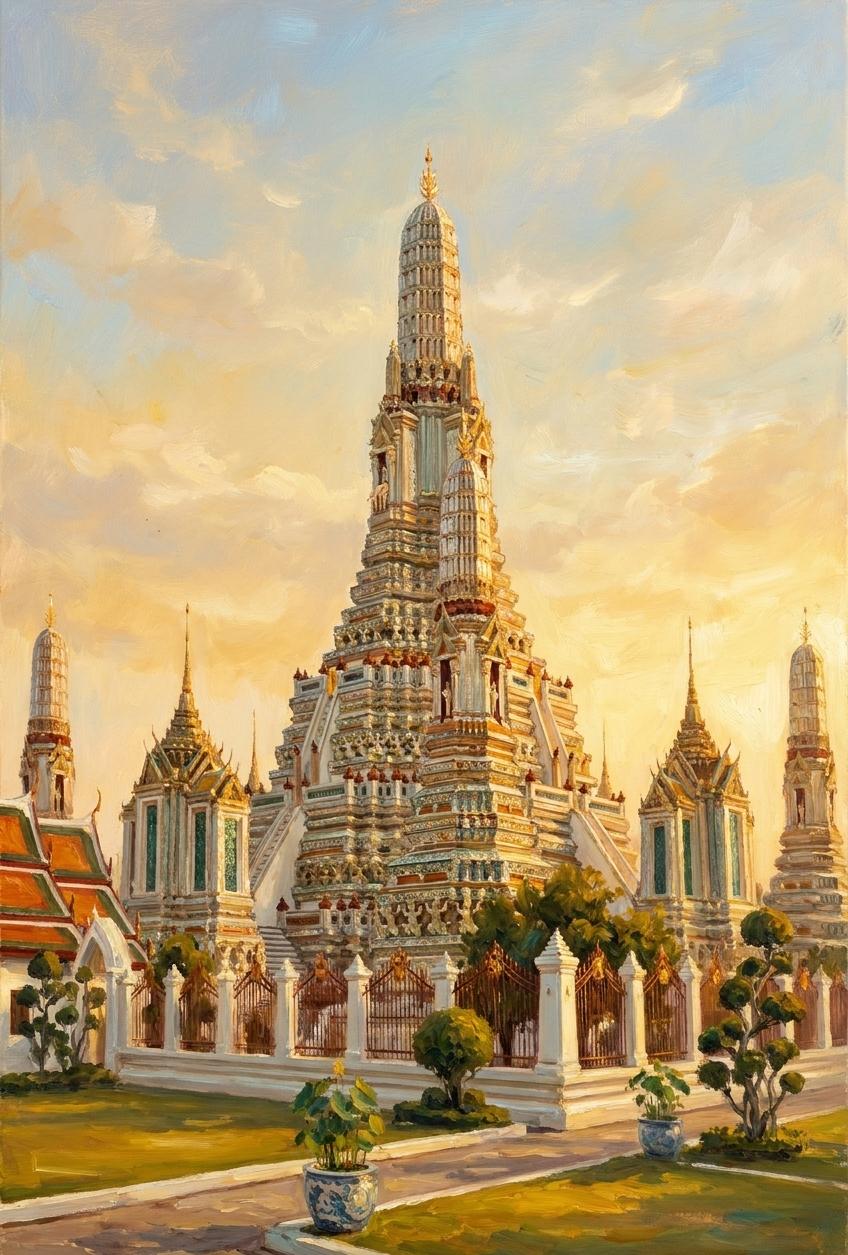
Visiting Wat Arun offers an immersive journey through Theravada Buddhist cosmology along the scenic bank of the Chao Phraya River. Visitors should explore early in the morning to experience peaceful river breezes and view intricate porcelain mosaics before peak midday crowds arrive.
Highlights
- Steep multi-tiered ascent of the central 82-meter Mount Meru prang
- Intricate mosaic motifs assembled from Chinese porcelain dishes and cowrie shells
- Colossal guardian Yaksha warrior statues standing sentinel at the ordination hall
- Principal golden Buddha image in the Ubosot cast under the direction of King Rama II
Things to Know
- Modest dress covering shoulders and knees is strictly enforced at the gate
- Upper terraces feature narrow, steep stone steps that require careful footing
- Monastic chants in the Ubosot may temporarily restrict interior entry during service hours
Location
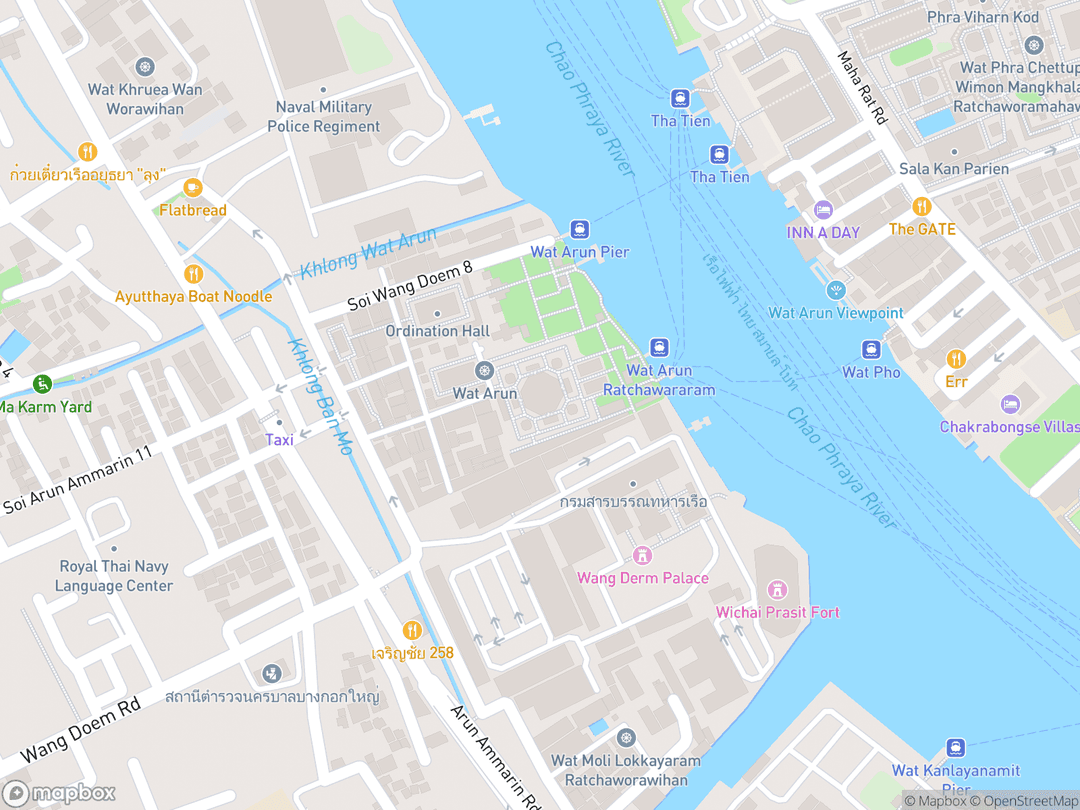
158 Thanon Wang Doem, Khwaeng Wat Arun, Khet Bangkok Yai, Bangkok 10600, Thailand
Hours: Daily 8:00 AM – 6:00 PM
Getting There: Take the Chao Phraya Express Boat to Wat Arun Pier or take the 5-THB cross-river ferry from Tha Tien Pier behind Wat Pho.
Get DirectionsTips for Your Visit
Cross-River Ferry Connection
Combine your trip with Wat Pho across the river by taking the rapid five-baht ferry directly between Tha Tien and Wat Arun piers.
Sunset River Views
While named the Temple of Dawn, the best photography occurs at sunset when viewed from the opposite eastern riverbank.
Strict Sacred Dress Code
Wear loose lightweight clothing covering knees and shoulders, or rent a sarong from the entrance pavilion before passing ticket gates.
About
Wat Arun Ratchawararam, commonly called the Temple of Dawn, stands prominently on the western bank of the Chao Phraya River as one of Thailand's most revered royal monasteries. Its soaring central prang forms an unmistakable landmark along Bangkok's historic waterfront skyline.
Originating in the Ayutthaya period as Wat Bang Makok, the complex attained premier status in 1768 when King Taksin established his capital at Thonburi. King Taksin renamed the site Wat Chaeng after arriving at daybreak, dedicating it as his personal royal chapel and enshrining the sacred Emerald Buddha.
During the 19th-century Rattanakosin era, Kings Rama II and Rama III transformed the site into an architectural masterpiece by expanding the central tower to nearly 82 meters. Craftsmen applied thousands of mosaic patterns using discarded Chinese porcelain ballast, turning the stupa into a shimmering Dharmic reliquary.
Rooted deeply in Theravada Buddhist devotion, Wat Arun represents Mount Meru, the universal axis of Dharmic cosmology. The complex continues to operate as an active center of Buddhist monastic education, silent meditation, and national spiritual heritage.
Gallery
Symbolic Elements
The temple's exterior features intricate carvings, each rich with spiritual meaning:
Central Prang (Phra Prang Prathan)
The 82-meter central spire represents Mount Meru as the cosmic axis of Dharmic and Buddhist cosmology.

Trident of Shiva and Vajra
The bronze seven-pronged spire apex symbolizes cosmic authority and spiritual transcendence over earthly delusion.
The Royal Crown (Mongkut)
Installed by King Rama III, this gilded coronet proclaims that earthly sovereignty is offered in submission to the Buddha.
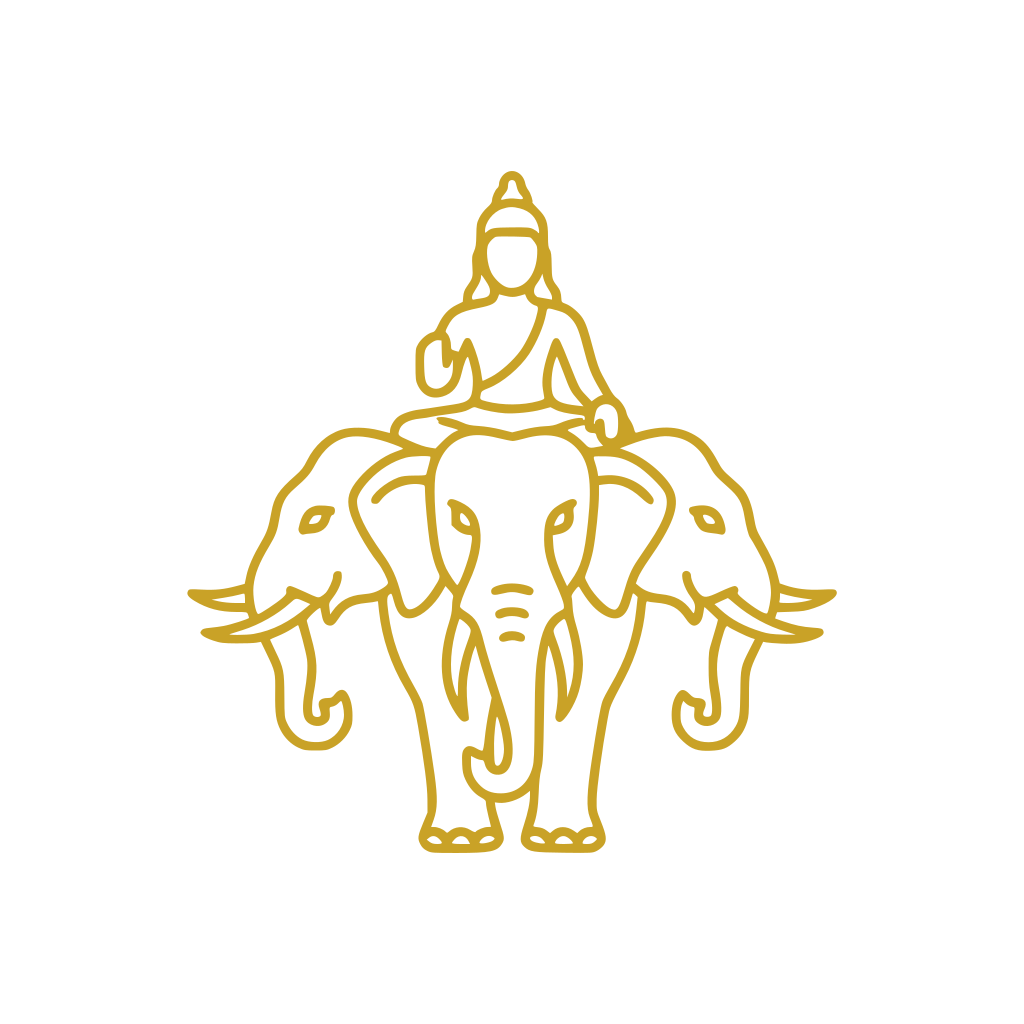
Indra Riding Airavata
Statues of Indra atop the three-headed elephant Erawan occupy the cardinal niches to signify celestial moral order.
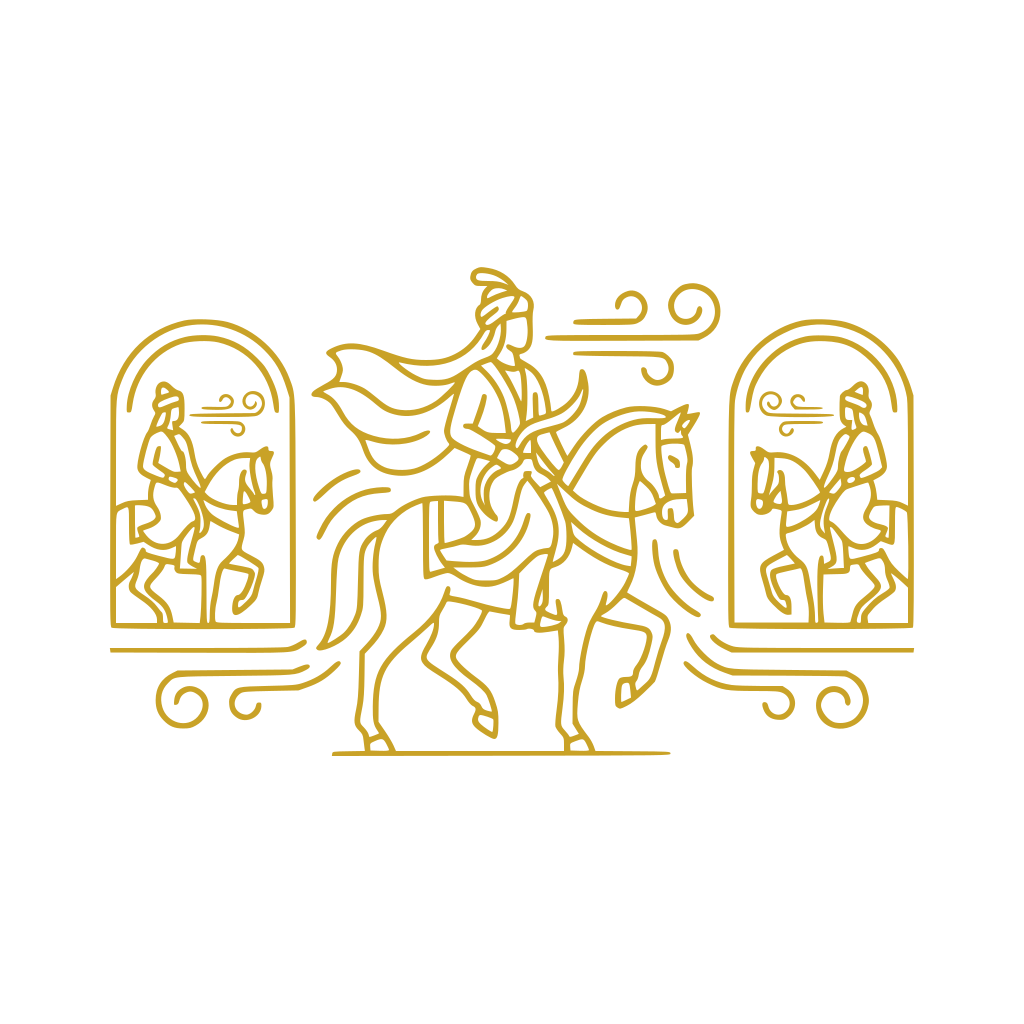
Phra Phai the Wind Deity
Sculpted equestrian figures of the wind god in satellite niches symbolize the divine breath animating universal life.
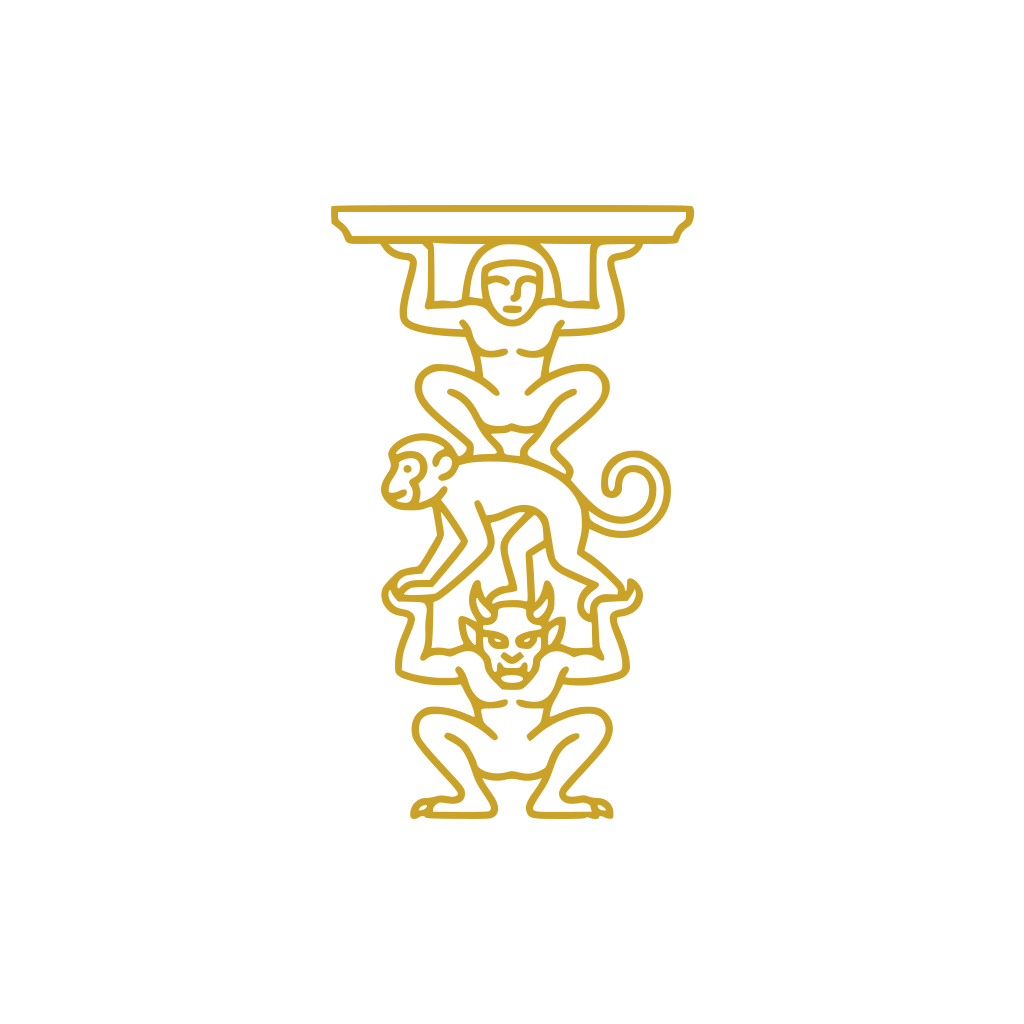
Tiered Caryatid Yakshas
Friezes of demons and monkeys supporting the terraces illustrate that worldly and chaotic forces are subdued by the Dharma.
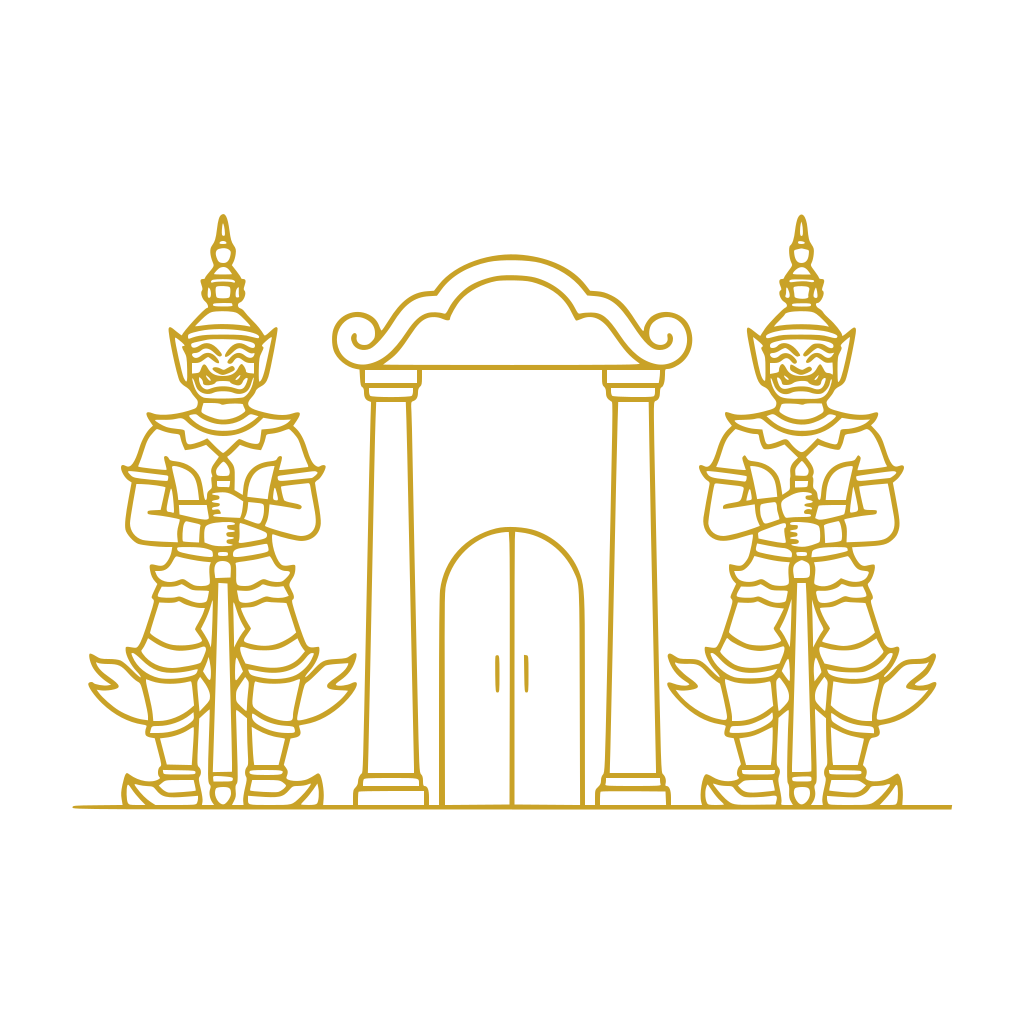
Guardian Yaksha Warriors
Six-meter statues of Thotsakan and Sahassa Deja flank the gate to protect consecrated monastic ground from malevolent spirits.
Phra Buddha Dhammakaya Tirok-amahat
The principal golden Buddha inside the Ubosot enshrines the mortal ashes of King Rama II within its sacred pedestal.
Interesting Facts
The temple is named after Aruna, the Hindu personification of the reddish glow of dawn and charioteer to the sun god Surya (Tier B).
Millions of colorful porcelain pieces adorning the walls were originally broken household dishes used as trade ship ballast (Tier A).
The sacred Emerald Buddha resided within Wat Arun for five years before moving across the river to Wat Phra Kaew in 1785 (Tier A).
Official laser surveys verified the true summit height at 81.85 meters, settling decades of conflicting guidebook estimates (Tier A).
King Rama III mounted an ornamental royal crown atop the central trident as an homage to the Buddha's spiritual sovereignty (Tier B).
The mortal ashes of King Rama II are permanently interred inside the altar pedestal beneath the principal Buddha image (Tier A).
The steps ascending the central prang were deliberately built at a steep 70-degree angle to require a humble, focused climb (Tier B).
Local Bangkok folklore claims the temple's guardian giants once fought a legendary battle with the giants of Wat Pho across the river (Tier C).
Common Questions
Why is Wat Arun called the Temple of Dawn?
It is named after Aruna, the deity of the dawn, commemorating the morning hour when King Taksin first arrived in 1768.
Can visitors climb to the top of the central spire?
Visitors can climb to the lower exterior terraces, but the uppermost platforms remain closed for safety and preservation.
What is the appropriate dress code for entering Wat Arun?
Guests must wear clothing that completely covers their shoulders and knees, removing footwear before entering the Ubosot.
How do travelers reach Wat Arun from Wat Pho?
Take the cross-river commuter ferry from Tha Tien Pier directly across the Chao Phraya River to the Wat Arun landing.
Featured Stories
King Taksin's Dawn Arrival
1768
Steering his fleet downriver through early morning mist after the fall of Ayutthaya, General Taksin gazed upon the silhouette of the riverside monastery at the break of dawn. Moved by spiritual conviction, he resolved to anchor his new kingdom here and dedicate the sanctuary to an enduring reign of peace.
Source: Royal Chronicles of the Thonburi Kingdom
The Sovereign's Clay Sculpting
1820
King Rama II demonstrated his artistic and spiritual devotion by personally sculpting the clay facial features of the temple's principal Buddha image. The tranquil expression he crafted remains an enduring masterpiece of Rattanakosin sacred art, inspiring generations of worshipers who meditate before the altar.
Source: Department of Fine Arts Monograph
Transforming Sea Ballast into Sacred Art
1851
When King Rama III sought materials to embellish the massive prang, royal artisans repurposed broken Chinese porcelain plates and bowls discarded as shipping ballast. Through delicate craftsmanship, fragments that once weighted merchant vessels were refashioned into luminous floral mosaics celebrating the enlightened realm.
Source: Wat Arun Chronicle of Inscriptions
Timeline
Ayutthaya Monastery Founding
French naval charts document an active riverside monastery known locally as Wat Bang Makok.
MilestoneTaksin Establishes Royal Chapel
King Taksin reaches the temple at dawn, selects Thonburi as his capital, and renames the monastery Wat Chaeng.
MilestoneEnshrinement of Emerald Buddha
General Chao Phraya Chakri transports the sacred Emerald Buddha from Vientiane and temporarily enshrines it at Wat Chaeng.
MilestoneTransfer to Wat Phra Kaew
Following the move of the capital across the river to Bangkok, the Emerald Buddha is moved to its permanent home.
MilestoneRoyal Expansion Blueprint
King Rama II designs blueprints to enlarge the modest Ayutthayan stupa into a monumental eighty-meter tower.
MilestoneCompletion and Dedication
King Rama III completes the towering central prang and crowns the summit trident with a gilded royal diadem.
DedicationRenaming by King Rama IV
King Mongkut confers the monastery's formal title and inters the royal ashes of Rama II beneath the main altar.
MilestoneSubterranean Riverbank Stabilization
Engineers reinforce the underlying hardwood foundation pilings against erosion caused by motorized river traffic.
RenovationFine Arts Department Restoration
Preservationists finish a four-year restoration to stabilize brickwork and refresh the historic white lime plaster finish.
RenovationDigital Survey and Monitoring
Conservation authorities install high-precision photogrammetry systems to monitor long-term architectural stability.
MilestoneHistory by Decade
1650s–1760s — The Ayutthaya River Monasteries
A quiet sanctuary of peace beside the Chao Phraya navigating fleets toward the inland kingdom.
During the late Ayutthaya Kingdom, the temple originated under the name Wat Bang Makok, taking its title from native olive trees lining the canal. French maritime maps from the 1680s record the riverside monastery as a recognizable navigational marker for foreign merchant vessels sailing upstream toward the Siamese royal capital. The modest complex survived the catastrophic destruction of Ayutthaya in 1767.
1760s–1780s — King Taksin's Royal Chapel at Thonburi
Here the dawn brought renewal and the foundation of an enduring independent realm.
Following the fall of Ayutthaya, General Taksin rallied Siamese defenders and selected Thonburi on the river's western bank as his new seat of government. Arriving at the monastery grounds precisely as day broke, Taksin proclaimed the shrine his personal royal chapel and christened it Wat Chaeng. For five years, the monastery housed the revered Emerald Buddha before the court relocated across the river.
1800s–1820s — Rama II and the Grand Architectural Vision
After several decades of relative royal neglect, Crown Prince Isarasunthon undertook the comprehensive restoration of the monastery, renaming it Wat Arun Ratchatharam. Upon ascending the throne as King Rama II, the monarch prepared ambitious architectural designs to transform the modest 16-meter stupa into an 80-meter spire. Rama II personally molded the clay face of the principal Buddha image housed in the ordination hall.
1830s–1850s — Construction of the Great Porcelain Prang
Let the shattered porcelain of trading junks rise in everlasting tribute to the enlightened one.
King Rama III oversaw the structural execution of the massive central spire, incorporating broken Chinese porcelain and ceramic plates brought as ship ballast on maritime trade junks. Upon reaching the apex in 1851, the king installed an ornamental royal crown atop the seven-pronged trident. King Rama IV subsequently completed the finishing works and interred his father's mortal remains in the Ubosot altar.
1960s–1980s — Foundation Engineering on the Chao Phraya
Increased modern vessel traffic along the Chao Phraya River prompted critical structural engineering assessments of the temple's centuries-old hardwood pilings. Thailand's Fine Arts Department carried out comprehensive geotechnical stabilization to safeguard the massive brick tower against river current vibrations and groundwater shifts. The complex remained a centerpiece for royal ceremonies, notably the annual Royal Barge Procession.
2010s–2020s — Scientific Restoration and Global Pilgrimage
A major multi-year conservation project concluded in 2017, replacing degraded ceramic tesserae and securing the lime plaster facade to restore its luminous white exterior. State-of-the-art structural laser scanning now monitors the foundation while millions of Buddhist pilgrims and international travelers visit each year. The monastery maintains an active community of resident monks dedicating their lives to study and meditation.
Architecture & Facilities
Wat Arun represents the zenith of the Rattanakosin architectural prang, evolving ancient Khmer temple towers into an elongated, upward-soaring monument characterized by redented corners and brilliant mosaic cladding.
Building Materials
Earthen Core Brick
Dense kiln-fired red clay bricks form the massive structural foundation of the central tower.
Teak Pile Substructure
Subterranean hardwood timber pilings driven deep into river silt stabilize the monument's great mass.
Chinese Porcelain Mosaics
Discarded antique trade ceramics were chipped into petals and geometric motifs set into plaster.
Slaked Lime Mortar
Traditional hydraulic lime plaster provides the distinctive bright reflective coating across exterior tiers.
Interior Features
Ubosot (Ordination Hall)
The primary monastic hall displays detailed wall murals alongside the principal golden Buddha image.
Main Altar Pedestal
The gilded tiered throne enshrines the sacred funerary ashes of King Rama II.
Four Cardinal Mondops
Square pavilions between satellite spires house shrine representations of four milestones in the Buddha's life.
Monastic Library (Ho Trai)
A traditional wooden pavilion preserves sacred Theravada scriptures written on palm leaves.
Temple Grounds
The riverside compound features lush tropical trees, manicured courtyards, stone statues, and six open-air waterfront pavilions along the Chao Phraya River.
Additional Facilities
The temple includes a functioning monastic monastery complex, an administrative office, visitor restrooms, a ticket pavilion, and a formal pier.
Religious Significance
Wat Arun embodies the profound cosmic theology shared across Dharmic traditions, expressing the structural architecture of the universe through Theravada Buddhist metaphysics.
The monastery serves as a physical representation of Mount Meru and an active sanctuary for monastic ordination, merit-making, and Dharma practice.
Sacred Ordinances
Upasampada (Monastic Ordination)
Sacred rites wherein novices take vows to enter the Theravada Buddhist Sangha within the consecrated Ubosot.
Buddhaphisek (Image Consecration)
Chanting ceremonies performed by elder monks to infuse Buddha statues with spiritual power and virtue.
Khao Phansa (Rains Retreat Vows)
The annual solemn commitment of monastics to reside and meditate within the monastery walls for three lunar months.
Wian Thian (Circumambulation)
Devotees circle the sacred prang three times holding candles, incense, and lotus buds during major holy days.
Cosmological Representation of Mount Meru
The tiered central tower symbolizes Mount Meru, the center of the universe according to Buddhist cosmology. Ascending the steep terraces mirrors the soul's arduous spiritual journey from worldly attachment through various heavenly realms toward the ultimate state of Nirvana.
Subordination of Worldly Gods to the Dharma
Throughout the monument, Hindu-derived deities such as Indra and Shiva appear not as supreme creators, but as devoted protectors of the Buddha's teachings. This visual hierarchy emphasizes that even the most powerful cosmic entities revere the Dharma and remain subject to karma.
Similar Temples
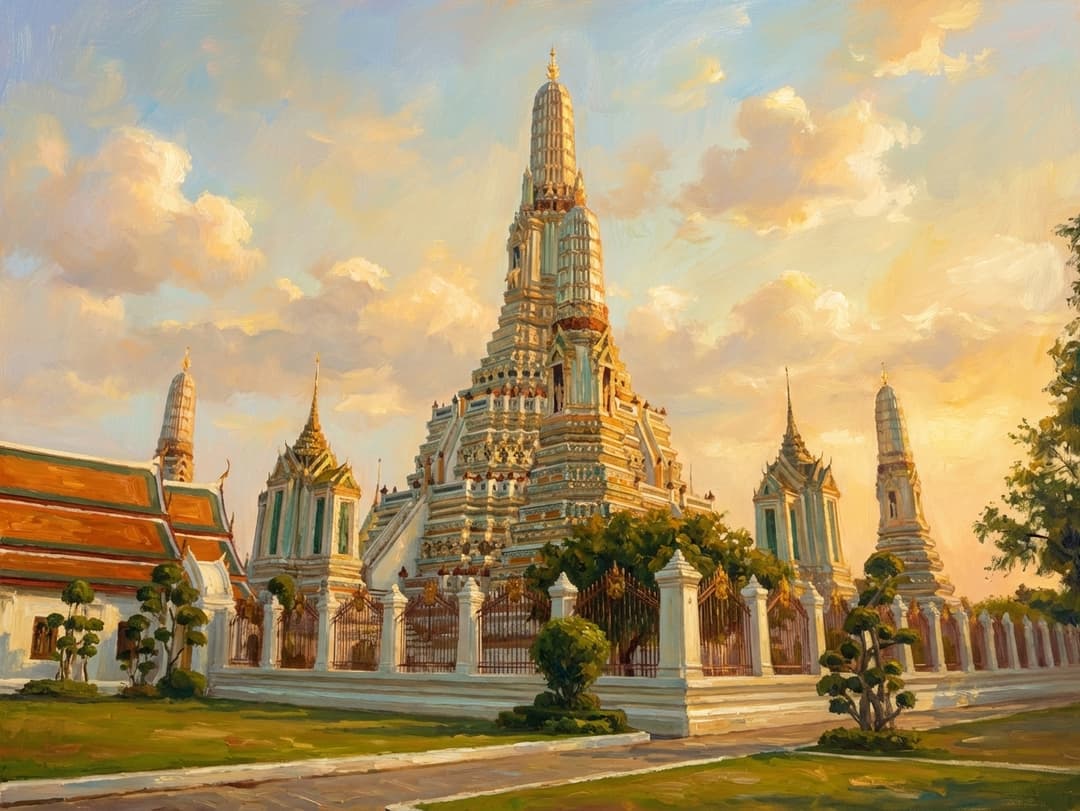
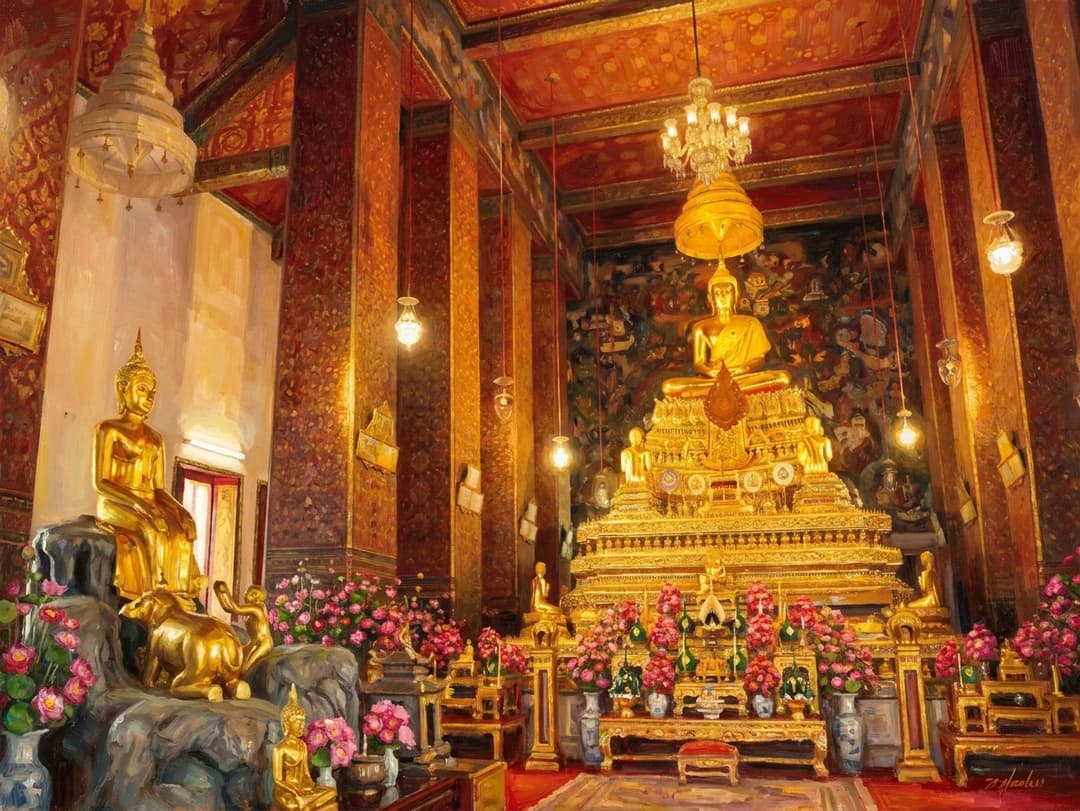
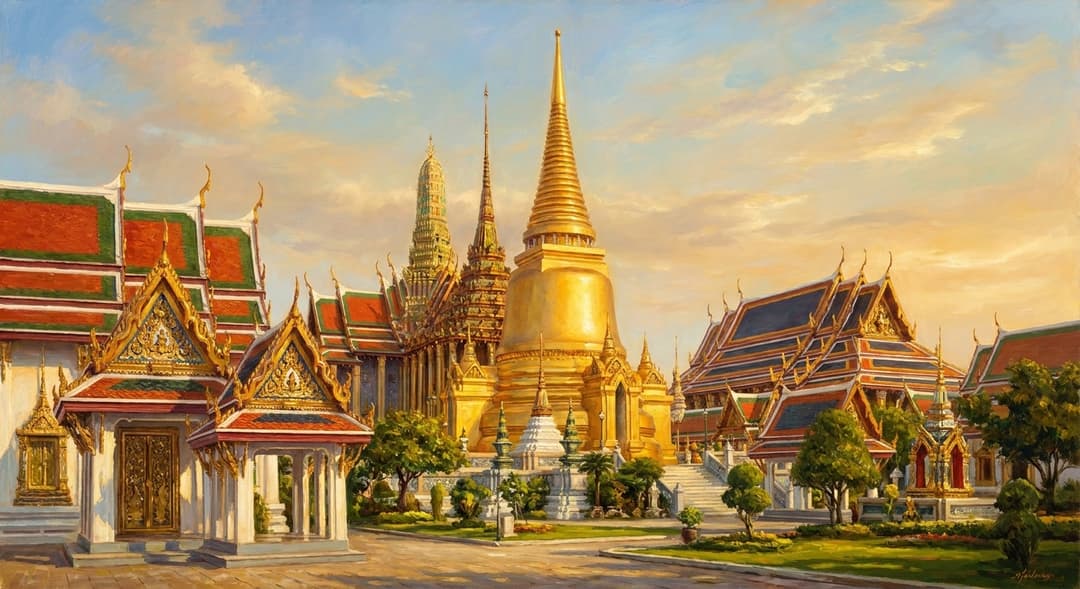
Sources & Research
Every fact on Temples.org is backed by verified Sources & Research. Each piece of information is rated by source tier and confidence level.
View All Sources (10)
| Field | Source | Tier | Retrieved |
|---|---|---|---|
| About & Historical Background | Wat Arun Royal Monastery Administration (opens in a new tab) | A | 2026-02-18 |
| Architecture & Structural Preservation | CyArk Heritage Documentation (opens in a new tab) | B | 2026-02-18 |
| Theological Significance & Cosmology | Dhamma Wiki Foundation (opens in a new tab) | B | 2026-02-18 |
| Architectural Survey & History | ResearchGate Academic Network (opens in a new tab) | B | 2026-02-18 |
| Sacred Art & Iconography | Thai Buddha Foundation (opens in a new tab) | B | 2026-02-18 |
| Royal Restoration & Decorative Arts | Cittra Conservation Collective (opens in a new tab) | B | 2026-02-18 |
| Historical Geography & Materials | Atlas Obscura (opens in a new tab) | C | 2026-02-18 |
| Visitor Insights & Practical Travel | Go to Thailand Travel Guide (opens in a new tab) | C | 2026-02-18 |
| Cultural Heritage & Folklore | Taste of Thailand Cultural Organization (opens in a new tab) | C | 2026-02-18 |
| River Access & Ceremony Protocol | Thaizer Travel Journal (opens in a new tab) | C | 2026-02-18 |