Visitor Insights
Visiting Maha Ganapati Temple of Arizona
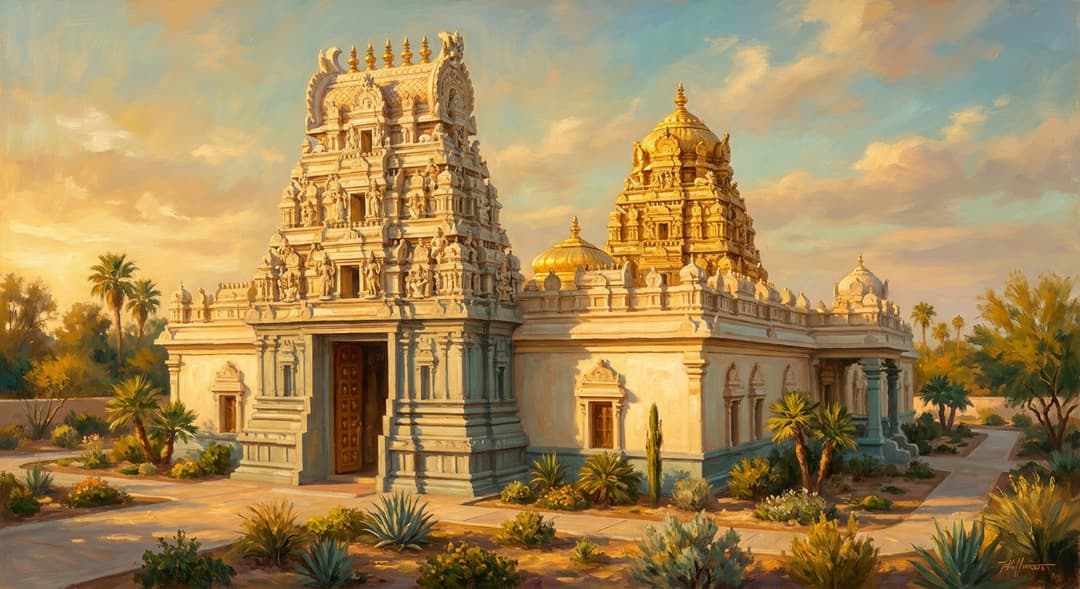
The temple provides a deeply serene atmosphere set against panoramic desert mountain vistas. Visitors should remove all footwear before entering and dress modestly according to Hindu sacred etiquette.
Highlights
- Traditional South Indian Agamic stone architecture and detailed hand-carved towers
- Central sanctum enshrining the 1,400-pound black granite Maha Ganapati murti
- Authentic outdoor Peepal Tree shrine honoring Naga deities and Karya Siddhi Ganapati
- Fresh vegetarian Maha Prasadam served to pilgrims during weekend celebrations
Things to Know
- Footwear must be deposited in the covered shoe pavilion before ascending steps
- Photography of sacred murtis within the inner sanctums is strictly prohibited
- The temple closes during solar and lunar eclipses for ritual purification
Location
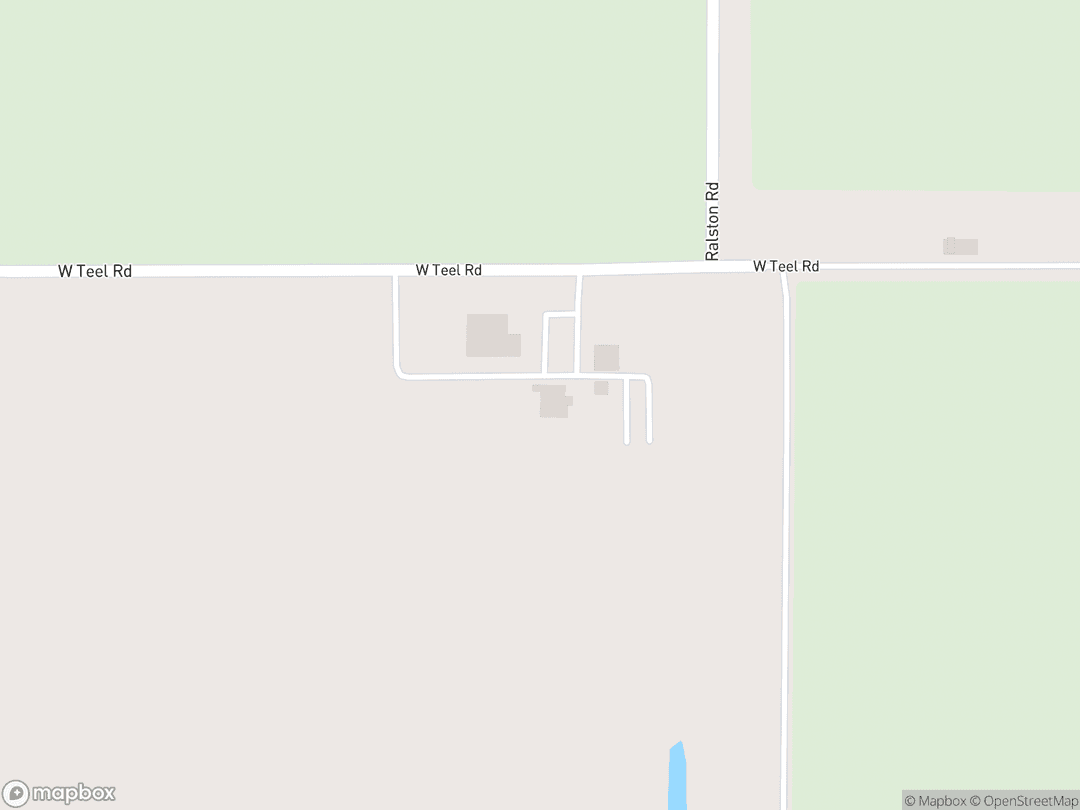
51293 W. Teel Road, Maricopa, AZ 85139
Hours: Mon-Fri: 10:30 AM-12:30 PM & 5:30 PM-7:30 PM; Sat-Sun: 10:00 AM-6:00 PM
Getting There: Located south of Maricopa via AZ-347 and rural country roads to West Teel Road.
Get DirectionsTips for Your Visit
Arrive for Morning Abhishekam
Morning ritual ablutions of the deities begin promptly at 11:00 AM daily.
Weekend Prasadam Dining
Complimentary consecrated vegetarian meals are offered on weekend afternoons.
Desert Weather Preparedness
Summers are extremely hot, so early morning or evening visits are recommended.
Respect Inner Sanctum Guidelines
Observe peaceful silence and keep cell phones silenced within the Maha Mandapa.
About
The Maha Ganapati Temple of Arizona is a vibrant center of Dharmic worship situated in the rural Sonoran Desert of Hidden Valley. Consecrated to Lord Maha Ganapati, the sanctuary serves the expanding Hindu community of Greater Phoenix and the American Southwest.
Constructed under the guidance of Padmashri Muthiah Sthapathi, the complex adheres strictly to ancient Agama and Shilpa Shastras. Its Dravidian layout features an expansive hypostyle Maha Mandapa, a towering Vimana sanctum, and a magnificent monumental gateway.
Reflecting the inclusive Smarta theological tradition, the temple harmoniously accommodates both Saivite and Vaishnavite deities under one sacred roof. Devotees gather regularly for traditional temple liturgies, scriptural chanting, and Vedic rituals.
Interesting Facts
The foundational 1,400-pound granite Ganesha was gifted by American-born spiritual master Satguru Sivaya Subramuniyaswami (Tier A).
For five initial years, devotees gathered for worship inside a modest double-wide mobile trailer on the desert parcel (Tier A).
The temple towers were structurally engineered to withstand Sonoran desert storm winds of up to 120 mph (Tier B).
Traditional master sculptors traveled from Tamil Nadu to hand-mold intricate stucco ornamentation in extreme Arizona heat (Tier A).
Architectural master planning was directed by Padmashri Muthiah Sthapathi, one of India's preeminent temple designers (Tier A).
The complex features a rare ecumenical layout giving equal prominence to major Shaiva and Vaishnava deities (Tier A).
Harvard University's Pluralism Project profiled the sanctuary as an exemplary case study of immigrant sacred geography (Tier B).
The temple hosts an annual eco-friendly initiative distributing biodegradable clay to thousands of families for Ganesh Chaturthi (Tier A).
A living Peepal tree on the grounds replicates ancient rural Indian village sacred tree veneration (Tier A).
Common Questions
Who is the primary deity of the temple?
The temple is primarily dedicated to Lord Maha Ganapati, the remover of obstacles.
Can non-Hindus visit the temple?
Visitors of all religious backgrounds are warmly welcomed to tour the grounds and observe worship.
What is the appropriate dress code?
Modest attire covering shoulders and knees is strictly required for all visitors entering the building.
Is food available on-site?
Complimentary consecrated vegetarian meals are served on weekends following noon liturgical services.
Featured Stories
The Journey of the Desert Ganesha
May 1, 1999
In May 1999, Satguru Sivaya Subramuniyaswami presented a four-foot black granite Ganesha to Arizona's fledgling Hindu community. Hand-carved in historic Mahabalipuram, the 1,400-pound deity journeyed across oceans before arriving at the Port of Los Angeles. Devotees reverently welcomed the sacred icon into an East Valley home, initiating the spiritual impetus for the desert sanctuary.
Source: Maha Ganapati Temple Historical Records
The Faithful Desert Trailer
2002
Before magnificent stone towers arose, devotees navigated dusty desert trails to worship inside a modest double-wide trailer. Despite intense summer temperatures and lack of paved roads, community members gathered faithfully every weekend for community bhajans. Their steadfast devotion during these humble years established the unshakeable spiritual foundation of the current complex.
Source: MGTOA Pioneer Archives
Master Sculptors in the Sonoran Heat
April 22, 2018
Guilds of traditional shilpis traveled from Tamil Nadu to mold intricate sacred ornamentation directly upon the desert superstructure. Working patiently under blinding sunlight and searing temperatures exceeding 110 degrees, they sculpted divine reliefs with exquisite classical precision. Their dedicated craftsmanship culminated in the joyous Kumbhabhishekam as holy waters were poured atop the golden pinnacles.
Source: Consecration Chronicles
Timeline
Gift of Ganesha Murti
Satguru Sivaya Subramuniyaswami of Kauai Aadheenam gifts a 1,400-pound granite Ganesha to Arizona.
MilestoneNon-Profit Incorporation
The temple organization is legally incorporated as a non-profit religious institution in Arizona.
MilestoneMobile Trailer Operations
Regular worship services begin inside a double-wide mobile trailer situated on the donated desert land.
EventBhoomi Puja Groundbreaking
Groundbreaking rites mark the commencement of construction for the permanent 7,600-square-foot Maha Mandapa.
component.timeline.groundbreakingInaugural Kumbhabhishekam
The formal consecration and Prana Pratishtha of the central sanctum deities are celebrated.
DedicationAuxiliary Shrines Expansion
Phase two construction begins to house Goddess Visalakshi, Goddess Padmavathy, and Lord Subrahmanya.
RenovationJeeranodharana Kumbhabhishekam
Artisans complete ornamental stucco carvings on interior shrines leading to reconsecration.
DedicationVimana Gopuram Completion
Builders complete the 26-foot-tall sculpted Vimana tower directly above the primary sanctum.
MilestoneSri Rama Parivar Consecration
The sacred icons of Rama, Sita, Lakshmana, and Hanuman are formally consecrated with celestial wedding rites.
DedicationMaha Raja Gopuram Kumbhabhishekam
The monumental entrance gateway is consecrated with holy water poured over its golden pinnacles.
DedicationNataraja Shrine Groundbreaking
Construction begins on a specialized shrine dedicated to Lord Nataraja and Sivagama Sundari.
MilestoneHistory by Decade
1990s — The Gift and Vision
The divine presence of Ganesha will clear every obstacle on the path to raising this sacred house of worship.
During the late 1990s, Hindu immigrants residing across Phoenix sought to establish an authentic Agamic worship center. In May 1999, Satguru Sivaya Subramuniyaswami gifted a monumental 1,400-pound granite Ganesha to anchor their shared aspirations. Devotees temporarily enshrined the deity in private residences while organizing institutional foundations.
2000s — Foundations in Hidden Valley
The society formally incorporated in March 2000 and secured a generous 15-acre land donation from the Gunnala family in Maricopa. From 2002 to 2007, rites were performed within a humble trailer before groundbreaking for the permanent hall commenced. The community celebrated the inaugural Kumbhabhishekam of the Maha Mandapa in May 2008.
2010s — Towers and Canonical Expansion
The decade brought profound architectural elevation through the construction of auxiliary shrines, the 26-foot Vimana, and the monumental Raja Gopuram. Traditional stone sculptors executed intricate stucco reliefs, transforming the desert sanctuary into an Agamic masterpiece. Multi-day consecration festivities in 2018 drew thousands of pilgrims to witness the installation of golden kalasams.
2020s — Cultural Growth and Outreach
Entering its third decade, the temple expanded community educational programs and initiated construction on a dedicated Nataraja shrine. Its signature eco-friendly clay modeling workshops engaged thousands of households across the Phoenix metropolitan area. The sanctuary continues to flourish as a spiritual oasis uniting diverse Dharmic traditions in the Southwest.
Architecture & Facilities
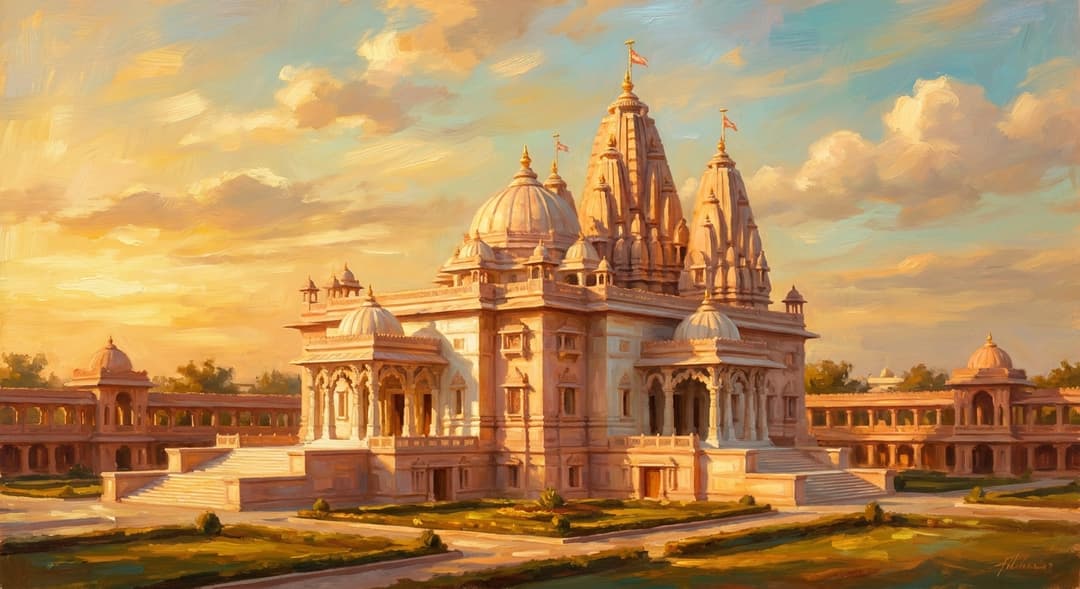
The temple exemplifies traditional South Indian Dravidian architecture designed in strict compliance with Agama and Shilpa Shastras under Padmashri Muthiah Sthapathi.
Building Materials
Black Granite Vigrahas
Sacred murtis were quarried and sculpted from dense black granite blocks in Mahabalipuram, India.
Ornamental Sudha Stucco
Tower reliefs and deity niches were molded by traditional Indian artisans using classical plaster mortar.
Gold-Plated Kalasams
Tower finials were fabricated from high-grade conductive copper alloy and electroplated with pure gold.
Reinforced Desert Core
Concrete footings and structural steel were engineered to resist severe 120 mph desert wind storms.
Interior Features
Maha Ganapati Garbhagriha
The primary east-facing sanctum enshrines the monumental 1,400-pound black granite Ganesha murti.
Lord Shiva Sanctum
The northern sanctum houses the sacred cylindrical stone Lingam fronted by an ornate Nandi figure.
Lord Venkateswara Sanctum
The southern sanctum enshrines Lord Balaji depicted with traditional Vaishnavite conch and discus emblems.
Navagraha Mandapa
A raised nine-celled pedestal aligns nine planetary deities according to canonical cardinal directions.
Temple Grounds
The 15-acre desert grounds feature paved parking for 200 vehicles, native desert flora, and an outdoor Peepal Tree shrine embedded with sacred Naga stones.
Additional Facilities
The temple includes a commercial vegetarian dining hall for prasadam distribution, administrative offices, and a covered shoe pavilion.
Religious Significance
Within Hindu Dharmic traditions, an Agamic temple is an energetic cosmic body where the Transcendent manifests into physical form.
To serve as a consecrated spiritual sanctuary where devotees connect with divine consciousness through traditional Vedic rituals and darshan.
Sacred Ordinances
Prana Pratishtha
The sacred rite that formally infuses divine life-breath and cosmic presence into the carved stone murtis.
Abhishekam
Daily liturgical ablutions utilizing sanctified water, milk, yogurt, honey, and sandalwood paste.
Archana
Individualized devotional chanting of the sacred names of deities accompanied by holy flower offerings.
Aarti
The waving of lit camphor lamps before the deities to bestow illuminated spiritual blessings upon devotees.
The Smarta Theological Synthesis
Codified by Adi Shankara, the Smarta tradition encourages inclusive veneration of diverse divine aspects. By housing shrines for Ganesha, Shiva, Vishnu, Subrahmanya, and the Divine Mother under one roof, the temple nurtures harmony across varied regional backgrounds.
The Temple as Vastu Purusha Mandala
Every architectural proportion reflects the sacred geometry of the cosmic being. The gateway symbolizes the grounding feet, the assembly hall represents the heart of collective worship, and the dark sanctum sanctorum represents the primordial light of absolute consciousness.
Major Festivals
Ganesh Chaturthi
August or September (Bhadrapada Shukla Chaturthi)
A ten-day celebration honoring the birth of Lord Ganesha featuring grand chariot processions and clay idol immersion rites.
Maha Shivaratri
February or March (Phalguna Krishna Chaturdashi)
An all-night vigil celebrating Lord Shiva through continuous chanting of Vedic hymns and four rounds of special abhishekam.
Vaikunta Ekadashi
December or January (Margashirsha Shukla Ekadashi)
A revered Vaishnavite festival celebrating the symbolic opening of the celestial gateway to Lord Vishnu's abode.
Navaratri and Deepavali
October or November (Ashvin and Kartika months)
Nine nights honoring the Divine Mother followed by the festival of lights celebrating spiritual illumination over darkness.
Similar Temples

Sources & Research
Every fact on Temples.org is backed by verified Sources & Research. Each piece of information is rated by source tier and confidence level.
View All Sources (5)
| Field | Source | Tier | Retrieved |
|---|---|---|---|
| About & Historical Background | Maha Ganapati Temple of Arizona (opens in a new tab) | A | 2026-03-31 |
| Timeline & Consecration Records | Shree Ganesh Portal (opens in a new tab) | C | 2026-03-31 |
| Ritual Rites & Agamic Details | YatraDham Pilgrimage Directory (opens in a new tab) | C | 2026-03-31 |
| Community Outreach & Programs | Hindu Heritage Education Online (opens in a new tab) | C | 2026-03-31 |
| Festival Calendar & Liturgical Events | Hindupad Religious Network (opens in a new tab) | C | 2026-03-31 |