Visitor Insights
Visiting Hindu Temple and Cultural Center of Las Vegas
Visitors to the temple experience an oasis of quiet devotion and ornate sacred art just minutes away from the bustling Las Vegas corridor. Modest dress covering shoulders and knees is strictly requested, and all shoes must be removed before entering the central prayer hall.
Highlights
- Witnessing the transformative evening Āratī service with live bell ringing and devotional chanting
- Viewing hand-carved Makrana marble murtis and black granite Dravidian icons side-by-side
- Circumambulating the dedicated outdoor Navagraha pavilion aligned with planetary directions
- Observing the shared Jain Derasar sanctuary exemplifying non-violence and Dharmic unity
Things to Know
- Photography of consecrated deities within the inner sanctums is strictly prohibited
- Visitors are asked to maintain quiet reverence and silence mobile devices within the hall
- Devotees often bring whole fruits, coconuts, or flowers for sacramental blessing by priests
Location
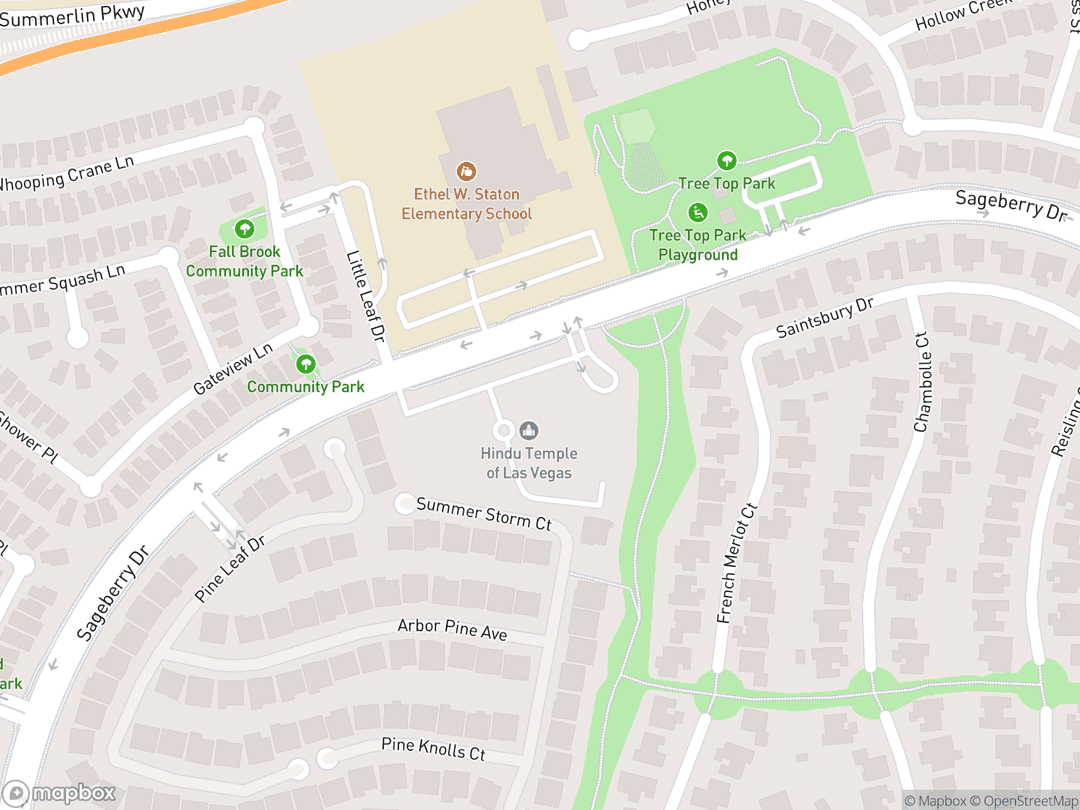
1701 Sageberry Drive, Las Vegas, Nevada 89144
Hours: Monday–Friday: 9:00 AM–12:00 PM, 5:30 PM–8:30 PM; Saturday–Sunday: 9:00 AM–2:00 PM, 4:30 PM–8:30 PM
Getting There: Located in Summerlin West off Sageberry Drive, easily accessed from Summerlin Parkway via Town Center Drive.
Get DirectionsTips for Your Visit
Timing Your Darshan
Arrive fifteen minutes prior to the noon or 7:00 PM Āratī to observe the lighting of sacred lamps.
Footwear Cubbies
Remove all shoes and socks if desired in the climate-controlled narthex before entering the carpeted mandapa.
Navagraha Circumambulation
Walk clockwise nine times around the planetary shrine to follow traditional astronomical balance rites.
About
The Hindu Temple and Cultural Center of Las Vegas stands as the foundational spiritual home for Sanātana Dharma in Southern Nevada. Built upon a serene five-acre desert campus in Summerlin, the mandir unites ancient Dharmic principles with modern communal fellowship against the backdrop of the Spring Mountains.
Rooted in Dharmic cosmological understanding, the complex harmoniously bridges the major traditions of Hinduism with Jainism under a unified sacred roof. Through authentic Vedic consecration, classical iconography, and active community outreach, it serves as an enduring sanctuary for meditation, worship, and ethical reflection.
Interesting Facts
This sacred complex was the first purpose-built traditional Hindu temple established in the State of Nevada (Tier A).
It represents a rare collaborative design where Hindu and Jain communities share a unified main prayer hall (Tier B).
The temple's five-acre parcel was purchased directly from The Howard Hughes Corporation in 1997 (Tier A).
Pittsburgh architect Sashi Patel synthesized North and South Indian temple designs to accommodate diverse diaspora customs (Tier B).
The initial April 2000 groundbreaking was consecrated by chief priests from the Malibu Hindu Temple in California (Tier A).
The temple features a dedicated standalone Navagraha Mandir designed for clockwise planetary circumambulation (Tier A).
A consecrated royal diadem crown and jeweled waistband adorn the central monolithic Lord Balaji icon (Tier A).
The sanctuary sits at an elevation over three thousand feet near Red Rock Canyon, offering a tranquil desert contrast to the city (Tier B).
Common Questions
Are non-Hindus welcome to visit the temple?
Yes, visitors of all backgrounds and faiths are warmly invited to tour the grounds and observe worship.
Why does the temple also feature Jain shrines?
The temple operates ecumenically, partnering with the Jain Center of Las Vegas to host shared Dharmic worship.
What is the proper etiquette regarding footwear?
All shoes must be removed and placed in the entrance cubbies before stepping into the central prayer hall.
Is photography allowed inside the mandir?
Photography of the consecrated deities within their sanctums is strictly prohibited to preserve ritual sanctity.
Featured Stories
Founding Faith in the Desert Sand
April 21, 2000
Devotees gathered beneath the morning desert sun as Sri Krishnamacharyulu Samudrala chanted ancient Vedic mantras to sanctify five acres of barren desert earth. Families placed auspicious brass vessels filled with sacred waters and precious grains into the groundbreaking trench. This collective sacrifice transformed raw Mojave scrubland into consecrated ground for generations of worshippers.
Source: Hindu Temple of Las Vegas Archives
The Enthronement of Lord Balaji
April 29, 2001
During the three-day Prāṇa Pratiṣṭhā, over six hundred worshippers watched as the monolithic black granite icon of Lord Venkateshwara was ritually bathed in sanctified milk, honey, and herbal waters. The invocation invited the divine cosmic presence to permanently abide within the stone form. When the curtain opened for the first Darśana, spontaneous hymns filled the newly dedicated hall.
Source: Hindu Society of Nevada Dedication Records
Planetary Harmony in the Summerlin Wind
April 2, 2006
The consecration of the freestanding Navagraha Mandir culminated in elaborate fire offerings where priests poured clarified butter into nine sacred sacrificial pits. Devotees joined in solemn circumambulation around the open-air pavilion to appease cosmic influences and seek spiritual balance. The ceremony established one of the few fully realized planetary sanctuaries in the American Intermountain West.
Source: Hindu Temple of Las Vegas Commemorative Monograph
Timeline
Incorporation of Hindu Society
Community pioneers formally incorporate the Hindu Society of Nevada to build a permanent house of worship.
MilestoneSummerlin Land Acquisition
The Society purchases five acres of master-planned worship land in Summerlin from The Howard Hughes Corporation.
MilestoneArchitectural Fundraising Gala
Devotees commit over three hundred thousand dollars to approve master blueprints drafted by architect Sashi Patel.
MilestoneVedic Groundbreaking Ceremony
Head priest Sri Krishnamacharyulu Samudrala of the Malibu Hindu Temple sanctifies the desert earth during Bhūmi Pūjā.
component.timeline.groundbreakingCommercial Building Permits Issued
The City of Las Vegas approves full structural permits allowing general contractor M.G. Fauci to begin building.
MilestoneTemple Consecration and Opening
Prāṇa Pratiṣṭhā rites culminate as major Hindu and Jain deities are formally enthroned in their sanctums.
DedicationNavagraha Mandir Groundbreaking
Ritual ground blessing begins for a specialized standalone sanctuary housing the nine planetary deities.
component.timeline.groundbreakingNavagraha Consecration
The Navagraha Mandir is consecrated with extensive Vedic fire offerings during the temple's fifth anniversary.
DedicationPriestly Expansion
Pandit Brijesh Kumar Raval joins the temple staff to broaden North Indian and Jain liturgical services.
EventAgamic Tradition Expansion
Pandit Vishnuvardhana Chakrapanachar is appointed to lead traditional South Indian and Pancharatra rituals.
EventTwentieth Anniversary
The temple observes two decades of spiritual service with commemorative outdoor blessings and hybrid darshan.
MilestoneHistory by Decade
1990s — Vision and Desert Acquisition
In September 1994, local community leaders incorporated the Hindu Society of Nevada to build a permanent temple for Southern Nevada's growing diaspora. An initial banquet at the Masonic Lodge gathered four hundred supporters who pledged critical seed funds. In 1997, the society acquired five master-planned acres in Summerlin from The Howard Hughes Corporation, engaging architect Sashi Patel to design an inclusive mandir.
2000s — Consecration and Campus Growth
Following groundbreaking ceremonies in spring 2000, general contractor M.G. Fauci completed the primary structure within twelve months. The temple opened in April 2001 with the Prāṇa Pratiṣṭhā of Hindu and Jain deities presided over by founding priest Gopalakrishna Panchangam. In 2006, the campus expanded through the dedication of a dedicated outdoor Navagraha pavilion and royal regalia for Lord Balaji.
2010s–2020s — Ecumenical Maturity and Expansion
The temple formalized its identity as the Hindu and Jain Temple of Las Vegas, expanding priestly staffing to serve broad regional traditions. Marking its twentieth anniversary in 2021, the leadership launched modernizations for outdoor festival spaces and educational pavilions. Today, the center remains the spiritual and cultural anchor for tens of thousands of Dharmic residents across the region.
Architecture & Facilities
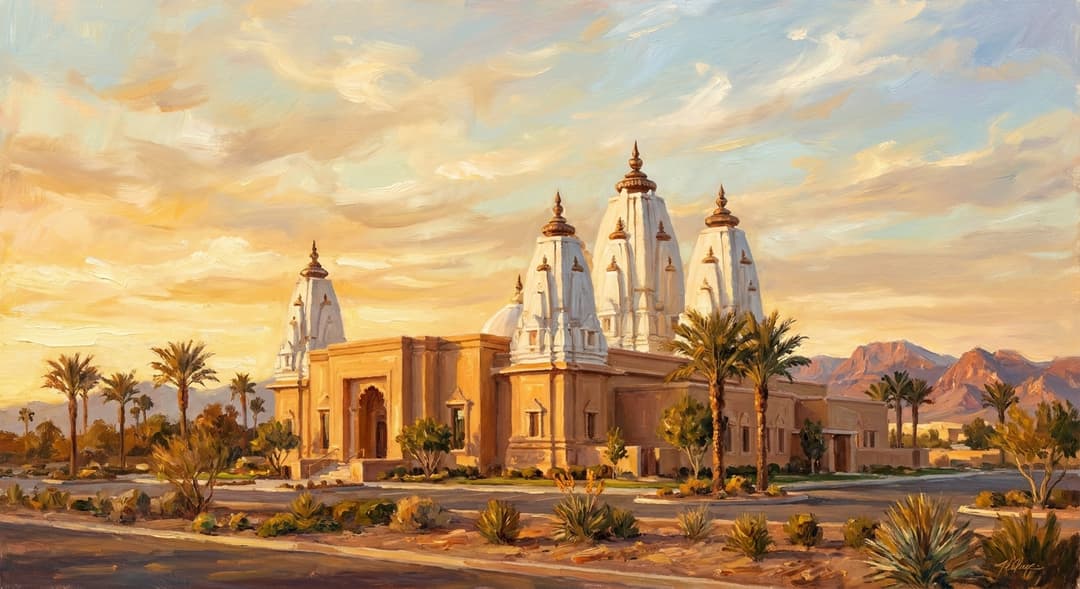
The temple exemplifies the ecumenical diaspora style of contemporary North American mandir architecture, harmonizing North Indian Nagara spires with South Indian Dravidian sanctum layouts while incorporating warm, desert-toned stucco, stepped parapets, and shaded arcades that respect the regional Mojave Desert climate.
Building Materials
Makrana White Marble
Pristine Rajasthani marble sculpted in India forms the shrines and radiant murtis of Krishna, Durga, and the Jain Tirthankaras.
Black Granitic Stone
Monolithic dark granite carved in South India provides the enduring sacred substance for Lord Balaji and Ganesha.
Mojave Stucco Envelope
Earth-toned exterior masonry and stucco insulate the congregational prayer space against harsh desert temperature swings.
Polished Architectural Brass
Cast metal deepams and suspended bells furnish auspicious sound and traditional temple lighting throughout the interior.
Interior Features
Mahāmaṇḍapa
An expansive carpeted central hall accommodates hundreds of worshippers for collective chanting and discourse.
Garbhagṛhas
Individually elevated marble-clad sanctums house the consecrated forms of Shiva, Venkateshwara, Krishna, and Durga.
Jain Derasar
A pristine marble sanctuary within the main hall enshrines unblinking Tirthankara figures seated in tranquil meditation.
Navagraha Pavilion
An open stone arcade houses the nine planetary deities aligned directionally on an elevated central platform.
Temple Grounds
The five-acre Summerlin campus features desert-adapted native landscaping, shaded pedestrian walkways, spacious paved parking lots, and open outdoor gathering spaces designed to host vibrant community festivals.
Additional Facilities
The campus includes a multipurpose community assembly hall, an industrial vegetarian kitchen for preparing sanctified meals, administrative offices, and permanent residential quarters for the resident priestly staff.
Religious Significance
Within the broader Dharmic family of traditions, the temple functions as an architectural embodiment of cosmic reality where the individual soul meets the transcendent Divine through sacred geometry and sound.
To provide a consecrated sanctuary for Vedic ritual, iconographic worship, personal meditation, and inter-Dharmic community fellowship grounded in the eternal principles of Dharma and non-violence.
Sacred Ordinances
Āratī
The waving of lighted camphor and oil lamps accompanied by hymns and bells to invoke divine illumination.
Abhiṣeka
The ritual ablution of consecrated deities using sacred substances like milk, honey, yogurt, and water.
Pradakṣiṇā
The clockwise circumambulation of sanctums and planetary deities to align one's life with cosmic order.
Prasāda Distribution
The sharing of sanctified vegetarian food offerings blessed during worship as an act of divine grace.
Dharmic Fellowship and Unity
The Las Vegas Mandir uniquely expresses the shared cosmological foundations of Hinduism and Jainism. While honoring distinctive philosophical expressions—from devotional theism to ascetic contemplation—the temple unites worshippers around common convictions of Karma, Saṃsāra, and Mokṣa.
The Presence of Prāṇa Pratiṣṭhā
Through the ancient rite of Prāṇa Pratiṣṭhā, sacred stone and metal sculptures are energized with transcendent divine consciousness. For worshippers, gazing upon the sanctified forms allows for Darśana, a reciprocal exchange of sight that awakens inner peace and spiritual resolve.
Major Festivals
Diwali
October or November (Kartika Amavasya)
The Festival of Lights celebrating the triumph of righteousness over darkness with thousands of earthen lamps and cultural fireworks.
Maha Shivaratri
February or March (Phalguna Krishna Chaturdashi)
An all-night vigil honoring Lord Shiva marked by continuous milk ablutions, Vedic chanting, and deep introspective meditation.
Navaratri
September or October (Ashvin)
Nine nights of joyous Garba dance and devotional offerings dedicated to the divine feminine manifestations of Goddess Durga.
Janmashtami
August or September (Bhadrapada Krishna Ashtami)
The joyful midnight celebration commemorating the birth of Lord Krishna featuring cradle ceremonies and devotional hymns.
Mahavir Jayanti
March or April (Chaitra Shukla Trayodashi)
The paramount festival of the Jain tradition celebrating the birth and ethical teachings of Bhagwan Mahavira.
Sources & Research
Every fact on Temples.org is backed by verified Sources & Research. Each piece of information is rated by source tier and confidence level.
View All Sources (4)
| Field | Source | Tier | Retrieved |
|---|---|---|---|
| About & Historical Background | Hindu Temple and Cultural Center of Las Vegas (opens in a new tab) | A | 2026-02-18 |
| Community Inception & Land Acquisition | VegasDesi Community Archives (opens in a new tab) | B | 2026-02-18 |
| Inter-Dharmic Architecture & Jain Fellowship | Academic Research on North American Temples (opens in a new tab) | B | 2026-02-18 |
| Visitor Profile & Community Operations | Holidify Cultural Directory (opens in a new tab) | D | 2026-02-18 |