Visitor Insights
Visiting Cathedral of Our Lady of the Angels
The Cathedral of Our Lady of the Angels offers a peaceful sanctuary in downtown Los Angeles. Visitors can explore the main nave, crypt mausoleum, and expansive plaza during daily open hours.
Highlights
- Luminous interior lit by 27,000 square feet of Spanish alabaster panels.
- The 25 Jacquard-woven Tapestries of the Communion of Saints by John Nava.
- The 30-foot bronze Great Doors sculpted by artist Robert Graham.
- Subterranean crypt mausoleum containing relics of Saint Vibiana.
Things to Know
- Silence is requested inside the nave during active liturgical services and prayer.
- Underground parking is available on site with entrance off Hill Street or Temple Street.
Location
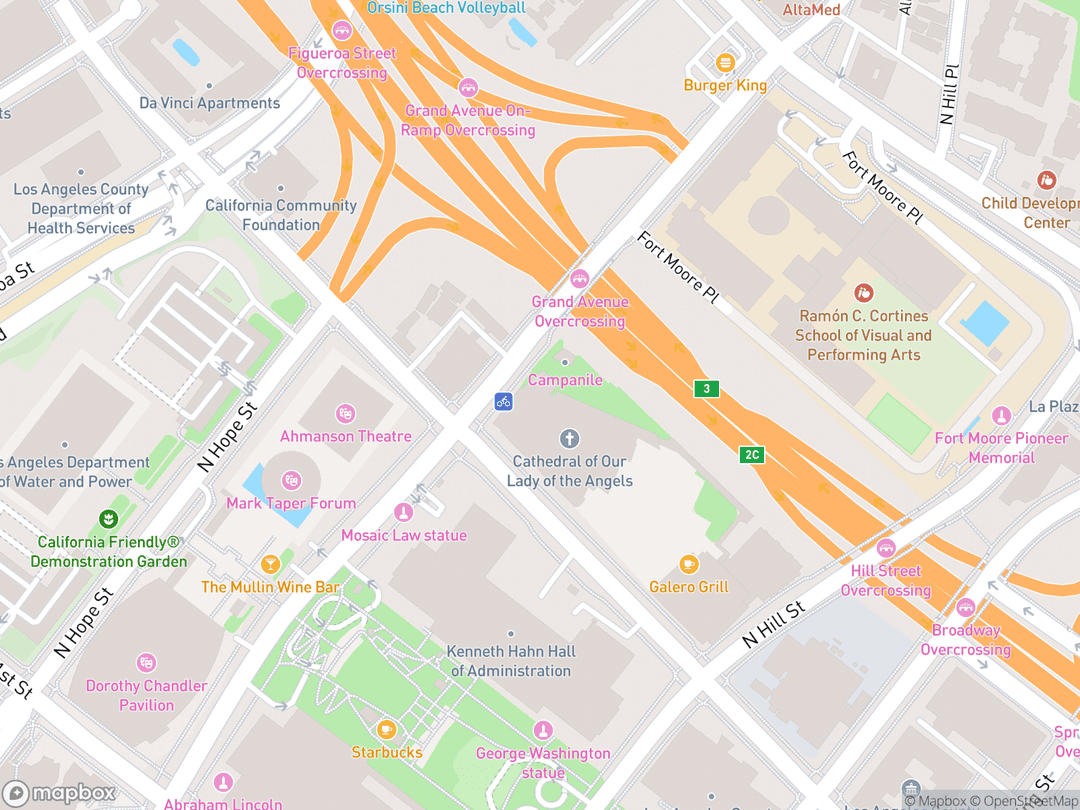
555 West Temple Street, Los Angeles, California 90012, United States
Hours: Monday–Friday 6:30 AM–6:00 PM, Saturday 9:00 AM–6:00 PM, Sunday 6:00 AM–7:00 PM.
Getting There: Accessible via Metro Rail A/E Lines at Grand Av Arts/Bunker Hill Station or B/D Lines at Civic Center/Grand Park Station. Located right off the US-101 Temple Street exit.
Get DirectionsTips for Your Visit
Best Time for Lighting
Visit mid-morning to early afternoon on sunny days to experience sunlight filtering through translucent alabaster panels.
Self-Guided Tour
Informational brochures and audio tour guides are available at the welcome desk near the cathedral entrance.
Crypt Exploration
Descend into the crypt mausoleum to view historic Spanish stained-glass windows and Saint Vibiana's sarcophagus.
About
The Cathedral of Our Lady of the Angels serves as the mother church for over four million Catholics in the Archdiocese of Los Angeles. As part of the broader Christian faith and Abrahamic tradition, the cathedral centers its worship on Jesus Christ and the Holy Eucharist while honoring Mary, Queen of the Angels.
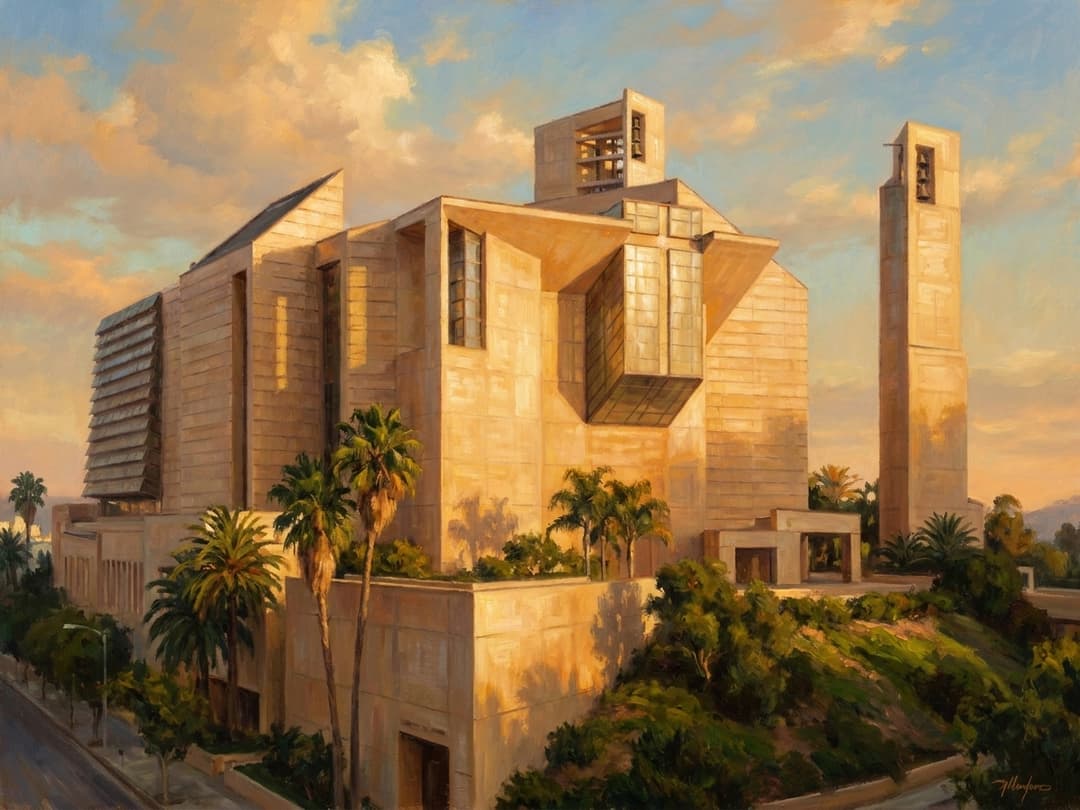
Designed by Pritzker Prize laureate José Rafael Moneo, the landmark opened in 2002 following the destruction of the historic Saint Vibiana Cathedral in the 1994 Northridge earthquake. Its warm-sand concrete walls and Spanish alabaster windows create an uplifting sanctuary in downtown Los Angeles.
Gallery
Symbolic Elements
The temple's exterior features intricate carvings, each rich with spiritual meaning:

Great Bronze Doors
Designed by sculptor Robert Graham, these 30-foot bronze doors display global Marian representations and a figure of the Virgin Mary.

Spanish Alabaster Windows
Over 27,000 square feet of hand-carved Navarra alabaster panels filter California sunlight into a golden interior glow.

Communion of Saints Tapestries
John Nava's 25 Jacquard-woven tapestries portray 135 saints walking in procession alongside contemporary worshipers.

Granite Immersion Baptistery
A cross-shaped black granite pool at the nave entrance features living water flowing continuously over its edges.

Relic of Our Lady of Guadalupe
A side chapel houses the only authentic fragment of Saint Juan Diego's 1531 tilma preserved outside Mexico.

Seismic Base Isolators
198 elastomeric rubber and lead bearings allow the entire 58,000-square-foot sanctuary to float safely during major earthquakes.

Campanile Bell Tower
Rising 156 feet above Grand Avenue, the freestanding bell tower holds historic bells and marks the cathedral's urban presence.

Crypt Mausoleum Sarcophagus
The subterranean marble sarcophagus holds the 3rd-century relics of Roman martyr Saint Vibiana beneath Spanish stained glass.
Interesting Facts
The cathedral nave measures 333 feet in length, intentionally designed one foot longer than St. Patrick's Cathedral in New York. (Tier A)
Engineered with 198 base isolators, the entire structure can slide up to 24 inches during an 8.0 earthquake. (Tier A)
The interior nave completely avoids 90-degree right angles to enhance acoustics and create dynamic visual perspectives. (Tier A)
It features over 27,000 square feet of Spanish alabaster, making it the largest installation of architectural alabaster in the Western Hemisphere. (Tier A)
Artist John Nava used real Southern California residents as physical models for the 135 saints on the nave tapestries. (Tier A)
The subterranean crypt houses a white marble sarcophagus holding relics of 3rd-century Roman martyr Saint Vibiana. (Tier A)
A dedicated side chapel contains the only authenticated fragment of Saint Juan Diego's 1531 Guadalupe tilma outside Mexico. (Tier A)
The 60-foot grand pipe organ contains 6,019 pipes and incorporates historic pipework from the 1876 Saint Vibiana Cathedral. (Tier A)
The cathedral name preserves the original 1781 Spanish name of Los Angeles: El Pueblo de Nuestra Señora la Reina de los Ángeles. (Tier A)
Common Questions
What religion and denomination is the cathedral?
It is a Roman Catholic cathedral serving as the seat of the Archbishop of Los Angeles.
Are non-Catholics allowed to visit?
Yes, visitors of all faiths are welcome to tour the sanctuary, crypt, and plaza during daily opening hours.
Who was the lead architect of the cathedral?
Spanish architect José Rafael Moneo, a laureate of the prestigious Pritzker Architecture Prize, designed the structure.
Is there parking available on site?
Yes, a multi-level underground parking garage is located directly beneath the cathedral plaza.
Featured Stories
Building a Modern Sanctuary After Earthquake Devastation
1994–2002
When the 1994 Northridge earthquake rendered Saint Vibiana Cathedral unsafe, civic and religious leaders faced a major crisis. Cardinal Roger Mahony envisioned a new cathedral that would serve an exceptionally diverse population while enduring for five centuries. Architect José Rafael Moneo crafted a design using warm concrete and seismic base isolators that unified modern engineering with enduring spiritual dignity.
Source: Archdiocese of Los Angeles Historical Records
Angelenos Posing as Sacred Saints
2000–2002
Artist John Nava was commissioned to create 25 massive tapestries depicting 135 canonized saints for the cathedral nave. To express the universal call to holiness, Nava recruited ordinary Southern California residents—including local parish children, street workers, and neighbors—to pose as physical models for holy figures like Saint Augustine and Saint Kateri Tekakwitha. The resulting art links everyday Angeleno faces directly with heavenly history.
Source: Cathedral Sacred Art Commission
The Journey of Saint Vibiana's Relics
1854–2002
The physical relics of Saint Vibiana, a 3rd-century Roman martyr, were discovered in the Catacombs of Saint Agnes in 1853 and brought to California in 1854. After resting in the historic 1876 downtown cathedral for over a century, her remains were carefully transferred to a new white marble sarcophagus in the cathedral's subterranean crypt mausoleum during its 2002 dedication.
Source: Archdiocese of Los Angeles Archives
Timeline
Founding of Los Angeles
Spanish settlers establish El Pueblo de Nuestra Señora la Reina de los Ángeles, setting the city's Marian patronage.
MilestoneDedication of Saint Vibiana Cathedral
Saint Vibiana Cathedral opens at Main and 2nd Streets as the mother church for Southern California.
DedicationPapal Approval for Title
Pope Pius XII grants formal permission for any future cathedral to be dedicated to Our Lady of the Angels.
MilestoneNorthridge Earthquake Damage
A 6.7-magnitude earthquake damages Saint Vibiana Cathedral, forcing plans for a new cathedral complex.
EventArchitect Selection
Pritzker Prize winner José Rafael Moneo wins the international design competition for the cathedral.
MilestoneGround Blessing
Cardinal Roger Mahony presides over the formal ground blessing ceremony on Bunker Hill.
component.timeline.groundbreakingCathedral Consecration
Cardinal Roger Mahony consecrates the Cathedral of Our Lady of the Angels before thousands of worshipers.
DedicationDobson Pipe Organ Installation
The 6,019-pipe Dobson organ is installed in the cathedral choir loft.
EventTilma Relic Chapel Dedicated
A dedicated chapel holding a fragment of Our Lady of Guadalupe's tilma is blessed.
EventHistory by Decade
1780s–1870s — Marian Roots & Saint Vibiana
Spanish settlers founded Los Angeles in 1781 under the patronal protection of Our Lady, Queen of the Angels. In 1876, the Archdiocese dedicated Saint Vibiana Cathedral in downtown Los Angeles, providing a spiritual home for Southern California Catholics for over a century.
1940s–1980s — Suburban Growth & Renewal Vision
By 1945, anticipating rapid population growth, Pope Pius XII authorized the title Our Lady of the Angels for a future cathedral. Over subsequent decades, Los Angeles grew into the largest and most ethnically diverse Catholic archdiocese in the United States.
1990s — Northridge Earthquake & New Architecture
The 1994 Northridge earthquake severely compromised Saint Vibiana Cathedral. Cardinal Roger Mahony acquired a 5.5-acre site on Bunker Hill and selected Spanish architect José Rafael Moneo to design a modern cathedral built to endure 500 years.
2000s — Consecration & Modern Legacy
Dedicated on September 2, 2002, the cathedral established an iconic spiritual center for Los Angeles. Featuring alabaster light, John Nava's tapestries, and a 6,019-pipe organ, it seamlessly blends traditional Catholic devotion with modern art.
Architecture & Facilities
The Cathedral of Our Lady of the Angels represents a masterwork of modern sacral architecture designed by Pritzker Prize laureate José Rafael Moneo. The structure departs from traditional Gothic revival forms in favor of warm geometric volumes, angular geometry, and indirect natural lighting that evoke solemnity without historicist revivalism.
Building Materials
Architectural Concrete
Warm-sand concrete pigmented with local iron oxides engineered for a 500-year structural lifespan.
Spanish Alabaster
27,000 square feet of translucent alabaster panels imported from Navarra, Spain for soft ambient lighting.
Spanish Cedar Wood
Dark-stained cedar ceilings spanning the nave roof to provide acoustic warmth and visual richness.
Bronze & Granite
30-foot bronze entry doors and polished black granite baptistery water features.
Interior Features
Nave Assembly
A 333-foot seating hall accommodating 3,000 worshipers without right interior angles.
Presbytery & Altar
A raised sanctuary centered on a massive red marble altar block.
Ambulatory Walkway
A perimeter processional corridor that transitions visitors from city streets into quiet sanctuary space.
Crypt Mausoleum
A subterranean burial space featuring historic stained glass and Saint Vibiana's sarcophagus.
Temple Grounds
A 5.5-acre plaza complex incorporating olive trees, water fountains, a bell tower, conference center, and public dining facilities overlooking downtown Los Angeles.
Additional Facilities
Underground parking garage, cathedral gift shop, center for pastoral ministry, and multi-purpose event spaces.
Religious Significance
Within the Catholic tradition—situated firmly in the Christian heritage and Abrahamic monotheistic faith—the Cathedral of Our Lady of the Angels is the mother church of the Archdiocese of Los Angeles. It houses the bishop's throne (cathedra), symbolizing apostolic continuity, episcopal authority, and ecclesial unity.
To serve as the principal house of Catholic worship, sacramental administration, and community gathering for Southern California.
Sacred Ordinances
The Holy Eucharist (Holy Mass)
The primary worship rite celebrated daily upon the central altar as the source and summit of Christian life.
Baptism
The gateway sacrament of initiation celebrated by immersion in the cross-shaped black granite pool.
Confirmation & Holy Orders
Sacraments of spiritual maturity and priestly ordination conferred by the archbishop at the cathedral altar.
Marian Patronage
Dedicated to Mary under the title Our Lady of the Angels, the cathedral honors Christ's mother as the special patroness of Los Angeles.
The Communion of Saints
John Nava's nave tapestries visually articulate the Catholic doctrine that all faithful believers share in the eternal communion of saints.
Sources & Research
Every fact on Temples.org is backed by verified Sources & Research. Each piece of information is rated by source tier and confidence level.
View All Sources (8)
| Field | Source | Tier | Retrieved |
|---|---|---|---|
| About & Historical Background | Cathedral of Our Lady of the Angels (opens in a new tab) | A | 2026-01-30 |
| About & Historical Background | Archdiocese of Los Angeles (opens in a new tab) | A | 2026-01-30 |
| Architecture & Engineering | The Pritzker Architecture Prize (opens in a new tab) | A | 2026-01-30 |
| Architecture & Engineering | Leo A Daly Architecture (opens in a new tab) | A | 2026-01-30 |
| Architecture & Pipe Organ | Dobson Pipe Organ Builders (opens in a new tab) | A | 2026-01-30 |
| Religious Significance & Sacraments | The Holy See (opens in a new tab) | A | 2026-01-30 |
| Timeline & History | Los Angeles Times Archives (opens in a new tab) | B | 2026-01-30 |
| Visitor Insights & Access | County of Los Angeles (opens in a new tab) | B | 2026-01-30 |