Visitor Insights
Visiting Cathedral of Saint Mary of the Assumption
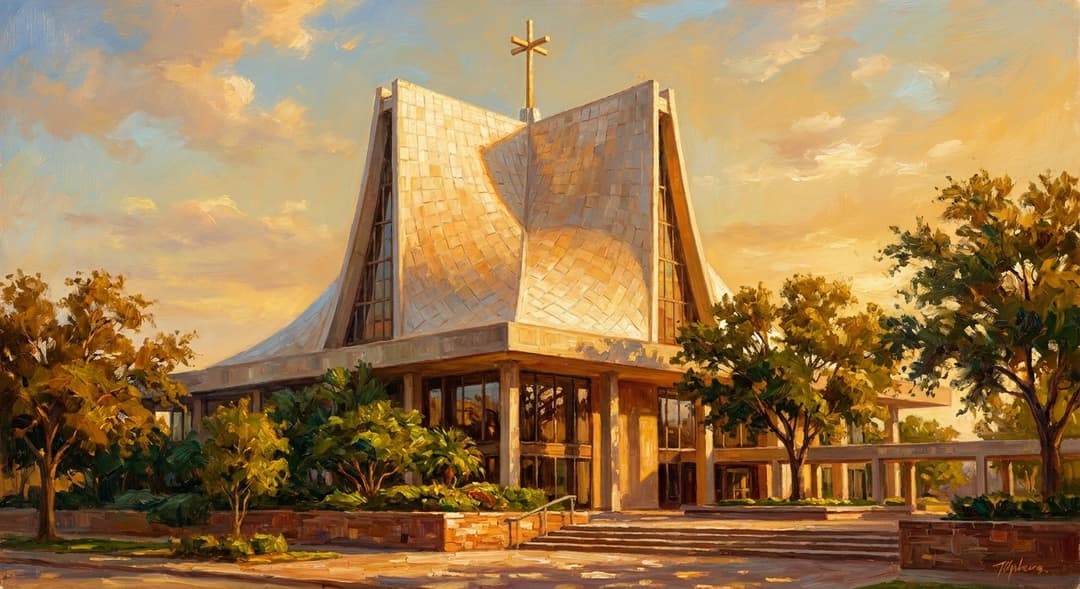
Visitors experience a dramatic, column-free arena crowned by an amber cross of natural light. The vast interior provides unobstructed views of the marble altar beneath a shimmering kinetic baldachin.
Highlights
- Midday sunlight refracting through the four-arm Kepes stained glass cross
- The kinetic aluminum baldachin suspended fifteen stories over the high altar
- The monumental Fratelli Ruffatti pipe organ towering in the north gallery
- Expansive corner windows framing panoramic vistas of San Francisco
Things to Know
- Silence mobile phones and observe quiet contemplation in the sanctuary
- Refrain from photography and entering the altar platform during Mass
- Check the music calendar for Sunday afternoon organ recitals
- Subterranean parking is accessible directly from Gough Street
Location
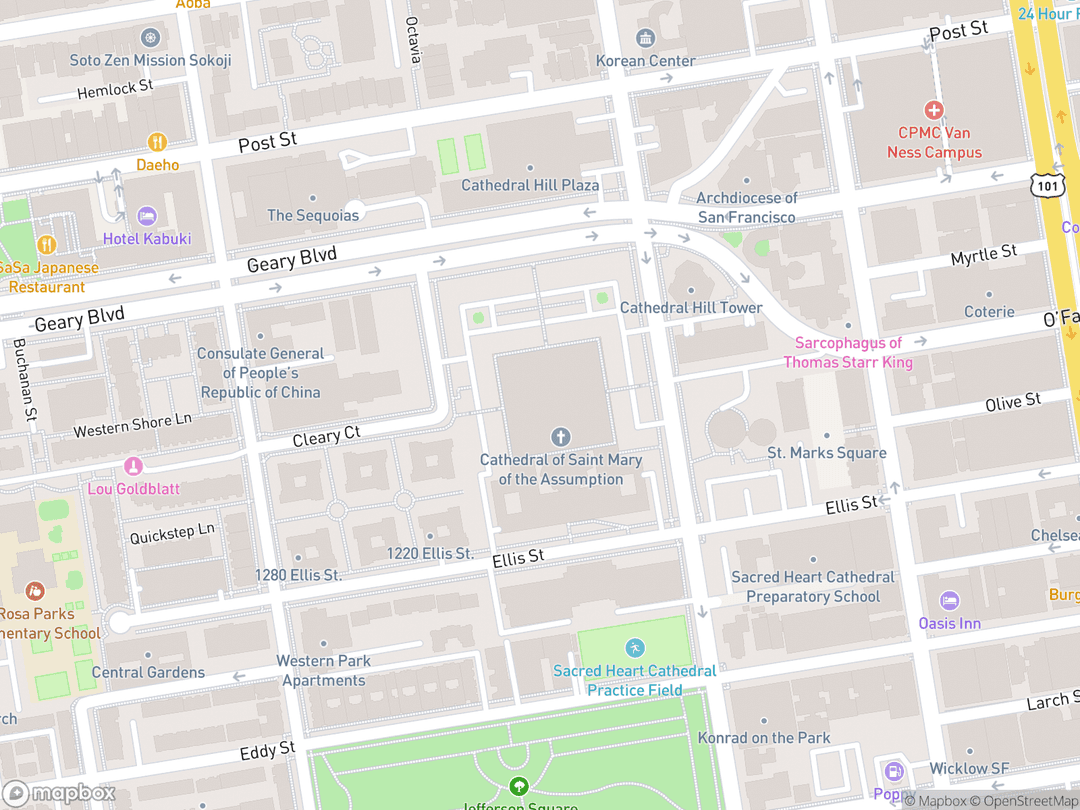
1111 Gough Street, San Francisco, California 94109, United States
Hours: Open daily from 8:00 AM to 5:00 PM for prayer, visits, and liturgical services.
Getting There: Located at Gough Street and Geary Boulevard, reachable via Muni bus routes 38 or 49.
Get DirectionsTips for Your Visit
Optimal Sunlight Viewing
Visit between 11:30 AM and 2:00 PM to watch colored shafts of light illuminate the red brick nave.
Sunday Choral Liturgies
Attend the 11:00 AM Archiepiscopal Mass to hear the choir and grand organ in full acoustics.
On-Site Parking
Use the integrated 240-stall parking structure located under the western plaza promenade.
About
The Cathedral of Saint Mary of the Assumption serves as the mother church of the Roman Catholic Archdiocese of San Francisco. Anchored in the ancient Abrahamic tradition of the sacred tabernacle as an earthly vessel for the Divine Presence, the sanctuary gathers the metropolitan community into solemn covenantal assembly.
Dedicated to the mystery of the Virgin Mary assumed into heaven, the monument manifests the liturgical vision of the Second Vatican Council. World-renowned architects Pietro Belluschi and Pier Luigi Nervi synthesized Italian structural expressionism with regional craft to create a column-free, four-cornered sanctuary where the faithful surround the altar of sacrifice.
Erected to succeed the historic 1891 cathedral destroyed by arson, Saint Mary's stands atop Cathedral Hill as an international landmark. The cathedral remains an active center of Eucharistic life, monumental pipe organ recitals, and metropolitan civic unity.
Gallery
Symbolic Elements
The temple's exterior features intricate carvings, each rich with spiritual meaning:

Kinetic Altar Baldachin
Fourteen tiers of suspended aluminum rods symbolize heavenly grace showering down onto the altar.

Cruciform Glass Ribbons
Four vertical stained glass ribbons represent the classical elements crossing overhead in amber light.

The Cathedra
Carved from Botticino marble, the episcopal throne represents unbroken apostolic teaching authority.

Bronze Portals of Christ
Cast bronze doorway panels depict the Risen Savior welcoming humanity past the trials of mortal life.

Hyperbolic Paraboloid Shells
Twisting concrete shells enact an upward motion symbolizing the bodily assumption of Mary into heaven.

Red Mission Brick Flooring
Earthen nave pavers ground the ultra-modern structure in California early Franciscan missionary legacy.

Gilded Summit Cross
A fifty-five foot golden cross caps the structure to proclaim Christ redemptive sacrifice over the city.

Shrine of the Assumption
A bronze sculptural niche captures the Virgin Mary ascending into glory flanked by choirs of angels.
Interesting Facts
The cathedral roof transfers its entire multi-million pound load into just four corner bedrock pylons (Tier A).
Nervi designed 128 mathematically unique molds to cast the 1,680 precast triangular ceiling coffers (Tier A).
The building endured the severe 1989 Loma Prieta earthquake without suffering any structural damage (Tier A).
Belluschi selected red quarry floor bricks to deliberately evoke California Spanish Franciscan missions (Tier A).
The massive pipe organ was crafted in Padua, Italy, featuring 89 ranks and 4,842 hand-voiced pipes (Tier A).
A 1963 newspaper critique by Allan Temko persuaded the archdiocese to abandon safe revivalist plans (Tier B).
Its saddle roof shares a direct architectural affinity with Kenzo Tange 1964 Tokyo cathedral (Tier B).
No congregational seat sits further than one hundred feet away from the central sacrificial altar (Tier A).
Common Questions
Why is the cathedral affectionately called 'Our Lady of Maytag'?
Locals coined the playful nickname because its fluted hyperbolic roof resembles a washing machine agitator.
Are visitors permitted inside during the day?
Visitors of all faiths are welcome daily between 8:00 AM and 5:00 PM outside scheduled services.
Does the vast sanctuary contain any interior support columns?
The interior contains zero columns because the entire roof load rests on four massive exterior pylons.
Who designed the kinetic sculpture above the high altar?
Renowned American sculptor Richard Lippold crafted the fifteen-story aluminum baldachin.
Featured Stories
Rising from Ashes
September 7, 1962
When a five-alarm arson fire leveled the 1891 cathedral, Archbishop Joseph McGucken vowed to build a world-class successor. Overcoming conservative pressure, the archdiocese engaged master designers to create an unprecedented modern sanctuary.
Source: Archdiocese of San Francisco Heritage Archives
Allan Temko's Architectural Dare
1963
After early revivalist sketches drew public derision, Pulitzer-winning critic Allan Temko challenged church leaders to choose greatness. Archbishop McGucken boldly enlisted Pietro Belluschi and Pier Luigi Nervi to manifest modern liturgical ideals.
Source: San Francisco Chronicle Historical Retrospective
A Papal Embrace of Compassion
September 17, 1987
During his pastoral visit, Pope John Paul II gathered inside Saint Mary's to meet caregivers and patients suffering from HIV and AIDS. In a moment of tenderness, the pontiff embraced a young boy diagnosed with the virus.
Source: Vatican Press Office Historical Records
Timeline
Pioneer Archdiocese Established
Archbishop Joseph Sadoc Alemany begins organizing the mother church in Gold Rush California.
MilestoneOld Saint Mary's Opens
The original cathedral at California and Grant Streets is dedicated on Christmas Day.
DedicationSecond Cathedral Groundbreaking
Archbishop Patrick Riordan breaks ground for a grand red-brick edifice on Van Ness Avenue.
component.timeline.groundbreakingSecond Cathedral Dedicated
The Victorian Gothic-Romanesque cathedral is consecrated for the expanding archdiocese.
DedicationGreat Earthquake Relief
The Van Ness cathedral survives the shock waves and serves as a vital emergency refuge.
EventPapal Legate Mass
Cardinal Eugenio Pacelli, the future Pope Pius XII, celebrates Mass inside the cathedral.
MilestoneCathedral Destroyed by Fire
A catastrophic five-alarm arson fire levels the historic Van Ness church building.
EventCathedral Hill Excavation
Excavation commences for the new modernist complex on the western urban renewal site.
component.timeline.groundbreakingCornerstone Blessing
Apostolic Delegate Archbishop Luigi Raimondi solemnly blesses the massive cornerstone.
MilestoneSolemn Blessing Mass
The completed hyperbolic paraboloid cathedral opens for regular liturgical worship.
MilestonePastoral Visit of Pope John Paul II
Pope John Paul II gathers in the sanctuary with pastoral caregivers and people with AIDS.
EventSolemn Consecration
Archbishop William Levada solemnly dedicates the cathedral after retiring all debts.
DedicationHistory by Decade
1850s–1870s — The Gold Rush Pioneer Cathedral
Following California statehood, Archbishop Joseph Alemany oversaw construction of Old Saint Mary's in 1854. Built from ship ballast bricks and granite, the modest sanctuary served miners and immigrants during rapid urban growth.
1880s–1900s — The Van Ness Landmark
As the Catholic population expanded westward, Archbishop Patrick Riordan constructed a larger Victorian Gothic cathedral on Van Ness Avenue. Dedicated in 1891, the red-brick monument anchored local civic and liturgical celebrations.
1910s–1950s — Earthquake Survival and Growth
The second cathedral survived the 1906 Great Earthquake, serving as an essential relief distribution hub. In 1936, future Pope Pius XII celebrated Mass in the sanctuary as the archdiocese flourished across northern California.
1960s — Fire, Controversy, and Bold Reinvention
A devastating 1962 arson fire reduced the historic cathedral to ruins, forcing a radical rethinking of sacred architecture. Civic critics and church leaders united behind Pietro Belluschi and Pier Luigi Nervi to commission a modernist monument.
1970s–1980s — Realization and Global Welcome
Blessed in 1971, the hyperbolic paraboloid sanctuary introduced post-conciliar active liturgical participation. In 1987, Pope John Paul II visited the cathedral, extending pastoral solidarity to victims of the AIDS epidemic.
1990s–Present — Solemn Dedication and Preservation
With all construction debts retired, Archbishop William Levada solemnly consecrated the cathedral altar and walls on October 5, 1996. The landmark continues to serve as an enduring cultural, musical, and spiritual center.
Architecture & Facilities
The cathedral represents Structural Expressionist Modernism, translating Catholic sacramental theology into engineering geometry. Pietro Belluschi and Pier Luigi Nervi utilized hyperbolic paraboloids to generate a column-free sanctuary where structural form itself functions as sacred ornament.
Building Materials
Exterior Travertine Cladding
Honed Roman travertine tiles spanning 140,000 square feet reflect changing Pacific fog and sunlight.
Precast Concrete Ceiling Coffers
A structural matrix of 1,680 triangular concrete coffers dampens sound and channels compression forces.
Red Earthen Quarry Brick
Paving the entire nave floor, warm quarry bricks honor early Spanish Franciscan mission churches.
Botticino Marble Sanctuary
A monolithic ten-ton block of Brescia marble forms the freestanding central high altar of sacrifice.
Interior Features
Central Nave and Altar Sanctuary
A column-free square space accommodating 2,400 worshippers within one hundred feet of the altar.
North Gallery Pipe Organ Loft
A reinforced concrete cantilevered pedestal elevating the 4,842 pipes of the Ruffatti instrument.
Bishop Cathedra Platform
An elevated liturgical dais featuring the marble episcopal throne adorned with archdiocesan arms.
Corner Glass Vistas
Floor-to-ceiling glass corner walls opening expansive vistas to unite worship with metropolitan civic life.
Temple Grounds
The cathedral sits atop Cathedral Hill on a spacious stone plaza with landscaped pedestrian terraces and urban courtyards.
Additional Facilities
A subterranean 240-vehicle garage, extensive banquet conference halls, choir rehearsal suites, and archdiocesan administrative offices.
Religious Significance
Within the shared Abrahamic tradition, the sacred temple represents a meeting place between divine transcendence and human assembly. Saint Mary's manifests this biblical heritage through Roman Catholic sacramental theology, housing the cathedral cathedra as a symbol of unity and unbroken apostolic tradition.
To serve as the metropolitan mother church of the Archdiocese of San Francisco, sanctifying the community through the Holy Mass, the sacraments, and apostolic pastoral leadership.
Sacred Ordinances
The Holy Sacrifice of the Mass
The source and summit of Catholic worship celebrated facing the assembled people around the central altar.
Holy Orders and Ordinations
Conferral of priestly and diaconal ordinations by the Archbishop from the cathedra seat.
The Sacrament of Confirmation
The sealing of metropolitan candidates with the Holy Spirit and sacred chrism oil.
The Sacrament of Reconciliation
Penitential forgiveness and spiritual healing offered in dedicated cathedral reconciliation chapels.
Vatican II Liturgical Reform in Concrete
Conceived during the Second Vatican Council, the cathedral dismantled medieval architectural barriers. By positioning 2,400 seats in a square arena around an elevated, freestanding altar, the design promotes full and active participation.
The Marian Assumption as Eschatological Hope
Dedicated to the dogma of the Assumption defined in 1950, the cathedral's upward curving concrete shells evoke Mary's entrance into heaven, presenting her as an archetype of hope for the Pilgrim Church.
Sources & Research
Every fact on Temples.org is backed by verified Sources & Research. Each piece of information is rated by source tier and confidence level.
View All Sources (6)
| Field | Source | Tier | Retrieved |
|---|---|---|---|
| About & Historical Background | Archdiocese of San Francisco (opens in a new tab) | A | 2026-02-18 |
| Architecture & Structural Engineering | Cathedral of Saint Mary of the Assumption (opens in a new tab) | A | 2026-02-18 |
| Reconstruction & Urban Heritage | The New Fillmore (opens in a new tab) | B | 2026-02-18 |
| Structural Design & Hyperbolic Shells | ArchDaily Architectural Archives (opens in a new tab) | B | 2026-02-18 |
| Visitor Insights & Engineering Dimensions | Architectuul Building Database (opens in a new tab) | B | 2026-02-18 |
| Artisan Furnishings & Sacred Furnishings | Archiweb Architecture Database (opens in a new tab) | B | 2026-02-18 |