Visitor Insights
Visiting Cedar City Utah Temple
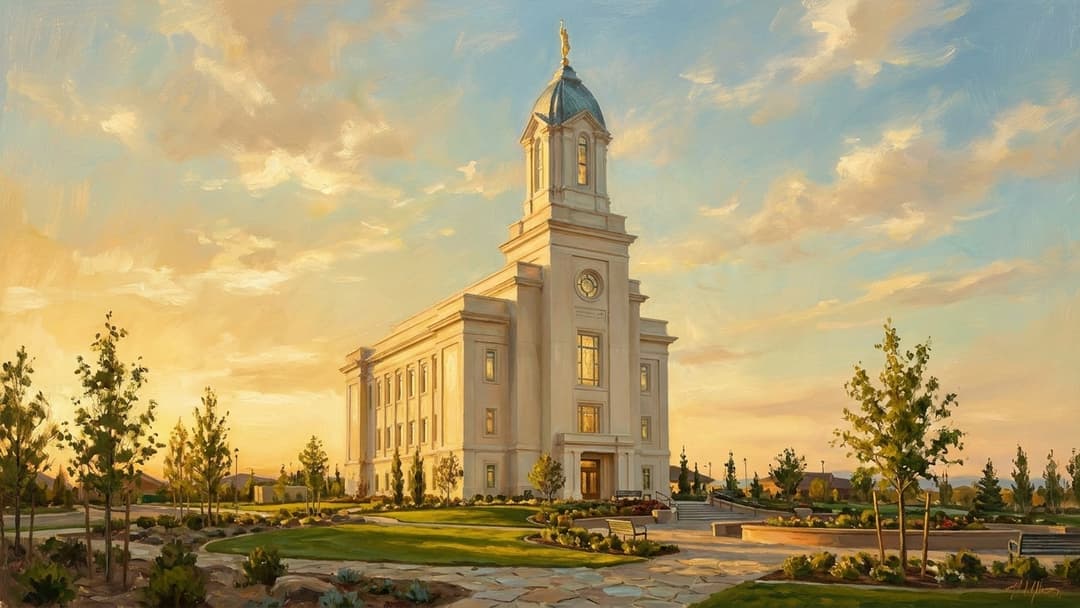
The Cedar City Utah Temple sits majestically on Leigh Hill, offering visitors a peaceful sanctuary with panoramic views of the Cedar Valley and the red rock formations of the Markagunt Plateau. The beautifully manicured grounds are open to the public, providing a serene environment for quiet contemplation, photography, and walking. While the interior is reserved for patrons holding a temple recommend, the exterior plazas and gardens welcome all who seek a moment of spiritual respite. Visitors can experience a profound sense of peace, especially during the golden hour when the sunset illuminates the temple's warm beige precast concrete.
Highlights
- Panoramic views of the Cedar Valley and the Markagunt Plateau
- Beautifully landscaped grounds featuring native high-desert flora
- Stunning night illumination making the temple a visible beacon
Things to Know
- Interior access is restricted to members with a valid temple recommend
- No public visitor center is available on-site
- Modest dress and a quiet, reverent demeanor are requested on the grounds
Location
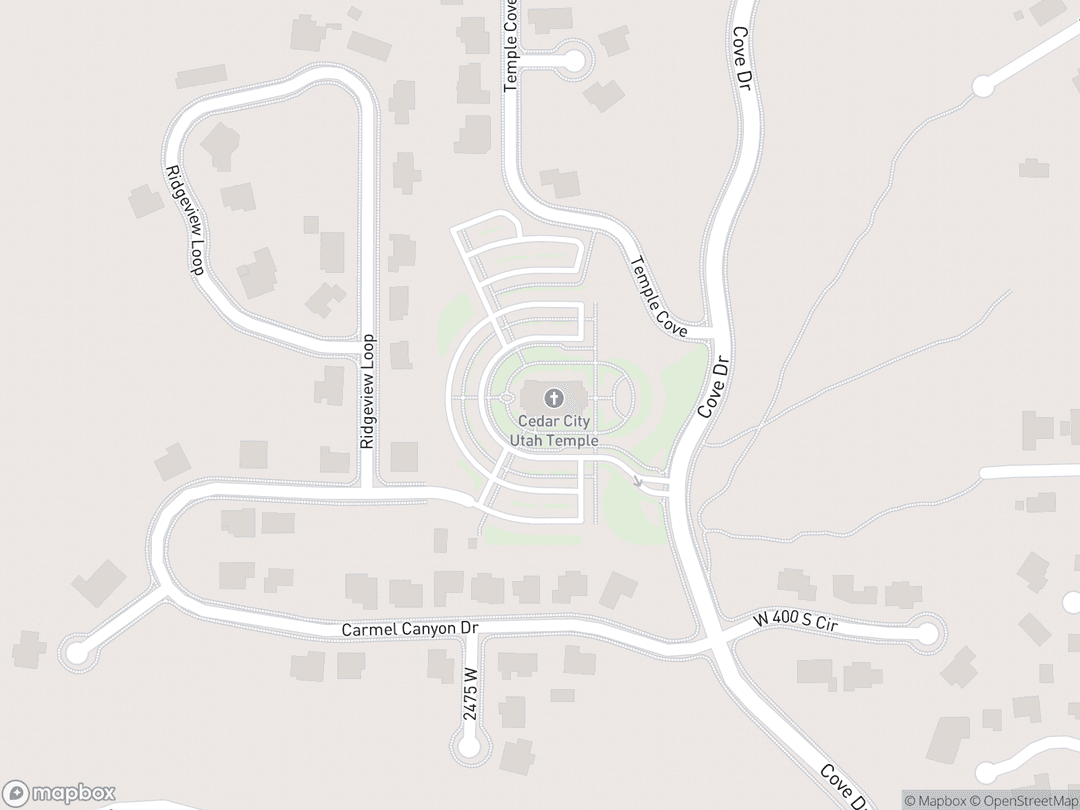
280 South Cove Drive, Cedar City, Utah 84720
Hours: Grounds open daily from sunrise to 10:00 PM. Temple ordinance hours vary by schedule.
Getting There: Located at 280 South Cove Drive on Leigh Hill. Easily accessible via local roads with ample free parking on-site.
Get DirectionsTips for Your Visit
Golden Hour Photography
Visit during the late afternoon to capture the warm sunlight reflecting off the beige concrete walls, mimicking the natural red hues of the surrounding cliffs.
Walk the Perimeter
Take a stroll along the outer walkways to appreciate the custom flagstone pavers and the detailed bronze ornamental fencing.
About
Within the broader Abrahamic and Christian theological traditions, the concept of a sacred space set apart from the world is deeply rooted. From the biblical Tabernacle of Moses in the wilderness to the grand Temple of Solomon in Jerusalem, houses of worship have historically served as physical manifestations of humanity's covenant relationship with God. In mainstream Christianity, cathedrals and sanctuaries are revered as places of communal worship, prayer, and divine contemplation. The Church of Jesus Christ of Latter-day Saints shares this reverence for sacred space but draws a distinct theological line between standard meetinghouses and temples.
While chapels are open to the public for weekly Sabbath worship and community gatherings, temples are dedicated as literal "Houses of the Lord." Latter-day Saint temple theology bridges ancient biblical practices with modern restorationist doctrine. In Latter-day Saint doctrine, the temple is a place of higher covenants and sacred ordinances essential for eternal salvation and the progression of the soul. These ordinances include the endowment—a course of instruction regarding the plan of salvation and covenants of obedience—and the sealing ordinance, which binds husbands, wives, and children in eternal family units.
The Cedar City Utah Temple stands as a physical monument to this theology, situated on Leigh Hill, a prominent elevation on the west side of the city. The elevated site commands a panoramic view of the Cedar Valley and the towering red rock formations of the Markagunt Plateau to the east. The temple's design is a deliberate exercise in architectural historicism, seeking to establish a direct visual kinship with the historic pioneer tabernacles and temples of southern Utah.
Dedicated in 2017, the temple serves as a spiritual sanctuary for Latter-day Saints across southern Utah and eastern Nevada. It represents the sanctification of the arid wilderness, echoing the biblical prophecy that "the desert shall rejoice, and blossom as the rose." Through its sacred ordinances and beautiful design, the Cedar City Utah Temple continues to stand as a visible beacon of faith and devotion.
Gallery
Symbolic Elements
The temple's exterior features intricate carvings, each rich with spiritual meaning:

The Cupola Spire
Unlike the sharp, modern spires of many contemporary temples, the single tower features a cupola-style spire. This design is a direct tribute to the Box Elder Stake Tabernacle and the lost Cedar City Tabernacle, symbolizing a bridge between the community's pioneer past and its eternal future.

The Temple Inscription
Engraved directly into the precast concrete of the East Spire above the main entryway is the sacred seal: Holiness to the Lord / The House of the Lord. This inscription serves as a threshold symbol, reminding all who enter that they are leaving the secular world.

The Columbine Motif
The stylized columbine flower—a resilient wildflower native to the high mountain valleys of southern Utah—is the primary decorative motif. It is repeated in the custom-woven carpets, carved into the sapele wood doors, and integrated into the hand-painted wall friezes.

Juniper Berries and Local Flora
Alongside the columbine, the juniper berry and native high-desert vegetation are featured in the interior art glass and decorative borders. This represents the sanctification of the arid wilderness, echoing biblical prophecy.

Indigenous Paiute Honors
The intricate patterns in the custom rugs and light fixtures subtly incorporate stylized feather motifs. These elements were designed in honor of the native Paiute people, the original stewards of the southern Utah valleys.
Rescued Presbyterian Stained Glass
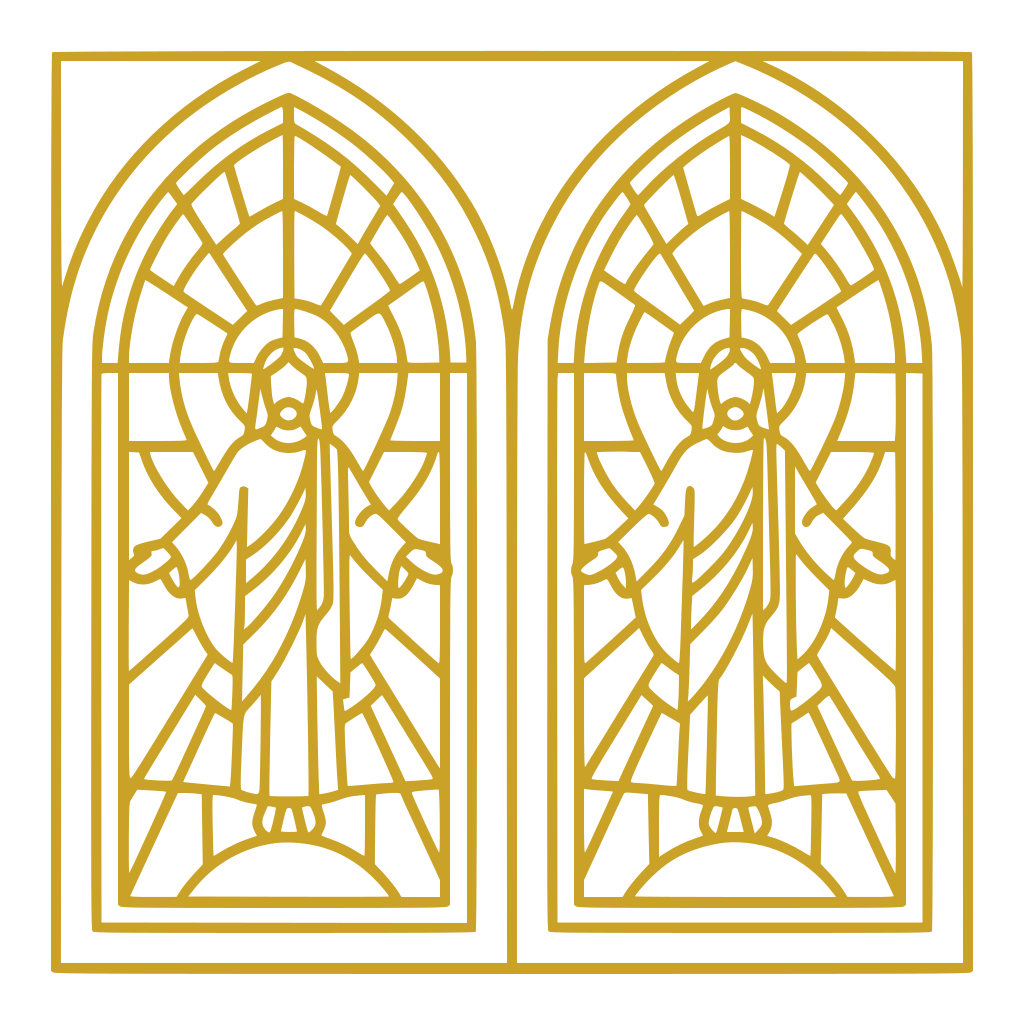
Adorning the entry lobbies are two historic stained-glass windows depicting Jesus Christ. Originally crafted for the First Presbyterian Church of Astoria in Queens, New York, their inclusion symbolizes a shared Christian adoration of Jesus Christ.
Sapele Wood Sheraton Carvings
The woodwork features rich African mahogany and sapele wood, carved with patterns that echo the traditional Sheraton furniture style. This style was highly popular during the pioneer era, reinforcing the historic connection.

Brown's Canyon Flagstone
The entry plazas feature a custom paver pattern utilizing natural flagstone sourced from Brown’s Canyon in Heber, Utah. This material grounds the temple's entrance in the physical geology of the state.
Interesting Facts
The temple's design is heavily inspired by the Box Elder Stake Tabernacle in Brigham City, Utah, making it one of the most explicitly 'pioneer-style' temples built in the modern era. (Tier B)
While Utah is home to dozens of temples, the Cedar City Temple was the first to be constructed in Iron County, serving stakes across southern Utah and eastern Nevada. (Tier A)
The stained-glass windows in the lobby are sister panes to those placed in the Provo City Center Temple and the Star Valley Wyoming Temple—all rescued from the same demolished Presbyterian church in New York. (Tier A)
Joel Hill Johnson wrote the famous Latter-day Saint temple hymn, 'High on a Mountain Top,' in Enoch, Utah—a direct neighbor to Leigh Hill where the Cedar City Temple now stands. (Tier B)
The temple's structural engineering includes 15-inch-thick solid concrete walls designed to withstand major seismic activity without twisting or swaying. (Tier B)
The public open house attracted 187,000 visitors, which is more than triple the entire population of Cedar City and more than double the population of Iron County. (Tier A)
According to the general contractor, Zwick Construction, a significant portion of the interior design was modified when construction was already 50% complete, requiring a highly coordinated effort. (Tier B)
The entryways feature natural flagstone hand-selected and transported from Brown's Canyon in Heber, Utah, grounding the building's entrance in the geology of the state. (Tier B)
The dramatic 100-foot height variance in records is due to architectural blueprints utilizing a benchmark datum plane of 100 feet as the baseline 'ground level' for structural engineering calculations. (Tier B)
The intricate patterns in the custom rugs and light fixtures subtly incorporate stylized feather motifs in honor of the native Paiute people, the original stewards of the southern Utah valleys. (Tier B)
Common Questions
Why is there a discrepancy in the temple's reported height?
The official Church Fact Sheet lists the height as 260 feet, 6 inches, while architectural databases record it as 160 feet, 6 inches. This is due to drafting conventions: blueprints used a 100-foot baseline datum plane for structural calculations. The physical height above actual ground level is 160 feet, 6 inches.
What is the significance of the stained-glass windows in the lobby?
The entry lobbies feature two historic stained-glass windows depicting Jesus Christ. These were originally crafted for the First Presbyterian Church of Astoria in Queens, New York, and were rescued when the church was demolished in 2008. Their inclusion symbolizes a shared Christian adoration of Christ.
What is the primary decorative motif used throughout the temple?
The primary motif is the columbine flower, a resilient wildflower native to southern Utah's high mountain valleys. It is integrated into the custom carpets, carved into sapele wood doors, and hand-painted on wall friezes.
Can the general public tour the inside of the temple?
No, the interior is reserved for members of the Church who hold a valid temple recommend. However, the public is welcome to explore the beautifully landscaped grounds and enjoy the peaceful atmosphere.
How does the temple's design honor the local Native American heritage?
The interior design subtly incorporates stylized feather motifs in the custom rugs and light fixtures, honoring the native Paiute people who were the original stewards of the southern Utah valleys.
Featured Stories
The Rescue of Astoria's Stained Glass
2008
In 2008, the historic First Presbyterian Church of Astoria in Queens, New York, was slated for demolition. An art dealer rescued several magnificent stained-glass windows depicting Jesus Christ, which were later purchased by a Latter-day Saint art collector and donated to the Church. Restored by Holdman Studios, these historic windows were installed in the Cedar City Temple's entry lobbies.
Their presence serves as a beautiful bridge of shared Christian faith and artistic heritage, welcoming patrons with a historic representation of the Savior. The inclusion of these windows reflects a deep respect for the sacred art of other faith traditions and a shared adoration of Jesus Christ.
Source: Church Newsroom Fact Sheet & Holdman Studios Records
A Mid-Construction Pivot
2016
During the construction of the temple, the general contractor, Zwick Construction, faced an unexpected challenge when a significant portion of the interior design was modified with construction already 50% complete. This late-stage redesign required intense coordination between the architects, craftsmen, and builders to implement high-end finishes without delaying the project.
The team successfully adapted, delivering the intricate African mahogany woodwork and imported stone flooring on schedule. This feat stands as a testament to the dedication and skill of the modern builders who mirrored the determination of the area's original pioneers.
Source: Zwick Construction Project Archives
The Legacy of Leigh Hill
December 10, 2017
The selection of Leigh Hill as the temple site carries deep historical resonance for the local community. In 1851, Latter-day Saint pioneers arrived in the area to establish an iron foundry, enduring severe hardships to build a community in the high desert. For decades, local members traveled long distances to the St. George Temple, often sacrificing time and resources.
The dedication of the Cedar City Utah Temple on this prominent hill in 2017 fulfilled generations of prayers, placing a 'House of the Lord' directly overlooking the valleys settled by those early iron-mining pioneers. It stands as a monument to their enduring faith and sacrifice.
Source: Cedar City Historical Society & Church Dedication Records
Timeline
Cedar City Settled
A company of Latter-day Saint pioneers sent by Brigham Young settles Cedar City to mine iron ore.
MilestoneTabernacle Cornerstone Laid
The cornerstone is laid for the original Cedar City Tabernacle, though construction is delayed to build the St. George Temple.
MilestoneTabernacle Completed
The historic Cedar City Tabernacle is officially completed, serving as the ecclesiastical and cultural heart of the community.
MilestoneTabernacle Razed
The tabernacle property is sold to the federal government for a post office, and the historic structure is razed.
EventFirst Cedar Stake Organized
The first permanent Cedar Stake is formally organized, reflecting decades of steady growth in southern Utah.
MilestoneTemple Announced
President Thomas S. Monson announces the intent to construct a temple in Cedar City during General Conference.
MilestoneGroundbreaking Ceremony
L. Whitney Clayton of the Presidency of the Seventy presides over the formal groundbreaking ceremony.
component.timeline.groundbreakingStructural Walls Poured
Workers complete the pouring of the 15-inch-thick structural concrete walls.
MilestonePrecast Panels Installed
Installation of the exterior beige precast concrete panels begins on the temple structure.
MilestoneAngel Moroni Installed
The gold-leafed statue of the Angel Moroni is installed atop the temple's cupola spire.
MilestonePublic Open House Begins
The public open house begins, welcoming over 187,000 visitors over a three-week period.
EventOpen House Concludes
The public open house concludes after drawing massive crowds from across southern Utah and eastern Nevada.
EventCultural Celebration
Local youth perform in a grand cultural celebration at the Southern Utah University America First Event Center.
EventTemple Dedicated
President Henry B. Eyring formally dedicates the Cedar City Utah Temple as the 157th operating temple.
DedicationTemporary Pandemic Closure
The temple temporarily suspends operations in response to the global COVID-19 pandemic.
EventPhased Reopening
The temple transitions through phased reopening protocols to safely resume full ordinance work.
MilestoneHistory by Decade
1850s — Pioneer Settlement and Iron Mission
In November 1851, a company of Latter-day Saint pioneers arrived in the southern Utah valley under the direction of Brigham Young. Their primary mission was to establish an iron foundry to support the growing territory, giving rise to the name "Iron County." Early religious services and community meetings were held in temporary log structures as the settlers focused on survival and industry in the harsh high-desert environment.
1870s — Laying the Tabernacle Foundation
As the community grew, the need for a permanent, large-scale meetinghouse became apparent. On November 2, 1877, the cornerstone was laid for the original Cedar City Tabernacle. However, construction progressed slowly over the next several years, as local labor, timber, and stone were frequently diverted to assist in the completion of the nearby St. George Temple, demonstrating the pioneers' prioritization of temple worship over local facilities.
1880s — Completion of the Historic Tabernacle
The historic Cedar City Tabernacle was finally completed in 1885. Featuring classic pioneer craftsmanship, the building became the ecclesiastical, cultural, and social heart of the community. For nearly five decades, it stood as a monument to the faith and sacrifice of the early settlers, hosting conferences, concerts, and civic gatherings.
1930s — Sacrifice and the Rock Church
The onset of the Great Depression brought severe economic hardships to Iron County. In 1932, in a difficult decision to stimulate the local economy and secure federal funds, the community voted to sell the tabernacle property to the federal government for the construction of a new post office. The beloved pioneer tabernacle was razed. To preserve their heritage, the community used funds from the sale to build the historic Rock Church chapel, utilizing local stone and volunteer labor.
1940s — Post-War Growth and Stake Organization
Following the hardships of the depression and World War II, Cedar City experienced a period of steady population growth. In 1948, as the local population neared 6,000, the first permanent Cedar Stake was formally organized. This milestone reflected the maturing of the local ecclesiastical structure and laid the groundwork for the eventual establishment of a temple district in the region.
2010s — Announcement, Construction, and Dedication
On April 6, 2013, President Thomas S. Monson announced the intent to construct the Cedar City Utah Temple. Ground was broken on August 8, 2015, on Leigh Hill, initiating a highly coordinated construction process. Following a public open house that drew 187,000 visitors, the temple was formally dedicated on December 10, 2017, by President Henry B. Eyring, becoming the 157th operating temple of the Church.
2020s — Pandemic Resilience and Continued Service
In March 2020, the Cedar City Utah Temple temporarily suspended operations in response to the global COVID-19 pandemic. It subsequently transitioned through phased reopening protocols, eventually resuming full ordinance work. Today, the temple continues to serve as a spiritual anchor for Latter-day Saints throughout southern Utah and eastern Nevada, bridging the community's pioneer past with its eternal future.
Architecture & Facilities
The architecture of the Cedar City Utah Temple is a deliberate exercise in historicism, designed by Architectural Nexus to establish a direct visual kinship with the historic pioneer tabernacles and temples of southern Utah. Drawing inspiration from classical proportions and localized decorative motifs, the building features a prominent end tower with a cupola-style spire, reminiscent of the Box Elder Stake Tabernacle and the lost Cedar City Tabernacle. This design philosophy honors the architectural legacy of the 19th-century Latter-day Saint builders while utilizing modern construction techniques to ensure structural longevity and seismic resilience in the high-desert environment.
Building Materials
Exterior Walls
Beige precast concrete panels accented with sections of gypsum fiber reinforced concrete (GFRC), fabricated by Forterra of Salt Lake City.
Entry Plazas
Custom paver patterns utilizing natural flagstone hand-selected and transported from Brown’s Canyon in Heber, Utah.
Fencing and Gates
Dark bronze ornamental steel fencing manufactured by Ameristar, punctuated by custom steel pilasters.
Structural Concrete
Seismically resilient 15-inch-thick solid concrete walls anchored by massive concrete footings measuring 8 feet wide and 40 inches deep.
Interior Features
Celestial Room
A serene, high-ceilinged space featuring level-five drywall finishes, premium Swarovski crystal chandeliers, and hand-painted wall friezes.
Sealing Rooms
Rooms dedicated to eternal marriage ordinances, adorned with rich African mahogany and sapele wood millwork carved in the Sheraton style.
Entry Lobbies
Lobbies featuring imported stone flooring from Israel and Turkey, accented by two rescued historic Presbyterian stained-glass windows.
Baptistry
A sacred font resting on the backs of twelve sculpted oxen, surrounded by detailed decorative borders and custom general lighting.
Temple Grounds
The 8.51-acre property features beautifully landscaped grounds planted with native high-desert vegetation, manicured lawns, and concrete walkways accented with geometric control joints.
Additional Facilities
An auxiliary arrival center, maintenance facility, and mechanical housing designed to match the main temple's architectural aesthetic.
Religious Significance
Within the broader context of Abrahamic and Christian theology, the Cedar City Utah Temple stands as a modern manifestation of sacred space, drawing a direct line to the biblical Tabernacle of Moses and the Temple of Solomon. While standard chapels serve as centers for weekly communal worship, the temple is dedicated as a literal 'House of the Lord'—a sanctuary set apart from the world where humanity enters into a formal covenant relationship with God.
The core spiritual purpose of the temple is to provide a sacred environment for the administration of saving ordinances and the making of eternal covenants, bridging earthly life with the eternal realm.
Sacred Ordinances
The Endowment
A course of spiritual instruction and covenant-making regarding the plan of salvation, the Creation, and the Savior's Atonement.
The Sealing Ordinance
Sacred rites that bind husbands, wives, and families together eternally, transcending the boundaries of physical death.
Vicarious Baptisms
Baptisms performed by proxy on behalf of deceased ancestors, offering them the opportunity to accept the gospel in the spirit world.
Covenant Theology and Universal Grace
Latter-day Saint temple theology emphasizes the universal reach of Christ's grace. By performing ordinances vicariously for the deceased, members demonstrate the doctrine that God's love extends to all generations, offering every soul the opportunity to receive the blessings of the gospel.
The Sanctuary of Peace
In a fast-paced and secular world, the temple serves as a physical and spiritual refuge. Inside its quiet halls, patrons seek divine guidance, engage in personal contemplation, and experience a profound sense of peace that strengthens them to face daily challenges.
Similar Temples
Sources & Research
Every fact on Temples.org is backed by verified Sources & Research. Each piece of information is rated by source tier and confidence level.
View All Sources (3)
| Field | Source | Tier | Retrieved |
|---|---|---|---|
| About & Historical Background | Temples of The Church of Jesus Christ of Latter-day Saints (opens in a new tab) | C | 2026-02-18 |
| Timeline & Featured Stories | LDS Living (opens in a new tab) | B | 2026-02-18 |
| About & Historical Background | FHE on the Road (opens in a new tab) | C | 2026-02-18 |