Visitor Insights
Visiting Belém Brazil Temple
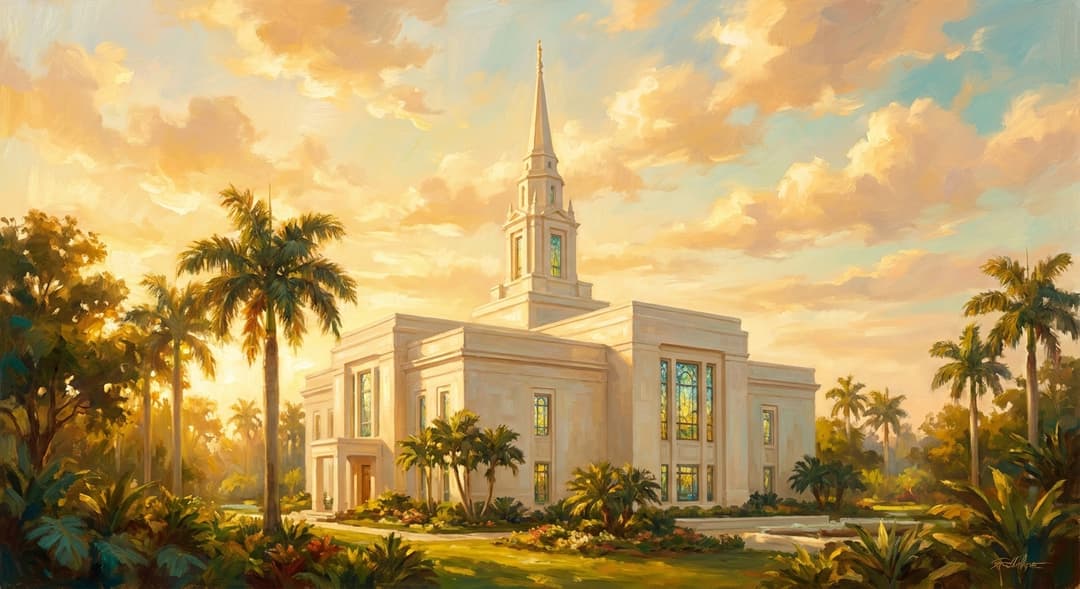
The Belém Brazil Temple grounds offer a peaceful, tropical sanctuary in the bustling Parque Verde district of Belém. Visitors are welcomed by beautifully manicured gardens featuring native Brazilian plants, paved walkways, and quiet areas designed for contemplation and prayer. While the interior of the temple is reserved for members of the Church holding active temple recommends, the public is invited to enjoy the serene atmosphere of the exterior grounds. The bright white Brazilian granite of the temple facade stands out beautifully against the lush green canopy, making it a striking landmark both day and night.
Highlights
- Meticulously landscaped gardens featuring native Amazonian tropical flora.
- Stunning exterior views of the 89-foot spire rising gracefully above the main entrance.
- Quiet, paved pathways perfect for personal reflection and peaceful walks.
- Beautiful evening illumination that highlights the temple's unique architectural features.
Things to Know
- The interior of the temple is not open to the general public; access is reserved for patrons.
- Visitors are asked to dress modestly and maintain a quiet, reverent demeanor on the grounds.
- Belém experiences a highly humid tropical climate with frequent rain showers, so carrying an umbrella is advised.
Location
Av. Centenário da Assembleia de Deus, 2200, Parque Verde, Belém - PA, 66635-894, Brazil
Hours: The temple grounds are open to the public daily from sunrise to 9:00 PM.
Getting There: Located at Av. Centenário da Assembleia de Deus, 2200, in the Parque Verde neighborhood. It is easily accessible via taxi, rideshare, or public transit, and is approximately 12 kilometers (7.5 miles) from Val de Cans International Airport.
Get DirectionsTips for Your Visit
Visit at Sunset
Arrive just before sunset to experience the transition as the tropical sky colors fade and the temple's exterior lighting system illuminates the white granite.
Explore the Gardens
Take time to walk the entire perimeter path to appreciate the native Amazonian landscaping and find the best angles for viewing the unique stained-glass windows.
Utilize the Arrival Center
If you are traveling from afar or have questions, stop by the on-site arrival center where missionaries and volunteers can provide information and assistance.
About
The Belém Brazil Temple stands as a monumental sacred landmark in northern Brazil, serving as the first temple of The Church of Jesus Christ of Latter-day Saints constructed in the vast Amazon region. Located in the historic port city of Belém—often called the "gateway to the Amazon"—this beautiful structure represents a major milestone for the local Latter-day Saints, who previously had to travel thousands of miles to attend the nearest temple. The temple's presence in Belém brings the sacred ordinances of the restored gospel directly to the diverse populations of the Amazon basin.
As part of the broader Christian tradition, Latter-day Saints share a profound reverence for sacred spaces, drawing inspiration from biblical accounts of the Tabernacle of Moses and the Temple of Solomon. However, while standard Latter-day Saint chapels are open to the general public for weekly Sunday worship, temples are designated as literal houses of the Lord. They are sacred sanctuaries where faithful members enter into formal covenants with God and participate in holy ordinances, such as eternal marriages and baptisms on behalf of deceased ancestors, bridging the gap between heaven and earth.
The construction of the temple in Belém is the culmination of decades of faith and growth in northern Brazil. From the arrival of the first missionaries in 1975 to the organization of stakes and missions, the local Saints have demonstrated remarkable devotion. The temple's design beautifully reflects this heritage, blending modern Latter-day Saint architectural standards with local Portuguese-Brazilian influences and motifs inspired by the natural beauty of the Amazon rainforest and indigenous cultures.
Interesting Facts
The name of the city, Belém, is the Portuguese word for 'Bethlehem,' drawing a beautiful spiritual parallel to the birthplace of Jesus Christ. (Tier A)
The temple was dedicated on November 20, 2022, the exact same day as the Quito Ecuador Temple, marking the first double dedication in over two decades. (Tier A)
During the dedicatory services, Elder Dale G. Renlund compared the spiritual yielding of hearts to the *pororoca*, the powerful tidal bore of the Amazon River. (Tier A)
The temple's announcement in 2016 coincided precisely with the 400th anniversary of the founding of the city of Belém by Portuguese explorers. (Tier A)
Prior to the temple's completion, local members had to travel 1,200 miles (1,900 km) by bus or take a 2.5-hour flight to reach the nearest temple in Recife. (Tier C)
The intricate, custom-sculpted carpets in the celestial and sealing rooms were hand-carved on-site by a skilled local Brazilian craftsman. (Tier C)
The temple is one of the few globally to incorporate pre-Columbian design motifs, utilizing geometric patterns inspired by Marajoara indigenous pottery. (Tier C)
The temple serves as a vital spiritual beacon for remote Latter-day Saint communities throughout the Amazon basin, many of whom can only travel by riverboat. (Tier C)
The Belém Brazil and Quito Ecuador temples share a deep connection, having been announced on the exact same day in April 2016 and dedicated on the same day in 2022. (Tier C)
Breaking standard protocol during the dedicatory sessions, Apostle Elder Dale G. Renlund stood at the entrance to personally shake hands with entering members. (Tier B)
Common Questions
Who can enter the interior of the Belém Brazil Temple?
The interior of the temple is reserved for faithful members of The Church of Jesus Christ of Latter-day Saints who hold an active temple recommend, which certifies they meet the spiritual standards of the faith. However, the beautifully landscaped exterior grounds are open to the general public of all faiths.
What is the significance of the temple's location in Belém?
Belém is known as the 'gateway to the Amazon.' The temple is the first to be built in northern Brazil's vast Amazon region, eliminating a grueling 1,200-mile (1,900 km) journey by bus or a 2.5-hour flight that local members previously had to undertake to reach the nearest temple in Recife.
How does the temple's design reflect the local culture of northern Brazil?
The temple incorporates unique regional elements, including stylized carvings of the native Victoria amazonica (giant water lily) on the exterior granite and stained glass, geometric patterns inspired by ancient Marajoara indigenous pottery, and a color palette reflecting the vibrant Amazon rainforest.
Does the Belém Brazil Temple have an Angel Moroni statue?
No, the Belém Brazil Temple was constructed without an Angel Moroni statue on its spire, joining several other modern Latter-day Saint temples built with a simple finial or spire tip.
What is the difference between a Latter-day Saint chapel and this temple?
Latter-day Saint chapels are local meetinghouses open to everyone for weekly Sunday worship services, social activities, and community events. Temples, however, are sacred 'houses of the Lord' dedicated to higher spiritual ordinances, such as eternal marriages and baptisms for ancestors, and are not used for regular Sunday services.
Featured Stories
The Bethlehem of the Amazon
November 20, 2022
During the dedicatory services of the Belém Brazil Temple, Elder Dale G. Renlund highlighted a beautiful linguistic and spiritual connection. The name of the city, Belém, is the Portuguese translation of 'Bethlehem,' the biblical birthplace of the Savior. Elder Renlund noted that just as the Wise Men of old journeyed to Bethlehem in Judea to worship the infant Christ, modern-day Saints now make sacred journeys to Belém to worship Him in His holy house. This comparison deeply resonated with the local members, who view the temple as a literal sanctuary where they can draw closer to Jesus Christ. The dedication transformed the city's name from a historical label into a living symbol of their devotion to the Savior.
Source: Elder Dale G. Renlund, Dedicatory Prayer and Address
Eliminating a 1,200-Mile Journey of Faith
January 1991
For decades, faithful Latter-day Saints in the Amazon region demonstrated extraordinary sacrifice to participate in temple worship. Before the Belém Brazil Temple was constructed, members in northern Brazil belonged to the Recife Temple district, which required a grueling 1,200-mile (1,900 km) journey. Many families saved money for years to afford either a 2.5-hour flight or a multi-day bus trip across rough, unpaved roads, often traveling in organized caravans. These journeys required immense physical endurance, financial strain, and unwavering faith just to spend a few sacred days inside the temple. The completion of the temple in Belém stands as a monument to their decades of sacrifice, bringing the blessings of the temple directly to their doorstep.
Source: Local Stake Historical Records & Member Oral Histories
An Apostle's Personal Welcome
November 19, 2022
On the eve of the temple's dedication, Elder Dale G. Renlund of the Quorum of the Twelve Apostles performed an act of profound humility that broke with standard protocol. As local Latter-day Saints arrived at the temple gates for the dedicatory sessions, Elder Renlund stood personally at the front entrance of the building. Rather than remaining inside, he spent hours greeting entering members individually, offering warm smiles and personal handshakes to hundreds of patrons. This unexpected gesture deeply touched the Saints, many of whom had traveled from remote river communities deep within the Amazon basin. For the members, this personal apostolic welcome served as a beautiful, earthly reflection of the Savior's open arms, welcoming them into His holy house.
Source: Church News Dedication Report
Timeline
First Missionaries Arrive
The first full-time Latter-day Saint missionaries arrive in the port city of Belém, establishing a small rented facility for the city's first branch.
MilestoneFirst Native Brazilian Missionary Assigned
Elder Munhoz arrives from São Paulo, becoming the first native Brazilian full-time missionary assigned to labor in Belém.
EventBranch Relocation and New Leadership
The growing Belém branch relocates to a larger house in the Batista Campos neighborhood, with Karl Kidman called as branch president.
EventFirst Temple Caravan
The first temple caravan of 40 faithful Saints from Belém embarks on a grueling three-day road journey to the São Paulo Brazil Temple.
EventFirst Stake Organized
The Belém Brazil Stake, the first stake in northern Brazil, is officially organized with Luiz Carlos Silva de França as president.
MilestoneBrazil Belém Mission Established
The Church establishes the Brazil Belém Mission to manage the rapid influx of converts across the vast Amazon basin.
MilestoneRapid Growth and Stake Reorganization
An unprecedented surge in growth leads to the reorganization of local congregations, creating five stakes in the metropolitan area.
EventTemple Announcement
President Thomas S. Monson announces the construction of the Belém Brazil Temple during the Sunday morning session of General Conference.
MilestoneGroundbreaking Ceremony
Elder Marcos A. Aidukaitis presides over the official groundbreaking ceremony, dedicating the 6.7-acre site for construction.
component.timeline.groundbreakingPublic Open House Begins
The completed temple opens its doors to the public for a highly anticipated two-week open house, welcoming tens of thousands of visitors.
EventPublic Open House Concludes
The public open house concludes after drawing widespread interest from government officials, journalists, and interfaith leaders.
EventApostolic Welcome
Elder Dale G. Renlund arrives in Belém and breaks protocol by personally greeting arriving Saints with individual handshakes at the temple entrance.
EventOfficial Temple Dedication
Elder Dale G. Renlund of the Quorum of the Twelve Apostles officially dedicates the Belém Brazil Temple in three successive sessions.
DedicationDedicatory Broadcast
The dedicatory services are broadcast to all congregations within the temple district, officially establishing it as the 174th operating temple.
EventHistoric Double Dedication
The dedication of the Belém Brazil Temple occurs on the exact same day as the Quito Ecuador Temple, marking a historic double dedication.
MilestoneHistory by Decade
1970s — The Seeds of Faith in the Amazon
The history of The Church of Jesus Christ of Latter-day Saints in the Amazon region began in 1975 when the first full-time missionaries arrived in the port city of Belém. Operating in a small rented facility, they established the city's very first branch, laying the groundwork for future growth. In April 1976, Elder Munhoz arrived from São Paulo as the first native Brazilian missionary assigned to the city, bringing a local voice to the proselytizing efforts. By late 1976, the growing congregation relocated to a larger home in the Batista Campos neighborhood under the leadership of Karl Kidman, a Vietnam War veteran from Utah who had moved his family to Belém to run a local sawmill.
1990s — Stake Organization and Caravans of Sacrifice
The 1990s marked a period of rapid institutional growth and deep spiritual devotion for the Saints of Belém. In January 1991, a group of 40 local members organized the city's first temple caravan, embarking on a challenging three-day road journey to the São Paulo Brazil Temple—the only operating temple in South America at the time. This milestone was quickly followed by the official organization of the Belém Brazil Stake on December 29, 1991, with Luiz Carlos Silva de França called as the inaugural stake president. To support the massive influx of converts across the Amazon basin, the Church formally established the Brazil Belém Mission on July 1, 1994.
2010s — Rapid Expansion and the Temple Announcement
By the turn of the decade, the Church's footprint in northern Brazil had expanded dramatically, necessitating a stronger leadership infrastructure. In December 2010, an unprecedented surge in growth led to the reorganization of local congregations, resulting in the creation of five stakes in the Belém metropolitan area alone. This preparation culminated on April 3, 2016, when President Thomas S. Monson announced the construction of the Belém Brazil Temple during General Conference, a historic announcement that coincided with the 400th anniversary of the founding of Belém. On August 17, 2019, local members and civic leaders gathered as ground was officially broken and the site dedicated by Elder Marcos A. Aidukaitis.
2020s — Completion, Open House, and Dedication
Despite global challenges, construction progressed steadily, culminating in the temple's completion in late 2022. From October 22 to November 5, 2022, the temple hosted a public open house that drew tens of thousands of visitors, including government officials, journalists, and interfaith leaders who toured the sacred interior. On November 20, 2022, Elder Dale G. Renlund of the Quorum of the Twelve Apostles officially dedicated the temple in three successive sessions, which were broadcast to all congregations in the temple district. The dedication marked a historic milestone, officially establishing the Belém Brazil Temple as the 174th operating temple worldwide and the first in the Amazon region.
Architecture & Facilities
The Belém Brazil Temple features a modern classic design characterized by clean, symmetrical lines and a single attached central spire that rises gracefully above the main entrance. The spire's profile draws direct inspiration from the historic, colonial-era church towers found in downtown Belém, blending modern Latter-day Saint temple design with local Portuguese-Brazilian heritage.
Building Materials
Exterior Cladding
Clad in high-quality, soft-white Brazilian granite selected for its durability in the intense tropical humidity and heavy rainfall of the Amazonian climate.
Interior Flooring
Crafted from premium national porcelain tile, accented by a travertine stone border, Brazilian brown stone detailing, Arezzo stone, and a base of Crema Marfil Spanish stone.
Millwork and Woodwork
Crafted from a medium-brown native Brazilian hardwood, showcasing precise geometric carvings that mirror the water lily motifs found on the temple's exterior.
Art Glass Windows
Stained-glass windows featuring a vibrant blue gradient surrounded by an ornamental border and overlaid with an intricate grill pattern, transitioning through shades of blue, green, yellow, and pink.
Interior Features
Instruction Rooms
Two beautifully appointed instruction (endowment) rooms designed for a seamless, reverent flow of patrons participating in sacred covenants.
Sealing Rooms
Two sacred sealing rooms featuring custom-sculpted carpets hand-carved by a local Brazilian craftsman, where eternal marriages are performed.
Baptistry
A sacred baptistry featuring a baptismal font resting on the backs of twelve life-sized, sculpted oxen, cast in a style reflecting ancient biblical designs.
Celestial Room
A magnificent, quiet room symbolizing heaven, featuring elegant lighting, premium finishes, and custom-sculpted carpets that flow harmoniously with the adjacent art glass.
Temple Grounds
The temple sits on a beautifully landscaped 6.7-acre property featuring native Brazilian tropical plants, paved walkways, and quiet areas designed for reflection and prayer.
Additional Facilities
An on-site arrival center is located on the property to assist traveling patrons and visitors, providing comfortable facilities and information.
Religious Significance
For centuries, Christians of various traditions have built grand cathedrals, basilicas, and chapels to honor God and create spaces for communal worship, prayer, and quiet contemplation. This desire to establish a dedicated sanctuary is deeply rooted in the biblical accounts of the Tabernacle of Moses and the Temple of Solomon, where the covenant people of Israel sought the manifest presence of the Almighty. The Church of Jesus Christ of Latter-day Saints shares this profound Christian reverence for sacred spaces but distinguishes its temples from standard meetinghouses or chapels.
While Latter-day Saint chapels are open to the general public for weekly Sunday worship services, temples are designated as literal houses of the Lord. They are not houses of public assembly but are sacred sanctuaries where faithful members enter into formal covenants with God and participate in holy ordinances, such as eternal marriages and baptisms on behalf of deceased ancestors. For Latter-day Saints, the temple represents the ultimate bridge between heaven and earth, where the family unit can be bound together forever under priesthood authority.
Sacred Ordinances
The Endowment
A sacred ceremony where members receive instruction regarding God's plan of salvation and make formal covenants to keep His commandments.
Eternal Marriage (Sealing)
An ordinance performed in sealing rooms where couples are united for eternity, ensuring that family relationships continue beyond death.
Proxy Baptism
A sacred practice performed in the baptistry where members are baptized on behalf of deceased ancestors who did not have the opportunity in life.
A Spiritual Beacon for the Amazon Basin
The Belém Brazil Temple serves as a vital spiritual beacon for members living across the vast Amazon basin, including remote communities that can only access Belém by riverboat. It brings the highest ordinances of the restored gospel directly to a region that was previously isolated from temple blessings.
Covenants and the Christian Heritage
By entering into sacred covenants within the temple, Latter-day Saints seek to align their lives more closely with Jesus Christ. This commitment to discipleship and covenant-keeping continues ancient biblical patterns of temple worship, adapted for the modern era.
Similar Temples
Sources & Research
Every fact on Temples.org is backed by verified Sources & Research. Each piece of information is rated by source tier and confidence level.
View All Sources (6)
| Field | Source | Tier | Retrieved |
|---|---|---|---|
| About & Historical Background | The Church of Jesus Christ of Latter-day Saints (opens in a new tab) | A | 2026-02-18 |
| Timeline & Regional Growth | A Igreja de Jesus Cristo dos Santos dos Últimos Dias (opens in a new tab) | A | 2026-02-18 |
| Architecture & Materials | ChurchofJesusChristTemples.org (opens in a new tab) | C | 2026-02-18 |
| Architecture & Design Details | Photogent (opens in a new tab) | C | 2026-02-18 |
| Visitor Insights & Open House | The Church of Jesus Christ of Latter-day Saints Newsroom (opens in a new tab) | A | 2026-02-18 |
| Symbolic Elements & Indigenous Art | ChurchofJesusChristTemples.org (opens in a new tab) | C | 2026-02-18 |