Visitor Insights
Visiting Giant Wild Goose Pagoda
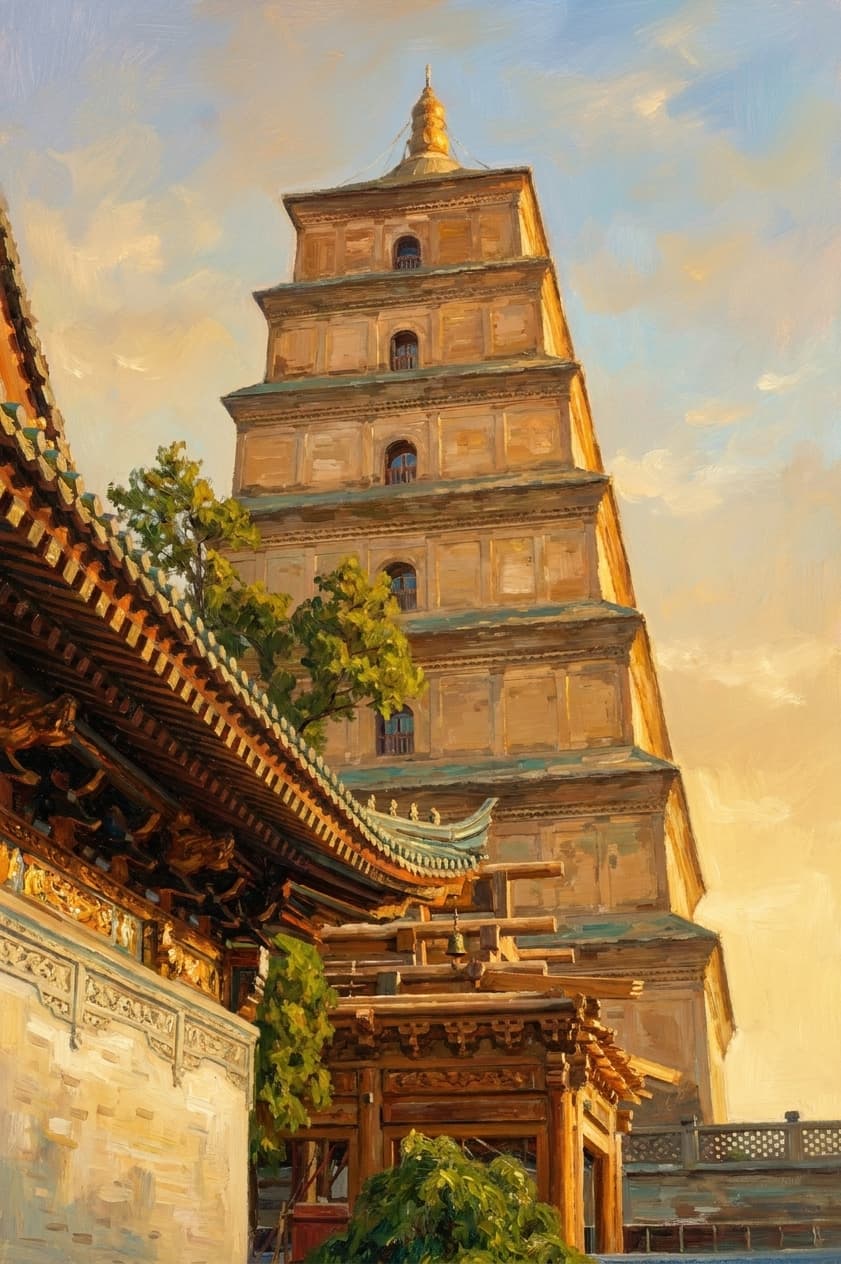
Situated within the peaceful Da Ci'en Temple complex in southern Xi'an, the Giant Wild Goose Pagoda offers a profound encounter with Tang Dynasty spirituality. Visitors can stroll through traditional incense-scented courtyards before ascending the leaning brick tower for sweeping views across the ancient capital. The surrounding plaza comes alive each evening with dramatic illumination and music performances.
Highlights
- Climb the interior wooden staircase for panoramic views across Xi'an
- Explore the Da Ci'en Temple halls featuring active Buddhist monastic chanting
- Inspect ancient stone lintels carved by Tang court artist Yan Liben
- Witness the vast illuminated musical fountain display in the North Square
Things to Know
- Ascending the pagoda requires an additional ticket beyond the temple entrance
- The interior wooden staircase is steep and narrow during peak visiting hours
- Monks conduct daily morning recitation services that require quiet respect
Location
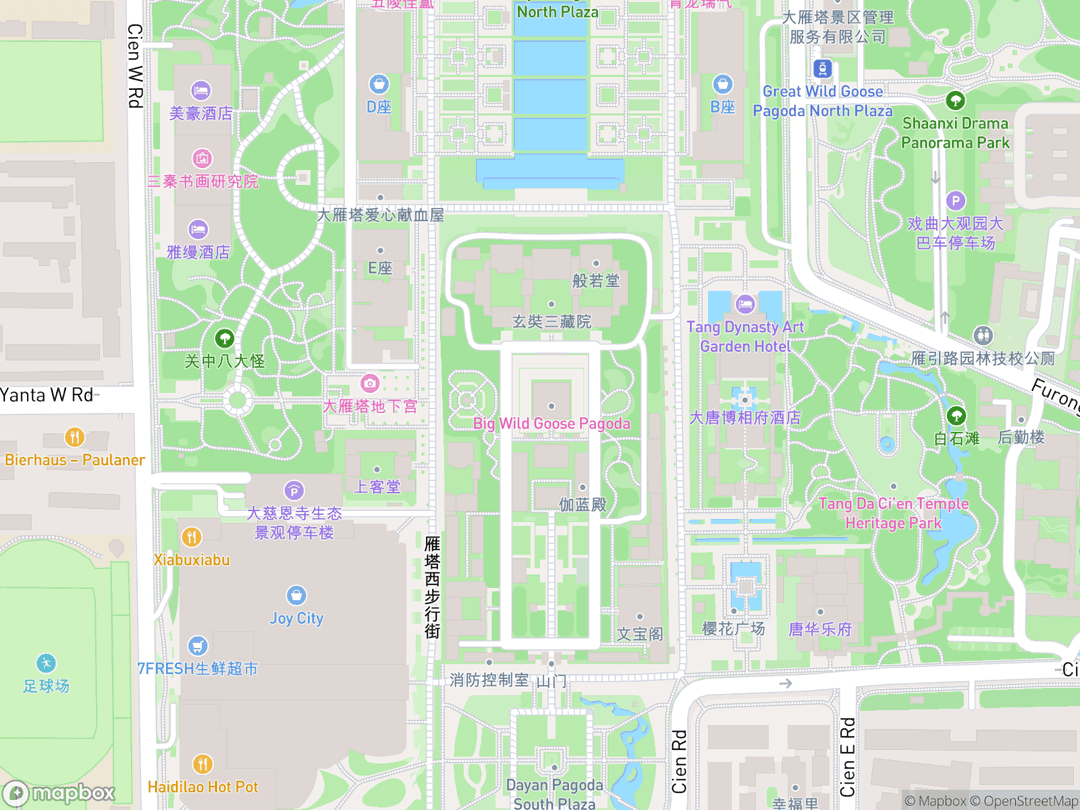
No. 1 Ci'en Road, Yanta District, Xi'an City, Shaanxi Province, China
Hours: 08:00–17:30 (March to November); 08:00–17:00 (December to February)
Getting There: Take Xi'an Metro Line 3 or Line 4 directly to Dayanta Station, Exit B or C, or ride public bus lines 606 or 609 to the Dayanta stop.
Get DirectionsTips for Your Visit
Morning Temple Services
Arrive at opening to witness monastic residents chanting morning sutras in the main shrine halls.
Evening Fountain Display
Plan your visit for late afternoon to view the daytime complex before enjoying the illuminated night fountain.
Ticketing Strategy
Purchase your temple grounds entry at the main gate, then buy the pagoda climbing pass inside.
About
Rising above the ancient imperial capital of Chang'an, the Giant Wild Goose Pagoda stands as an enduring monument to Buddhist scholarship and Silk Road devotion. Founded in 652 within the Da Ci'en Temple complex, the pagoda was constructed under the direct supervision of the venerable monk Xuanzang following his seventeen-year pilgrimage to India.
As a foundational Dharmic sanctuary in East Asia, the pagoda served as a translation center where Sanskrit sutras were rendered into Chinese. Its pavilion-style architecture fused indigenous Chinese brickwork with ancient Indian stupa cosmology, profoundly transforming the transmission of the Dharma across imperial China.
Surviving catastrophic earthquakes, dynastic transitions, and modern upheavals, this seven-story tower remains an active pilgrimage site and UNESCO World Heritage sanctuary. Today, pilgrims and travelers gather to honor Xuanzang's heroic legacy and the enduring philosophical traditions of Mahayana Buddhism.
Gallery
Symbolic Elements
The temple's exterior features intricate carvings, each rich with spiritual meaning:

Stupa Form
The square architectural silhouette adapts the ancient Indian hemispherical reliquary stupa into a multi-tiered Chinese tower.

Wild Goose
The goose symbolizes the Mahayana ideal of self-sacrifice and compassion taught in classic Buddhist Jataka parables.

Lotus Throne
Carved stone lotus motifs throughout the base represent spiritual purity emerging unstained from worldly suffering.

Dougong Brackets
Imitation interlocking timber brackets molded into the brickwork harmonize earthly Chinese craftsmanship with divine order.

Sutra Scrolls
Representations of Sanskrit palm-leaf texts honor the transmission of the Dharma across Central Asia into China.

Seven Pagoda Tiers
The seven surviving ascending levels symbolize the seven steps toward spiritual enlightenment in Buddhist cosmology.

Square Earth Base
The broad quadrangular foundation embodies the ancient Chinese cosmological concept of the stable, receptive earth.

Reliquary Chamber
The inner sanctum was constructed specifically to enshrine sacred sarira relics and statues gifted by Indian kingdoms.
Interesting Facts
The pagoda leans slightly toward the west due to historical earthquakes and regional groundwater variations (Tier A).
Imperial examination scholars in the Tang Dynasty carved their names on the pagoda walls to signify soaring careers (Tier B).
Monk Xuanzang spent seventeen years walking thousands of miles across India to gather authentic Buddhist manuscripts (Tier A).
The pagoda was originally built from rammed earth and exterior brick without using any cement mortar (Tier B).
Its name derives from a Buddhist Jataka tale where a wild goose offered itself as food to inspire monastics toward vegetarianism (Tier B).
Empress Wu Zetian completely rebuilt the pagoda in 704, expanding it to an imposing ten stories before earthquake damage (Tier A).
The Great Shaanxi Earthquake of 1556 sheared off the top three levels, leaving the seven stories seen today (Tier B).
The adjoining Da Ci'en complex was originally an imperial estate containing nearly two thousand monastery rooms (Tier B).
In 2014, the pagoda was inscribed as a UNESCO World Heritage Site along the Silk Roads Chang'an-Tianshan Corridor (Tier A).
Common Questions
Why is it called the Giant Wild Goose Pagoda?
The name commemorates a Buddhist parable where a wild goose offered itself as food to inspire monastics toward vegetarianism.
Can visitors climb inside the pagoda?
Yes, visitors who purchase an additional climbing ticket can ascend the interior wooden staircase to the seventh floor.
Why does the pagoda lean toward the west?
Centuries of seismic activity and uneven regional groundwater extraction created a slight architectural tilt.
What relics were originally placed inside the pagoda?
Xuanzang deposited hundreds of Sanskrit palm-leaf manuscripts, sacred relics of the Buddha, and gilded Indian statues.
When is the musical fountain show held?
The expansive musical fountain in the North Square operates scheduled water and light performances during the afternoon and evening.
Featured Stories
Xuanzang's Epic Silk Road Quest
652
After defying imperial border restrictions, the scholar-monk Xuanzang journeyed across deserts and mountain passes for seventeen years to reach India's Nalanda monastery. Upon his triumphant return to Chang'an with hundreds of Sanskrit scriptures, Emperor Gaozong granted him an imperial workshop and funded the pagoda's construction. Xuanzang spent the remainder of his life inside these sanctuary walls translating fundamental Yogacara texts into classical Chinese.
Source: Historical Records of the Tang Dynasty
The Imperial Rebirth Under Empress Wu
704
By the turn of the eighth century, the original rammed-earth core of Xuanzang's pagoda had begun to deteriorate in Chang'an's humid climate. Empress Wu Zetian, a devoted patron of Buddhism who drew political legitimacy from the Dharma, ordered the tower rebuilt entirely in brick and raised to ten stories. Her grand renovation cemented the monument as the preeminent architectural landmark of the Tang imperial capital.
Source: Imperial Tang Inscriptions
Enduring the Great Shaanxi Quake
1556
In 1556, the deadliest earthquake in recorded history struck Shaanxi province, flattening surrounding towns and shaking the ancient capital to its foundations. While numerous stone towers collapsed completely, the Giant Wild Goose Pagoda shed only its top three levels and sustained a permanent westward lean. Ming Dynasty artisans subsequently reinforced the exterior masonry, leaving the resilient seven-story structure that endures today.
Source: Ming Dynasty Chronicle of Shaanxi
Timeline
Da Ci'en Temple Founded
Crown Prince Li Zhi commissions the temple complex in honor of his late mother, Empress Zhangsun.
MilestoneOriginal Pagoda Completed
Monk Xuanzang oversees the construction of a five-story rammed-earth and brick pagoda to store Indian sutras.
DedicationReconstruction by Empress Wu
Empress Wu Zetian rebuilds the pagoda in durable brick, expanding the structure to ten stories.
RenovationSurvival of Great Persecution
The pagoda miraculously survives the Huichang suppression of Buddhism that razed thousands of Chinese monasteries.
EventFive Dynasties Stabilization
Regional leaders carry out structural repairs following political instability and warfare in Chang'an.
RenovationThe Great Shaanxi Earthquake
A catastrophic earthquake shears off the top three levels, reducing the pagoda to its present seven stories.
EventMing Dynasty Brick Refacing
Ming craftsmen comprehensively re-face the damaged outer walls with an exterior skin of kiln-fired blue bricks.
RenovationState Structural Conservation
The Chinese government carries out significant reinforcement work to stabilize the tower's interior wooden framework.
RenovationGroundwater Mitigation Measures
Municipal engineers implement strict water table controls around Yanta District to halt the pagoda's westward tilt.
MilestoneUNESCO World Heritage Inscription
The pagoda is inscribed as a World Heritage Site within the Silk Roads Chang'an-Tianshan Corridor network.
MilestoneHistory by Decade
640s–650s — Imperial Foundation and Xuanzang's Vision
Let the sacred Dharma be preserved in stone and brick so that light may dispel darkness for endless generations.
Crown Prince Li Zhi founded the Da Ci'en Temple in 648 to express filial piety toward his mother, creating an expansive monastery with hundreds of halls. Following his epic pilgrimage to Nalanda, Master Xuanzang was appointed abbot and supervised the erection of the pagoda in 652 to house his sacred collection of Buddhist sutras and relics.
700s–710s — The Reconstruction by Empress Wu Zetian
Due to the deterioration of its original mud-brick core, Empress Wu Zetian ordered a full-scale reconstruction of the pagoda in 704. The newly erected brick tower reached ten stories, serving as both a triumphant imperial monument and the primary intellectual center for the translation of esoteric Buddhist doctrines.
1550s–1600s — Earthquake Destruction and Ming Dynasty Rebuilding
The devastating 1556 Shaanxi earthquake destroyed the pagoda's uppermost three stories and imparted a noticeable westward lean. During the late Ming Dynasty in 1604, engineers consolidated the remaining seven stories by encasing the older Tang masonry within a stout exterior skin of kiln-fired blue brick.
1960s–Present — Conservation, Tourism, and World Heritage Inscription
Modern conservation programs in 1964 and the 1990s halted the pagoda's tilt through careful environmental stabilization and groundwater monitoring. In 2014, the pagoda attained global recognition as a UNESCO World Heritage site, affirming its status as a vital crossroads of Dharmic faith and Silk Road culture.
Architecture & Facilities
The Giant Wild Goose Pagoda represents a masterwork of Tang Dynasty pavilion-style brick masonry, seamlessly synthesizing ancient Indian stupa reliquary geometry with multi-tiered Chinese wooden architectural traditions.
Building Materials
Kiln-Fired Blue Brick
Dense blue-gray bricks were laid with sticky-rice and lime mortar to encase the core structure.
Cypress Timber Framework
Internal floor joists and spiral staircases are fashioned from seasoned native cypress and pine.
Carved Stone Lintels
Bas-relief stone doorframes feature delicate Tang Buddhist engravings attributed to court artist Yan Liben.
Granite Foundation
A massive raised stone terrace provides a level and stable base atop the regional loess soil.
Interior Features
Ground Floor Relic Hall
This central entrance hall displays ancient stone tablets and historical commemorative stelae from Tang emperors.
Sutra Translation Chamber
The second level preserves classical Chinese reproductions of the original Sanskrit palm-leaf manuscripts.
Central Wooden Stairwell
A steep wooden staircase winds through the hollow core to provide access between the seven tiers.
Upper Observation Chamber
The seventh-floor portal chamber offers expansive vistas overlooking the city of Xi'an and surrounding plains.
Temple Grounds
The pagoda is framed by the serene courtyards of Da Ci'en Temple, containing ancient pine trees, monumental bronze incense burners, drum and bell towers, and landscaped public squares.
Additional Facilities
Visitor amenities include the Xuanzang Memorial Hall, an exhibition of Silk Road artifacts, multilingual guide stations, and the extensive North Square fountain park.
Religious Significance
Within the Dharmic traditions of Mahayana Buddhism, the Giant Wild Goose Pagoda stands as one of the most revered sanctuaries of textual preservation and scriptural transmission in Asian history.
The monument was constructed as a sacred reliquary and translation center to enshrine the Buddha's relics and the Sanskrit sutras retrieved by Xuanzang from the Indian subcontinent.
Sacred Ordinances
Sutra Veneration (Fa Bao)
Pilgrims circumambulate the pagoda to pay homage to the sacred scriptures that embody the enlightened mind of the Buddha.
Monastic Chanting (Chant and Puja)
Resident monks conduct daily morning and afternoon chanting ceremonies inside the Da Ci'en prayer halls.
Incense Offering (Shang Xiang)
Devotees offer fragrant incense before altars as a symbolic act of purifying the mind and releasing attachment.
Circumambulation (Pradaksina)
Walking clockwise around the perimeter of the pagoda mimics the ancient Dharmic practice honoring enlightened wisdom.
Master Xuanzang and Yogacara Philosophy
Xuanzang's perilous journey to Nalanda revitalized East Asian Buddhism by providing definitive translations of Yogacara (Consciousness-Only) philosophy, establishing the Faxiang school directly within the temple.
Stupa Cosmology in Chinese Masonry
The transformation of the Indian dome-like stupa into an ascending multi-tiered square pavilion reflected the Dharmic worldview of ascending spiritual planes while honoring Chinese architectural aesthetics.
Similar Temples
Sources & Research
Every fact on Temples.org is backed by verified Sources & Research. Each piece of information is rated by source tier and confidence level.
View All Sources (10)
| Field | Source | Tier | Retrieved |
|---|---|---|---|
| About & Historical Background | Travel China Guide (opens in a new tab) | D | 2026-03-31 |
| Architecture & Structural Design | China Highlights (opens in a new tab) | A | 2026-03-31 |
| Timeline & Restoration Eras | Advantour Silk Road Travel (opens in a new tab) | A | 2026-03-31 |
| Religious Significance & Scripture Preservation | Great Tibet Tour (opens in a new tab) | A | 2026-03-31 |
| Symbolic Elements & Artifacts | Asian Art Museum (opens in a new tab) | B | 2026-03-31 |
| Featured Stories & Xuanzang Pilgrimage | Wild Great Wall Adventures (opens in a new tab) | D | 2026-03-31 |
| Visitor Insights & Access | Xi'an Private Tour (opens in a new tab) | D | 2026-03-31 |
| Visitor Tips & Practical Planning | Tour Beijing (opens in a new tab) | D | 2026-03-31 |
| Common Questions & Folklore | China Explorer Tour (opens in a new tab) | D | 2026-03-31 |
| Interesting Facts & Fountain Complex | Trip.com Group (opens in a new tab) | D | 2026-03-31 |