Visitor Insights
Visiting Mount Emei Scenic Area and Leshan Giant Buddha
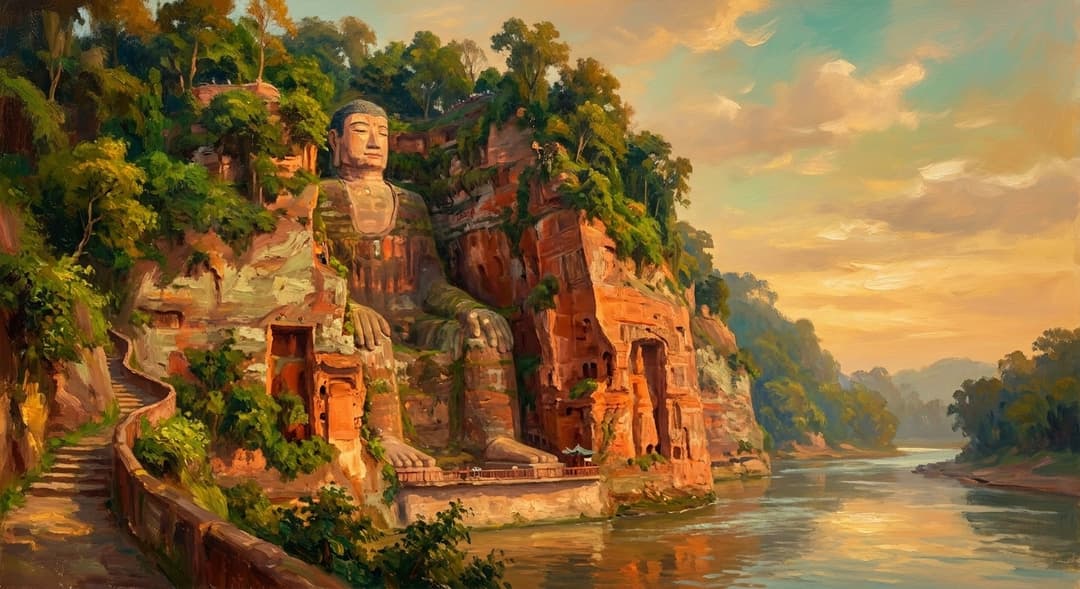
Visiting Mount Emei and the Leshan Giant Buddha offers an impressive journey through imperial cliff carvings and sacred high-mountain monasteries. Pilgrims can view the 71-meter seated Maitreya Buddha by foot or boat before ascending Mount Emei to witness the Golden Summit above the clouds.
Highlights
- The 71-meter Leshan Giant Buddha carved directly into red sandstone cliff face.
- The 48-meter multi-faced Golden Statue of Samantabhadra at Golden Summit.
- The 62-ton Northern Song Dynasty bronze Samantabhadra at Wannian Temple.
- Panoramas of the Sea of Clouds from the 3,077-meter peak.
Things to Know
- Expect long queues along the narrow Nine Bends Plank Road during peak seasons.
- Mountain weather changes rapidly, so carry layered waterproof clothing for higher elevations.
- Secure personal belongings near wild Tibetan macaque habitats along lower trails.
Location
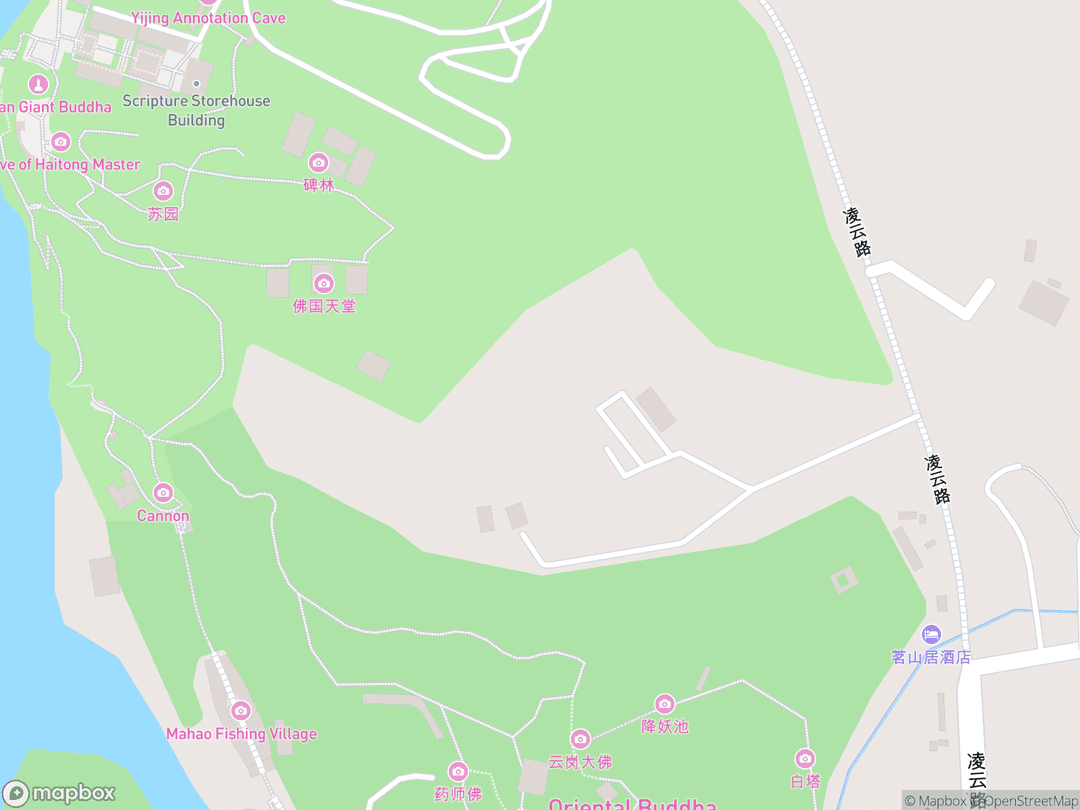
Leshan City and Emeishan City, Leshan Prefecture, Sichuan Province, China
Hours: Leshan Buddha: 07:30–18:30 (Apr–Oct), 08:00–17:30 (Nov–Mar). Mount Emei shuttles: 06:00–18:00 daily.
Getting There: High-speed rail connects Chengdu to Leshan (50 mins) and Emeishan (70 mins). Local eco-shuttles and cable cars transport visitors to high mountain complexes.
Get DirectionsTips for Your Visit
Beat the Queues at Leshan
Arrive before 08:30 at Lingyun Mountain to avoid two-hour wait times on the steep cliffside stairs.
River Perspective Boat View
Take a short river ferry tour from Leshan Port for a full panoramic view of the giant statue and Sleeping Buddha mountain profile.
Golden Summit Sunrise
Stay overnight at Leidongping or Jinding to experience the early morning Sea of Clouds and golden sunrise.
About
Mount Emei and the Leshan Giant Buddha together form one of Chinese Mahayana Buddhism's most revered sacred sanctuaries. Rooted in the foundational Dharmic tradition shared across ancient India and East Asia, this sacred mountain bodhimaṇḍa serves as an earthly realm for spiritual wisdom, ethical practice, and ultimate liberation from suffering.
Established in the 1st century CE, Mount Emei hosts China's earliest recorded Buddhist temple and is venerated as the consecrated abode of Bodhisattva Samantabhadra, guardian of moral virtue and boundless action. Nearby, the 71-meter Leshan Giant Buddha carved into Lingyun Mountain reflects Tang Dynasty devotion to Maitreya Buddha, transforming dangerous river currents into a haven of physical and spiritual protection.
Gallery
Symbolic Elements
The temple's exterior features intricate carvings, each rich with spiritual meaning:

Seated Maitreya Buddha
Depicted in the Bhadrāsana pose with hands on knees to symbolize future hope, compassion, and spiritual peace.

Bodhisattva Samantabhadra
Represents boundless practice and ethical action through the execution of spiritual vows.

Six-Tusked White Elephant
The sacred mount of Samantabhadra symbolizing the six perfections of Generosity, Discipline, Patience, Diligence, Meditation, and Wisdom.

Ten-Directional Heads
Crown feature of the 48-meter Golden Statue representing Samantabhadra's ability to observe and liberate beings across all spatial directions.
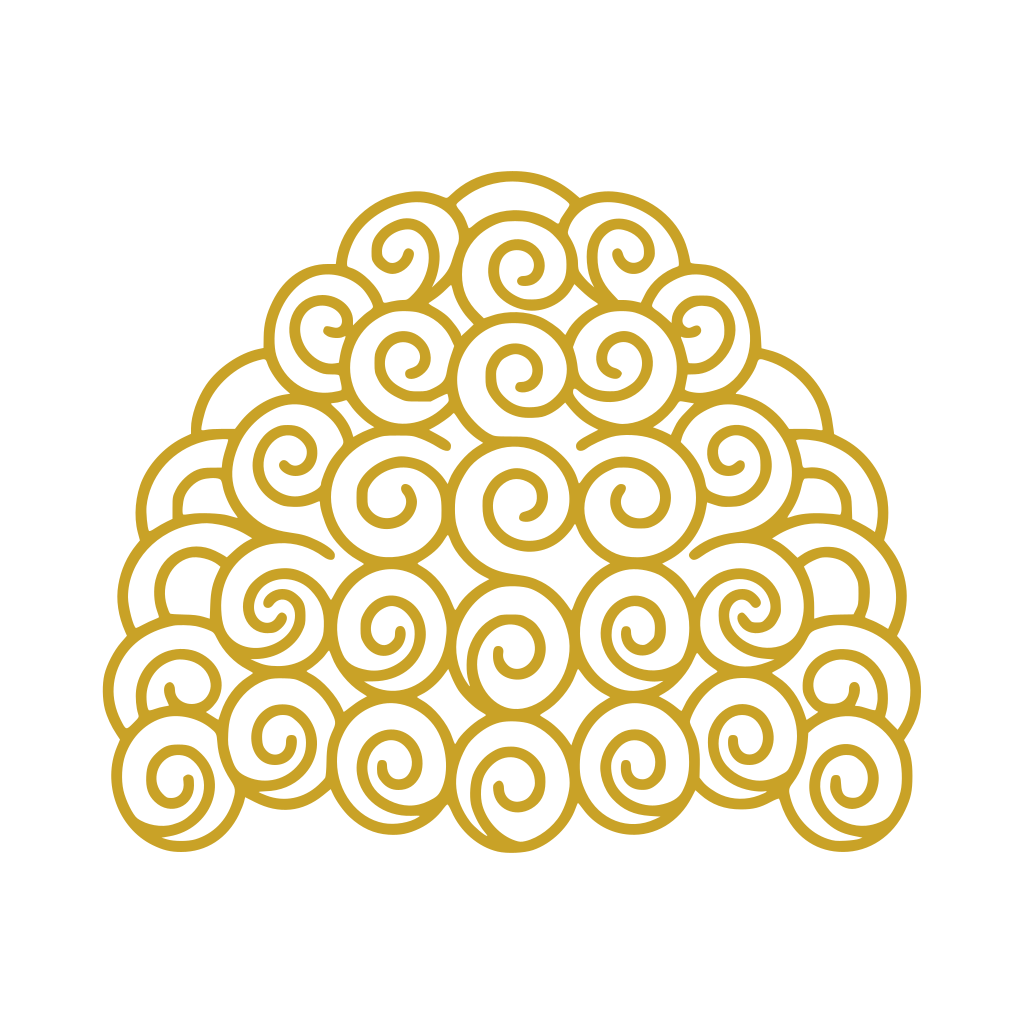
1,021 Stone Hair Coils
Individual coiled hair buns carved into the Leshan Buddha's head marking supreme enlightenment and wisdom.

Internal Drainage Channels
Concealed moisture channels behind the ears and within clothing folds that protect the sandstone core from water damage.

River Confluence Sanctuary
The carving's strategic position at the junction of three rivers transforming a site of navigational hazard into a realm of spiritual refuge.

Beamless Brick Hall
A Ming Dynasty masonry dome built without wooden supports to symbolize structural purity and fireproof endurance.
Interesting Facts
Carving debris dumped into the river changed the underwater topography and successfully calmed dangerous boat-sinking currents. (Tier A)
Monk Hai Tong gouged out his own eye to prevent greedy local government officials from seizing sacred construction funds. (Tier A)
Structural conservation studies proved the Buddha's seven-meter ears are made of wooden frames covered in clay rather than solid stone. (Tier B)
Primary steles erected by Governor Wei Gao in 803 CE confirm the statue's exact 90-year construction timeline. (Tier B)
The surrounding mountain ridgeline naturally forms the silhouette of a sleeping Buddha when viewed from the river. (Tier A)
Workers inside a chest cavity discovered a Song Dynasty stele recording historic repairs to a long-lost 13-story protective pavilion. (Tier B)
Mount Emei established China's first Buddhist temple in the first century CE during the Eastern Han Dynasty. (Tier B)
Wannian Temple's 62-ton bronze Samantabhadra was cast in separate sections in 980 CE and assembled without cranes. (Tier A)
Tibetan macaque monkeys inhabiting Mount Emei's trails are revered in local tradition as spiritual guardians of the sacred mountain paths. (Tier C)
Diffraction of sunlight through mountain mist frequently projects a rainbow halo around visitors' shadows known as Buddha's Light. (Tier B)
Common Questions
Why was the Leshan Giant Buddha carved out of the cliff?
Monk Hai Tong initiated the carving in 713 CE to calm treacherous river currents that sank trade vessels at the three-river confluence.
Which Bodhisattva is associated with Mount Emei?
Mount Emei is the sacred bodhimaṇḍa of Bodhisattva Samantabhadra, who represents action, virtue, and moral practice in Mahayana Buddhism.
How tall is the Leshan Giant Buddha?
The seated statue measures 71 meters (233 feet) in total height, making it the largest pre-modern stone Buddha sculpture in the world.
What prevents the Leshan Giant Buddha from eroding in heavy rains?
A hidden internal drainage network carved inside the head, hair coils, and clothes channels rainwater away from the sandstone core.
Featured Stories
The Sacrifice of Monk Hai Tong
713 CE
In 713 CE, Monk Hai Tong initiated the carving of the Leshan Giant Buddha to protect local boatmen from treacherous river currents. When corrupt government officials attempted to extort the project's raised funds, Hai Tong gouged out his own eye to demonstrate that while they could take his eye, they could not touch the sacred donations. Terrified by his unshakeable devotion, the officials fled, allowing construction to proceed without further interference.
Source: Historical Records of the Tang Dynasty & Wei Gao Stele (803 CE)
The 62-Ton Bronze Masterpiece
980 CE
In 980 CE, Emperor Taizu of the Northern Song Dynasty commissioned a colossal bronze statue of Bodhisattva Samantabhadra seated atop a six-tusked white elephant for Wannian Temple. Artisans cast the 62-ton monument in thousands of separate bronze pieces, transporting them up Mount Emei's steep slopes before assembling them with seamless precision. In 1601 CE, Ming Dynasty engineers built the Beamless Brick Hall around the statue to safeguard it permanently against fire and weathering.
Source: Mount Emei Monastic Chronicles & Wannian Temple Inscriptions
Engineering the Hidden Drainage Network
803 CE
When Governor Wei Gao finalized the Leshan Giant Buddha in 803 CE, master builders integrated an invisible hydraulic drainage network directly into the sculpture's anatomy. Hidden channels carved behind the ears, across hair coils, and inside clothing folds drain rainwater and subterranean seepage away from the fragile red sandstone interior. This ancient engineering feat has preserved the giant statue's structural integrity through twelve centuries of intense seasonal rains.
Source: UNESCO Technical Conservation Dossier & Tang Dynasty Architectural Studies
Timeline
First Buddhist Shrine Established
Guangxiang Temple is founded near Mount Emei's summit, creating China's earliest documented Buddhist place of worship.
MilestoneTransition to Bodhisattva Sanctuary
Wannian Temple is established during the Jin Dynasty, cementing Mount Emei as the sacred bodhimaṇḍa of Samantabhadra.
EventConstruction of Qingyin Pavilion
Sui Dynasty architects initiate the Qingyin Pavilion garden complex on the middle slopes of Mount Emei.
EventLeshan Buddha Construction Begins
Monk Hai Tong commences carving the 71-meter Leshan Giant Buddha to calm turbulent river currents.
component.timeline.groundbreakingConstruction Interruption
Carving halts following the death of Monk Hai Tong and disputes over project funding.
EventWork Resumes Under Wei Gao
Military Governor Wei Gao secures imperial support and funding to complete the colossal statue.
RenovationLeshan Giant Buddha Dedicated
Carving finishes after 90 years, accompanied by the erection of a protective 13-story wooden shelter.
DedicationCasting of Bronze Samantabhadra
Song Dynasty artisans cast a monumental 62-ton bronze statue of Samantabhadra riding a six-tusked elephant.
EventWannian Beamless Hall Constructed
Ming Dynasty builders construct a masonry dome hall without wooden beams to protect the 62-ton bronze statue.
EventUNESCO World Heritage Inscription
Mount Emei and Leshan Giant Buddha are jointly recognized as a UNESCO World Cultural and Natural Heritage site.
MilestoneGolden Samantabhadra Consecrated
A 48-meter golden multi-faced statue of Samantabhadra is dedicated at Mount Emei's Golden Summit.
DedicationComprehensive Restoration Completed
Engineers complete a major structural stabilization and internal drainage restoration project on the Giant Buddha.
RenovationHistory by Decade
1st–4th Century CE — Foundation of Chinese Mahayana Sanctuary
During the Eastern Han Dynasty, Mount Emei became the site of China's first recorded Buddhist temple, Guangxiang Temple. By the 4th century Jin Dynasty, the mountain transitioned from a Daoist hermitage into a major Mahayana sanctuary dedicated to Bodhisattva Samantabhadra.
8th Century CE — Carving the Leshan Giant Buddha
In 713 CE, Monk Hai Tong began carving the 71-meter seated Maitreya Buddha into Lingyun Mountain's sandstone cliff to calm deadly river currents. Despite financial disruptions and Hai Tong's death, Military Governor Wei Gao revived and completed the project in 803 CE.
10th–17th Century CE — Imperial Patronage & Architectural Expansion
During the Northern Song Dynasty in 980 CE, Emperor Taizu commissioned the 62-ton bronze Samantabhadra statue at Wannian Temple. Ming Dynasty emperors expanded Mount Emei's monastic footprint, constructing Baoguo Temple, Fuhu Temple, and the brick Beamless Hall.
20th Century — Preservation & UNESCO World Heritage Inscription
Following decades of wartime disruption, Chinese conservation teams instituted comprehensive surveys of Mount Emei's timber temples and the Leshan cliff face. In 1996, UNESCO designated the combined region as a World Cultural and Natural Heritage site.
21st Century — Modern Restoration & Golden Summit Consecration
In 2006, religious authorities consecrated the multi-faced 48-meter Golden Statue of Samantabhadra atop Mount Emei's Golden Summit. State engineers completed extensive bio-cleaning and structural drainage restoration on the Leshan Giant Buddha in 2020.
Architecture & Facilities
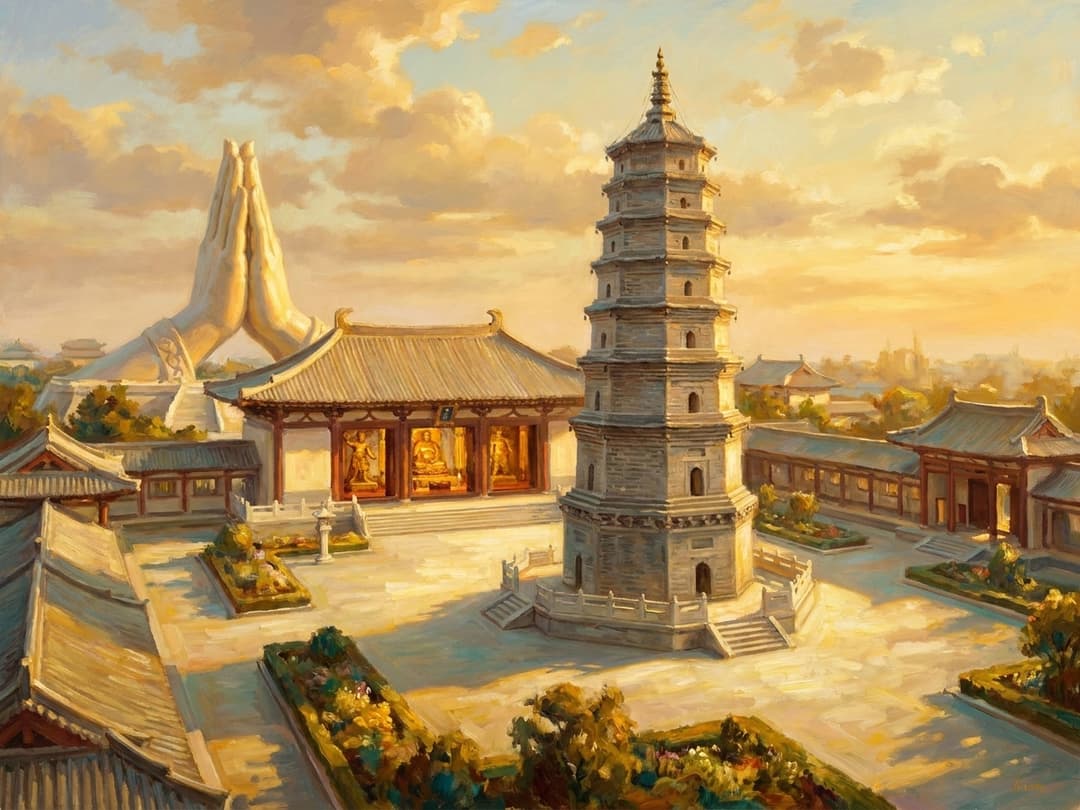
A synthesis of Tang Dynasty cliffside rock-cut art and classical Chinese mountain timber-frame temple architecture harmonized with steep alpine landforms.
Building Materials
Red Sandstone
Native Cretaceous Danxia red sandstone carved directly to form the main body of the Leshan Giant Buddha.
Clay and Wood Composite
Internal wooden frames coated in mud mortar used to construct the seven-meter-long ears of the Leshan Buddha.
Bronze and Gold Leaf
Cast bronze plated with pure gold leaf forming the 48-meter multi-faced Samantabhadra statue on Mount Emei.
Brick Masonry
Solid brick layout assembled without wooden beams forming the fireproof dome hall at Wannian Temple.
Interior Features
Wannian Beamless Hall
A vaulted brick masonry interior housing the 62-ton bronze Samantabhadra statue cast in 980 CE.
Huazang Temple Main Hall
A summit shrine containing golden altars and sacred Mahayana scripture repositories.
Golden Summit Pavilion
A high-altitude sanctuary housing triple metal halls crafted from bronze, silver, and gold materials.
Lingyun Temple Halls
A Cliffside monastery housing traditional Buddha images overlooking the head of the Leshan Giant Buddha.
Temple Grounds
Spanning 154 square kilometers across Mount Emei's alpine forests and Lingyun Mountain's river cliffs, featuring stone pilgrim stairways, ancient timber courtyards, and natural biological reserves.
Additional Facilities
Visitor centers at Baoguo Temple and Leshan, eco-shuttle transportation hubs, mountain cable car lines, pilgrim lodges, and environmental research stations.
Religious Significance
In Chinese Mahayana Buddhism, sacred places function as physical bodhimaṇḍas—earthly seats where enlightenment and wisdom materialize to assist sentient beings.
Mount Emei serves as the earthly realm of Bodhisattva Samantabhadra, guiding pilgrims to transform moral vows into active compassion and practical spiritual practice.
Sacred Ordinances
Circumambulation (Kora)
Pilgrims walk clockwise around the Golden Summit statue and the Leshan Giant Buddha to generate spiritual merit and mental focus.
Vow Recitation
Devotees chant the Ten Great Vows of Samantabhadra to reinforce ethical discipline, generosity, and commitment to liberating all beings.
Incense Offerings
Worshippers offer incense at mountain temple altars to symbolize purification of the mind and devotion to the Triple Gem.
Maitreya Devotion and River Protection
Carving Maitreya Buddha at the turbulent river confluence expressed Tang Dynasty Mahayana faith in the Future Buddha's power to calm physical dangers and provide spiritual refuge.
The Six Paramitas and the White Elephant
Samantabhadra's six-tusked elephant mount symbolizes the Six Perfections required for Buddhahood: generosity, ethics, patience, diligence, meditation, and wisdom.
Similar Temples
Sources & Research
Every fact on Temples.org is backed by verified Sources & Research. Each piece of information is rated by source tier and confidence level.
View All Sources (5)
| Field | Source | Tier | Retrieved |
|---|---|---|---|
| About & Historical Background | UNESCO World Heritage Centre (opens in a new tab) | B | 2026-02-22 |
| About & Historical Background | Encyclopaedia Britannica (opens in a new tab) | B | 2026-02-22 |
| Architecture & Engineering | UNESCO World Heritage Centre Nomination Documentation (opens in a new tab) | B | 2026-02-22 |
| Religious Significance & Symbolism | The Metropolitan Museum of Art (opens in a new tab) | B | 2026-02-22 |
| Timeline & Construction History | Encyclopaedia Britannica (opens in a new tab) | B | 2026-02-22 |