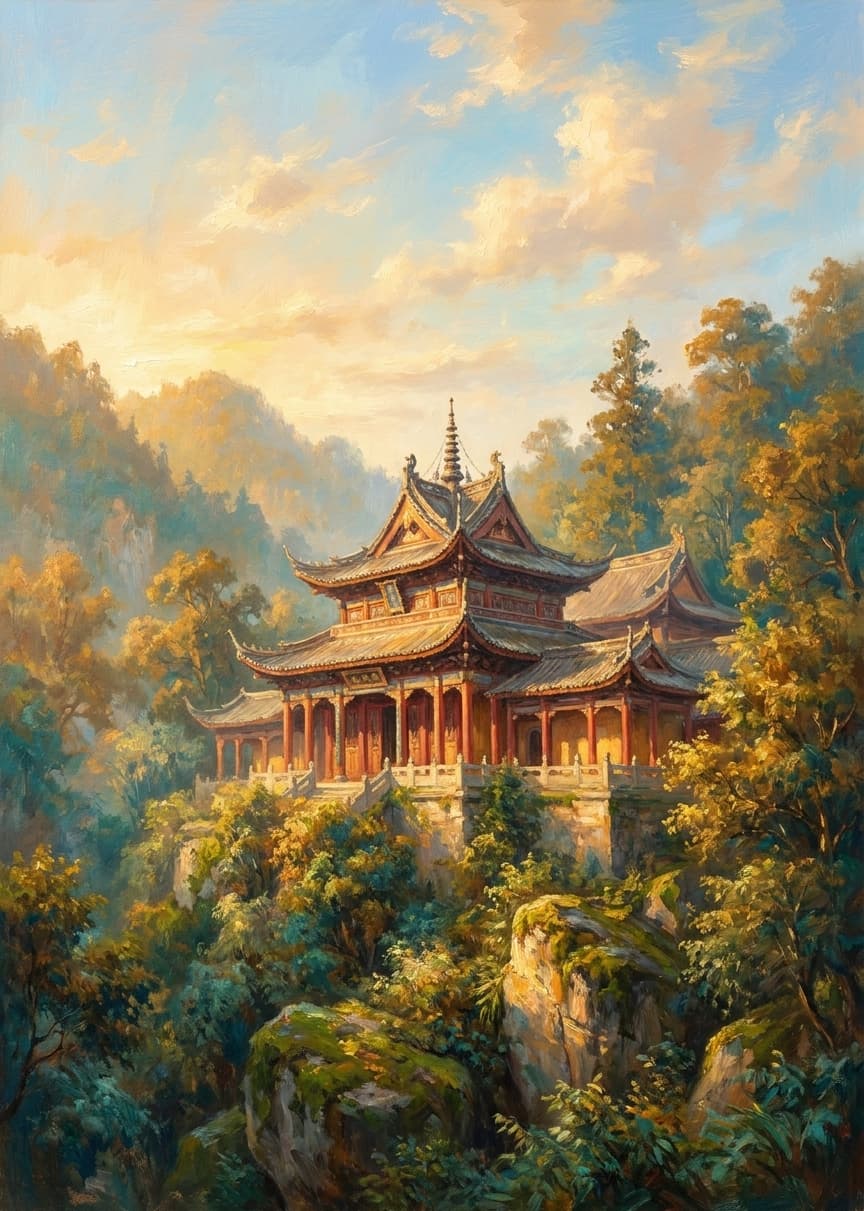
Visitor Insights
Visiting Mount Qingcheng
Visiting Mount Qingcheng provides a serene and spiritual experience, immersing visitors in the heart of Taoist culture. The mountain's tranquil atmosphere, lush greenery, and historic temples offer a unique glimpse into Taoist traditions. Visitors should expect to walk and climb, exploring the various palaces and enjoying the natural beauty.
Highlights
- Explore Jianfu Palace with its intricate architecture and long couplet.
- Visit Shangqing Palace near the summit for panoramic views and Taoist inscriptions.
- Discover Tianshi Cave, where Zhang Daoling founded the Way of the Celestial Masters.
Things to Know
- Wear comfortable shoes suitable for walking and climbing.
- Bring rain gear, as the mountain is subject to frequent rain and fog.
- Visit early to avoid crowds, especially during peak seasons.
Location

No. 168 Qingchengshan Road, Dujiangyan City, Chengdu, Sichuan, China
Hours: 08:30-17:00
Getting There: Take a high-speed train from Chengdu to Qingchengshan Railway Station, followed by a sightseeing bus, or a direct bus from Chengdu's Chadianzi Bus Station.
Get DirectionsAbout
Mount Qingcheng, located in Dujiangyan, Chengdu, Sichuan, China, is a revered mountain in Taoism, holding immense cultural and religious significance. As one of the birthplaces of Taoism, it is often referred to as "the most secluded place under heaven" due to its tranquil environment and lush scenery. The mountain, with its numerous Taoist temples and monasteries, offers a unique blend of natural beauty and spiritual heritage.
Mount Qingcheng is a central place in the development of Taoism, particularly important within the Taoic traditions. In 142 AD, Zhang Daoling, the first Celestial Master, established the Way of the Five Pecks of Rice, a significant movement in Taoism, on Mount Qingcheng. This event solidified the mountain's role as a central place in the development of Taoism.
The architecture on Mount Qingcheng reflects the traditional styles of western Sichuan, harmoniously blending with the natural environment. The temples and palaces are constructed primarily of wood and integrated with the surrounding rocks and forests, embodying the Taoist principle of "Tao follows nature". Mount Qingcheng, along with the Dujiangyan Irrigation System, was listed as a UNESCO World Heritage Site in 2000.
Gallery
Symbolic Elements
The temple's exterior features intricate carvings, each rich with spiritual meaning:

Tao
The Tao represents the natural order of the universe, central to Taoism. On Mount Qingcheng, it is reflected in the harmonious integration of architecture and nature, embodying the principle of living in accordance with the natural world.

The Three Treasures
The Three Treasures (道, 经, 师) represent the core tenets of Taoism: compassion, moderation, and humility. These are often symbolized by three incense sticks lit during rituals, signifying reverence and adherence to Taoist principles.

Yin and Yang
The balance of Yin and Yang, opposing yet complementary forces, is a key concept in Taoism. On Mount Qingcheng, this is reflected in the mountain's blend of tranquility and activity, as well as in the architectural designs of the temples, symbolizing harmony and equilibrium.
Laozi
Laozi, the founder of Taoism and author of the Tao Te Ching, is a central figure in Taoist philosophy. His teachings and image are prominent on Mount Qingcheng, particularly in the Laojun Pavilion, which houses a statue of Laozi, honoring his wisdom and influence.

Zhang Daoling
Zhang Daoling, the founder of the Way of the Celestial Masters, is honored in temples such as Tianshi Cave, where he is said to have meditated and taught. His establishment of organized Taoism on Mount Qingcheng marks the mountain as a pivotal site in Taoist history.
Jianfu Palace Couplet
The 394-character couplet at Jianfu Palace is one of the longest in China, reflecting the depth and complexity of Taoist philosophy. Its presence signifies the importance of literary and philosophical expression within Taoist tradition, encapsulating core beliefs and values.
Red Lanterns
The red lanterns hung throughout Jianfu Palace symbolize vitality, good fortune, and the dispelling of darkness. Their vibrant color contrasts with the surrounding greenery, creating a visual representation of the balance between Yin and Yang, and adding to the palace's spiritual ambiance.

Calligraphy
Inscriptions carved into the cliffs at Shangqing Palace, including the characters 'Shangqing Palace' by Chiang Kai-shek, represent the enduring legacy of Taoism and its integration with Chinese history and culture. These inscriptions serve as a testament to the mountain's continued importance as a spiritual and cultural center.
Interesting Facts
Mount Qingcheng is divided into the Front Mountain (Qianshan) and the Back Mountain (Houshan).
The name 'Qingcheng' means 'green city,' referring to the mountain's lush vegetation.
Mount Qingcheng is considered the 'Fifth Celestial Cave' in Taoist tradition.
The mountain has 36 peaks, with the main peak, Laoxiao Summit, reaching 1,260 meters.
Zhang Daoling founded Taoism on Mount Qingcheng in 142 AD.
The mountain is home to numerous Taoist temples, including Jianfu Palace and Shangqing Palace.
Mount Qingcheng is known as 'the most secluded place under heaven'.
The mountain was listed as a UNESCO World Heritage Site in 2000.
Mount Qingcheng is associated with the Yellow Emperor.
The vibrant scenery inspired the Panda Village in 'Kung Fu Panda 3'.
Common Questions
What is Mount Qingcheng known for?
Mount Qingcheng is known as one of the birthplaces of Taoism and is revered as 'the most secluded place under heaven' due to its tranquil environment and lush scenery. It is also a UNESCO World Heritage Site.
Who founded Taoism on Mount Qingcheng?
Zhang Daoling, the first Celestial Master, founded Taoism on Mount Qingcheng in 142 AD, establishing the Way of the Five Pecks of Rice.
What are the main attractions on Mount Qingcheng?
The main attractions include Jianfu Palace, Shangqing Palace, Tianshi Cave, and Laojun Pavilion, each showcasing unique architectural and religious significance.
When is the best time to visit Mount Qingcheng?
The best time to visit Mount Qingcheng is all year round, with summer being a popular time to escape the heat. However, it's advisable to visit early to avoid crowds.
What should I wear when visiting Mount Qingcheng?
Wear comfortable shoes suitable for walking and climbing. It's also recommended to bring rain gear, as the mountain is subject to frequent rain and fog.
Featured Stories
Zhang Daoling's Founding of Taoism
142 AD
In 142 AD, Zhang Daoling, a visionary seeker of spiritual truth, arrived at Mount Qingcheng. Drawn to its serene beauty and natural harmony, he recognized it as an ideal place to cultivate and propagate his teachings. Here, he established the Way of the Celestial Masters, a pivotal moment in the history of Taoism.
Zhang Daoling's teachings emphasized direct experience of the Tao, the natural order of the universe, and the importance of living in harmony with nature. His movement attracted followers from all walks of life, who sought spiritual guidance and a deeper connection to the world around them. Mount Qingcheng became a center of learning and practice, where Taoist principles were studied, rituals were performed, and the seeds of a new spiritual tradition were sown.
Source: East China Trip
The Construction of Jianfu Palace
730 AD
During the Tang Dynasty, the construction of Jianfu Palace marked a significant expansion of Taoist presence on Mount Qingcheng. The palace was designed to blend seamlessly with the natural landscape, embodying the Taoist principle of living in harmony with nature. Its architecture reflected the traditional styles of western Sichuan, with wooden structures integrated into the surrounding rocks and forests.
Jianfu Palace became a center of Taoist learning and practice, attracting scholars, monks, and pilgrims from across China. Its halls were adorned with intricate carvings, vibrant paintings, and philosophical inscriptions, creating a space that inspired contemplation and spiritual growth. The palace's serene atmosphere and stunning natural setting made it a beloved destination for those seeking solace and enlightenment.
Source: Longhu Mountain
Mount Qingcheng's UNESCO Recognition
2000
In 2000, Mount Qingcheng, along with the Dujiangyan Irrigation System, was inscribed on the UNESCO World Heritage List. This recognition celebrated the mountain's unique cultural and natural significance, acknowledging its role as a birthplace of Taoism and a testament to the harmonious relationship between humans and the environment.
The UNESCO designation brought renewed attention to Mount Qingcheng, attracting visitors from around the world who came to experience its spiritual atmosphere and natural beauty. Preservation efforts were intensified to protect the mountain's cultural heritage and ecological integrity, ensuring that future generations could continue to appreciate its unique value. Mount Qingcheng stands as a symbol of the enduring power of Taoism and the importance of preserving sacred places for the benefit of all humanity.
Source: UNESCO
Timeline
Zhang Daoling Establishes Taoism
Zhang Daoling, the first Celestial Master, established the Way of the Five Pecks of Rice on Mount Qingcheng, marking it as a central place in Taoism's development.
MilestoneConstruction of Tianshi Cave
Tianshi Cave (Celestial Master Cave) was built during the Sui Dynasty, further solidifying the mountain's religious importance.
MilestoneFirst Construction of Jianfu Palace
Jianfu Palace was first built during the Tang Dynasty, adding to the mountain's architectural heritage.
MilestoneConstruction of Shangqing Palace
The current buildings of Shangqing Palace were constructed during the Qing Dynasty, showcasing traditional Sichuan architecture.
MilestoneRepair of Jianfu Palace
Jianfu Palace was repaired during the Qing Dynasty, preserving its historical and cultural significance.
RenovationRebuilding of Laojun Pavilion
Laojun Pavilion was rebuilt in the late 1980s, restoring a key landmark on the mountain.
RenovationUNESCO World Heritage Listing
Mount Qingcheng, along with the Dujiangyan Irrigation System, was listed as a UNESCO World Heritage Site, recognizing its global importance.
MilestoneWenchuan Earthquake Damage
The Wenchuan Earthquake damaged parts of Mount Qingcheng, including Laojun Pavilion, leading to subsequent rebuilding efforts.
EventFounding of Taoism
Zhang Daoling founded Taoism on Mount Qingcheng, establishing the Way of the Celestial Masters.
MilestoneTianshi Cave Construction
The Tianshi Cave, also known as the Celestial Master Cave, was constructed during the Sui Dynasty.
MilestoneJianfu Palace Construction
The Jianfu Palace was first constructed during the Tang Dynasty, showcasing traditional Chinese architecture.
MilestoneShangqing Palace Construction
The current buildings of Shangqing Palace were constructed during the Qing Dynasty.
MilestoneJianfu Palace Repair
The Jianfu Palace was repaired during the Qing Dynasty, preserving its historical significance.
RenovationLaojun Pavilion Rebuilding
The Laojun Pavilion was rebuilt in the late 1980s, restoring a key landmark.
RenovationUNESCO Listing
Mount Qingcheng was listed as a UNESCO World Heritage Site, recognizing its global importance.
MilestoneReligious Significance
Mount Qingcheng holds profound religious significance as one of the birthplaces of Taoism, particularly within the Taoic traditions. Its serene environment and lush scenery have made it a revered site for spiritual practice and contemplation for centuries.
The core spiritual purpose of Mount Qingcheng is to provide a place for individuals to connect with the Tao, the natural order of the universe, and to cultivate inner harmony through meditation, ritual, and living in accordance with Taoist principles.
Sacred Ordinances
Meditation
Meditation is a central practice on Mount Qingcheng, allowing individuals to quiet the mind, cultivate inner peace, and connect with the Tao. Practitioners often meditate in caves, temples, or natural settings, seeking to achieve a state of oneness with the universe.
Ritual
Taoist rituals are performed on Mount Qingcheng to honor deities, purify the environment, and promote harmony. These rituals often involve chanting, music, dance, and offerings, creating a sacred atmosphere that fosters spiritual connection.
Living in Harmony with Nature
Living in harmony with nature is a fundamental principle of Taoism, and Mount Qingcheng provides an ideal setting for practicing this principle. Visitors and residents alike are encouraged to respect the environment, minimize their impact, and appreciate the beauty and interconnectedness of all things.
The Way of the Celestial Masters
The establishment of the Way of the Celestial Masters by Zhang Daoling on Mount Qingcheng marked a pivotal moment in the history of Taoism. This movement emphasized direct experience of the Tao, the importance of ethical conduct, and the practice of healing and exorcism. The Way of the Celestial Masters laid the foundation for many subsequent Taoist traditions.
The Integration of Architecture and Nature
The architecture on Mount Qingcheng reflects the Taoist principle of living in harmony with nature. Temples and palaces are constructed primarily of wood and integrated with the surrounding rocks and forests, creating a seamless blend of human creation and natural beauty. This integration symbolizes the interconnectedness of all things and the importance of respecting the environment.
Similar Temples
Sources & Research
Every fact on Temples.org is backed by verified Sources & Research. Each piece of information is rated by source tier and confidence level.
View All Sources (10)
| Field | Source | Tier | Retrieved |
|---|---|---|---|
| About & Historical Background | East China Trip (opens in a new tab) | A | 2024-01-04 |
| About & Historical Background | Longhu Mountain (opens in a new tab) | A | 2024-01-04 |
| About & Historical Background | UNESCO (opens in a new tab) | B | 2024-01-04 |
| Architectural Description | China Expedition Tours (opens in a new tab) | D | 2024-01-04 |
| Visitor Information | Travel Chengdu (opens in a new tab) | D | 2024-01-04 |
| Interesting Facts | The China Guide (opens in a new tab) | D | 2024-01-04 |
| Historical Timeline | Travel China Guide (opens in a new tab) | D | 2024-01-04 |
| Symbolic Elements | Incenzo (opens in a new tab) | D | 2024-01-04 |
| About & Historical Background | Yes CN Tour (opens in a new tab) | D | 2024-01-04 |
| About & Historical Background | China West Trip (opens in a new tab) | D | 2024-01-04 |