Visitor Insights
Visiting Pramukh Swami Maharaj Smruti Mandir
Visitors to Sarangpur experience a tranquil atmosphere centered around white marble architecture and spiritual devotion. The sacred sanctuary welcomes pilgrims daily for darshan, silent reflection, and morning or evening arti rituals.
Highlights
- Viewing the preserved cremation ground soil encased in glass beneath the sanctum
- Intricate narrative relief friezes detailing Pramukh Swami Maharaj's world travel and humanitarian work
- Attending the daily morning or evening arti ceremonies accompanied by devotional chanting
Things to Know
- Modest attire covering shoulders and knees is mandatory for entry
- Footwear must be deposited at the complimentary counter on the perimeter before walking on the marble plinth
Tips for Your Visit
Arrive for Morning Arti
Attending the early morning arti provides a peaceful devotional environment with fewer crowds.
Explore the Larger Campus
Take time to visit the neighboring 1916 historic shikharbaddha mandir and Shastriji Maharaj's memorial.
About
Across the broader Hindu Dharmic tradition, spiritual teachers are revered as living conduits of divine grace who guide souls toward liberation. Sites associated with the final rites or physical departure of enlightened teachers are consecrated as sacred samadhi or smruti mandirs, where devotees gather for darshan and prayer.
Within the Swaminarayan tradition, Pramukh Swami Maharaj (1921–2016) is honored as the fifth spiritual successor in the gunatit guru lineage. During his 45 years as spiritual head of BAPS, he traveled globally and inspired the creation of over 1,100 traditional Hindu mandirs, including the Akshardham complexes in Gandhinagar and New Delhi.
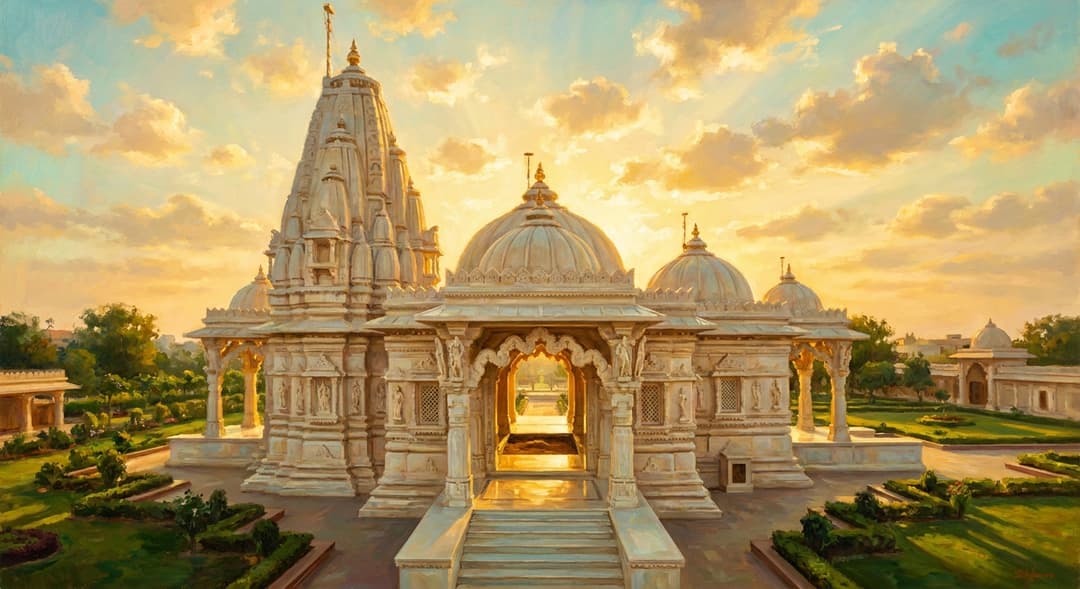
Consecrated on January 26, 2023, by Mahant Swami Maharaj, the Pramukh Swami Maharaj Smruti Mandir stands directly above Swamishri's preserved cremation site. Built from hand-carved white Makrana marble, this 63-foot-tall sanctuary serves as an active place of pilgrimage and meditation.
Interesting Facts
The temple is constructed directly over the exact cremation ground where Swamishri's final rites were performed in 2016. (Tier A)
Pramukh Swami Maharaj personally chose this location years prior so his memorial would face his guru's shrine. (Tier A)
All 7,839 stone components were carved from Rajasthan's white Makrana marble, the same source used for the Taj Mahal. (Tier A)
Over two million devotees traveled to Sarangpur within four days following Swamishri's passing in August 2016. (Tier A)
A glass floor casing inside the sanctum allows pilgrims to view the preserved unpaved soil of the cremation site. (Tier A)
Exterior wall friezes depict modern 21st-century historic events rather than strictly ancient mythological scenes. (Tier A)
The architecture relies entirely on mortarless interlocking stone joints without embedded steel rebar. (Tier A)
The Sarangpur campus serves as the main training monastery (Sadhu Talim Kendra) for BAPS monks. (Tier A)
Common Questions
What is the primary spiritual significance of this mandir?
It stands over the exact cremation site of Pramukh Swami Maharaj, housing consecrated murtis and preserved sacred earth.
Is there an entry fee to visit the Smruti Mandir?
No, admission is completely free and open to visitors of all backgrounds and faiths.
What material was used to build the memorial?
The entire 63-foot-tall structure was constructed from 7,839 pure white Makrana marble blocks from Rajasthan.
Where is the temple located?
It is located within the BAPS Swaminarayan Mandir campus in Sarangpur, Botad District, Gujarat.
Featured Stories
Selecting the Sacred Ground
August 2016
Years prior to his passing, Pramukh Swami Maharaj personally designated the exact plot of land where his final rites were to take place. He requested this location so his memorial would forever remain in direct view of the main Sarangpur Mandir and Shastriji Maharaj's shrine. This deliberate choice highlighted his lifelong devotion to his spiritual guru.
Source: BAPS Swaminarayan Sanstha Official Records
Crafting the White Marble Masterpiece
2018–2023
Artisans in Rajasthan hand-carved 7,839 blocks of pure Makrana marble to construct the 63-foot-tall sanctuary. Master builders utilized ancient interlocking masonry techniques without embedding structural steel rebar to ensure long-lasting stability. Despite global construction challenges, the monument was completed within four years.
Source: BAPS Design Studio Architecture Dossier
Consecration by Mahant Swami Maharaj
January 26, 2023
On Republic Day in 2023, Mahant Swami Maharaj presided over the Vedic Murti-Pratishtha ceremony in Sarangpur. Thousands of devotees gathered as sacred mantras were recited to consecrate the marble murtis above the memorial site. The inauguration transformed the cremation ground into an active, permanent sanctuary for spiritual seekers.
Source: BAPS Newsroom Consecration Report
Timeline
Sarangpur Mandir Founded
Shastriji Maharaj establishes the historic BAPS Shri Swaminarayan Mandir in Sarangpur.
MilestoneBirth of Pramukh Swami Maharaj
Shantilal Patel (later Pramukh Swami Maharaj) is born in Chansad, Gujarat.
MilestonePassing of Shastriji Maharaj
Shastriji Maharaj passes away in Sarangpur, leading to the creation of the Yagnapurush Smruti Mandir.
MilestoneSpiritual Succession
Pramukh Swami Maharaj becomes the spiritual head of BAPS Swaminarayan Sanstha.
MilestonePassing of Swamishri
Pramukh Swami Maharaj passes away at age 94 in Sarangpur, Gujarat.
MilestoneSacred Cremation Rites
Pramukh Swami Maharaj is cremated at the specific location he personally selected across from the main temple.
EventFoundation Ceremony
Mahant Swami Maharaj performs the Shilanyas foundation stone-laying ceremony for the memorial sanctuary.
component.timeline.groundbreakingDoorway Framework Ceremony
The Dwarshakh Pujan ceremony marks advanced progress in the stone assembly.
MilestonePillar Installation
The initial pillar installation (Pratham Stambh Sthapan Vidhi) establishes the marble interior framework.
MilestoneTemple Consecration
Mahant Swami Maharaj consecrates the Pramukh Swami Maharaj Smruti Mandir during the Murti-Pratishtha ceremony.
DedicationArchitecture & Facilities
The Pramukh Swami Maharaj Smruti Mandir is designed in the classical Naagar style of Indian temple architecture merged with regional Maru-Gurjara stylistic elements. Constructed entirely from pure white Makrana marble on a 140-foot square footprint, the 63-foot sanctuary features intricate interlocking stone joints without structural steel.
Building Materials
Exterior Structure
Carved from white Makrana marble known for its luminous quality and weather durability.
Structural Interlocks
Utilizes ancient mortarless stone joinery without internal metal reinforcement.
Sanctum Floor Casing
Features a transparent glass floor aperture preserving the original unpaved soil.
Wall Narrative Friezes
Intricately carved marble panels depict 21st-century historic events and spiritual journeys.
Interior Features
Garbhagriha (Sanctum Sanctorum)
Houses consecrated murtis of Bhagwan Swaminarayan, Gunatitanand Swami, and Pramukh Swami Maharaj.
Central Ghummat (Dome)
Intricately carved marble ceiling adorned with lotus rosettes and celestial motifs.
Preserved Cremation Soil Reliquary
A floor opening encased in glass allowing devotees to view the sacred cremation site below.
Carved Marble Pillars
Supports roof vaults with detailed relief carvings of sadhus and traditional symbols.
Temple Grounds
Situated within the expansive BAPS Sarangpur campus, surrounded by landscaped stone courtyards, tree-lined walkways, and immediate sightlines to historic mandir structures.
Additional Facilities
Includes visitor footwear counters, informational displays, drinking water stations, and adjacent pilgrim reception centers on the BAPS Sarangpur campus.
Religious Significance
Across the broader Hindu Dharmic heritage, spiritual teachers (gurus) are revered as living guides toward liberation, with their physical departure sites sanctified as samadhi mandirs. In the BAPS Swaminarayan tradition, Pramukh Swami Maharaj is venerated as the fifth spiritual successor in the gunatit guru lineage, making his cremation site a sacred sanctuary of divine presence.
To serve as a consecrated memorial shrine where devotees engage in darshan, pradakshina, and meditation while honoring the spiritual legacy of Pramukh Swami Maharaj.
Sacred Ordinances
Darshan
Sacred viewing of the consecrated murtis and the preserved cremation earth within the inner sanctum.
Pradakshina
Ritual circumambulation around the central shrine and floor reliquary as an act of veneration.
Arti
Daily worship ceremonies featuring light offerings, devotional music, and collective prayers.
Smaran
Quiet contemplative remembrance of the guru's spiritual teachings and virtues.
The Akshar-Purushottam Upasana
The theology of BAPS emphasizes that God is eternally present on earth through a continuous lineage of spiritual teachers, making the Smruti Mandir a vibrant center of ongoing spiritual realization.
Sanctification of Earth
The glass-encased soil beneath the central floor commemorates the physical final rites performed in 2016, transforming the ground into a permanent focal point of reverence.
Similar Temples

Sources & Research
Every fact on Temples.org is backed by verified Sources & Research. Each piece of information is rated by source tier and confidence level.
View All Sources (6)
| Field | Source | Tier | Retrieved |
|---|---|---|---|
| About & Historical Background | BAPS Swaminarayan Sanstha (opens in a new tab) | A | 2026-02-23 |
| About & Historical Background | BAPS Swaminarayan Sanstha (opens in a new tab) | A | 2026-02-23 |
| Architecture & Materials | BAPS Swaminarayan Sanstha (opens in a new tab) | A | 2026-02-23 |
| Timeline & Key Events | DeshGujarat (opens in a new tab) | C | 2026-02-23 |
| Religious Significance & Rites | BAPS Swaminarayan Sanstha (opens in a new tab) | A | 2026-02-23 |
| Visitor Insights & Access | BAPS Swaminarayan Sanstha (opens in a new tab) | A | 2026-02-23 |