
Visitor Insights
Visiting Pura Tanah Lot
Tanah Lot welcomes visitors to view its dramatic coastal setting while preserving its inner sanctum exclusively for Hindu worship. Guests can explore the tidal flats during low tide and observe sunset silhouettes of the iconic pagoda towers.
Highlights
- Witness the five-tiered Meru shrine silhouetted against glowing Indian Ocean sunsets.
- Cross the exposed coral shelf at low tide to receive blessings from the subterranean holy freshwater spring.
- View the nearby natural rock arch and sister sanctuary at Pura Batu Bolong.
- Observe traditional temple guardian serpents resting peacefully in coastal sea caves.
Things to Know
- Entry into the elevated inner courtyard (Utama Mandala) is strictly restricted to practicing Hindu devotees.
- High tide completely covers the sandy causeway, preventing foot access to the base of the rock.
- Modest dress including a Balinese sarong and waist sash is required when walking near the sacred rock.
- Slippery wet rocks along the reef require sturdy, slip-resistant footwear.
Location
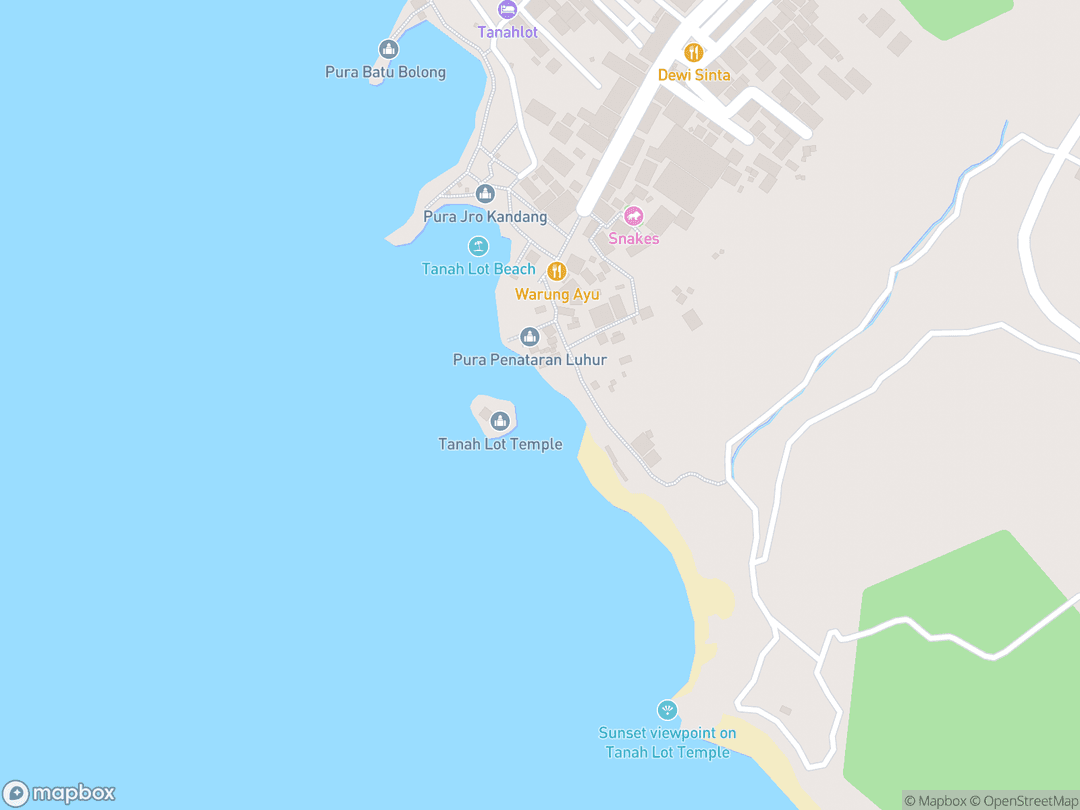
Desa Beraban, Kecamatan Kediri, Kabupaten Tabanan, Bali 82121, Indonesia
Hours: Daily from 06:00 to 19:00 WITA
Getting There: Located 20 kilometers northwest of Denpasar, accessible by taxi, private hire car, or scooter along Jalan Raya Tanah Lot.
Get DirectionsTips for Your Visit
Arrive for Morning Solitude
Visit at dawn between 06:00 and 08:00 for peaceful reflection before afternoon tour groups arrive.
Observe Ocean Safety
Stay well clear of sudden rogue swells along wet rocky ledges facing the open ocean.
Prepare Appropriate Attire
Wear or rent a traditional sarong and sash at the visitor entrance before approaching the tidal reef.
About
Pura Tanah Lot is an ancient Hindu sea temple dramatically situated on a rugged offshore rock formation along the southwestern coast of Bali. Founded in the sixteenth century by the Shaivite reformer Dang Hyang Nirartha, the sanctuary stands as one of the island's seven revered sea temples built to establish a protective spiritual perimeter against oceanic disorder.
Rooted within Balinese Agama Hindu Dharma and broader Dharmic traditions, the temple harmonizes cosmic forces across land and sea. Perched above crashing Indian Ocean tides, it embodies the theological principle of Rwa Bhineda—the essential balance between opposing dualities—transforming untamed marine energy into spiritual peace and island protection.
The rock outcrop on which the shrine stands has weathered severe maritime erosion across the centuries. A significant engineering restoration in the late twentieth century fortified the natural coral bedrock with disguised structural reinforcement, ensuring the sanctum endures as an active center of prayer, community pilgrimage, and deep cultural veneration.
Gallery
Symbolic Elements
The temple's exterior features intricate carvings, each rich with spiritual meaning:

Five-Tiered Meru Tower
The prominent five-roofed shrine represents cosmic levels and Mount Meru, honoring the sea deity Bhatara Segara.

Sacred Guardian Serpents
Black-and-white banded sea kraits inhabiting shoreline caves represent spiritual protectors guarding the sanctum.

Freshwater Ocean Spring
A subterranean spring bubbling through saltwater rock symbolizes divine life-giving nectar used for purification.

Poleng Checked Cloth
Woven black-and-white checked fabric draped over shrines reflects Rwa Bhineda, the cosmic balance of opposites.

Bedawang Nala Base
The carved cosmic turtle beneath the main throne represents the foundational tectonic anchor of the earth.

Candi Bentar Gateway
The mainland split stone portal symbolizes the division of the sacred mountain into complementary dualities.

Batu Bolong Promontory
A perforated natural stone arch nearby serves as a purifying coastal gateway for ceremonial processions.
Interesting Facts
A natural freshwater spring emerges directly from the saltwater reef at the base of the temple. (Tier A)
More than one-third of the visible rock foundation consists of disguised steel-reinforced concrete. (Tier B)
Venomous black-and-white banded sea kraits reside in base caves without a recorded strike on pilgrims. (Tier B)
The temple is an essential node in a line-of-sight spiritual network spanning Bali's southwest coast. (Tier A)
Legend holds that the founding priest crossed the sea magically atop a floating squash. (Tier C)
The temple's major Odalan festival is governed by the 210-day Balinese Pawukon calendar. (Tier A)
The inner sanctum atop the rock has remained closed to casual sightseers throughout its history. (Tier A)
A holy dagger given to the village chief in the sixteenth century established enduring protection. (Tier B)
Common Questions
Can non-Hindu visitors enter the main temple platform?
No, access to the elevated inner sanctum atop the rock is reserved exclusively for practicing Hindu worshippers.
How does the ocean tide affect a visit to Tanah Lot?
During low tide visitors can walk across the sand to the rock base, while high tide completely cuts off access.
Where is the holy water spring located?
The freshwater spring flows from a natural crevice in the rocks directly opposite the ocean surf.
What is the appropriate dress code for the site?
Visitors must wear respectful clothing covering shoulders and knees, along with a customary sarong and waist sash.
Featured Stories
The Transformation of the Scarf
1546
When the chieftain Bendesa Beraban demanded that Nirartha vacate the offshore rock, the sage meditated and pushed the landmass into the breaking surf. Nirartha then cast his holy waist scarf across the stones, where it transformed into banded sea snakes charged with defending the sanctuary forever. Overwhelmed by this spiritual power, the chieftain surrendered and became the temple's devoted custodian.
Source: Babad Dwijendra Customary Chronicles
Engineering the Living Rock
1995
By the early 1990s, ocean swells had eroded more than a third of Tanah Lot's limestone base, threatening its complete collapse. Japanese and Indonesian engineers collaborated to anchor hidden concrete reinforcement piles deep into the seabed. They sculpted textured, mineral-pigmented artificial stone across the outer facade, successfully saving the sacred sanctuary without altering its ancient visual harmony.
Source: World Monuments Fund Preservation Reports
The Miracle of the Freshwater Spring
1900
For generations, pilgrims walking the tidal flats have marveled at a freshwater spring issuing directly from the base of the saltwater reef. Hindu priests gather this pristine water to perform purification rites before devotees ascend toward the shrine. The sweet water remains completely free of sea salt despite being submerged beneath ocean tides twice each day.
Source: Desa Adat Beraban Temple Records
Timeline
Arrival of Dang Hyang Nirartha
The Shaivite priest travels from Java to Bali during the golden age of the Gelgel Kingdom.
MilestoneSpiritual Consecration of Gili Beo
Dang Hyang Nirartha meditates upon the offshore rock stack and establishes it as a sacred sanctuary.
MilestoneResolution with Bendesa Beraban
The local village leader embraces Nirartha's Dharmic teachings and builds the first seaside shrines.
EventMengwi Royal Patronage
The Mengwi Dynasty extends royal spiritual guardianship over Tanah Lot as a temple of universal protection.
EventCustomary Village Preservation
The Beraban village council secures undisturbed continuity of temple ceremonies during colonial transitions.
MilestoneSevere Coastal Erosion Documented
Indian Ocean waves create critical subterranean fractures within the porous coral-limestone base.
EventInitial Breakwater Installation
Engineers deploy concrete tetrapods along the reef to dissipate destructive tidal impact.
RenovationComprehensive Structural Reconstruction
An international engineering effort rebuilds fragile cliffs using disguised reinforced composite stone.
RenovationWorld Monuments Watch Listing
The World Monuments Fund highlights the sanctuary to balance environmental preservation and tourism.
MilestoneHeritage Zoning Enacted
Local authorities institute strict multi-zone boundaries to protect the sacred ritual perimeter.
EventPandemic Ecological Recovery
Tourism pauses during global travel restrictions, facilitating natural shoreline and reef regeneration.
EventHistory by Decade
1540s — Nirartha and Sacred Consecration
Let this rock in the sea stand as an eternal shield against cosmic imbalance.
During his spiritual travels across Bali, Dang Hyang Nirartha rested on an offshore limestone outcrop then known as Gili Beo. Attracted by radiant spiritual energy, he gathered followers to establish a sanctuary dedicated to the deities of the sea.
1630s — Princely Reverence and Expansion
The royal courts of Tabanan and Mengwi recognized Tanah Lot as an indispensable pillar of islandwide spiritual defense. Royal artisans embellished the tiered shrines and instituted regular ceremonial offerings to safeguard coastal crops and maritime voyages.
1900s — Colonial Survival and Community Stewardship
Despite political upheavals across southern Bali in the early twentieth century, the hereditary priestly lineage at Beraban maintained all cyclical rituals. The sanctuary remained an unviolated refuge of Balinese prayer and ancestral custom.
1980s — The Crisis of Ocean Erosion
Relentless wave bombardment threatened to collapse the porous rock formation supporting the Meru shrines into the sea. Geologists discovered immense voids within the cliff foundation, requiring immediate international scientific intervention.
1990s — Advanced Structural Restoration
With international assistance, engineers reinforced the cavernous base with structural piles and sculpted textured artificial stone to match natural limestone. The project preserved the temple's authentic spiritual profile while securing its physical survival.
2000s–Present — Balanced Guardianship
Modern site management enforces strict spatial zoning between public coastal viewing areas and consecrated prayer spaces. The sanctuary continues to host major devotional gatherings while serving as a global symbol of Balinese heritage.
Architecture & Facilities
Pura Tanah Lot is a classic example of Balinese Pura Segara maritime architecture, characterized by vertical timber shrines erected atop natural sea-swept rock formations. The design harmonizes austere sacred structures with raw coastal topography, expressing the Agama Hindu Dharma philosophy of integrating divine worship with natural elemental forces.
Building Materials
Black Palm Fiber (Ijuk)
Water-resistant dark fiber harvested from sugar palms provides long-lasting thatch for the tiered Meru roofs.
Engineered Marine Composite
Pigmented artificial concrete seamlessly reinforces the crumbling coral limestone cliff without visual disruption.
Volcanic Andesite (Batu Candi)
Carved dark volcanic river stone forms the foundational plinths and sacred altars across the upper court.
Teak and Ironwood Timber
Dense native hardwoods support the multi-tiered structural frames against relentless maritime humidity.
Interior Features
Pelinggih Meru Tumpang Lima
The primary five-tiered wooden shrine is consecrated to Bhatara Segara as ruler of oceanic expanses.
Pelinggih Meru Tumpang Tiga
A three-tiered pagoda shrine honors the deified sage Dang Hyang Nirartha as the sanctuary's spiritual founder.
Padmasana Shrine
An open stone throne symbolizes the supreme formless Godhead, Sang Hyang Widhi Wasa, above the cosmic turtle.
Pebersihan Courtyard
The upper stone platform serves as an open ceremonial area where priests present offerings during high festivals.
Temple Grounds
The temple grounds encompass mainland manicured coastal gardens, traditional market promenades, and the tidal marine shelf. Stepping stones and natural reef paths lead from the mainland cliff down to the ocean floor, opening access to the sacred cave springs during low water.
Additional Facilities
The mainland complex features a cultural performance pavilion, dedicated ceremonial gathering spaces, and customary village administrative offices.
Religious Significance
Within Balinese Hinduism, Tanah Lot serves as an indispensable cosmic sentinel. Anchored on the oceanic boundary, it sanctifies the kelod realm—the seaward direction traditionally associated with powerful, untamed natural spirits.
To appease and honor oceanic deities, maintain cosmic equilibrium across the island, and purify human life through sacred water rites.
Sacred Ordinances
Melukat
Ritual purification using sacred spring water to wash away spiritual impurities and negative karma.
Pakelem
Sacrificial maritime offerings presented directly into the ocean to placate elemental marine spirits.
Panghyangan Puja
Hymns and flower offerings presented by ordained priests to invoke blessings from Dewa Baruna.
The Tri Mandala Spatial Hierarchy
The temple layout reflects the tripartite division of the cosmos. The mainland approach forms the secular outer zone (Nista Mandala), the rocky staircase comprises the transitional middle zone (Madya Mandala), and the elevated summit platform represents the sanctified divine realm (Utama Mandala), preserved solely for solemn prayer.
The Chain of Cardinal Sea Temples
Tanah Lot is an integral link in an unbroken line of seven sea sanctuaries ringing southwestern Bali. Each temple stands within direct line of sight of its neighbors, creating an uninterrupted spiritual boundary protecting the island against malevolent external energies.
Major Festivals
Odalan Anniversary
Every 210 days on Buda Cemeng Klawu
A grand four-day temple festival drawing thousands of white-clad pilgrims bearing vibrant tiered fruit and flower offerings.
Melasti Coastal Purification
Several days before Nyepi (Balinese New Year)
Sacred temple heirlooms and effigies are carried from inland villages to the sea for ceremonial cleansing.
Kuningan Devotions
Ten days following Galungan
Pilgrims present special prayers thanking ancestral spirits before they ascend back to the heavenly realm.
Similar Temples

Sources & Research
Every fact on Temples.org is backed by verified Sources & Research. Each piece of information is rated by source tier and confidence level.
View All Sources (9)
| Field | Source | Tier | Retrieved |
|---|---|---|---|
| About & Historical Background | Ministry of Tourism and Creative Economy of Indonesia (opens in a new tab) | A | 2026-03-31 |
| Historical Timeline & Royal Patronage | Regency Government of Tabanan (opens in a new tab) | A | 2026-03-31 |
| Religious Significance & Customary Rites | Provincial Government of Bali (opens in a new tab) | A | 2026-03-31 |
| Spiritual Lineage & Theological Traditions | Parisada Hindu Dharma Indonesia (opens in a new tab) | A | 2026-03-31 |
| Architectural Conservation & Restoration | World Monuments Fund (opens in a new tab) | B | 2026-03-31 |
| Geographical Context & Marine Topography | WorldAtlas (opens in a new tab) | C | 2026-03-31 |
| Symbolic Elements & Sacred Guardianship | Eternal Raga (opens in a new tab) | C | 2026-03-31 |
| Visitor Insights & Tidal Protocols | Bali Tour Us (opens in a new tab) | D | 2026-03-31 |
| Festivals & Cultural Folklore | Finns Holidays (opens in a new tab) | D | 2026-03-31 |