Visitor Insights
Visiting Tövkhön Monastery
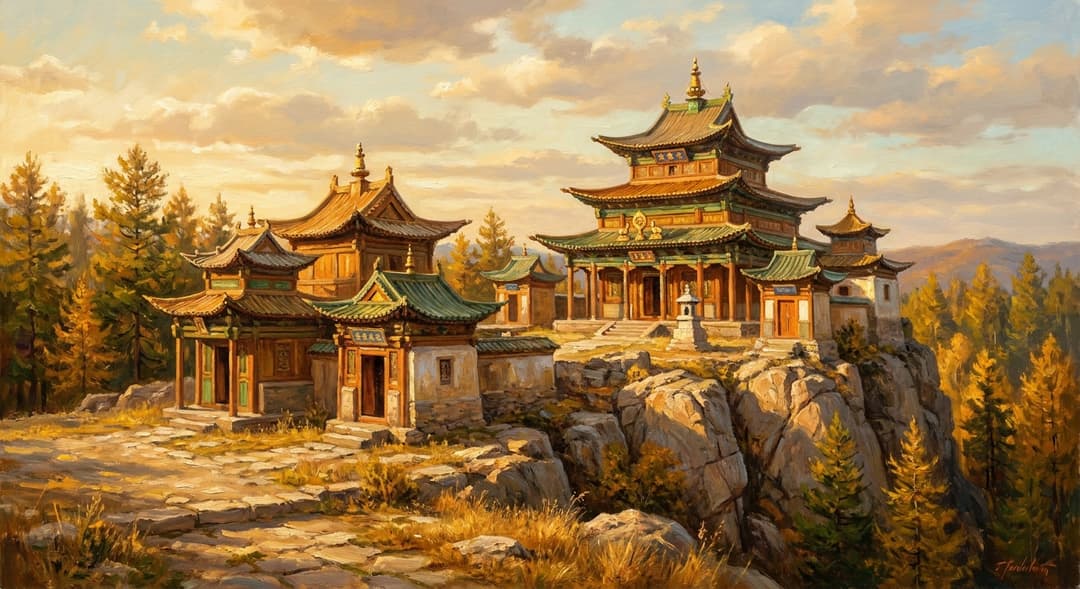
Visiting Tövkhön Monastery involves an invigorating mountain pilgrimage through pine forests to reach a peaceful cliffside sanctuary. Situated at an elevation of 2,312 meters, the retreat offers sweeping panoramic views across the Orkhon Valley Cultural Landscape. Pilgrims and travelers visit during summer to circumambulate temples, explore sacred caves, and experience the quiet solitude of Zanabazar's mountain refuge.
Highlights
- Exploring the historic timber temples rebuilt without metal nails
- Crawling through Ehiin Umai (Mother's Womb Cave) for karmic cleansing
- Viewing the granite petrosomatoglyphs of Zanabazar's footprint and handprint
- Taking in panoramic views of the Orkhon Valley from the clifftop ridge
Things to Know
- Requires a 3.5 to 5 km uphill hike or horse ride from the mountain base parking lot
- Accessible primarily during summer months due to winter ice and heavy snowfall
- Visitors should dress in layers and carry rain gear for rapid mountain weather shifts
Location
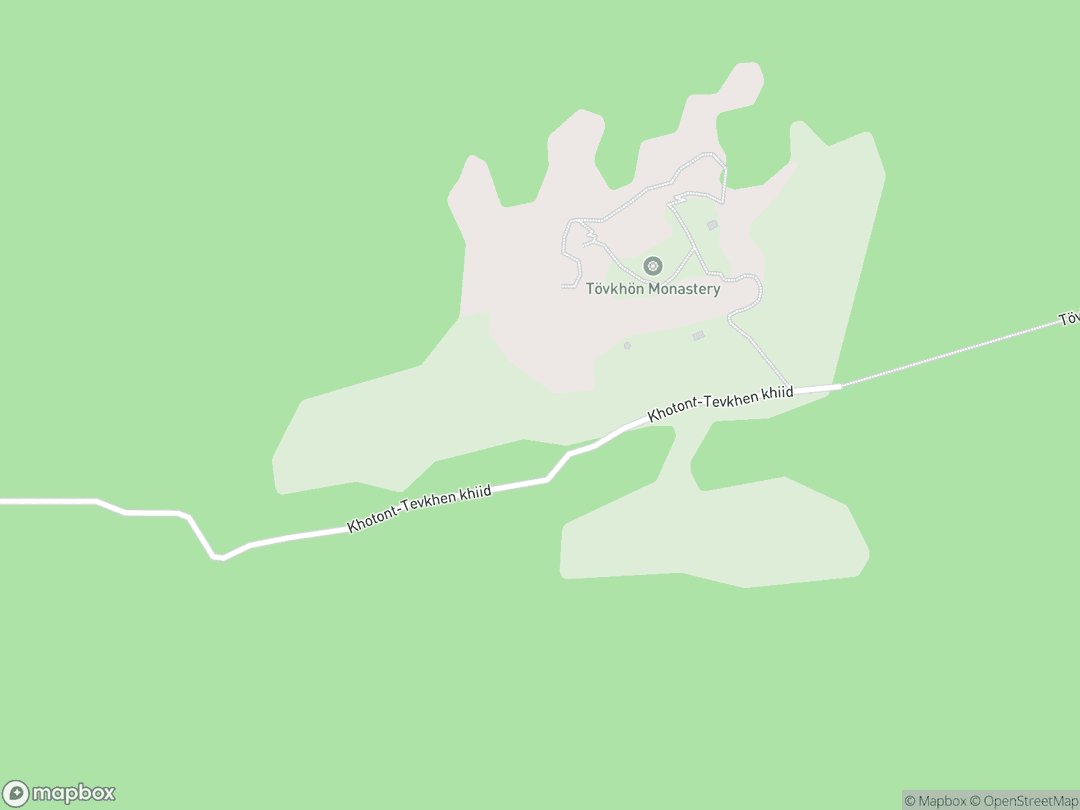
Shireet Ulaan Mountain, Bat-Ölzii Soum, Övörkhangai Province, Mongolia
Hours: Open daily May through October from 8:00 AM to 7:00 PM (winter access restricted).
Getting There: Accessible via 4WD vehicle from Kharkhorin (~47 km) to Shireet Ulaan base, followed by a 1 to 1.5 hour mountain hike or horse ride.
Get DirectionsTips for Your Visit
Footwear & Clothing
Wear sturdy hiking boots with good traction for the steep granite path and carry warm layers.
Temple Etiquette
Circumambulate temples, stupas, and sacred rocks in a clockwise direction as part of traditional Buddhist kora.
About
Tövkhön Monastery, known historically as Bayasgalant Aglag Oron ('Land of Happy Solitude'), is a sacred mountain hermitage perched high on Shireet Ulaan Mountain in Mongolia's Orkhon Valley. Rooted in the ancient Dharmic tradition of seeking solitary natural sanctuaries (aranya) for tapassu (austere practice) and dhyana (deep meditation), the hermitage reflects a profound synthesis of esoteric Vajrayana Buddhism and traditional Mongolian mountain veneration.
Founded in 1648 by the 14-year-old Öndör Gegeen Zanabazar, the first Jebtsundamba Khutuktu and spiritual head of Khalkha Mongolia, Tövkhön served as his personal retreat, artistic workshop, and intellectual sanctuary. Here, perched on granite cliffs surrounded by Siberian larch, Zanabazar created legendary gilt-bronze deity sculptures and invented the Soyombo script in 1686, which gave Mongolia its iconic national emblem.
Despite suffering total destruction during the 17th-century Khalkha-Oirat War and the communist anti-religious purges of the 1930s, Tövkhön was meticulously rebuilt in the 1990s using traditional nail-free joinery. Inscribed as a UNESCO World Heritage site within the Orkhon Valley Cultural Landscape in 2004, the monastery remains an active pilgrimage site where monks and seekers cultivate spiritual insight.
Interesting Facts
The Soyombo symbol on Mongolia's national flag was created at Tövkhön Monastery in 1686 by Zanabazar. (Tier A)
The wooden temples were constructed using traditional joinery without using a single metal nail. (Tier A)
Öndör Gegeen Zanabazar designated the cliffside sanctuary in 1648 when he was just 14 years old. (Tier A)
At 2,312 meters altitude, Tövkhön is among the highest historically active monastery retreats in Mongolia. (Tier A)
Pilgrims crawl through the narrow granite channel of Ehiin Umai Cave in a symbolic ritual of karmic rebirth. (Tier B)
Zanabazar cast world-renowned gilt-bronze Buddhist masterworks directly at this remote cliffside workshop. (Tier A)
Two 17th-century white stupas survived both 1688 wartime destruction and 1930s anti-religious purges. (Tier A)
Depressions in the granite rock face are venerated as Zanabazar's permanent boot print and handprint. (Tier B)
The sanctuary was originally named Bayasgalant Aglag Oron, meaning 'Land of Happy Solitude'. (Tier A)
The monastery is a core anchor of the UNESCO World Heritage-listed Orkhon Valley Cultural Landscape. (Tier B)
Common Questions
Why is Tövkhön Monastery historically important to Mongolia?
It is the site where Öndör Gegeen Zanabazar created the Soyombo script and emblem in 1686, which now graces Mongolia's national flag.
How do visitors reach Tövkhön Monastery?
Visitors drive 4WD vehicles to the mountain base near Bat-Ölzii Soum and undertake a steep 3.5 to 5 km hike or horse ride through larch forests.
What is the Ehiin Umai Cave ritual?
Pilgrims crawl through a narrow rock fissure near the upper complex in a traditional symbolic ritual of karmic cleansing and spiritual rebirth.
Is Tövkhön Monastery an active religious site?
Yes, it is an active Gelugpa Buddhist retreat and a protected UNESCO World Heritage site.
Featured Stories
The Creation of the Soyombo Script
1686
In 1686, while residing at his remote retreat on Shireet Ulaan Mountain, Zanabazar created the Soyombo script to transcribe Sanskrit, Tibetan, and Mongolian phonetics. The opening emblem—the Soyombo—symbolized cosmic balance, vigilance, and national identity for the Khalkha Mongols. Today, this spiritual symbol designed high on the granite cliffs forms the central icon on the national flag of Mongolia.
Source: Mongolian National Cultural Heritage Center
The 14-Year-Old Polymath's Vision
1648
At just fourteen years old, Öndör Gegeen Zanabazar climbed through the forested slopes of the Orkhon Valley and identified Shireet Ulaan Mountain as an ideal sanctuary for meditation. Returning three years later from his studies in Tibet, he directed Khalkha master carpenters in erecting timber meditation cells directly on living granite ledges. This isolated haven soon blossomed into a renowned center for artistic creation, linguistic innovation, and esoteric practice.
Source: UNESCO World Heritage Centre
Rebirth from the Ashes
1990s
Tövkhön Monastery survived two major waves of historic destruction, first in the 17th-century Khalkha-Oirat War and again during 1930s anti-religious purges. Following Mongolia's democratic transition in 1990, local craftsmen and scholars mobilized to rebuild the timber shrines using original 17th-century nail-free joinery. Re-consecrated in 1997, the hermitage continues its historical role as an active sanctuary of Buddhist meditation.
Source: Ministry of Culture of Mongolia
Timeline
Site Designation
Fourteen-year-old Öndör Gegeen Zanabazar selects Shireet Ulaan Mountain as a sacred retreat.
MilestoneConstruction Begins
Building commences on timber meditation halls following Zanabazar's return from Tibet.
component.timeline.groundbreakingMonastery Completed
Master carpenters complete the hermitage, named Bayasgalant Aglag Oron.
DedicationInvention of Soyombo Script
Zanabazar creates the Soyombo script and emblem while meditating at Tövkhön.
EventDestruction in Oirat Invasion
Zungar forces under Galdan Boshugtu Khan destroy the complex during the Khalkha-Oirat War.
Event18th-Century Restoration
Khalkha patrons rebuild the wooden temples and stupas to resume monastic retreats.
RenovationPurge Destruction
Communist government anti-religious purges severely damage the monastery and disperse monks.
EventState Protection Granted
Mongolia's post-democratic government designates Tövkhön as a protected national heritage site.
MilestoneReconstruction Completed
A five-year reconstruction restores the principal temples, gates, and stupas using historic plans.
RenovationUNESCO Inscription
Tövkhön Monastery is inscribed on the UNESCO World Heritage list within the Orkhon Valley landscape.
MilestoneHistory by Decade
1640s–1650s — Founding and Creation
In 1648, fourteen-year-old Öndör Gegeen Zanabazar identified the forested high ridge of Shireet Ulaan Mountain as a sanctuary of spiritual peace. Following his return from Tibetan studies in 1651, Khalkha carpenters began building timber meditation halls directly on granite ledges. By 1653, the retreat was dedicated as Bayasgalant Aglag Oron ('Land of Happy Solitude'), providing a quiet haven for esoteric practice and creative work.
1680s — Cultural Crucible and Invasion
During the 1680s, Tövkhön served as the intellectual heart of Khalkha Mongolia. In 1686, Zanabazar developed the Soyombo script here to standardize the transliteration of Buddhist texts across Mongolian, Sanskrit, and Tibetan. However, in 1688, the Khalkha-Oirat War forced Zanabazar to flee as Zungar troops devastated the mountain complex.
1770s — Eighteenth-Century Renewal
In 1773, Khalkha Buddhist patrons restored Tövkhön Monastery to its original form. Senior monks and meditators returned to the high ridge to rebuild wooden shrines over original granite foundations. The sanctuary resumed its vital role as a high-mountain retreat for Gelugpa tantric visualization and solitary study.
1930s — Suppression and Damage
The communist religious purges of 1937–1939 severely damaged Tövkhön Monastery. Shrines were destroyed, sacred art scattered, and monastic routines forcibly suppressed across Mongolia. Despite the destruction, two 17th-century white stone stupas and cliffside foundations survived intact on the mountain ridge.
1990s — Rebirth and Restoration
Following Mongolia's 1990 democratic transition, Tövkhön was placed under State Protection in 1992. A comprehensive five-year restoration project culminated in 1997, rebuilding four principal wooden temples and ceremonial gates using historic mortise-and-tenon carpentry. The monastery was reconsecrated with new sacred art, restoring active Buddhist practice to the site.
2000s–Present — World Heritage Anchor
In 2004, UNESCO inscribed Tövkhön Monastery as a crucial cultural site within the Orkhon Valley Cultural Landscape. Today, the active monastery balances ancient monastic traditions with growing international heritage tourism. Monks continue solitary meditation while welcoming pilgrims to this iconic birthplace of Mongolian spiritual culture.
Architecture & Facilities
Tövkhön Monastery represents a unique synthesis of traditional Mongolian timber construction, Tibetan Buddhist layout, and East Asian roof aesthetics, engineered directly onto steep granite ledges 2,312 meters above sea level.
Building Materials
Coniferous Siberian Larch
Harvested locally to form durable structural timbers capable of withstanding severe sub-zero winters.
Living Granite Foundations
Chiseled rock plinths that secure the temple platforms directly to cliff faces.
Mortise-and-Tenon Carpentry
Interlocking wooden joinery constructed entirely without metal nails or fasteners.
Natural Earth Pigments
Traditional paints applied to roof eaves, brackets, and interior ceiling caissons.
Interior Features
Tsogchin Dugan Main Hall
Houses sacred statues of Shakyamuni Buddha, Je Tsongkhapa, and Mahakala.
Dubkhan Meditation Cell
Reconstructed timber chamber over Zanabazar's personal retreat and bronze workshop.
Temple of Gombo Makhagal
Specialized shrine housing wrathful guardian deity iconography to protect the monastery.
Rock-Cut Hermitage Chambers
Natural granite cliff cavities behind the wooden halls used for solitary tantric meditation.
Temple Grounds
Spread across narrow rocky terraces, featuring twin stone stupas, holy water springs, and hiking trails through Siberian larch forests.
Additional Facilities
Visitor parking lot and horse guide station at the base of Shireet Ulaan Mountain, with temporary summer ger camps for pilgrims.
Religious Significance
Within the broader Dharmic tradition, spiritual awakening is pursued through solitary retreat (aranya), disciplined asceticism (tapassu), and focused meditation (dhyana) far from worldly distractions. Tövkhön Monastery manifests this timeless ethos within Gelugpa Tibetan Esoteric Buddhism, synthesizing Vajrayana deity visualization with traditional Mongolian reverence for sacred mountains.
Serves as an active mountain hermitage (Aglag Oron) dedicated to solitary Vajrayana meditation, tantric retreat, and the preservation of Mongolian Buddhist heritage.
Sacred Ordinances
Dhyana & Sadhana Meditation
Solitary mental discipline and tantric deity visualization performed by monks in mountain cells and granite caves.
Ehiin Umai Purification Ritual
A pilgrimage practice of crawling through a narrow rock channel to symbolize karmic cleansing and rebirth.
Kora Circumambulation
Clockwise devotional walking around wooden temples, stupas, and sacred granite formations.
Ovoo Mountain Worship
Offering prayers and ceremonial blue silk scarves (khadag) at mountain cairns to harmonize with natural spirits.
Synthesis of Esoteric Buddhism and Mountain Sanctity
Tövkhön exemplifies how Vajrayana Buddhism integrated with indigenous Mongolian culture. By establishing a hermitage on Shireet Ulaan Mountain, Zanabazar joined esoteric Gelugpa rituals with traditional mountain veneration, creating a unique sanctuary where spiritual practice and national identity flourished.
Similar Temples
Sources & Research
Every fact on Temples.org is backed by verified Sources & Research. Each piece of information is rated by source tier and confidence level.
View All Sources (8)
| Field | Source | Tier | Retrieved |
|---|---|---|---|
| About & Historical Background | Government of Mongolia Cultural Portal (opens in a new tab) | A | 2026-02-18 |
| Architecture & Symbols | UNESCO World Heritage Centre (opens in a new tab) | B | 2026-02-18 |
| Religious Significance & History | Encyclopaedia Britannica (opens in a new tab) | B | 2026-02-18 |
| Timeline & Restoration | Ministry of Construction and Urban Development of Mongolia (opens in a new tab) | A | 2026-02-18 |
| Visitor Insights & Location | Mongolian National Tourism Organization (opens in a new tab) | A | 2026-02-18 |
| Soyombo Symbol & Zanabazar Heritage | Zanabazar Fine Arts Museum (opens in a new tab) | B | 2026-02-18 |
| Orkhon Valley Cultural Landscape | International Council on Monuments and Sites (ICOMOS) (opens in a new tab) | B | 2026-02-18 |
| Monastic Hermitages in Mongolia | Rubin Museum of Art (opens in a new tab) | B | 2026-02-18 |