Visitor Insights
Visiting Wat Rong Khun
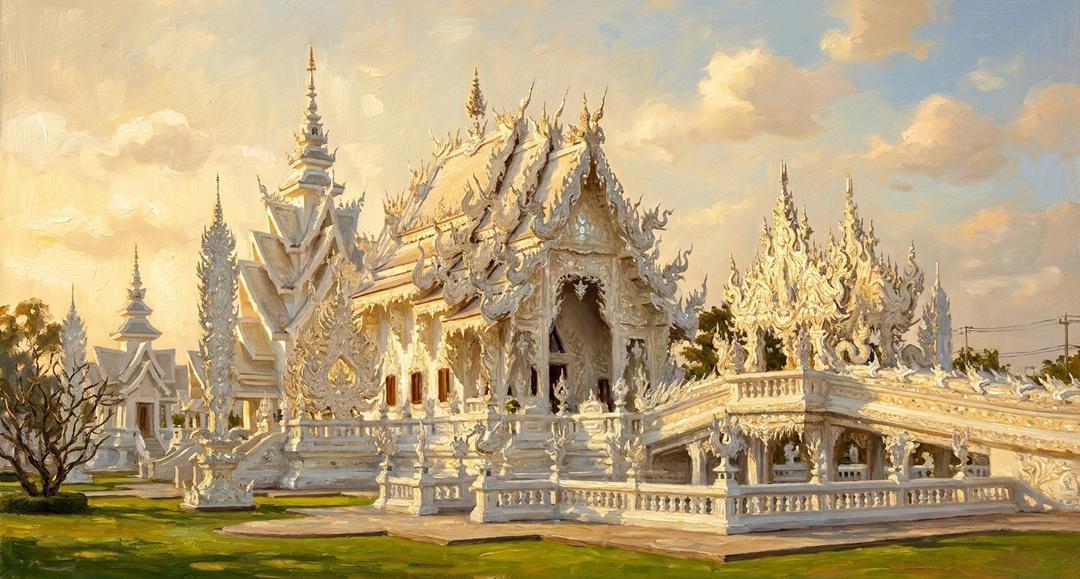
Wat Rong Khun offers a profound spatial transition from worldly desire to spiritual quietude across its ornate grounds. Visitors cross an allegorical causeway past hell realms before entering the serene ordination hall. Strict reverence, modest dress, and observance of the photography ban inside the inner hall ensure the site's spiritual atmosphere is preserved.
Highlights
- Walking the strictly one-way Bridge of the Cycle of Rebirth across the hell pit
- Viewing the contrast between apocalyptic pop-culture murals and serene white Buddhas
- Admiring the radiant sunlight bouncing off thousands of hand-cut glass mirror inlays
- Observing the opulent palace-like Golden Restroom challenging ideas of physical vanity
Things to Know
- Shoulders and knees must be fully covered before entering the sacred perimeter
- All photography and filming are strictly prohibited inside the main ordination hall
- Visitors may not pause or turn backward while crossing the Bridge of Rebirth
- Shoes must be removed and placed into bags before crossing into the inner sanctum
Location
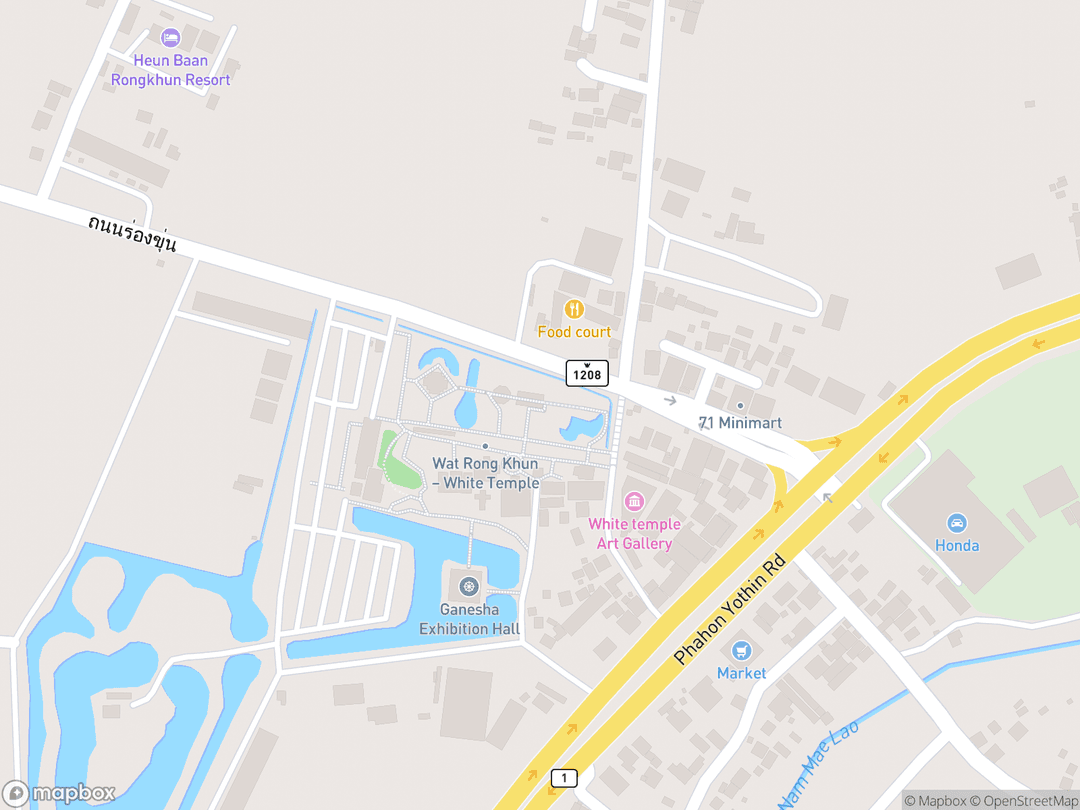
60 Mu 1 Phahonyothin Road, Pa O Don Chai, Mueang Chiang Rai, Chiang Rai 57000, Thailand
Hours: Open daily from 08:00 to 17:00
Getting There: Located 13 kilometers south of Chiang Rai along Highway 1, accessible by local bus from Platform 8 at Chiang Rai Bus Terminal 1, songthaew, or private taxi.
Get DirectionsTips for Your Visit
Arrive for Morning Opening
Enter at 08:00 to experience the grounds in cooler morning temperatures and avoid midday reflection off the bright white stucco.
Wear Slip-On Footwear
Bring shoes that are easy to remove and put on, as temple protocols require going barefoot inside the inner ordination hall.
Observe the Movement Protocol
Walk continuously forward across the bridge, as security guards enforce the symbolic rule against retreating toward worldly desire.
Explore the Art Museum
Visit the adjacent gallery building to view Chalermchai's original paintings and gain deeper insight into the temple's philosophical themes.
About
Wat Rong Khun, renowned globally as the White Temple, stands in Chiang Rai Province as an extraordinary fusion of classical Theravada Buddhist cosmology and avant-garde architectural expression. Rooted deeply in the overarching Dharmic understanding of Samsara, Karma, and spiritual liberation, the temple was conceptualized by National Artist Chalermchai Kositpipat to represent the arduous path toward enlightenment.
Originally a modest village monastery that fell into dereliction during the late twentieth century, the sanctuary underwent complete reconstruction beginning in 1996 under Chalermchai's personal funding and artistic stewardship. Unlike traditional Thai temples adorned in gilded gold and red lacquer, its principal structures radiate in stark white plaster and mirror mosaics, symbolizing the immaculate purity of the Buddha and the infinite radiance of the Dharma.
Operating both as an active consecrated Buddhist ordination hall and an evolving sacred monument, the complex serves as a visual sermon on the illusions of modern materialism. Guided by an expansive nine-building master plan slated for continuation through 2070, Wat Rong Khun remains one of Southeast Asia's most arresting theological landmarks.
Gallery
Symbolic Elements
The temple's exterior features intricate carvings, each rich with spiritual meaning:
All-White Stucco
The pristine white exterior embodies Visuddhi, representing the absolute moral and spiritual purity of Gautama Buddha.
Embedded Mirrored Mosaics
Tens of thousands of reflective glass fragments symbolize the radiant wisdom of the Dharma illuminating every corner of the universe.
Bridge of the Cycle of Rebirth
The ascending causeway represents the necessary crossing over worldly attachment and cyclical suffering toward spiritual liberation.

Pit of Reaching Hands
Hundreds of tormented hands reaching upward symbolize insatiable sensory desire, greed, and the torments of the hell realms.
Gate of Heaven Guardians
Towering statues of Phra Yom and Rahu brandishing blades represent karmic judgment and the certainty of physical mortality.

Pop Culture Mara Murals
Contemporary depictions of science fiction icons and global conflicts illustrate how modern media and consumerism blind the mind.

The Golden Pavilion
The gilded palace housing the restrooms symbolizes how mortals adorn the temporary physical body while neglecting their inner spirits.
Serpentine Naga Balustrades
Multi-headed sacred serpents framing the walkway act as celestial protectors bridging human consciousness to divine realms.
Interesting Facts
Chalermchai strictly caps private donations at 10,000 THB to prevent wealthy donors from influencing the temple's artistic vision (Tier A).
The entire complex is financed through personal sales of Chalermchai's original paintings and prints in the on-site gallery (Tier A).
Crossing the Bridge of Rebirth is strictly one-way, with guards warning that turning back symbolizes tumbling into hell realms (Tier B).
The elaborate golden palace on the temple grounds is actually a public restroom designed to mock human physical vanity (Tier B).
Murals inside the ordination hall incorporate images of Neo from The Matrix, Superman, and spaceships alongside traditional demons (Tier B).
A magnitude 6.3 earthquake in 2014 cracked the central hall, but reinforced concrete columns kept the sanctuary structurally intact (Tier A).
Chalermchai has trained dozens of young master apprentices to ensure construction continues toward its targeted completion in 2070 (Tier A).
Alcohol bottles and severed demon heads are displayed among the garden trees to warn pilgrims against destructive habits (Tier C).
Common Questions
Why is Wat Rong Khun painted white rather than traditional gold?
The white stucco embodies the pure moral perfection of the Buddha, while embedded mirror glass symbolizes the radiant wisdom of the Dharma.
Can visitors take photographs inside the main hall?
Photography and video recording are strictly prohibited inside the ordination hall to protect sacred artwork and maintain spiritual decorum.
Why are contemporary pop-culture characters painted on the temple walls?
The modern figures represent the manifestations of Mara, illustrating how modern illusions, violence, and technology distract humanity from awakening.
Is Wat Rong Khun an active monastery or an art gallery?
The complex is a consecrated Buddhist sanctuary housing an active ordination hall, though funded privately as an ongoing sacred art installation.
What is the dress code for visiting the temple?
Visitors must wear respectful attire that fully covers both the shoulders and knees, with wraps available for rent at the entrance.
Featured Stories
The Vow of Independent Patronage
1997
Determined to create a sanctuary beholden solely to the Dharma and Thai artistic heritage, Chalermchai Kositpipat made the radical decision to reject substantial corporate and governmental subsidies. By establishing an unyielding ceiling of 10,000 Thai baht on individual contributions, he preserved complete creative and spiritual freedom. This vow ensured that every carved petal and brushstroke originated from the humble devotion of everyday pilgrims and the sale of his personal art.
Source: SPACES Cultural Archives
Surviving the Mae Lao Earthquake
May 5, 2014
When a powerful magnitude 6.3 earthquake shook Northern Thailand, the violent tremors shattered exterior gables and split the sanctuary's delicate internal murals. Despondent in the immediate aftermath, the master architect feared his life's magnum opus would require complete demolition. Within forty-eight hours, independent structural engineers verified that the reinforced concrete core remained steadfast, igniting a two-year restoration campaign that restored every fractured surface.
Source: Tourism Authority of Thailand
The Strictly One-Way Crossing
2000
Pilgrims approaching the principal hall must navigate the ascending Bridge of Rebirth while temple staff ensure that no visitor turns back. The strict progression mirrors the Buddhist principle that one cannot retreat into desire once the crossing toward truth has begun. Walking forward past the sea of reaching hands becomes a visceral, physical meditation on leaving behind earthly cravings.
Source: Inside Inside Architectural Review
Timeline
Establishment of Ban Rong Khun
The rural settlement of Ban Rong Khun is founded in the agrarian plains south of Chiang Rai.
EventOriginal Village Temple Built
Local residents construct a modest timber ordination hall to serve community religious rites.
MilestoneLondon Mural Commission
Chalermchai completes contemporary murals at Wat Buddhapadipa in Wimbledon, establishing his signature style.
EventReconstruction Project Commences
Distressed by the decaying village temple, Chalermchai commits personal funds to rebuild the site as a masterwork.
MilestoneUbosot Opened to Pilgrims
The principal white ordination hall opens to the public, sparking global attention for its radical white aesthetic.
DedicationGolden Pavilion Completed
The extravagantly gilded pavilion housing public restrooms is opened to symbolize the impermanence of physical vanity.
MilestoneIndividual Donation Ceiling Imposed
Chalermchai caps individual financial gifts at 10,000 THB to ensure complete independence from political or corporate influence.
EventNational Artist Distinction
Chalermchai Kositpipat is honored by Thailand's Ministry of Culture as a National Artist in Visual Arts.
MilestoneThe Mae Lao Earthquake
A magnitude 6.3 earthquake fractures the main hall and damages interior murals, prompting a temporary closure.
EventStructural Clearance and Reopening
Engineers confirm the reinforced concrete core remains sound, allowing the grounds to reopen within three days.
MilestoneEarthquake Restoration Completed
Artisans complete a comprehensive two-year repair of external relief carvings and inner wall murals.
RenovationOngoing Master Plan Construction
Apprentice artisans continue erecting auxiliary meditation halls and monastic quarters targeted for completion by 2070.
MilestoneHistory by Decade
1860s–1950s — Agrarian Settlement of Ban Rong Khun
During the late nineteenth century, rural families established the farming village of Ban Rong Khun amid the floodplains south of Chiang Rai. Community spiritual life revolved around seasonal harvest rites and periodic visits from wandering Theravada monks. For nearly a century, the village lacked a permanent consecrated ordination hall, relying on makeshift shrines for religious gatherings.
1960s — Founding of the Original Wooden Sanctuary
In 1964, local residents pooled their modest savings to erect a traditional timber ordination hall for the village. Built with simple teak posts and clay tiles, the modest structure served as the center for ordinations and communal prayers. It provided the spiritual foundation that would later inspire native son Chalermchai Kositpipat during his childhood.
1970s–1980s — Decay, Neglect, and Chalermchai's Early Career
By the late 1970s, demographic shifts and an absence of maintenance funds left the wooden temple in acute disrepair. Peeling paint, termite infestations, and waterlogged roof beams rendered the primary hall nearly unusable. Meanwhile, Chalermchai graduated from Silpakorn University and gained international acclaim painting murals for Wat Buddhapadipa in London.
1990s — Rebirth and Avant-Garde Reconstruction
Returning to his native village in 1996, Chalermchai was heartbroken by the sanctuary's derelict ruins and resolved to reconstruct the entire grounds using his own personal fortune. Demolishing the decayed wooden structure, he laid the foundations for a brilliant white temple designed to endure for centuries. The central ubosot opened in 1997, immediately capturing national and international attention.
2000s — Global Prominence and Compound Expansion
The compound expanded dramatically over the decade, incorporating the Bridge of Rebirth, ornamental ponds, and the satirical Golden Pavilion. Chalermchai established strict patronage caps to preserve his independence and began training a dedicated guild of apprentices. The site rapidly became one of Thailand's most recognized artistic and religious landmarks.
2010s — The Mae Lao Earthquake and Resurrection
In May 2014, a magnitude 6.3 earthquake severely damaged the ubosot, fracturing walls and dislodging exterior relief carvings. After engineers verified the structural safety of the concrete framework, Chalermchai directed an intensive two-year restoration that fully repaired the sanctuary. By 2016, an adjacent museum and the Golden Ganesha Hall were formally integrated into the complex.
2020s and Beyond — The 2070 Vision and Living Guild
Entering its third decade of construction, Wat Rong Khun continues to evolve according to an ambitious nine-building master plan. A resident guild of more than sixty sculptors and painters advances work on auxiliary meditation halls, crematoriums, and monk residences. The compound remains on schedule for its long-term projected completion around the year 2070.
Architecture & Facilities
The architecture represents a distinctive synthesis of traditional Northern Thai Neo-Lanna design and contemporary surrealism, articulated through sweeping multi-tiered rooflines and monochromatic white relief carvings.
Building Materials
Reinforced Concrete Frame
Cast-in-place steel-reinforced concrete creates a seismic-resistant core engineered to withstand regional tectonic activity.
White Lime-Gypsum Stucco
A custom-mixed white plaster is hand-molded across exterior walls to produce flame motifs and intricate sculptural iconography.
Mirrored Mosaic Glass
Thousands of hand-cut reflective glass fragments embedded into the plaster catch natural sunlight and symbolize the radiance of the Dharma.
Composite Roof Tiles
White interlocking composite tiles line the multi-tiered gables, accented with flame-like hang hong eaves and soaring sky tassels.
Interior Features
Principal Ordination Hall (Ubosot)
The consecrated central chamber where monastic ordinations occur, featuring murals that transition from worldly fire to golden celestial realms.
Altar of the White Buddha
The serene western focal point housing white and golden seated Buddha statues radiating peaceful meditative detachment.
The Mural of Samsaric Turmoil
The eastern interior wall depicting modern warfare, consumerism, and pop-culture icons as contemporary manifestations of delusion.
Chalermchai Art Museum
An auxiliary gallery exhibiting hundreds of the master artist's original paintings, preliminary sketches, and cast-bronze sculptures.
Temple Grounds
The five-acre compound is organized around reflective water moats, paved ceremonial plazas, landscaped gardens, and sculptural installations warning against worldly vice.
Additional Facilities
Facilities include the multi-tiered Golden Restroom pavilion, the Ganesha Hall of the Arts, an apprentice workshop, souvenir galleries, and visitor reception areas.
Religious Significance
As part of the broad Dharmic family, Wat Rong Khun uses architectural symbolism to illustrate core Theravada Buddhist doctrines including Samsara, Karma, and liberation from suffering.
To serve as a living visual sermon and consecrated ordination sanctuary that elevates the pilgrim's mind from sensory craving toward the pristine stillness of Nirvana.
Sacred Ordinances
Monastic Upasampada (Ordination)
The sacred rite wherein candidate monks take their formal vows within the consecrated boundaries of the ubosot.
Meditation and Chanting
Daily recitations of the Tipitaka and silent contemplation undertaken by resident monks and visiting pilgrims.
Experiential Pilgrimage Crossing
The devotional transit over the Bridge of Rebirth, enacted as a physical metaphor for surmounting worldly temptations.
The Purity of Visuddhi
Departing from traditional gold gilding, the white color scheme expresses Visuddhi, the unblemished spiritual perfection of the Buddha that remains untainted by worldly illusion.
Mara in the Modern Era
The interior murals recontextualize Mara—the demonic force of distraction—as modern pop-culture icons and political warfare, cautioning that technological advancements without spiritual wisdom deepen Samsaric bondage.
Similar Temples
Sources & Research
Every fact on Temples.org is backed by verified Sources & Research. Each piece of information is rated by source tier and confidence level.