Visitor Insights
Visiting Selimiye Mosque
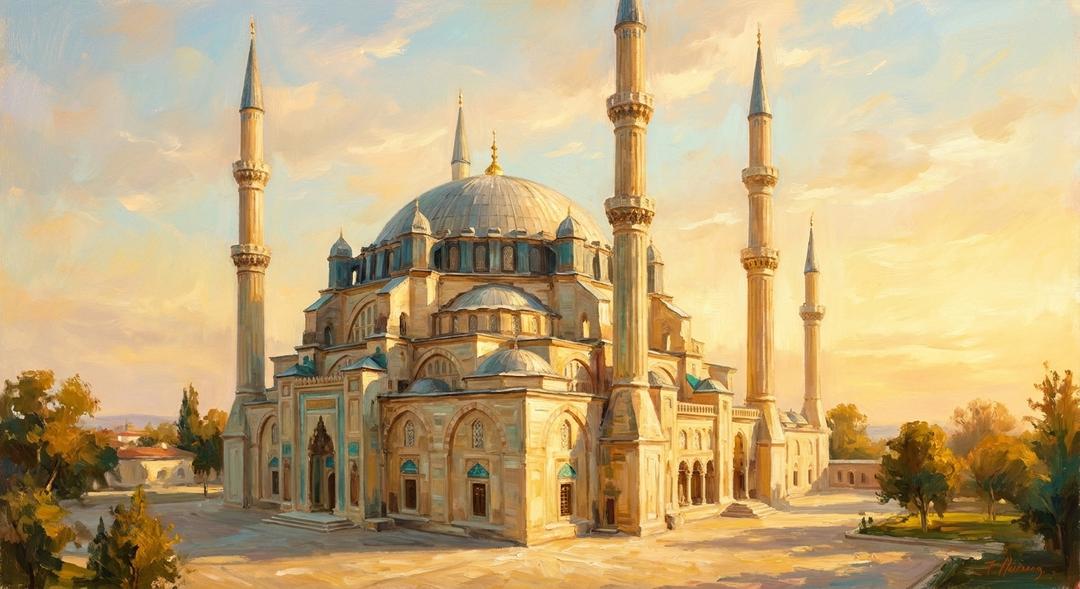
The Selimiye Mosque welcomes both faithful worshippers and global visitors into one of the world's grandest sacred spaces. Open daily from morning until night, non-worshipping visitors can tour the perimeter of the prayer hall and historic courtyards outside the five daily congregational prayer sessions. The expansive social complex features museums, shaded arcades, and a historic bazaar providing deep cultural engagement.
Highlights
- Unobstructed view of Mimar Sinan's soaring 31.28-meter dome resting on eight octagonal pillars.
- Exquisite 16th-century underglaze Iznik tiles lining the deep mihrab recess and royal gallery.
- Intricately carved monolithic marble minbar showcasing openwork geometric lace.
- Centrally positioned wooden Müezzin Mahfili sheltering a soothing indoor marble fountain.
Things to Know
- Modest attire is strictly required, with knees, shoulders, and midriffs fully covered.
- Women must wear headscarves covering hair and neck before stepping inside the prayer hall.
- Shoes must be removed and placed in provided bags before stepping onto the carpeted sanctuary.
- Visiting is paused for 30 to 45 minutes during daily prayer services and during Friday midday prayers.
Location
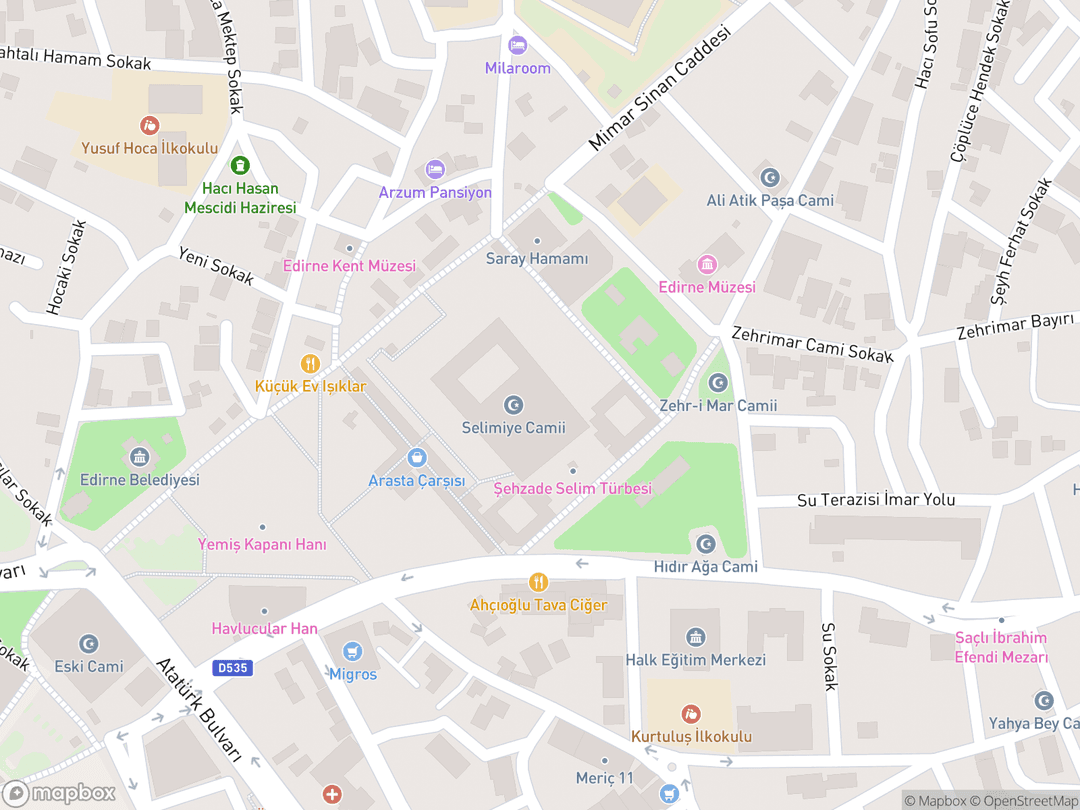
Meydan Mahallesi, Mimar Sinan Caddesi, 22020 Edirne Merkez, Edirne, Turkey
Hours: Open daily 08:30 to 18:00 for visitors; open from dawn prayer until late evening for worshippers.
Getting There: Located in central Edirne along Mimar Sinan Caddesi, easily reached by municipal minibuses from Edirne Bus Terminal or via a 2.5-hour highway drive from Istanbul.
Get DirectionsTips for Your Visit
Optimal Lighting Intervals
Visit during mid-morning or mid-afternoon between prayer calls when angled sunlight through 384 windows illuminates the dome calligraphy.
Friday Prayer Protocol
Avoid visiting as a tourist during the Friday congregational service (Jum'ah), when the mosque reaches full capacity for local worshippers.
Historic Arasta Bazaar
Walk through the covered Arasta market situated beneath the western terrace to experience traditional crafts and support local artisans.
About
The Selimiye Mosque in Edirne stands as the absolute zenith of classical Ottoman architecture and one of the supreme achievements in Islamic sacred design. Commissioned by Sultan Selim II and engineered by the legendary chief architect Mimar Sinan in his eighties, the monumental sanctuary was completed between 1568 and 1574. Sinan personally designated this complex as his definitive masterpiece, transcending all earlier geometric experiments.
Rooted in the monotheistic Abrahamic heritage, the mosque celebrates the absolute transcendence and unicity of God through an unobstructed central expanse. Sinan eliminated internal forest-like columns by supporting an immense 31.28-meter dome upon an innovative octagonal baldachin. This structural triumph opened the entire prayer floor to uninterrupted sightlines, creating a democratic prayer hall flooded with natural illumination from 384 windows.
Encompassing a vast social complex (külliye), the grounds preserve dual madrasas, a school of prophetic tradition, and a covered market street whose revenues sustained the institution across centuries. Inscribed as a UNESCO World Heritage Site in 2011, the Selimiye Mosque continues to serve as an active house of congregational prayer and an enduring symbol of spiritual devotion and architectural genius.
Gallery
Symbolic Elements
The temple's exterior features intricate carvings, each rich with spiritual meaning:

The Soaring Central Dome
Represents the unsegmented celestial canopy of heaven, manifesting the absolute unity and transcendence of God (*Tawhid*).
Octagonal Baldachin
The eight load-bearing pillars evoke the eight angels described in the Quran who bear the heavenly Throne of the Divine.
The Inverted Tulip
A delicate marble bas-relief representing worldly humility and spiritual submission, while the tulip bloom itself forms an anagram for Allah.

Triple-Spiral Minarets
Engineered with three independent entwined staircases symbolizing ascending thresholds of sacred knowledge and spiritual contemplation.

Cascade of 384 Windows
Pours radiant natural light into every recess of the hall, physically embodying the Quranic verse declaring God as the Light of the Heavens.

Marble Mihrab and Minbar
Carved from immaculate Marmara marble to anchor the communal orientation toward Mecca and elevate the delivery of prophetic sermons.
Central Müezzin Mahfili Fountain
Shelters an indoor basin evoking the paradisiacal spring of Kawthar whose soothing running water aids acoustic and meditative serenity.
Iznik Ceramic Almond Blossom Panels
Flowering floral tiles that symbolize seasonal resurrection, life renewal, and the lush gardens of eternal Paradise.
Interesting Facts
Chief Architect Mimar Sinan proclaimed Selimiye his ultimate masterpiece (*ustalık eseri*), finishing it when he was eighty-four years old (Tier A).
An inverted tulip is carved into a marble pier beneath the muezzin platform, commemorating a stubborn landlady according to local folklore (Tier B).
Two northern minarets house three independent spiral staircases in a single 3.8-meter shaft, allowing three muezzins to climb unseen by one another (Tier A).
The dome absorbed a Bulgarian artillery direct hit in 1913 without collapsing, leaving a blast scar preserved by order of Atatürk (Tier A).
Construction was funded largely through royal shares of war spoils from the Ottoman conquest of Venetian Cyprus in 1571 (Tier A).
Rare underglaze Iznik ceramic tiles plundered from the imperial gallery during the 1878 Russian occupation remain in the Hermitage Museum (Tier B).
Sinan engineered natural thermal air drafts that drew beeswax candle soot into a collection chamber to manufacture ink for Quranic calligraphers (Tier B).
Unlike conventional Ottoman layouts, the elevated wooden choral platform sits directly at the center of the hall above an indoor marble fountain (Tier A).
The dome perimeter is ringed by thirty-two pierced windows that create a visual illusion of a celestial canopy floating weightlessly above (Tier B).
The surrounding social complex contains twin madrasas, a primary school, and an expansive covered bazaar designed to support community life (Tier A).
Common Questions
Why did Sultan Selim II build his master mosque in Edirne rather than Istanbul?
Selim II held great affection for Edirne from his youth as prince-governor, and the former capital offered elevated hilltops free from Istanbul's crowded skyline.
Can non-Muslim visitors enter the Selimiye Mosque?
Yes, visitors of all backgrounds are warmly welcomed outside daily congregational prayer sessions provided they observe respectful attire and remove their shoes.
What is the architectural significance of the three-staircase minarets?
The northern minarets house three independent spiral staircases, enabling three muezzins to ascend simultaneously without meeting each other.
What does the carved upside-down tulip represent?
Folklore attributes it to a stubborn landowner who reluctantly yielded her tulip orchard, while in Sufi thought the tulip reflects humble devotion to God.
How does the mosque connect with the broader Abrahamic tradition?
Like the ancient sanctuaries of Jerusalem, the mosque employs a cosmic celestial dome and strict sacred orientation to honor the one true God without physical images.
Featured Stories
Sinan's Masterpiece at Eighty-Four
1574
Having characterized the Şehzade Mosque as his apprenticeship and Istanbul's Süleymaniye as his journeyman effort, master builder Mimar Sinan broke every precedent in Edirne. Approaching eighty-four years of age, he engineered an octagonal baldachin that allowed the central dome to float over an entirely unified prayer room. The resulting sanctuary resolved centuries of structural inquiry, securing Sinan's reputation as the supreme architectural genius of the Islamic world.
Source: General Directorate of Foundations Architectural Archives
The Mystery of the Inverted Tulip
1575
Carved into the face of a marble pillar beneath the central muezzin tribune sits a single upside-down tulip. Popular local lore relates that an obstinate landowner long refused to surrender her prized tulip garden for the mosque until persuaded by the Sultan. In response, Sinan carved the flower inverted to symbolize her contrariness, while simultaneously reminding worshippers that divine beauty requires earthly surrender.
Source: Edirne Oral Traditions & Foundation Records
Fortitude Under Artillery Siege
1913
During the devastating five-month Siege of Edirne in the First Balkan War, heavy Bulgarian artillery shells directly struck the outer cornice of the Selimiye dome. Rather than collapsing, Sinan's resilient interlocking brick masonry absorbed the explosive impact with only localized stone fractures. When Mustafa Kemal Atatürk inspected the damage after liberating the city, he ordered the shell mark preserved untouched as an eternal badge of honor.
Source: Turkish Ministry of Culture Historical Monograph
Timeline
Imperial Accession of Sultan Selim II
Sultan Selim II ascends the Ottoman throne and designates Edirne, his beloved princely residence, for his grand sultanic mosque complex.
MilestoneGroundbreaking Under Mimar Sinan
Imperial decrees authorize construction atop Poplar Square under the supervision of eighty-year-old chief imperial architect Mimar Sinan.
component.timeline.groundbreakingAllocation of Cyprus Spoils
Following the conquest of Venetian Cyprus, imperial war spoils are legally earmarked to finance the complex and its religious endowments.
MilestoneHoisting of the Central Dome
Masons and carpenters complete the revolutionary eight-pier baldachin framework and hoist the record-setting spherical dome.
EventPassing of Sultan Selim II
Sultan Selim II passes away in Istanbul shortly after physical completion of the mosque, briefly postponing the formal dedication.
EventInaugural Dedication Under Murad III
The complex is formally consecrated and opened to the public for Friday prayers under the reign of Sultan Murad III.
DedicationCompletion of the Covered Arasta
Architect Davud Agha completes the 124-shop covered market terrace to generate perpetual commercial revenue for the endowment.
MilestoneSurvival of Thracian Earthquake
A violent regional earthquake strikes Edirne, but Sinan's subterranean foundations preserve the central dome intact with minor finial damage.
EventSpoliation During Russo-Turkish War
Russian forces occupy Edirne and dismantle rare Iznik ceramic tile panels from the imperial loggia, moving them to Saint Petersburg.
EventPreservation of Artillery Damage
After the dome absorbs a Bulgarian artillery shell during the Siege of Edirne, Atatürk orders the blast mark left unplastered as a testament to structural resilience.
EventUNESCO World Heritage Inscription
UNESCO officially inscribes the Selimiye Mosque and its social complex onto the World Heritage List for its peerless architectural harmony.
MilestoneComprehensive Seismic Restoration
The General Directorate of Foundations concludes a multi-year restoration utilizing laser scanning, lead re-roofing, and tie-rod stabilization.
RenovationHistory by Decade
1560s — Conception and Groundbreaking
I have undertaken the erection of this mosque so that the believers may worship within an undivided sea of light.
Sultan Selim II selected the historic former capital of Edirne to erect his imperial complex, drawn to its open plateaus and strategic significance. Chief Imperial Architect Mimar Sinan cleared the historic Poplar Square to establish deep, seismic-dampening stone foundations.
1570s — Construction and Consecration
Masons hoisted the monumental 31.28-meter dome upon eight massive perimeter piers while Iznik tile masters lined the imperial precinct. Although Sultan Selim II died in late 1574, the complex was consecrated on March 14, 1575, under Sultan Murad III.
1580s — The Urban Market Addition
To ensure lasting financial autonomy for the religious endowment, imperial architect Davud Agha added the covered Arasta bazaar along the western terrace. Its commercial rent perpetually funded mosque repairs, academy professors, and charitable kitchens.
1750s — Earthquakes and Structural Trials
A major earthquake shook Eastern Thrace in 1752, causing widespread urban devastation across Edirne. Thanks to Sinan's interlocking masonry techniques, the core dome and structural pillars emerged unharmed, requiring only minor minaret consolidation.
1870s — Occupation and Artifact Spoliation
During the Russo-Turkish War, imperial Russian forces seized Edirne and entered the royal galleries of Selimiye. Russian officers dismantled irreplaceable underglaze Iznik ceramic wall panels from the Sultan's Loggia, shipping them to Saint Petersburg.
1910s — Balkan Wars and Artillery Defense
Bulgarian artillery directly bombarded the mosque during the 1912–1913 Siege of Edirne, but the central dome weathered the blasts with only surface perforations. Mustafa Kemal Atatürk visited following the city's recapture, decreeing that the artillery scar remain visible.
1930s–1950s — Early Republic Preservation
With the modernization of Turkish heritage management, the complex's twin madrasas were organized into specialized regional museums. The Directorate of Foundations carried out comprehensive timber, lead sheathing, and masonry restorations.
2010s–2020s — Global Inscription and Modern Restoration
UNESCO inscribed the complex onto the World Heritage List in 2011 in recognition of its timeless architectural harmony. Between 2021 and 2025, scientific laser scans, seismic tie-rod calibrations, and gentle tile cleanings secured the complex for centuries to come.
Architecture & Facilities
The Selimiye Mosque represents the consummate apex of Classical Ottoman architecture, synthesizing monumental geometry with deep spiritual metaphor. Master architect Mimar Sinan broke away from conventional fragmented bays and heavy dividing pillars by developing a unified octagonal baldachin. By positioning eight fluted masonry piers along the perimeter walls and transitioning to the 31.28-meter dome via squinches and semi-domes, Sinan attained an entirely open, column-free prayer sanctuary that harmonizes mathematical proportion with sacred transcendence.
Building Materials
Küfeki Limestone
Porous cream-colored biocalcareous stone quarried in Thrace that hardens upon atmospheric exposure while providing elastic seismic resilience.
Proconnesian Marble
Fine-grained grey-veined white marble from the Sea of Marmara used for courtyard colonnades, the ablution fountain, and interior liturgical furniture.
Iznik Ceramic Tiles
Masterwork underglaze ceramic tiles from royal kilns featuring vibrant cobalt blue, emerald green, and raised coral red almond blossom motifs.
Cast Lead Sheathing
Melted and hammered high-purity sheet lead cladding that seals the main dome, semi-domes, and outer portico vaults against harsh winter weather.
Interior Features
Unified Prayer Sanctuary
A column-free expanse of 1,620 square meters beneath the celestial dome where worshippers gather in unified ranks without visual obstructions.
Apse-Like Mihrab Recess
A deep projecting rectangular bay lined with radiant Iznik tiles and pierced by side windows that illuminate the prayer niche with natural light.
Monolithic Carved Minbar
A soaring marble preaching pulpit carved with intricate geometric fretwork and delicate openwork balustrades from a single stone block.
Raised Müezzin Mahfili
An elevated painted timber platform situated at the exact hall center, resting on eleven arches and sheltering an indoor singing fountain.
Temple Grounds
The mosque anchors a spacious elevated terrace overlooking Edirne, fronted by an expansive cloistered portico courtyard lined with porphyry, marble, and granite columns. At the center of the courtyard sits an openwork polygonal marble ablution fountain (şadırvan), surrounded by gardens, manicured pathways, and outer courtyards that seamlessly link the prayer hall to historical school wings and city streets.
Additional Facilities
The complex integrates the Darülhadis and Darülkurra madrasas, which currently house the Edirne Museum of Turkish and Islamic Art and the Foundations Museum. Along the western retaining wall lies the Arasta bazaar, a historic covered street containing 124 operational commercial shops that continue to animate urban life.
Religious Significance
Within Islamic theology, sacred architecture rejects hierarchical divisions between clergy and laity, serving as a unified field for congregational prostration before the uncreated Divine. In continuity with the broader monotheistic Abrahamic heritage, the Selimiye Mosque establishes a consecrated axis pointing toward the Kaaba in Mecca, organizing spatial geometry to cultivate absolute focus on the oneness of God (Tawhid).
To serve as a monumental congregational sanctuary where the faithful stand shoulder-to-shoulder in egalitarian prayer beneath a soaring dome reflecting divine unity and boundless light.
Sacred Ordinances
Congregational Prayer (*Salah*)
The performance of the five daily obligatory liturgical prayers along continuous aligned rows oriented directly toward the Mecca Qibla.
Friday Assembly (*Jum'ah*)
The weekly communal gathering featuring the formal sermon (khutbah) delivered from the elevated marble minbar followed by unified congregational prostration.
Quranic Recitation and Contemplation (*Tilawah & Dhikr*)
Choral responses intoned by muezzins from the central tribune along with individual scripture reading and meditative remembrance of God.
Radical Egalitarianism in Sacred Space
By supporting the vast central dome on perimeter piers rather than interior pillars, Mimar Sinan achieved a radical theological ideal: an entirely unobstructed hall where every worshipper shares identical proximity to the recitation of the Quran and sight of the mihrab.
The Divine Manifestation of Light (*Nur*)
Illuminated by 384 windows, the sanctuary architecturalizes the Quranic verse from Surah An-Nur: 'Allah is the Light of the heavens and the earth.' Light floods the interior, dematerializing the heavy stone walls into an ethereal realm of spiritual clarity.
Similar Temples
Sources & Research
Every fact on Temples.org is backed by verified Sources & Research. Each piece of information is rated by source tier and confidence level.
View All Sources (8)
| Field | Source | Tier | Retrieved |
|---|---|---|---|
| About & Historical Background | Republic of Türkiye Ministry of Culture and Tourism (opens in a new tab) | A | 2026-02-18 |
| Preservation & Architectural History | General Directorate of Foundations (Vakıflar Genel Müdürlüğü) (opens in a new tab) | A | 2026-02-18 |
| Religious Significance & Worship | Presidency of Religious Affairs (Diyanet) (opens in a new tab) | A | 2026-02-18 |
| Visitor Insights & Access | Governorship of Edirne (opens in a new tab) | A | 2026-02-18 |
| Architecture & Heritage Classification | UNESCO World Heritage Centre (opens in a new tab) | B | 2026-02-18 |
| Timeline & Featured Stories | TDV İslâm Araştırmaları Merkezi (opens in a new tab) | B | 2026-02-18 |
| Architecture & Decorative Arts | Museum With No Frontiers (opens in a new tab) | B | 2026-02-18 |
| Symbolic Elements & Interior Design | Smarthistory (opens in a new tab) | B | 2026-02-18 |