Visitor Insights
Visiting Peterborough Cathedral
Peterborough Cathedral welcomes worshippers and pilgrims into one of Britain's most awe-inspiring medieval spaces. Visitors can experience sublime choral music, explore rare Romanesque architecture, and view royal memorials within peaceful city center precincts.
Highlights
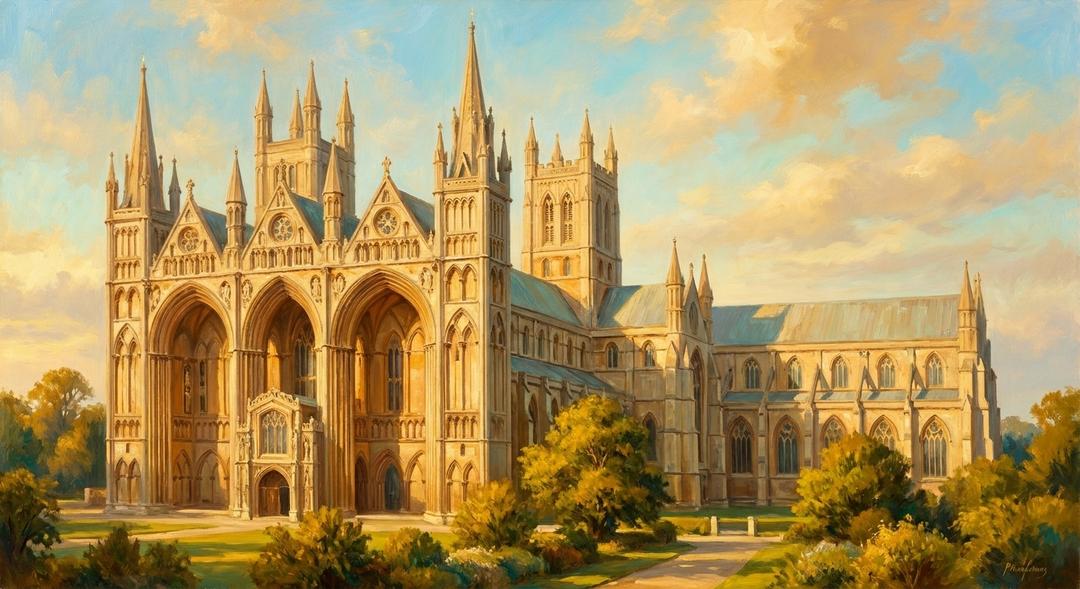
- Marvel at the colossal 82-foot triple-arched Early English Gothic West Front.
- Gaze upward at Britain's only surviving 13th-century painted wooden Romanesque nave ceiling.
- Pay respects at the solemn resting place of Queen Catherine of Aragon.
- Admire the intricate Perpendicular fan vaulting in John Wastell's New Building.
Things to Know
- Active worship services take precedence; sightseeing pauses during choral liturgies.
- No private parking inside the precincts; use public city center car parks nearby.
- High-level tower and ceiling tours require advance booking and physical mobility.
- Modest attire and respectful conduct are requested throughout the sanctuary.
Location
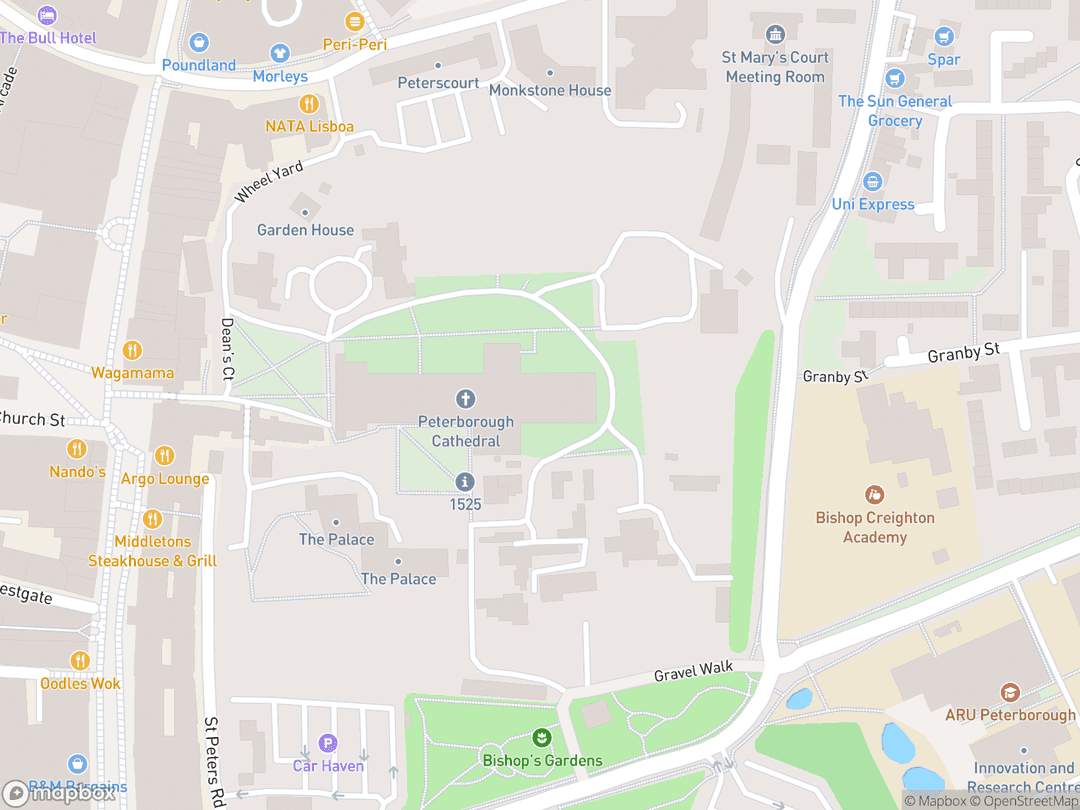
Minster Precincts, Peterborough, Cambridgeshire, PE1 1XS, United Kingdom
Hours: Monday to Saturday 10:00 AM – 5:00 PM; Sunday 12:00 PM – 4:00 PM (Services from 8:00 AM)
Getting There: Located a 10-minute flat walk east of Peterborough Railway Station via Cathedral Square, with direct rail connections from London King's Cross.
Get DirectionsTips for Your Visit
Attend Choral Evensong
Experience the cathedral choir singing during late afternoons for an unforgettable encounter with Anglican sacred acoustics.
Bring Binoculars
Magnification allows detailed viewing of the medieval bestiary and allegorical figures painted on the soaring timber ceiling.
About
Peterborough Cathedral stands as a majestic testament to Christian devotion in the ancient Abrahamic tradition of sanctuary and covenant. Founded around 655 AD as the Anglo-Saxon monastery of Medeshamstede, the sacred site was established to consecrate central Britain through perpetual prayer, scripture reading, and divine worship.
Following catastrophic destruction by Viking raiders in the ninth century and a devastating fire in 1116, Norman builders erected the monumental Romanesque church that stands today. Governed by the Benedictine rule of prayer and work, the abbey became one of England's wealthiest ecclesiastical centers, harmonizing monumental engineering with continuous liturgical observance.
Spared from demolition during the Henrician Reformation due to its burial of Queen Catherine of Aragon, the abbey was re-founded in 1541 as an Anglican cathedral. Today, as the episcopal seat of the Bishop of Peterborough, it unites medieval monastic solemnity with active civic mission and daily Eucharistic worship.
Gallery
Symbolic Elements
The temple's exterior features intricate carvings, each rich with spiritual meaning:

Keys of Saint Peter
Inscribed upon vault bosses and gable statues, these crossed keys represent apostolic authority and the Kingdom of Heaven.

Triple West Arches
Three colossal pointed arches towering over the west portal architecturally proclaim the Holy Trinity.

The Hedda Stone
An eighth-century carved limestone shrine honoring early Anglo-Saxon monastic martyrs slain during Viking incursions.

Painted Cosmological Bestiary
Grotesque and allegorical creatures on the nave ceiling symbolize fallen creation redeemed by divine harmony.

The Pomegranate Badge
Carved floral badges flanking Queen Catherine's grave symbolize royalty, fertility, and Christ's resurrection.

Christ in Majesty Nave Cross
A suspended bronze crucifix bearing the motto affirming that the Cross stands while the world turns.

Apostolic Martyrdom Emblems
The sword of Saint Paul and saltire of Saint Andrew adorn the facade to celebrate early Christian missionary zeal.
Interesting Facts
The cathedral is the burial place of Queen Catherine of Aragon, Henry VIII's courageous first wife (Tier A).
Mary, Queen of Scots was buried here in 1587 until her son King James I reinterred her at Westminster Abbey in 1612 (Tier A).
Its painted nave ceiling is the only surviving wooden ceiling of its era in Britain, dating to around 1230 (Tier A).
The cathedral sexton Robert Scarlett buried two queens and died at age 98, inspiring the gravedigger in Shakespeare's Hamlet (Tier B).
King Henry VIII spared the abbey from demolition during the Dissolution because it housed Queen Catherine's grave (Tier B).
Master mason John Wastell designed the retrochoir fan vaulting while finishing King's College Chapel in Cambridge (Tier A).
The Hedda Stone inside the cathedral dates to around 800 AD and commemorates monks killed by Viking invaders (Tier B).
The West Front's central arch is deliberately narrower than its outer companions to create visual dynamism (Tier B).
Oliver Cromwell's troops quartered horses in the nave and destroyed almost all thirty original medieval choir stalls (Tier B).
The cathedral nave piers and timber ceiling produce an expansive acoustic reverb lasting four and a half seconds (Tier A).
Common Questions
Is Peterborough Cathedral free to enter?
General admission is free, though voluntary donations are gratefully encouraged to support ongoing conservation.
Where is Queen Catherine of Aragon buried inside the cathedral?
She is buried beneath an inscribed black marble slab in the north presbytery aisle near the high altar.
Can visitors see the ancient painted nave ceiling up close?
The ceiling is viewed from the nave floor, and specialized upper-level guided tours are offered seasonally.
Does the cathedral still hold daily religious services?
Yes, the cathedral maintains a full schedule of daily services including Morning Prayer, Holy Communion, and Choral Evensong.
Featured Stories
A Queen's Sanctuary: Catherine of Aragon
1536
When Queen Catherine of Aragon died in exile at Kimbolton Castle, she was laid to rest with solemn monastic rites in Peterborough's north choir aisle. Tradition recounts that when courtiers urged Henry VIII to build a costly tomb for his discarded wife, the king declared he would instead bestow upon her one of the grandest monuments in Christendom. By elevating the abbey to cathedral status in 1541, Henry preserved the entire sanctuary from the destruction visited upon neighboring monasteries.
Source: Cathedral Archives and Diocesan Records
The Legendary Sexton 'Old Scarlett'
1594
Near the western portal hangs the eccentric painted likeness of Robert Scarlett, a sexton who died at the extraordinary age of ninety-eight after burying two full generations of parishioners. His greatest historical distinction was digging the royal graves for both Catherine of Aragon in 1536 and Mary, Queen of Scots in 1587. Literary scholars long noted that Scarlett's celebrated wit and macabre longevity served as William Shakespeare's direct inspiration for the gravedigger scene in 'Hamlet'.
Source: Peterborough Civic and Ecclesiastical Chronicle
Trial by Fire: The Painted Ceiling Saved
November 22, 2001
A devastating arson fire erupted in the cathedral's south choir aisle, sending dense clouds of petroleum soot billowing into the soaring timber vaulting. Conservators feared Britain's only surviving thirteenth-century painted wooden ceiling would be irreparably damaged by the toxic oily film. Over five years of painstaking work, specialists cleaned each painted timber lozenge by hand using delicate latex sponges, unveiling luminous medieval pigments hidden beneath centuries of grime.
Source: Cathedral Fabric Conservation Report
Timeline
Monastery Foundation
King Paeda of Mercia establishes the monastic settlement of Medeshamstede.
MilestoneViking Devastation
Danish invaders pillage the monastery and slay Abbot Hedda and his monastic brethren.
EventBenedictine Restoration
Bishop Æthelwold of Winchester rebuilds the abbey as a fortified Benedictine community.
MilestoneHereward the Wake's Raid
Anglo-Saxon rebels plunder the abbey treasures to prevent them from falling to the Norman abbot.
EventThe Great Fire
An accidental fire destroys the Saxon abbey church and surrounding domestic quarters.
EventNorman Reconstruction Begins
Abbot John de Sais lays the foundation stone for the monumental Romanesque church.
component.timeline.groundbreakingCathedral Consecration
Bishop Robert Grosseteste of Lincoln consecrates the completed Norman and Gothic abbey church.
DedicationCentral Lantern Tower Rebuilt
Masons replace the unstable Norman tower with a lighter Decorated Gothic crossing lantern.
RenovationNew Building Completed
Master mason John Wastell completes the Perpendicular Gothic retrochoir with fan vaulting.
MilestoneBurial of Catherine of Aragon
Henry VIII's first queen is laid to rest within the north presbytery aisle.
EventCathedral Reconstitution
Henry VIII creates the Diocese of Peterborough and elevates the abbey church to cathedral rank.
MilestoneBurial of Mary, Queen of Scots
Mary Stuart is interred opposite Catherine of Aragon following her execution at Fotheringhay Castle.
EventParliamentary Desecration
Oliver Cromwell's troops vandalize the cathedral interior, shattering medieval glass and monuments.
EventChoir Fire and Restoration
An arson fire triggers a comprehensive conservation campaign to clean the medieval painted ceiling.
RenovationHistory by Decade
650s–870s — Anglo-Saxon Foundation at Medeshamstede
Here was laid the holy seed of Christ's church amidst the fenland marshes.
In 655 AD, King Paeda of Mercia established Medeshamstede Abbey as a beacon of Christian faith in central England. Monks engaged in perpetual worship and scriptural study until Danish marauders burned the wooden monastery in 870 AD.
960s–1070s — Benedictine Rebirth and the Sacking of Burh
Bishop Æthelwold of Winchester refounded the abbey in 966 AD under the strict Rule of Saint Benedict, encircling the precinct with protective walls that earned it the name Burh. In 1070, Anglo-Saxon rebel Hereward the Wake plundered the abbey to safeguard its golden treasures from the newly appointed Norman abbot.
1110s–1170s — Great Fire and Norman Romanesque Reconstruction
A catastrophic fire destroyed the Saxon complex in August 1116, prompting Abbot John de Sais to initiate an ambitious Romanesque reconstruction in 1118. Over six decades, Norman masons raised massive compound piers, a triforium arcade, and a luminous ten-bay nave using durable local Barnack limestone.
1220s–1250s — Gothic Portico and the Painted Nave Ceiling
No facade in medieval Europe matches the optical audacity of Peterborough's triple portal.
Transitioning toward Early English Gothic, builders erected an unprecedented West Front featuring three soaring 82-foot arches flanked by twin spires. Overhead, artisans fashioned a flat timber ceiling embellished with diamonds depicting Christ, the Apostles, and allegorical beasts, consecrated in 1238 by Bishop Robert Grosseteste.
1490s–1540s — Wastell's Fan Vaulting and Royal Elevation
Between 1496 and 1508, master mason John Wastell wrapped the Norman apse in a breathtaking Perpendicular Gothic retrochoir crowned with intricate fan vaulting. Following Catherine of Aragon's burial here in 1536, King Henry VIII dissolved the monastery in 1539 but elevated the church to an episcopal cathedral in September 1541.
1640s–1680s — Civil War Desecration and Commonwealth Survival
In 1643, Parliamentary forces commanded by Oliver Cromwell sacked the cathedral, destroying priceless medieval stained glass, dismantling the high altar, and burning the library. The building survived total demolition during the Commonwealth and returned to diocesan worship upon the 1660 Stuart Restoration.
1880s–Present — Victorian Engineering and Modern Restoration
Between 1882 and 1886, architect J.L. Pearson dismantled and rebuilt the unstable Norman crossing tower stone by stone on strengthened foundations. A meticulous five-year restoration following a November 2001 arson fire safeguarded the historic organ and conserved every square foot of the thirteenth-century painted nave ceiling.
Architecture & Facilities
Peterborough Cathedral represents one of Europe's most intact and majestic Norman Romanesque interiors, celebrated for its stylistic dialogue with an audacious Early English Gothic western facade and delicate Late Perpendicular fan vaulting.
Building Materials
Barnack Ragstone
Dense oölitic shelly limestone quarried nearby produces the cathedral's distinctive warm honey hue.
Purbeck Marble
Polished dark fossiliferous stone forms delicate decorative colonnettes across the West Front.
Alwalton Stone
Locally extracted marble-like stone accents interior tomb effigies and monumental threshold markers.
Ancient English Oak
Massive timber trusses felled in regional fenland forests support the expansive high nave roof.
Interior Features
The Norman Nave
Ten rhythmic bays featuring alternating compound piers and open triforium galleries rise to 78 feet.
The Painted Wooden Ceiling
Crafted around 1230, this lozenge-patterned ceiling portrays Christ in Majesty and allegorical bestiary figures.
The New Building Retrochoir
Designed by John Wastell, this eastern ambulatory displays breathtaking stone fan vaulting cones.
Catherine of Aragon's Presbytery Tomb
A solemn black marble ledger slab marks Queen Catherine's grave, draped with Spanish standards.
Temple Grounds
The cathedral is cradled within the ancient Minster Precincts, entered through the historic Norman Gateway off Cathedral Square. Peaceful green lawns, medieval cloister ruins, and the historic Bishop's Palace surround the sanctuary, providing a contemplative oasis within urban Peterborough.
Additional Facilities
The precinct features the Cathedral Visitor Centre, a dedicated education room, a gift shop, and seasonal tea rooms in the historic Becket Chapel.
Religious Significance
Within Christian theology, the cathedral represents the dwelling place of God's holy presence, carrying forward the Abrahamic covenant of sanctuary and sacred assembly. As the episcopal seat of the Diocese of Peterborough, it functions as the mother church for dozens of regional parishes.
To serve as a house of prayer for all nations, consecrating human life through Christ's gospel, holy sacraments, and continuous praise.
Sacred Ordinances
Holy Eucharist (Communion)
The central sacrament of Christian thanksgiving, celebrated daily to commemorate Christ's sacrifice and resurrection.
Daily Choral Evensong
The traditional Anglican evening liturgy combining sung psalms, biblical canticles, and intercessory prayers.
Holy Baptism
The welcoming of new believers into the covenant family of the Church through water and the Holy Spirit.
Holy Orders (Ordination)
The solemn episcopal laying on of hands commissioning deacons and priests to minister across the diocese.
The Benedictine Monastic Legacy
For nine centuries, monks lived out Saint Benedict's rule of prayer and manual labor within these walls, shaping the cathedral's acoustic grandeur and liturgical rhythm.
A Sanctuary of Reconciliation
Having endured Viking attacks, Reformation suppression, and Civil War sacking, the cathedral stands today as an enduring symbol of spiritual renewal and Christian peace.
Similar Temples
Sources & Research
Every fact on Temples.org is backed by verified Sources & Research. Each piece of information is rated by source tier and confidence level.
View All Sources (5)
| Field | Source | Tier | Retrieved |
|---|---|---|---|
| About & Historical Background | The Chapter of Peterborough Cathedral (opens in a new tab) | A | 2026-03-31 |
| Architecture & Romanesque Sculpture | Corpus of Romanesque Sculpture in Britain and Ireland (opens in a new tab) | B | 2026-03-31 |
| Timeline & Medieval Chronology | TimeRef Medieval Heritage Database (opens in a new tab) | C | 2026-03-31 |
| Conservation History & 2001 Fire | Cambridge News Archives (opens in a new tab) | C | 2026-03-31 |
| Cathedral Dimensions & Architectural Survey | Doc Brown British Architecture Survey (opens in a new tab) | C | 2026-03-31 |