Visitor Insights
Visiting Historic Temple Beth Israel
Visitors to the Cutler-Plotkin Jewish Heritage Center encounter Arizona's foundational Jewish architectural landmark, preserved in its 1922 Mission Revival splendor. The campus features the historic sanctuary hall, the original rabbi's bungalow, and revolving exhibits on Southwestern Jewish pioneer life and Holocaust education.
Highlights
- Original 1922 Aron Kodesh ark cavity uncovered during historical preservation.
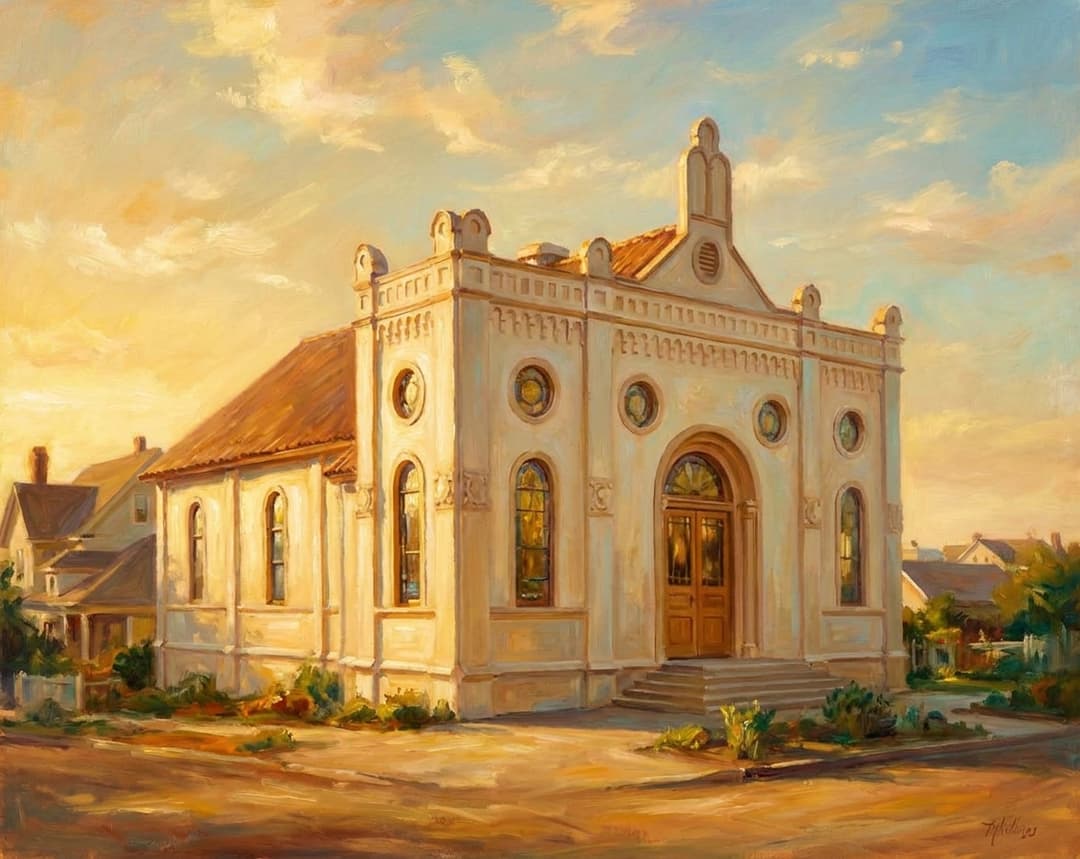
- Mission Revival facade featuring bell-less espadaña parapets and tiled gables.
- Permanent and traveling exhibits documenting Arizona's immigrant communities.
- Historic Holocaust survival relics including the renowned rescued violin.
Things to Know
- Open to the public for museum viewing Monday through Friday from 11:00 AM to 3:00 PM.
- Closed Saturdays for Shabbat and Sundays, as well as on Jewish and federal holidays.
- Self-guided and docent-led tours available through advance booking with AZJHS.
- Convenient street parking and an on-site lot available off Culver Street.
Tips for Your Visit
Docent Tours
Book an advance docent tour through the Arizona Jewish Historical Society to access archival materials.
Transit Access
Ride the Valley Metro Rail to Central Avenue and McDowell Road for a short five-minute walk.
Photography Etiquette
Still photography is welcomed in the main sanctuary, but silence cell phones during gallery presentations.
About
Erected in 1922 in downtown Phoenix, Historic Temple Beth Israel stands as the first purpose-built synagogue structure in the Salt River Valley. Designed by renowned Arizona architects Lescher, Kibbey & Mahoney, the sanctuary represents an architectural fusion of Mission Revival and Spanish Colonial forms tailored to the Sonoran Desert.
As part of the wider Abrahamic monotheistic heritage, this holy house offered a sacred locus for communal prayer, Torah study, and civic gathering. Built by a determined community of roughly 120 Jewish citizens, the sanctuary provided a resilient spiritual anchor in the territorial capital.
Over the course of a century, the sanctuary bore unique witness to Phoenix's cultural evolution, later sheltering Chinese and Hispanic Baptist immigrant congregations facing urban redlining. Carefully rescued and restored by the Arizona Jewish Historical Society, it now thrives as the Cutler-Plotkin Jewish Heritage Center.
Gallery
Symbolic Elements
The temple's exterior features intricate carvings, each rich with spiritual meaning:

Aron Kodesh Recess
The sacred wall alcove oriented toward Jerusalem that historically sheltered the hand-scribed Torah scrolls.

Bimah Platform
The elevated central wooden dais where the Torah was read aloud, symbolizing the mountain ascent of Sinai.

Ner Tamid Niche
The niche for the perpetual lamp recalling the desert Tabernacle menorah and symbolizing divine presence.

Magen David Transom
Hexagram geometric glasswork affirming the ancient protective covenant of the God of Israel.

Ten Commandments Tablets
The traditional twin arched tablets displayed prominently to signify the foundational moral law of the covenant.

Mission Espadaña Parapet
The scalloped Southwestern roofline adapted without church bells to signal civic integration in the Sonoran desert.

Arched Entry Portal
The rounded masonry doorway framing the entry to instill reverence upon crossing from the secular to the sacred.
Interesting Facts
This singular sanctuary served three distinct religious groups over a century: Jewish pioneers, Chinese Baptists, and Hispanic Baptists. (Tier A)
During the 2008 restoration, workers discovered the original 1922 Aron Kodesh ark cavity hidden behind modern drywall. (Tier A)
When the sanctuary was constructed in 1922, the Jewish community in Phoenix numbered merely 120 individuals. (Tier A)
Due to its curved parapet and stucco facade, early local residents nicknamed the building the Alamo of Culver Street. (Tier B)
The sanctuary was designed by Lescher, Kibbey & Mahoney, the same architectural firm that planned Phoenix's famed Orpheum Theatre. (Tier A)
During World War II, the congregation held regular Shabbat services and weekend dances for Allied airmen stationed at Luke Field. (Tier A)
Congregation Beth Israel's founding circle included Freeda Marks, who served as minority leader in the Arizona State Legislature in 1922. (Tier B)
The historical center holds a celebrated violin that survived the Holocaust after being buried underground in Europe. (Tier B)
The living Congregation Beth Israel continues today as metropolitan Phoenix's oldest congregation on a large Scottsdale campus. (Tier A)
Common Questions
Is Historic Temple Beth Israel still an active synagogue?
No, the historic Culver Street building operates as a museum and heritage center, while the active congregation worships in Scottsdale.
When was the sanctuary first built?
The sanctuary was constructed between 1921 and 1922 by architectural firm Lescher, Kibbey & Mahoney.
Why is the building called the Cutler-Plotkin Jewish Heritage Center?
It was named in honor of benefactors James and Bettie Cutler and longtime Beth Israel spiritual leader Rabbi Albert Plotkin.
What other groups held services in the historic sanctuary?
The building housed Phoenix's First Chinese Baptist Church and later the Spanish-speaking Iglesia Bautista Central.
Featured Stories
The Pioneer Leap of Faith
September 1922
In 1922, Phoenix was an isolated agricultural outpost where approximately 120 Jewish residents worshiped in rented second-floor rooms above local storefronts. Marshalling remarkable financial devotion, pioneer attorney Barnett Marks and community families commissioned architects Lescher, Kibbey & Mahoney to erect a permanent sanctuary. Their courageous construction established the first dedicated synagogue in the Salt River Valley, securing a lasting communal presence in the Sonoran Desert.
Source: Cutler-Plotkin Jewish Heritage Center Archives
The Hidden Ark Unearthed
June 2008
Decades after Congregation Beth Israel relocated northward, subsequent Christian congregations reconfigured the forward sanctuary stage for their own liturgical needs. When the Arizona Jewish Historical Society commenced comprehensive structural restoration in 2008, conservators carefully removed layers of drywall behind the pulpit. The demolition crew uncovered the intact 1922 Aron Kodesh niche, perfectly preserved where the Torah scrolls had rested eighty-six years earlier.
Source: Arizona Jewish Historical Society Preservation Log
Haven for the Immigrant Generations
October 1957
When Beth Israel moved north following World War II, the building was purchased to house Phoenix's First Chinese Baptist Church. For nearly three decades, Chinese-American families navigating municipal redlining gathered in the former synagogue hall for bilingual Cantonese and English services. The sanctuary once consecrated to Hebrew prayer seamlessly transformed into an immigrant haven, nurturing families across cultural lines before serving a Mexican-American congregation.
Source: National Register of Historic Places Inventory #11000043
Timeline
Territorial Holy Day Gatherings
Pioneer Jewish residents organize Phoenix's earliest documented High Holy Day services in rented commercial halls.
MilestoneOrganization of Congregation Emanuel
The growing local community organizes a regular Sunday school and consistent prayer meetings under early civic leaders.
MilestoneIncorporation of Congregation Beth Israel
Community trustees formally incorporate Congregation Beth Israel to build a permanent house of worship.
MilestoneGroundbreaking on Culver Street
Contractors break ground on the Culver Street parcel utilizing drawings prepared by Lescher, Kibbey & Mahoney.
component.timeline.groundbreakingSanctuary Dedication
Congregation Beth Israel formally consecrates the new Mission Revival sanctuary in time for the High Holy Days.
DedicationFormation of Congregation Beth El
Traditionalist congregants depart to found Phoenix's first Conservative congregation, solidifying Beth Israel's Reform path.
MilestoneSanctuary Fire and Recovery
A sudden interior fire damages the sanctuary hall, prompting rapid community-wide repair and redecoration.
EventWartime Airmen Hospitality
The synagogue opens its social hall for weekly services and dances for servicemembers stationed at Luke Air Field.
EventCongregational Relocation North
Having outgrown the downtown parcel, Congregation Beth Israel relocates north to Flower Street.
MilestoneFirst Chinese Baptist Church
The historic sanctuary becomes the spiritual center for Phoenix's Chinese-American Baptist congregation.
EventIglesia Bautista Central
The building transitions into a spiritual home for a growing Spanish-speaking Mexican-American church.
EventAcquisition by Historical Society
The Arizona Jewish Historical Society purchases the historic complex to avert demolition and plan historic restoration.
RenovationReopening as Cutler-Plotkin Center
The restored building officially reopens as a regional community archive, interfaith center, and museum.
MilestoneNational Register of Historic Places Listing
The property is officially listed on the National Register of Historic Places under inventory reference #11000043.
MilestoneHistory by Decade
1920s — Founding the Culver Sanctuary
The construction of a permanent sanctuary proved that Jewish life had taken permanent root in the young capital of Arizona.
In 1921, Phoenix's fledgling Jewish community retained prominent architects Lescher, Kibbey & Mahoney to construct a permanent house of worship. Completed in 1922, the Mission Revival sanctuary accommodated more than a hundred worshipers and instantly transformed into the civic heart of Jewish life in the desert. The sanctuary hosted community Passover Seders, youth religious education, and interfaith civic forums.
1930s — Institutional Growth and Reform Identity
During the Great Depression, the congregation matured into a cornerstone of civic advocacy. A friendly ideological parting in 1930 established Congregation Beth El for Conservative families, after which Beth Israel formally affiliated with the Union of American Hebrew Congregations in 1935. After an interior fire in 1935, congregants swiftly rallied to repair the sanctuary and installed Rabbi Abraham Lincoln Krohn in 1938.
1940s — Wartime Sanctuary and Migration
During World War II, Temple Beth Israel served as a crucial sanctuary for hundreds of servicemen training at nearby flight schools and desert garrisons. Following the war, rapid migration transformed Phoenix, and the congregation quickly outgrew its Culver Street home. In 1949, the congregation celebrated its final High Holy Days in the historic sanctuary before moving to a larger northern campus.
1950s–1970s — First Chinese Baptist Sanctuary
In the 1950s, the Southern Baptist Convention acquired the building to house Phoenix's first Chinese-speaking Christian congregation. For twenty-four years, the former synagogue resonated with Cantonese and English hymns, providing a welcoming community center for Chinese immigrant families. The congregation maintained the historic structure while adding auxiliary social ministries and family classrooms.
1980s–1990s — Hispanic Baptist Ministry
In 1981, the facility transitioned once again, becoming the home of Iglesia Bautista Central. Serving Mexican-American families throughout the central Phoenix corridor, the sanctuary maintained its historic identity as an immigrant haven. Sunday services, baptisms, and neighborhood outreach filled the building for over two decades as commercial developments surrounded the block.
2000s–Present — Preservation and Heritage Center
Faced with potential demolition in 2002, the Arizona Jewish Historical Society purchased the property and organized a comprehensive four-million-dollar restoration. Master conservators restored the original 1922 Mission Revival sanctuary finishes, exposed timber ceilings, and rabbi's residence. The complex was listed on the National Register of Historic Places in 2011 and operates as a vibrant museum and interfaith center.
Architecture & Facilities
Historic Temple Beth Israel was constructed in the Mission Revival and Spanish Colonial Revival styles, incorporating restrained Mediterranean massing and Romanesque Revival round-topped fenestration. Lescher, Kibbey & Mahoney deliberately adapted Southwestern architectural forms to harmonize the sacred structure with the arid Sonoran environment and Arizona's civic vernacular.
Building Materials
Exterior Stucco
Smooth cream-colored lime plaster applied over heavy load-bearing structural brick masonry.
Roofing Tiles
Unglazed red clay barrel-shaped Mission tiles laid in traditional Southwestern overlapping courses.
Interior Timber
Exposed Douglas fir roof beams supporting the vaulted sanctuary assembly ceiling.
Window Casements
Divided-lite wooden window sashes set within deeply recessed round-topped masonry arches.
Interior Features
Sanctuary Assembly Hall
The primary gathering hall featuring suspended period lighting and exposed timber roof framing.
Historic Bimah
A raised wooden platform positioned before the east wall to support the reading of the scriptures.
Aron Kodesh Cavity
The original recessed wall niche designed to shelter the Torah scrolls during divine worship.
Rabbi's Bungalow
An adjacent domestic structure historically utilized as the rabbi's home and administrative archive.
Temple Grounds
A desert-landscaped courtyard featuring brick pavers, olive trees, and native Sonoran plantings connecting the sanctuary to the auxiliary rabbi's bungalow.
Additional Facilities
Modern museum exhibition galleries, archival research storage, and multi-purpose civic meeting rooms operated by the Arizona Jewish Historical Society.
Religious Significance
Within the monotheistic Abrahamic heritage, the synagogue serves as a consecrated space dedicated to communal communion with the Creator through prayer, sacred study, and covenantal fellowship. Built away from the ancient centralized sanctuary of Jerusalem, Historic Temple Beth Israel continued the long tradition of the diaspora meetinghouse as a locus of divine reverence in the American desert.
To serve as a house of prayer, a house of study, and a house of community assembly for Phoenix's founding Jewish families.
Sacred Ordinances
Tefillah (Communal Prayer)
Daily and Sabbath liturgical services led from the bimah praising the one God and seeking divine mercy.
Kriat HaTorah (Torah Reading)
The solemn chanting and expounding of the sacred Hebrew scrolls retrieved from the Aron Kodesh.
Bar and Bat Mitzvah
Rites of spiritual passage welcoming youth into full covenantal responsibility within the community.
Passover Seders
Communal memorial meals celebrating divine redemption from Egyptian bondage and covenant freedom.
The Tripartite Synagogue in the Southwest
Departing from the sacrificial priesthood of antiquity, rabbinic tradition established the synagogue as a Beit Knesset (assembly house), Beit Midrash (study house), and Beit Tefillah (prayer house). On the Arizona frontier, Temple Beth Israel realized this complete mission, offering immigrant merchants and civic pioneers a spiritual sanctuary and a community haven.
An Abrahamic Legacy of Welcome
The sacred nature of the Culver Street sanctuary extended well beyond its initial congregants. When subsequent Christian congregations of Chinese and Hispanic heritage worshiped within these walls, they continued the biblical mandate to create an altar of devotion in the desert, cementing the building's place as a monument of interfaith reverence.
Sources & Research
Every fact on Temples.org is backed by verified Sources & Research. Each piece of information is rated by source tier and confidence level.
View All Sources (9)
| Field | Source | Tier | Retrieved |
|---|---|---|---|
| About & Historical Background | Arizona Jewish Historical Society (opens in a new tab) | A | 2026-03-30 |
| Historical Timeline & Dedication | Congregation Beth Israel (opens in a new tab) | A | 2026-03-30 |
| National Register Landmark Status | National Park Service (opens in a new tab) | A | 2026-03-30 |
| Municipal Historic Preservation Survey | City of Phoenix Historic Preservation Office (opens in a new tab) | A | 2026-03-30 |
| Heritage Restoration & Museum Exhibits | Hadassah Magazine (opens in a new tab) | B | 2026-03-30 |
| Southwestern Jewish Pioneer History | Moment Magazine (opens in a new tab) | B | 2026-03-30 |
| Salt River Valley Regional History | Salt River Stories (opens in a new tab) | B | 2026-03-30 |
| Visitor Information & Public Access | Visit Phoenix (opens in a new tab) | D | 2026-03-30 |
| Special Events & Venue Details | PartySlate (opens in a new tab) | D | 2026-03-30 |